Why do so many property managers believe their sealed pipework is a "safe zone" when it actually acts as a silent reservoir for bacteria? The common assumption that the legionella risk in closed-loop heating systems is non-existent is a dangerous misconception that can lead to unexpected HSE fines. While these systems don't typically produce spray, they often operate within the critical 25°C to 42°C growth range. This creates a perfect environment for bacteria to multiply before potentially migrating into your domestic water through cross-contamination or faulty non-return valves.
It's understandable if you feel frustrated by conflicting advice regarding which systems require monitoring. You want to protect your tenants and your business without overcomplicating your maintenance schedule. We'll show you why these closed loops are a hidden danger and how to manage the risk to stay fully compliant with ACOP L8. This article provides a clear breakdown of the technical risks and the actionable steps you need to take, ensuring your legal duties are met and your property management remains stress-free.
Key Takeaways
- Understand why "sealed" does not mean "sterile" and how modern low-temperature circuits can harbor dangerous bacteria.
- Identify how the legionella risk in closed-loop heating systems increases due to internal corrosion, sludge, and scale.
- Learn to spot hidden cross-contamination points like heat exchanger pinhole leaks and backflow from filling loops.
- Ensure full ACOP L8 compliance by implementing a written scheme of control and a professional chemical treatment regime.
- Discover how a specialist risk assessment transforms complex regulatory burdens into long-term peace of mind for property owners.
What is a Closed-Loop Heating System and Why is it a Legionella Risk?
A closed-loop system is a water circuit that doesn't intentionally expose its contents to the atmosphere. You can think of it as a continuous loop where the same water is heated or cooled and then pumped around a building through sealed pipework. Because the water is contained within radiators and manifolds, many property owners assume these systems are inherently safe. They believe that if the water isn't being sprayed from a showerhead or a cooling tower, it can't cause harm. This "sealed means sterile" mindset is a dangerous myth that leaves your property vulnerable.
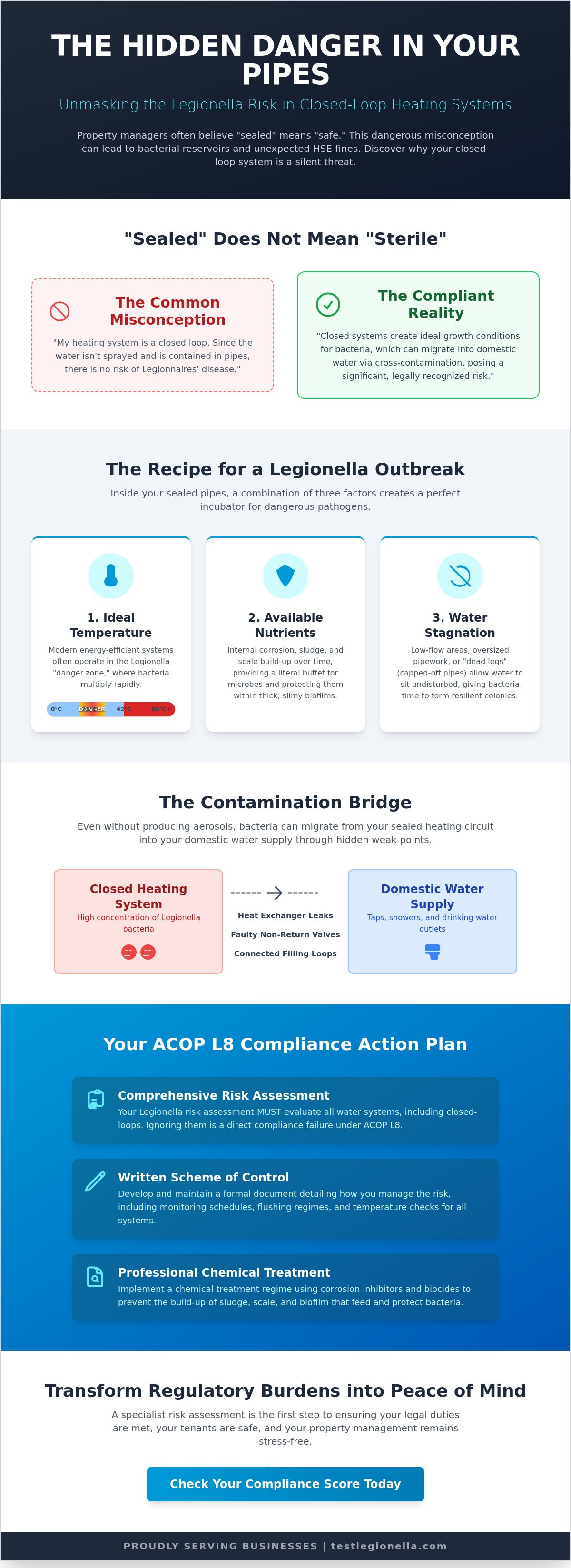
The legionella risk in closed-loop heating systems is real because these environments often provide the perfect conditions for bacterial growth. Stagnation, low flow areas, and temperatures frequently falling between 20°C and 45°C create a breeding ground for pathogens. Even though these systems don't generate aerosols directly during normal operation, the bacteria can still reach people through cross-contamination with domestic water supplies. If a leak occurs in a heat exchanger or a filling loop is left connected, contaminated water can migrate into your drinking water. This can lead to the spread of Legionnaires' disease, a severe form of pneumonia caused by inhaling small droplets of water containing the bacteria.
Common Examples of Closed-Loop Systems
Most commercial buildings in the Midlands rely on several types of sealed circuits that require monitoring. Low-temperature hot water (LTHW) systems are the most frequent, often operating at temperatures that don't quite reach the 60°C required to kill bacteria instantly. Chilled water systems for air conditioning are equally vulnerable, especially if they sit idle during cooler months. Underfloor heating manifolds are another common site for risk, as they use lower temperatures to prevent floor damage, unknowingly creating a cozy home for Legionella.
The 2026 Regulatory View on Sealed Circuits
The Health and Safety Executive (HSE) is clear in its guidance. Under ACOP L8, the fourth edition published in 2013, every water system in a building must be considered in a risk assessment. You can't simply ignore a system because it's "out of sight." Modern compliance requires a whole-building approach to water safety. This means your written scheme of control must document how you manage the legionella risk in closed-loop heating systems alongside your domestic taps and showers. Ignoring these circuits isn't just a safety risk; it's a legal failure that can lead to significant HSE fines. We make this process simple by identifying these hidden risks during our standard inspections, ensuring your compliance is total and your peace of mind is guaranteed.
The Biology of Risk: How Bacteria Thrive in Sealed Pipes
Bacteria don't need oxygen or sunlight to turn your pipework into a thriving colony. Inside a closed-loop system, the environment often stabilizes into a perfect incubator for pathogens. While we previously established that these systems are "sealed," this isolation actually protects bacterial growth from the external fluctuations that might otherwise disrupt it. The legionella risk in closed-loop heating systems is primarily driven by the "danger zone" temperature range. Most modern energy-efficient systems operate between 25°C and 42°C to save on fuel costs, which is exactly where Legionella bacteria multiply most rapidly. When water sits within this range, a single cell can quickly become a significant outbreak risk.
Nutrients are the second half of the survival equation. Over time, internal corrosion leads to the buildup of sludge and scale, providing a literal buffet for microbial life. This debris settles in low-flow areas or "dead legs" where the water rarely moves, such as capped-off pipe ends or bypassed sections of a commercial heating grid. These stagnant pockets allow for the formation of thick biofilms. These slimy layers act as a fortress, shielding bacteria from standard temperature spikes and making them incredibly difficult to eradicate. To understand the best practices for managing these hidden reservoirs, property owners should consult the OSHA guidelines for water system control. If you're unsure where your system stands, you can check your compliance score today to identify these biological blind spots.
Material Vulnerabilities: PEX, PVC, and Steel
Modern construction favors synthetic materials like PEX and PVC because they're cost-effective and easy to install. However, these plastics can leach organic carbon, which serves as a primary food source for microorganisms. In older systems, carbon steel pipes produce magnetite as they corrode. Magnetite acts as a protective shield for bacteria, encasing colonies in a mineral layer that prevents chemical treatments from reaching the core. This combination of synthetic nutrients and metallic shields makes professional monitoring essential for long-term safety.
Intermittent Use and Standby Periods
Risk levels often spike during seasonal transitions when systems are "mothballed" or left on standby. When a heating circuit is turned off during the spring, the water temperature drifts slowly through the 25°C to 42°C growth range. Standby pumps and bypassed loops are frequently overlooked during routine maintenance, yet they hold gallons of stagnant, untreated water. Poor insulation on these pipes further complicates the issue, as it allows heat to bleed into nearby cold water lines, creating a secondary legionella risk in closed-loop heating systems through thermal gain.
Cross-Contamination: The Bridge Between Closed and Open Systems
The biggest danger isn't just what's inside your pipes; it's how that water interacts with the rest of your building. Many property owners view their heating circuits as completely detached from their drinking water. This is a critical error. The legionella risk in closed-loop heating systems often materializes at the points where these systems meet. If a barrier fails, a "safe" closed circuit becomes a source of contamination for your entire property. You might have a perfectly managed domestic system, but a single breach in a shared component can compromise your entire compliance status.
Heat exchangers are a primary point of failure. Over time, internal plate heat exchangers can develop pinhole leaks or gasket failures that are invisible to the naked eye. Because domestic water and heating water are separated by only a thin metal plate, a breach allows bacteria-laden sludge to migrate into your clean water supply. Similarly, temporary filling loops are often left connected by mistake. Without a functional double-check valve, a drop in mains pressure can suck contaminated heating water backward into the building's potable water lines. This turns a localized issue into a systemic infection that can even seed dangerous cooling towers or decorative fountains.
The Mechanics of Leakage and Backflow
Identifying these breaches early is key. Monitor your system pressure daily; an unexplained drop often signals a leak that could be cross-contaminating other sources. We frequently find failed gaskets in older commercial units are the culprit. Ensuring filling loops are disconnected and capped when not in use is a simple, vital step for your compliance report. These checks prevent the legionella risk in closed-loop heating systems from spreading beyond the boiler room.
Aerosol Generation via Secondary Systems
While closed loops don't produce spray, they often feed equipment that does. Fan coil units and humidifiers rely on water from these circuits to regulate air quality. If Legionella is present in the heating water, it can be pulled into the ventilation air stream as an aerosol. This makes terminal unit maintenance a vital safety step. Testing systems in isolation is a compliance failure that leaves your tenants at risk and your business open to HSE scrutiny.
Managing the Risk: Maintenance and ACOP L8 Compliance
Securing your property against the legionella risk in closed-loop heating systems requires more than a "set and forget" approach. To meet the legal standards set out in the Health and Safety Executive’s ACOP L8 (2013 edition), you must include these sealed circuits in your written scheme of control. Compliance isn't just about ticking a box; it's about creating a verifiable trail of safety that protects both your tenants and your professional reputation. A robust management plan transforms a complex regulatory burden into a streamlined part of your property maintenance schedule.
The foundation of any successful strategy is a professional risk assessment. This document identifies every potential point of failure, from stagnant dead legs to faulty non-return valves. Once the risks are identified, you must implement a consistent chemical treatment regime. This involves more than just adding a splash of inhibitor once a year. Regular sampling and laboratory analysis are the only ways to verify that your system health is maintained. These lab results provide the concrete evidence you need during an HSE inspection, proving that you've taken proactive steps to mitigate the legionella risk in closed-loop heating systems. Keeping accurate, up-to-date logbooks is essential for this process, as they serve as your legal shield in the event of a safety audit. If you need to start this process today, you can get your professional risk assessment to ensure every circuit is covered.
Chemical and Thermal Control Strategies
Effective control relies on a two-pronged chemical approach. Corrosion inhibitors are used to prevent the buildup of scale and sludge, which we previously identified as primary food sources for bacteria. Oxidising biocides are then required to actively kill any microbial life that enters the circuit. While thermal disinfection is the go-to for domestic hot water, it's often impractical for closed loops because heating every pipe to 60°C can damage modern components or cause excessive pressure. You must verify the chemical balance of your system at least quarterly to ensure the inhibitor levels remain effective against corrosion and microbial growth.
The Importance of Physical Maintenance
Chemicals alone can't fix a poorly designed system. Physical maintenance must include strict flushing and cleaning protocols to remove heavy sediment that biocides can't penetrate. You must also identify and remove dead legs; those redundant sections of pipework where water sits stagnant for months. Finally, check that all pipe insulation is intact. High-quality insulation prevents external heat gain from heating pipes into nearby cold water lines, which otherwise creates new breeding grounds for bacteria in supposedly "safe" areas of the building.
Professional Testing: Your Path to Peace of Mind
Managing the legionella risk in closed-loop heating systems is a specialized task that goes far beyond the capabilities of a standard DIY kit. While a basic dip-test might show you pH levels, it won't reveal the complex microbial colonies hiding within your sludge or the specific chemical imbalances that allow biofilms to thrive. Attempting to handle this in-house often leads to incomplete data and a false sense of security. When the HSE arrives for an inspection, "I thought it was fine" isn't a valid defense. You need a partner who understands the intricate relationship between water chemistry and legal liability.
Our Compliance Care approach is designed to remove the stress from your property management duties. We provide a comprehensive compliance report that acts as your definitive guide to water safety. Instead of drowning in technical jargon, you receive a clear, tailored document that highlights exactly what needs to be fixed and when. This structured information ensures that even the most complex regulatory requirements feel accessible. We transform the burden of the law into a manageable maintenance routine, giving you the freedom to focus on your business while we track your compliance dates and send timely reminders.
What to Expect from a Professional Assessment
Our process begins with a detailed site survey of all your heating and cooling assets. We don't just look at the boiler; we examine every manifold, pump, and heat exchanger for signs of cross-contamination or stagnation. Any samples collected are sent to a UKAS-accredited laboratory for precise analysis, ensuring the results are legally defensible. Following the analysis, you'll receive a report with clear, actionable remedial recommendations. This isn't just a list of problems; it's a step-by-step roadmap to total system health.
Securing Your Property for 2026
As regulations become more stringent, the cost of a proactive risk assessment is a fraction of the price of reactive legal fees or potential HSE fines. Based on May 2024 data, domestic assessments in the UK typically range from £90 to £200, while small commercial sites like dental practices might pay around £200. These figures are negligible compared to the financial and reputational damage of an outbreak. By choosing a dedicated compliance partner, you gain long-term security and professional quality reports that stand up to scrutiny. Don't leave your safety to chance. Get your professional Legionella risk assessment quote today and move from uncertainty to total system security.
Secure Your Property and Achieve Total Compliance
The assumption that sealed pipework is maintenance-free is a vulnerability you can't afford to ignore. We've explored how the legionella risk in closed-loop heating systems stems from temperature traps, biofilm fortresses, and the silent threat of cross-contamination. By recognizing these hidden hazards, you've already taken the first step toward protecting your tenants and your business. Moving from a state of uncertainty to one of total control is the only way to avoid the gravity of a public health safety failure.
Now it's time to transform that knowledge into a sense of security. Our specialist expertise in commercial and residential water safety ensures your property meets all legal duties under ACOP L8. We provide comprehensive risk assessments backed by detailed UKAS-accredited laboratory reporting; this makes regulatory adherence simple and stress-free. You deserve a management plan that works as hard as you do, providing clear results without the technical jargon.
Ensure your heating system is compliant; book your professional assessment now.
Your path to peace of mind starts with a single proactive step. We're here to guide you through the maze of regulations, ensuring your property management remains efficient and your occupants stay safe.
Frequently Asked Questions
Do closed-loop systems really need a Legionella risk assessment?
Yes, every water system in a building is subject to a risk assessment under ACOP L8. While these systems are sealed, they aren't sterile. The legionella risk in closed-loop heating systems must be documented in your written scheme of control to ensure full legal compliance. Ignoring these circuits creates a blind spot that can lead to cross-contamination with domestic supplies.
How often should closed-loop heating systems be tested for Legionella?
You should check the chemical balance of your system at least quarterly to ensure inhibitors are effective. While ACOP L8 doesn't specify a rigid testing frequency for the bacteria itself in closed loops, a risk assessment should be reviewed every two years or whenever a significant change occurs. Regular sampling provides the documented evidence needed for HSE audits and long-term peace of mind.
Can Legionella bacteria survive in the high temperatures of a heating system?
Bacteria thrive between 20°C and 45°C, a range many modern energy-efficient heating systems operate within. While water stored at 60°C (140°F) kills Legionella, many closed-loop circuits suffer from "temperature drift" or poor insulation. This allows pockets of water to stay in the danger zone, turning pipework into a protected reservoir for microbial growth.
What are the symptoms of Legionnaires’ disease caused by heating systems?
Symptoms include a high fever, cough, and shortness of breath, often resembling severe pneumonia. While the heating system itself doesn't typically produce spray, it can seed bacteria into fan coil units or domestic outlets. If these aerosols are inhaled, it can lead to serious illness. Statistics from 2024 show that outbreaks in New York and Minnesota resulted in multiple hospitalizations and deaths.
Is chemical treatment enough to prevent Legionella in a closed loop?
Chemicals are only one part of a robust defense strategy. While biocides and inhibitors are essential, they can't penetrate thick sludge or reach stagnant dead legs. You must also implement physical maintenance, such as flushing sediment and removing redundant pipework. A combination of chemical and physical control is the only way to manage the legionella risk in closed-loop heating systems effectively.
What does the HSE say about closed-loop water system compliance?
The HSE's Approved Code of Practice L8 (ACOP L8) mandates that all water systems be included in a risk assessment. The fourth edition, published in 2013, serves as the benchmark for UK compliance. It requires the appointment of a "responsible person" to oversee water safety. Failing to document these systems can result in significant fines if a breach is discovered during an inspection.
Can a leak in a heating system cause a Legionella outbreak?
Yes, internal leaks in heat exchangers or failed gaskets can transfer contaminated water into your domestic supply. This cross-contamination allows bacteria to reach showers or taps where aerosols are generated. A single breach in a shared component can turn a localized heating issue into a building-wide safety crisis. Monitoring pressure drops daily is a vital early warning sign.
What is the cost of a Legionella risk assessment for commercial buildings?
Costs vary based on the size and complexity of the property. According to May 2024 data, a small dental practice or office typically pays around £200. Larger establishments like care homes or gyms may pay closer to £500. For complex sites such as hospitals or large hotels, the cost can range from £500 to over £2,000, depending on the number of water assets involved.