
A common misconception among property owners is that a "Legionella certificate" is the golden ticket to safety, but the Health and Safety Executive actually focuses on the quality of your risk assessment rather than a single piece of paper. Failing to meet your landlord legionella responsibilities uk 2026 could result in fines exceeding £20,000 or even criminal prosecution under the Health and Safety at Work etc. Act 1974. It's understandable that you feel overwhelmed by technical water safety standards and the fear of a compliance gap. You want to protect your tenants and your investment without getting lost in legal jargon.
This definitive guide will help you master your legal obligations for water safety and secure full compliance for the year ahead. We'll simplify the transition from confusion to total peace of mind by providing a clear record-keeping strategy that makes safety management easy. You'll learn exactly how to conduct a valid risk assessment, how often to review your systems, and how to maintain the professional standards required to keep your property safe and your business protected.
Key Takeaways
- Understand your legal duty of care under the Health and Safety at Work Act 1974 to ensure your rental properties remain safe and compliant.
- Master the updated landlord legionella responsibilities uk 2026 by implementing a mandatory risk assessment to identify and mitigate waterborne risks.
- Learn how to manage the critical 20°C to 45°C "danger zone" through simple, proactive temperature controls that protect your tenants.
- Debunk common myths surrounding "Legionella Certificates" and discover how to maintain a robust, audit-ready compliance folder.
- Identify when a basic assessment isn't enough and why professional water sampling is the most reliable way to secure total peace of mind.
The Legal Framework for Landlord Legionella Responsibilities in 2026
The legal landscape for property management is strict and uncompromising. By 2026, the Health and Safety Executive (HSE) has reinforced the fact that landlord legionella responsibilities uk 2026 are a core component of property safety. Your primary obligation stems from the Health and Safety at Work Act 1974. This legislation classifies landlords as "duty holders" who must ensure their premises remain safe for tenants, residents, and visitors. Because What is Legionnaires' disease? describes a potentially fatal form of pneumonia caused by inhaling bacteria from contaminated water systems, the law treats prevention with the highest priority.
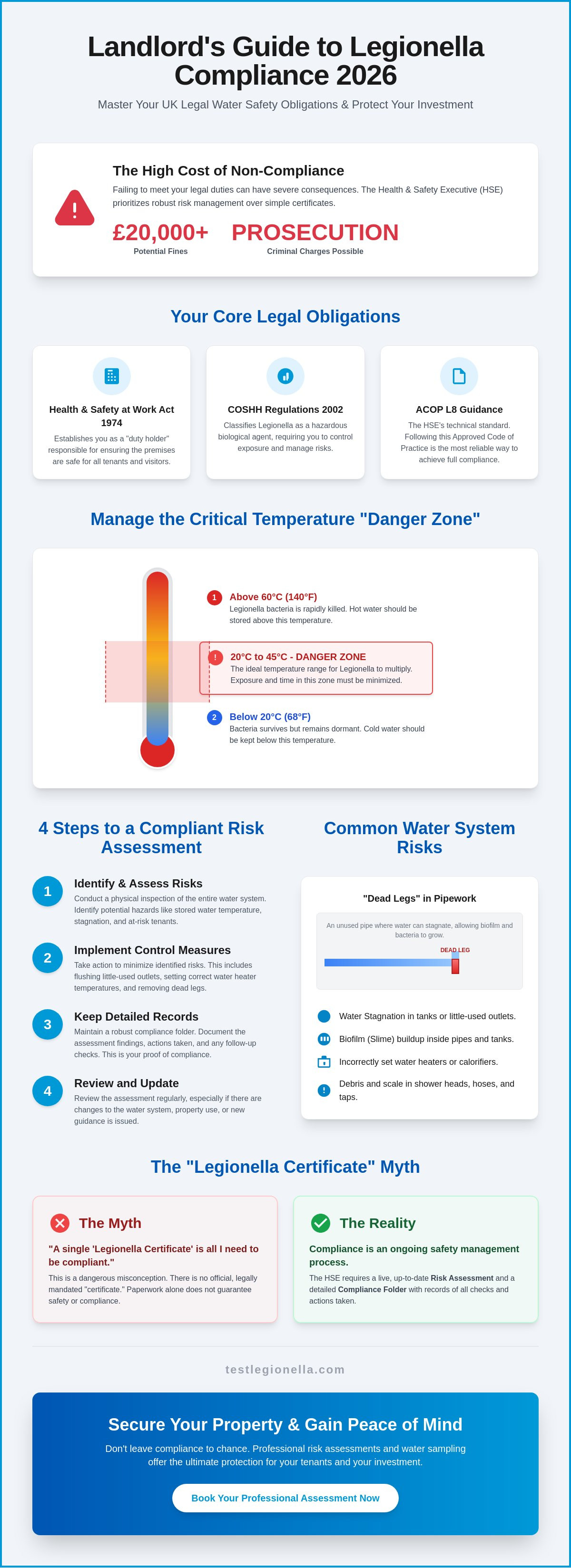
The Control of Substances Hazardous to Health (COSHH) Regulations 2002 provides the essential framework for managing biological risks. Legionella is specifically listed as a hazardous biological agent. Under these regulations, you must identify potential risks and implement measures to prevent or control exposure. The Approved Code of Practice (ACOP L8) serves as the technical standard for 2026. It outlines exactly how to conduct a risk assessment and maintain water systems. Following ACOP L8 is the most reliable way to achieve full compliance and gain total peace of mind. Our Compliance Care approach is designed to make these technical requirements simple and manageable for every property owner.
Understanding Your Duty of Care
You have a legal duty to identify and assess sources of risk within your property. This isn't just a paperwork exercise; it's a proactive safety measure. You must ensure tenants aren't exposed to health risks from the water systems you provide. There's no legal distinction between the requirements for a small residential studio and a large commercial office block. Both require a professional risk assessment. Ignorance of these rules isn't a valid legal defence. If a tenant becomes ill and you lack a current assessment, you face heavy fines or criminal prosecution. We make compliance easy by handling the logistics for you.
Who Qualifies as a Landlord Under Current Regulations?
The law applies to any individual or organisation that rents out property. This includes:
- Private Sector Landlords: Individuals renting out houses or flats.
- Housing Associations and Local Authorities: Social housing providers managing large portfolios.
- Resident Landlords: If you rent out a single room within your own home, you're still a duty holder.
- Short-term Lets: Holiday cottage owners and Airbnb hosts must meet the same safety standards.
In 2026, these sectors face increased scrutiny regarding safety documentation. Every property type needs a tailored plan to ensure the water system is safe. We provide clear, fast, and reliable reports that keep you protected. Get your assessment booked today to ensure your business remains on the right side of the law.
Conducting a Legionella Risk Assessment: A Step-by-Step Requirement
You can't manage a risk you haven't identified. Under UK law, every rental property must have a valid Legionella risk assessment on file to ensure tenant safety and legal protection. This document isn't just a recommendation; it's a core part of your legal responsibilities for landlords. Failing to produce a current report during an inspection or following an incident can lead to heavy fines or prosecution. The assessment serves as your roadmap for safety, documenting that you've taken reasonable steps to prevent the growth of bacteria.
A thorough assessment begins with a physical inspection of the water system layout. You'll need to map out where water enters the property, how it's stored, and how it's heated. Stagnation is the primary enemy. You must identify "dead legs," which are lengths of pipework leading to a closed end or a removed appliance where water can sit undisturbed. These areas allow biofilm to build up, providing the perfect breeding ground for Legionella. When you understand your landlord legionella responsibilities uk 2026, you'll see that identifying these structural weaknesses is the first step toward total compliance.
A competent person under 2026 standards is defined as an individual who possesses the specific technical knowledge, practical experience, and updated training required to accurately identify Legionella risks and provide actionable remedial advice for a domestic or commercial water system.
Identifying Potential Sources of Risk
Your assessment should focus on any area where water droplets, or aerosols, can be created and inhaled. This includes checking:
- Storage Tanks and Calorifiers: Inspect cold water tanks for debris, rust, or lack of a tight-fitting lid, and ensure hot water cylinders (calorifiers) store water at 60°C or higher.
- Outlets and Fittings: Check showerheads and taps for scale buildup, which provides nutrients for bacteria, and don't forget outdoor hose pipes that might sit in the sun.
- Specialized Systems: Evaluate whirlpool baths, humidifiers, or complex irrigation systems that might be present in larger or high-end rental properties.
If you're unsure if your property meets these standards, you can get your compliance score today to identify any immediate gaps in your records.
Assessing Vulnerable Tenant Groups
Risk isn't just about the pipes; it's about the people. Legionnaires' disease disproportionately affects certain demographics. You must identify if your tenants fall into higher-risk categories, such as those over the age of 45, smokers, or individuals with chronic respiratory conditions or weakened immune systems. If your property houses vulnerable groups, the frequency of your risk reviews should increase from the standard biennial check to an annual schedule.
Communication is your best tool for ongoing safety. You're required to provide tenants with clear instructions on water safety, such as the need to flush outlets after a period of absence and the importance of keeping showerheads clean. Providing a simple safety leaflet at the start of a tenancy ensures they play their part in maintaining a safe environment. This proactive approach transforms a complex regulatory burden into a streamlined process that protects both your tenants and your investment.
Practical Control Measures: Minimising Water Safety Risks
Managing water safety isn't just a tick-box exercise for your records. It's an active prevention strategy designed to protect lives. To understand the science behind these steps, you can read our guide on What is Legionella? for the full biological context. Meeting your landlord legionella responsibilities uk 2026 requires a proactive regime that stops bacteria from colonising your plumbing systems.
Temperature Control and Monitoring
Temperature is your most effective tool. Legionella bacteria thrive in the "danger zone" between 20°C and 45°C. You must disrupt this environment to stay compliant. Set water heaters and calorifiers to at least 60°C. This specific temperature kills 90% of Legionella bacteria within two minutes. Cold water must remain below 20°C at all outlets to prevent growth.
High temperatures at the boiler create a secondary risk of scalding. You can manage this by installing Thermostatic Mixing Valves (TMVs) at taps and showers. These valves blend hot and cold water to a safe exit temperature at the point of use while allowing the main system to remain at 60°C. This balance between thermal disinfection and user safety is a core part of conducting a Legionella risk assessment effectively.
Managing Stagnation in Vacant Properties
Stagnant water is a primary risk factor because it allows biofilm to build up inside pipes. In 2026, landlords must be particularly vigilant during void periods or when tenants are away on holiday. If a property sits empty for more than 7 days, you should implement a strict flushing protocol. Run every tap, flush every toilet, and turn on every shower for at least 2 minutes once a week. This simple action clears the system and prevents bacterial colonies from taking hold.
Routine maintenance tasks include several key actions for both landlords and tenants:
- Quarterly Cleaning: Descale and disinfect all showerheads and taps every 3 months to remove the scale that feeds bacteria.
- Dead Leg Removal: Identify and remove "dead legs" or redundant pipework where water doesn't flow.
- Tank Inspections: Ensure cold water storage tanks have tight-fitting lids and insect screens to prevent contamination.
Fulfilling your landlord legionella responsibilities uk 2026 means keeping precise records of these maintenance tasks. Whether it's a short-term void or a long-term renovation, consistent water movement provides the "Compliance Care" your tenants deserve. It transforms a complex regulatory burden into a clear, manageable routine that ensures peace of mind for everyone involved.
Documentation, Reviews, and the 'Legionella Certificate' Myth
Many landlords search for a "Legionella Certificate" to tick a compliance box, but this document doesn't actually exist in UK law. The Health and Safety Executive (HSE) doesn't issue or recognize a standard certificate of compliance. Instead, your landlord legionella responsibilities uk 2026 center on a valid, written Risk Assessment. This document serves as your primary evidence that you've identified potential hazards and implemented control measures. While some providers issue a summary sheet that looks like a certificate, it's the comprehensive report that protects you legally.
Staying organized is the key to stress-free management. You're legally required to keep records of your assessments and any remedial actions for at least five years. If you're planning your maintenance budget, check the Legionella Risk Assessment Cost to ensure you're getting professional quality without overpaying. A complete audit trail ensures that if an inspector calls or a tenant raises a concern, you can prove exactly what you did and when you did it. This is the foundation of professional Compliance Care.
The Importance of Accurate Record Keeping
A professional compliance report must include a detailed asset register, a schematic diagram of the water system, and a clear list of identified risks. Digital records are now the industry standard. They offer faster retrieval and better security than paper folders. These records act as your legal shield. In the rare event of a Legionnaires' disease outbreak, the HSE will first ask to see your documentation. Having a clear, dated history of temperature checks and showerhead descaling proves you've taken reasonable steps to prevent harm. It transforms a complex regulatory burden into a sense of security.
When Should You Review Your Assessment?
There's a common misconception that assessments must be repeated every 12 months. While some high-risk commercial sites require annual checks, domestic landlords usually only need a review if the original assessment is no longer valid. This happens during "trigger events" such as a change in the water system, a change in building use, or when new legislation is introduced. For low-risk domestic properties, a review every two years is often considered best practice to ensure nothing has been missed. If you've recently replaced a boiler or installed new plumbing, you'll need to update your records immediately to meet your landlord legionella responsibilities uk 2026.
Don't leave your safety to chance. Get your professional compliance report today and secure your property for the future.
Professional Compliance: Why Expert Testing Offers Ultimate Protection
Managing landlord legionella responsibilities uk 2026 requires more than just a tick-box exercise. While a basic risk assessment is the legal starting point, complex properties often demand a deeper level of scrutiny. Visual inspections can't see microscopic pathogens. Professional water sampling provides the hard data you need to prove your property is safe. This scientific evidence is vital for high-risk systems or buildings with older, intricate pipework.
Generic DIY templates often fail to account for the unique configurations of UK terrace houses or modern HMOs. These templates provide a false sense of security. If a tenant falls ill, a "best guess" assessment won't stand up in court. Professional testing offers a robust layer of legal indemnity. It shifts the burden of proof from your shoulders to a certified laboratory report. By 2026, the HSE's focus on documented evidence will make these professional audits even more critical for landlords.
To understand the technical benchmarks required for full compliance, read our ACOP L8 Explained guide. This resource outlines the Health and Safety Executive's specific expectations for the coming year, ensuring you stay ahead of regulatory changes without the stress.
DIY vs. Professional Legionella Sampling
A risk assessment identifies potential hazards like dead legs or lukewarm water storage. It doesn't confirm the presence of bacteria. Lab-verified results are the gold standard for landlord protection. In 2024, industry data suggested that approximately 12% of properties deemed "low risk" by visual inspection still contained detectable levels of Legionella bacteria. Professional sampling uses UKAS-accredited labs to provide a definitive "pass" or "fail" result. This clarity is your strongest defense against liability claims and potential fines.
Integrating Water Safety into Your Compliance Strategy
Proactive landlords treat water safety as a core pillar of their management strategy, right alongside annual gas and electrical checks. Combining these services simplifies your admin and reduces site visits. Professional reports don't just find problems; they provide clear roadmaps for remedial works. Instead of guessing which plumbing components need attention, you get a prioritized action plan. This approach turns a complex legal duty into a streamlined process we call Compliance Care.
Don't leave your property's safety to chance. Our team provides fast, reliable, and tailored testing across the Midlands to keep you protected. Ensure your property is 100% compliant today and gain the peace of mind you deserve.
Securing Your Property Portfolio for 2026
Navigating the legal landscape of water safety doesn't have to be a burden. By 2026, the Health and Safety Executive (HSE) expects every landlord to have a robust risk assessment in place that identifies and manages potential bacteria growth. You must move beyond the myth of a simple "Legionella certificate" and focus on detailed documentation and practical control measures. Taking proactive steps now ensures you meet your landlord legionella responsibilities uk 2026 while protecting your tenants from preventable harm.
At Test Legionella, we turn complex regulations into simple, actionable steps through our signature Compliance Care. We provide UK-wide professional testing and deliver HSE-aligned compliance reports with a fast turnaround on results. This approach gives you the peace of mind that your portfolio is fully protected without the stress of managing the logistics yourself. Don't leave your legal standing to chance; choose a specialist who understands the 1974 Act and the L8 Approved Code of Practice.
Get your professional Legionella compliance quote today
We're here to help you stay compliant and keep your properties safe.
Frequently Asked Questions
Is a Legionella risk assessment a legal requirement for UK landlords in 2026?
Yes, a Legionella risk assessment is a mandatory legal requirement for all UK landlords in 2026. The Health and Safety at Work etc. Act 1974 and the COSHH regulations 2002 require you to identify and assess risks. This duty covers all residential rental properties, including HMOs and flats. Our Compliance Care approach ensures you meet these landlord legionella responsibilities uk 2026 without the stress of navigating complex health and safety laws.
Do I need a Legionella certificate for every new tenancy?
You don't need a specific Legionella certificate for every new tenancy because the law doesn't recognize a formal certificate. However, you must have a valid risk assessment in place and provide evidence that you've reviewed the water system. Most landlords provide a copy of the latest assessment to new tenants as part of their move-in pack. This builds trust and proves you take their safety seriously from the very first day.
Can I carry out a Legionella risk assessment myself as a landlord?
Landlords can carry out their own risk assessments if they're competent to do so. This means you must understand the water system and identify potential hazards like dead legs or scale buildup. Many property owners prefer hiring a specialist to ensure total accuracy and legal protection. A professional report provides a robust paper trail that protects you if a health inspector or tenant ever questions your safety procedures or compliance status.
How often should a landlord review their Legionella risk assessment?
You should review your Legionella risk assessment at least every 2 years or whenever the water system changes. Significant changes include installing new pipework, replacing a water tank, or if the building has been vacant for over 30 days. Regular reviews are a core part of landlord legionella responsibilities uk 2026 to ensure your safety measures remain effective. We help you track these dates so you never miss a critical compliance update.
What are the penalties for landlords who fail to manage Legionella risks?
Failure to manage Legionella risks can result in heavy fines or even imprisonment for severe negligence. Under the Health and Safety at Work Act, the HSE can issue fines exceeding £20,000 for non-compliance, even if no one gets sick. If a tenant contracts the disease, you could face unlimited fines and civil litigation. Staying compliant isn't just a legal chore; it's essential protection for your property business and your personal reputation.
What should I tell my tenants about Legionella prevention?
Inform your tenants about simple maintenance tasks that keep the water safe. Tell them to flush through showers and taps that haven't been used for 7 days. Advise them to clean and descale showerheads at least once every 3 months to prevent bacterial growth. Providing a clear advice sheet helps tenants play their part in property safety. This proactive communication reduces your risk and keeps the water system healthy and safe for everyone.
Is water testing (sampling) mandatory for all rental properties?
Water sampling and laboratory testing aren't mandatory for most domestic rental properties. A visual and physical risk assessment is usually sufficient to meet your legal duties under ACoP L8. Testing is only required if the property has high-risk features like cooling towers or if the initial assessment identifies a specific problem. Most landlords find that a professional assessment provides all the peace of mind they need without the extra costs of lab testing.
What happens if a tenant contracts Legionnaires' disease in my property?
If a tenant contracts Legionnaires' disease, the HSE or local authority will investigate your property immediately. They'll demand to see your risk assessment records and proof of your prevention measures from the last 5 years. If you can't prove you've managed the risks, you face prosecution and massive legal claims. Having a professional compliance report is your best defense, showing you took all reasonable steps to protect your tenants and follow the law.