
Why does one quote for a legionella risk assessment cost £50 while another for the same postcode reaches £2,000? It's a massive gap that leaves many UK landlords and business owners feeling more confused than compliant. You're right to be wary of these price extremes. While you must meet ACOP L8 regulations to protect your tenants and your reputation, you shouldn't have to sign a blank cheque to stay safe. We've analysed the 2026 market to bring you a clear, honest breakdown of what a professional inspection really involves.
This guide will show you exactly how to budget for your specific property type, ensuring you get a high-quality report without the sting of hidden remedial fees. We'll walk through current UK price benchmarks and the must-have elements of a legal assessment so you can achieve total peace of mind. By the end, you'll know how to secure Compliance Care that's both thorough and fair. We've simplified the process to ensure your safety management remains effective and stress-free.
Key Takeaways
- Understand your mandatory legal obligations under ACOP L8 and HSG274 to ensure your UK property remains fully compliant.
- Identify the specific factors, such as water system complexity and outlet counts, that determine your legionella risk assessment cost.
- Learn why professional indemnity insurance and specialist expertise are vital for protecting your business against legal risks.
- Discover how the Compliance Care process simplifies health and safety by delivering clear, actionable reports with minimal disruption.
Understanding Legionella Risk Assessment Costs & Legal Necessity
A Legionella risk assessment is a mandatory health and safety requirement for any individual or organization in control of a premises. Whether you manage a small rental property or a large industrial site, the law is clear: you must identify and assess the risk of exposure to Legionella bacteria. This isn't a "nice-to-have" document. It's a core statutory obligation under the Health and Safety at Work etc. Act 1974. When calculating your legionella risk assessment cost, it's vital to view this as an investment in legal protection rather than a simple overhead expense.
The UK government mandates these assessments through the Health and Safety Executive (HSE) via the Approved Code of Practice L8 (ACOP L8) and the technical guidance HSG274. These documents outline exactly how water systems must be managed to prevent the growth of bacteria. To understand the severity of the risk, you can learn more about What is Legionnaires' Disease? and how it affects public health. A professional assessment ensures you aren't just guessing at safety; it provides a structured roadmap for compliance.
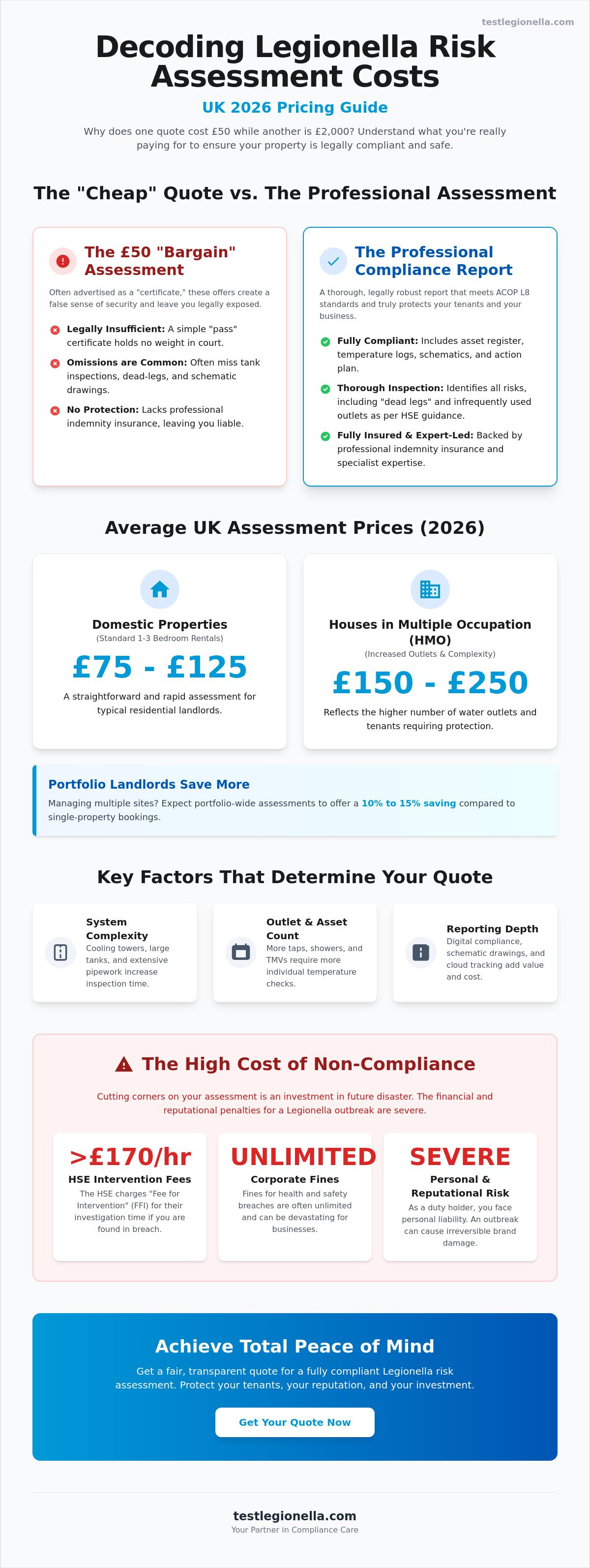
Many property owners mistakenly ask for a "Legionella certificate." It's important to clarify that a simple one-page certificate carries little weight in a legal setting. You need a comprehensive compliance report. This detailed document includes a full asset register, temperature logs, schematic drawings, and a prioritized action plan. Without this depth, you remain exposed to significant financial risks. Non-compliance can lead to HSE "Fee for Intervention" (FFI) charges, which currently exceed £170 per hour for investigation time. In more serious cases, fines for health and safety breaches are often unlimited and can be accompanied by devastating reputational damage.
The Legal Framework: ACOP L8 Explained
As a duty holder, you're legally responsible for the water safety of your tenants, employees, and visitors. The law doesn't care if you're a part-time landlord or a corporate CEO. "Ignorance of the law" is never a valid defence in a UK court. If an outbreak occurs and you haven't conducted a valid assessment, you face personal liability. We've simplified these complex requirements in our guide to ACOP L8 explained, which helps you stay on the right side of the HSE without the stress.
Why 2026 Pricing Differs from Previous Years
The legionella risk assessment cost has evolved in 2026 due to several key factors. Updated HSE guidance now requires greater depth in reporting, particularly regarding "dead legs" and infrequently used outlets. Furthermore, professional indemnity insurance for assessors has seen a market-wide increase, which is reflected in professional rates. We've also seen a significant shift toward digital compliance. Modern assessments now include cloud-based tracking and automated reminders. While this technology-driven approach ensures you never miss a deadline, it requires more sophisticated equipment and software than the basic paper checklists used in the past.
Average Legionella Assessment Prices in the UK for 2026
Understanding the legionella risk assessment cost is the first step toward securing your property and protecting your tenants. In 2026, UK pricing has shifted away from regional postcodes toward a model based strictly on system complexity. You won't pay more just because you're in London; you'll pay more if your building has complex cooling towers or extensive pipework. Complexity dictates the fee. While a studio flat requires minimal time, a care home with dozens of thermostatic mixing valves demands a far more rigorous inspection.
Many providers offer flat-fee pricing, but you should treat these with caution. Low-cost, "click-and-go" assessments often omit essential components like cold water tank inspections or detailed schematic drawings. These omissions leave you legally exposed. The UK Government Guidance on Legionella emphasizes that assessments must be "suitable and sufficient." If a cheap report misses a dead-leg in your plumbing, it isn't compliant. For those managing multiple sites, portfolio-wide assessments typically offer a 10% to 15% saving compared to single-property bookings. This efficiency makes long-term safety more affordable for professional landlords.
Domestic Property Pricing (Landlords & Residential)
For standard residential landlords, the process is straightforward and fast. A typical 1-3 bedroom rental property in 2026 usually costs between £75 and £125. If you manage a House in Multiple Occupation (HMO), expect the price to sit between £150 and £250. This increase reflects the higher number of water outlets and the increased risk profile of shared living spaces. Be wary of letting agent markups. Many agencies add a 20% administration fee on top of the contractor's price. Booking your specialist directly ensures you get the same professional report without the middleman's premium. It's an easy way to keep your compliance care costs down while maintaining high standards.
Commercial Property Pricing (SMEs to Industrial)
Commercial environments require a more technical approach. Small retail units or simple office blocks generally range from £200 to £400. However, high-risk environments like dental practices, gyms with showers, or care homes involve more intensive testing of aerosol-generating outlets. These assessments often start at £450. Large industrial sites or facilities with cooling towers represent the top tier of pricing. Because these systems pose a significant public health risk, assessments are bespoke and can exceed £1,500. Professional assessors will look at:
- The number of water storage tanks and their condition.
- Complexities in the hot and cold water distribution systems.
- The presence of high-risk assets like spa pools or evaporative condensers.
- The vulnerability of the building's occupants.
Investing in a thorough assessment now prevents the far higher costs of legal fines or emergency remedial works later. Accuracy provides peace of mind.
Key Factors That Influence Your Assessment Quote
Your legionella risk assessment cost isn't a flat fee because no two water systems are identical. A small retail unit with one toilet and a sink requires significantly less labor than a care home with 50 ensuite rooms. Assessors calculate quotes based on the total number of water outlets, including taps, showers, and toilets, as each one represents a potential point of aerosol transition. Beyond the outlets, the presence of cold water storage tanks and calorifiers adds layers of technical scrutiny to the job.
The HSE Approved Code of Practice (ACOP L8) dictates that your assessment must be proportional to the risk. If you manage a complex site, your quote will reflect the time needed to map every asset and identify potential stagnation points. We focus on providing a clear, tailored breakdown so you only pay for what your building actually requires. This keeps your property safe without unnecessary overheads.
System Complexity and Asset Counting
Asset counting is the foundation of a reliable quote. High numbers of Thermostatic Mixing Valves (TMVs) increase the workload because each valve must be checked for proper function and temperature control. Legacy plumbing often contains "dead legs" or redundant pipework where water can stagnate and bacteria can multiply. Identifying these hidden risks takes time and expertise. If you don't have up to date site schematics, your assessor will need to create them. This is a critical legal requirement for Compliance Care, but it can increase the initial cost of the report.
Water Sampling and Lab Testing Costs
There's a clear difference between a visual risk assessment and physical water sampling. A standard assessment identifies risks through observation and temperature monitoring. However, if the system is complex or the water temperature isn't consistently controlled, laboratory analysis becomes necessary. For UKAS-accredited laboratory analysis, industry data suggests costs typically range between £40 and £70 per sample.
Sampling is legally required in specific high-risk environments like healthcare settings or when cooling towers are present. In other sectors, it's often a best practice recommendation to provide total peace of mind. We make compliance easy by clearly distinguishing between what's mandatory and what's advisable for your specific property type. Your final legionella risk assessment cost will also depend on the frequency of these visits. While many landlords require a review every 24 months, high-risk sites may need more frequent intervention to remain compliant and safe.
The Hidden Risks of "Cheap" or DIY Legionella Assessments
Cutting corners on safety usually creates a more expensive problem later. A low legionella risk assessment cost might look attractive on a spreadsheet, but it often masks significant legal and financial vulnerabilities. When you pay for a professional service, you aren't just buying a piece of paper; you're purchasing a legal defence and expert oversight.
The Template Trap: Why DIY Fails Audits
Many landlords try to save money by using "free" online forms. These documents often lack site-specific detail, such as identifying dead legs in plumbing or measuring specific water storage temperatures. A sample Legionella risk assessment shows that a template isn't a compliance shield. If the HSE or a local council auditor finds your assessment inadequate, you'll pay for a professional one anyway. You'll also face potential fines that start in the thousands of pounds. Doing it twice doubles your initial outlay and triples your stress.
Professional indemnity insurance is the most valuable part of your fee. It transfers the risk from the property owner to the assessor. When you look at asbestos survey costs, you see a similar pattern where professional verification is non-negotiable for safety. Legionella carries the same level of personal liability. If an outbreak occurs and your "DIY" assessment is found lacking, the legal consequences are severe.
Watch out for these "red flags" when receiving a suspiciously low quote:
- Quotes provided without asking about the number of water outlets or the complexity of the system.
- Assessors who claim they can complete the work "remotely" or via photos without a site visit.
- A lack of a clear, prioritised remedial action plan in the final report.
- No evidence of professional indemnity insurance or specific water hygiene qualifications.
Competence vs. Cost: Choosing an Assessor
Look for assessors with City & Guilds or equivalent water hygiene certifications. A professional report doesn't just list problems; it provides a roadmap for maintenance. This proactive approach saves money on future plumbing repairs by identifying scale buildup or inefficient heating before they cause system failures. High-quality reports ensure your legionella risk assessment cost is an investment in asset protection, not just a box-ticking exercise. It's about moving from a state of risk to a state of "Compliance Care."
Don't leave your legal compliance to chance. Get your professional quote today and secure your peace of mind.
Maximising Value with Test Legionella’s Compliance Care
Managing your legionella risk assessment cost shouldn't feel like a gamble. We've refined our onsite procedures to ensure we're thorough but fast. Our specialists use proprietary digital tools to capture data in real-time. This reduces the hours spent at your premises by 25% compared to traditional paper-based methods. You get a faster turnaround and lower labor costs without sacrificing safety. It's about working smarter so your business stays protected without unnecessary disruption.
We believe in total transparency. Many providers offer a low initial price only to surprise you with hidden "essential" remedial works at a massive markup. Test Legionella operates differently. Our pricing is fixed and upfront. We identify what you actually need to stay compliant with ACoP L8 regulations. If a risk can be managed through a simple temperature regime rather than a £2,000 plumbing overhaul, that's exactly what we'll recommend.
Our Professional Assessment Checklist
Our Compliance Care package ensures every corner of your water system is scrutinised. We don't just look at the tanks; we look at the whole picture. Your digital report includes:
- Comprehensive site surveys: This covers temperature profiling of all hot and cold outlets and detailed inspections of cold water storage tanks.
- Digital evidence: Every asset checked is documented with photographic evidence. This creates a robust audit trail for health and safety inspectors.
- Tailored risk reduction: We provide clear, prioritised advice. Our goal is to reduce your risk profile using the most cost-effective methods possible.
Get Your Professional Quote Today
Getting an accurate, fixed-fee quote is simple. Tell us the number of outlets, the type of property, and your location. This allows us to provide a price that stays exactly as quoted. We offer a "Peace of Mind" guarantee. This means we take full responsibility for the accuracy of our assessment, giving you the confidence to focus on your business while we handle the safety details. Securing a predictable legionella risk assessment cost starts with accurate data and a partner you can trust.
Our automated reminder system is a standard part of our service. It tracks your future assessment dates so you never fall out of compliance. Statistics show that businesses face a 15% price hike when they book emergency, last-minute assessments. Our system eliminates that risk entirely. Take the first step toward stress-free management now.
Secure Your Compliance Strategy for 2026
Navigating property safety requirements in 2026 requires a proactive approach to avoid the legal risks outlined in the Health and Safety at Work etc. Act 1974. You've seen that your total legionella risk assessment cost depends on system complexity and the number of water outlets, but the price of non-compliance is always higher. Professional assessments ensure you meet ACoP L8 standards, whereas DIY attempts often leave landlords vulnerable to prosecution and safety failures.
Test Legionella delivers total budget certainty through fixed-fee pricing. Our UKAS-aligned testing procedures provide detailed digital reports featuring photographic evidence, creating a robust audit trail for your records. We've streamlined the entire process to be fast and stress-free, allowing you to focus on your business while we manage the technical logistics. You don't need to struggle with complex paperwork when our specialist team handles the heavy lifting. Protecting your tenants and your reputation is easy when you have the right specialist partner by your side.
Get a Fast, Reliable Legionella Quote Today
Frequently Asked Questions
Is a Legionella risk assessment a legal requirement for UK landlords?
Yes, a Legionella risk assessment is a legal requirement for all UK landlords under the Health and Safety at Work Act 1974. This duty applies to both residential and commercial property owners who must identify and manage risks in their water systems. You're responsible for the health of your tenants, and failing to comply means you're in breach of HSE ACoP L8 regulations. It's a vital step to ensure your property remains safe and legally compliant.
How often do I need to pay for a new Legionella risk assessment?
You should review your assessment at least every 2 years or whenever there's a significant change to your water system. Changes include new boiler installations, pipework modifications, or if the property's use changes significantly. Regular reviews keep your records up to date and ensure your "Compliance Care" stays active. If your initial risk level is low, a simple biennial check keeps your tenants protected and your legal obligations fulfilled without unnecessary stress.
Can I carry out my own Legionella risk assessment to save money?
You can perform your own assessment if you're competent to do so, but most landlords hire a specialist to ensure total accuracy. Professional assessors identify hidden risks that an untrained eye might miss, such as dead legs in pipework or temperature fluctuations. While doing it yourself might lower your initial legionella risk assessment cost, a professional report provides the robust legal protection you need if a health issue ever arises in your property.
What is the average cost of a Legionella assessment for a 3-bedroom house?
The average legionella risk assessment cost for a standard 3-bedroom house in 2026 typically ranges from £50 to £150. This price covers a standard domestic system without complex features like cold water storage tanks or secondary return loops. Prices vary based on your specific location in the UK and the complexity of the plumbing layout. Getting a fixed quote ensures you receive a professional service with no hidden fees or unexpected charges during the visit.
Does the cost of the assessment include water testing and sampling?
A standard assessment cost usually excludes water sampling and laboratory testing because these aren't always required. The process focuses on a physical and visual inspection to identify risks like stagnation or incorrect water temperatures. If the assessor identifies a high-risk situation, they'll recommend sampling as a separate, additional service. Most domestic properties only need the physical inspection to achieve compliance unless the system's condition suggests a deeper biological problem exists.
What happens if I don’t have a valid Legionella risk assessment?
Failing to maintain a valid assessment leaves you open to heavy fines, prosecution, and potential civil claims. The Health and Safety Executive (HSE) can issue improvement notices or pursue legal action if you're found to be negligent in your duties. If a tenant contracts Legionnaires' disease, the lack of a professional report makes it difficult to prove you took reasonable precautions. It's a significant risk that can lead to permanent damage to your reputation and finances.
How long does a professional Legionella assessment take to complete?
A professional assessment for a typical domestic property usually takes between 30 and 45 minutes to complete. Larger commercial sites or buildings with complex water storage systems can take 2 to 4 hours depending on the number of outlets. Our technicians work efficiently to minimize any disruption to your tenants while performing a thorough check of all taps, showers, and tanks. You'll get a clear appointment window so you can manage your schedule with total confidence.
Will I get a certificate after the Legionella risk assessment is finished?
You'll receive a detailed compliance report that serves as your official record and proof of assessment. This document outlines the findings, highlights any necessary remedial actions, and provides a clear summary of your system's safety status. We focus on making "Compliance Made Easy" by providing a professional report that you can show to letting agents or local authorities. It's your primary evidence that you've met your legal duty of care and protected your tenants.