
Would your insurance provider actually pay out if a Legionnaires' disease outbreak was traced back to your property, or would they point to a failure to take reasonable precautions to void your claim? With the disease proving fatal in up to 30% of cases, prioritising legionella testing for insurance compliance uk is the only way to ensure your policy remains a functional safety net rather than a false sense of security. You likely already feel the weight of this responsibility, especially since standard Public Liability insurance requires documented proof of active risk management to remain valid.
We're here to help you move from a state of uncertainty to one of total operational security. This guide provides the clarity you need to confirm your coverage is intact and your legal duties are met. We'll walk through an essential compliance checklist, explain how the 2024 updates to technical guidance affect your site, and show you how professional certification creates the peace of mind you deserve. You'll discover how to transform complex regulatory burdens into a streamlined process that protects both your people and your professional liability.
Key Takeaways
- Understand the "insurance gap" and why standard policies often fail to cover bacterial outbreaks without proof of statutory compliance.
- Learn how to align your water safety measures with ACOP L8 to satisfy the "reasonable care" clauses found in most UK commercial policies.
- Discover how professional legionella testing for insurance compliance uk secures your coverage and protects you from devastating personal liability.
- Establish a robust audit trail by identifying the critical water safety records you need to maintain for a minimum of five years.
- Explore the role of UKAS-accredited laboratory reports in providing the definitive evidence required by insurers during a claim investigation.
The Critical Link Between Legionella Testing and Insurance Validity
Many business owners and landlords view their Public Liability insurance as an absolute safety net. They pay their premiums and assume they are protected against every eventuality. However, a significant "insurance gap" exists between holding a policy and receiving a payout. In the event of a claim, insurers don't just look at whether you were covered; they scrutinize whether you were compliant. For water safety, legionella testing for insurance compliance uk serves as the objective proof that you met your legal obligations before an incident occurred.
Insurance companies typically include "reasonable precautions" or "due diligence" clauses. These aren't mere suggestions. They are binding requirements that mandate you follow the Health and Safety Executive (HSE) guidelines, specifically the Approved Code of Practice (ACOP L8). If a claimant contracts What is Legionnaires' Disease? at your premises, your insurer will investigate your maintenance records. If those records are missing or incomplete, they may categorize the incident as a result of negligence, potentially voiding your policy and leaving you personally liable for damages.
Why 'Intent' Isn't Enough for UK Insurers
Underwriters require hard evidence rather than a simple promise of maintenance. While a general risk assessment identifies potential hazards, specific water sampling provides the data needed to prove your control measures are actually working. Statutory compliance in UK water safety refers to the strict adherence to the Health and Safety at Work etc. Act 1974 and the Control of Substances Hazardous to Health Regulations 2002 (COSHH). This means you must demonstrate a continuous, documented effort to manage risks. Without regular legionella testing for insurance compliance uk, you lack the technical anchors required to defend your "Duty of Care" in a legal setting.
The Financial Risks of Non-Compliance
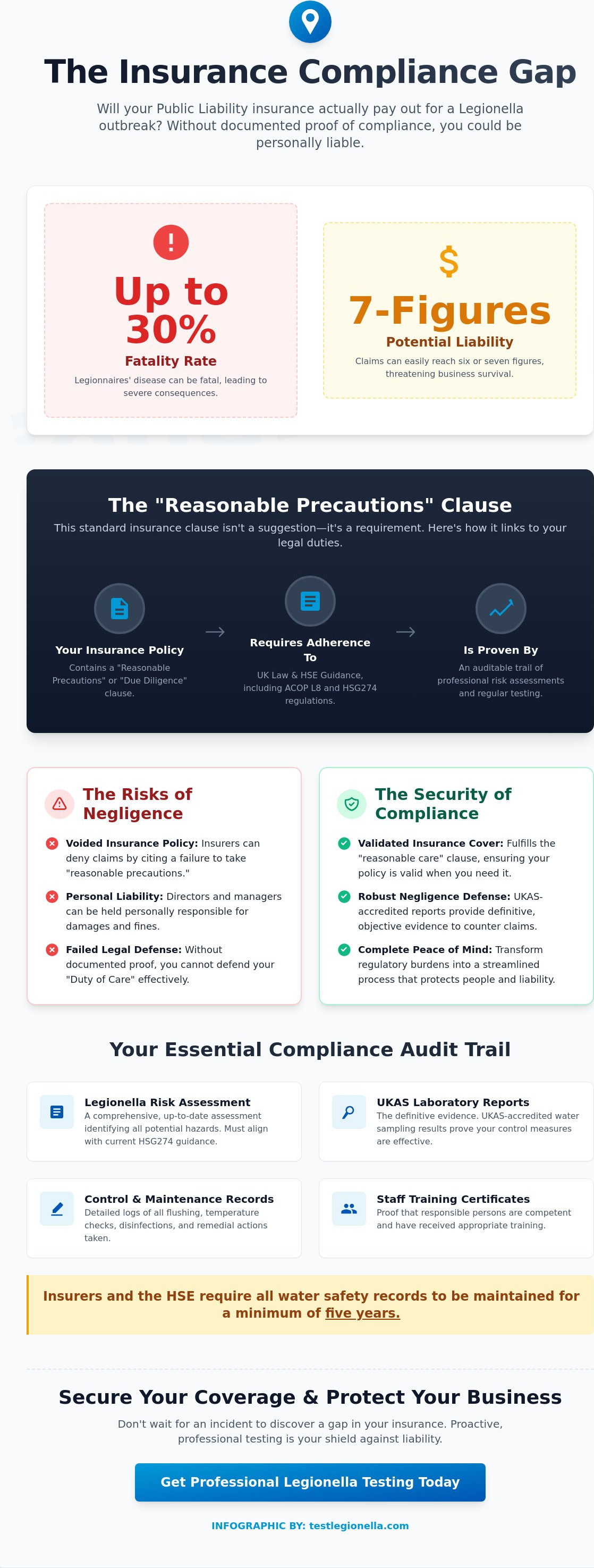
The financial consequences of a voided insurance policy are often catastrophic. With Legionnaires' disease proving fatal in up to 30% of cases, liability claims can easily reach six or seven figures. Insurers actively look for evidence of negligence to avoid these large payouts. If they find you ignored ACOP L8 or failed to conduct necessary sampling, they can argue that the risk was foreseeable and preventable. This shift in liability moves the financial burden from the insurer's balance sheet directly onto your business continuity and personal assets. Adhering to professional testing standards transforms these complex regulatory burdens into a secure, verifiable audit trail that protects your financial future.
- Policy Validity: Proves you haven't breached "reasonable care" clauses.
- Negligence Defense: Provides UKAS-accredited data to counter claims of oversight.
- Regulatory Alignment: Ensures your records match the current 2024 HSG274 technical guidance.
Understanding the 'Reasonable Precautions' Clause in UK Policies
Standard Public Liability policies are rarely a blank cheque. Most include a 'Reasonable Precautions' clause, which acts as a pivot point for claim approval or rejection. While this phrase may seem open to interpretation, insurers and courts align their expectations with the UK Health and Safety Executive (HSE) guidance. To an underwriter, 'reasonable' is synonymous with 'compliant'. If you cannot demonstrate that you followed ACOP L8 and the technical guidance in HSG274, you have likely failed the test of reasonable care.
Regular intervals are essential for maintaining continuous cover. A risk assessment isn't a one-time event; it must reflect the current state of your water system. Given that HSG274 Part 1 was updated in 2024, an assessment conducted several years ago may no longer meet the 'reasonable' standard. Consistent legionella testing for insurance compliance uk provides a chronological record of diligence. It proves that your control measures were active, monitored, and effective at the time of any alleged exposure, leaving no room for insurers to cite negligence.
You should also identify the 'Exclusion' fine print in your standard Public Liability documents. Many policies contain broad exclusions for 'Pollution and Contamination'. Without specific evidence that you followed statutory guidelines, insurers may categorize a bacterial outbreak as an excluded event. Proactive management turns these hidden traps into manageable risks by providing the documentation required to override such exclusions.
Decoding Underwriter Terminology
In a legal or insurance dispute, 'best practice' isn't a vague ideal; it refers specifically to the technical standards currently in effect. Sampling results act as your primary defense against claims of negligence. They provide objective, scientific data that physical inspections alone cannot offer. For a detailed breakdown of these legal benchmarks, refer to our guide on ACOP L8 Explained. By aligning your water management with these terms, you close the gap between policy intent and actual protection.
The Role of the Competent Person
Insurers scrutinize who carried out your safety checks. While basic tasks can be handled in-house, underwriters place significantly more weight on results from a 'competent person' or a specialist third party. UKAS-accredited laboratory results provide a level of forensic proof that is difficult to challenge during a liability dispute. A professional report satisfies the HSE requirement for technical competence, demonstrating that you sought expert guidance to manage high-stakes risks. Securing professional water sampling ensures that your compliance trail is robust enough to withstand the most rigorous insurance audit.
Why Standard Public Liability May Not Cover Legionella Outbreaks
Standard Public Liability policies often contain a "Pollution and Contamination" exclusion that catches many duty holders off guard. In the eyes of an underwriter, Legionella bacteria are frequently categorized as a biological contaminant. If your policy doesn't explicitly mention bacterial coverage, your insurer might argue that an outbreak falls under this broad exclusion. This technicality is why many UK businesses now require a specific "Legionella Extension" to their existing cover. Without this deliberate addition, you could be left to settle devastating claims using your own company's capital.
Timing is another critical factor in water safety management. You must understand the difference between "Claims Made" and "Claims Occurring" in the context of your policy. Because symptoms of the disease can take time to manifest, the gap between exposure and a legal claim can be significant. A "Claims Made" policy must be active when the claim is officially filed. Conversely, a "Claims Occurring" policy covers incidents that happened during the policy term, even if the claim arrives years later. Maintaining a rigorous schedule of legionella testing for insurance compliance uk creates the documented timeline necessary to trigger either type of coverage effectively.
The Legionella Exclusion Checklist
Don't wait for a crisis to discover a hole in your coverage. Take a proactive approach and ask your broker these four specific questions to ensure your protection is robust:
- Does the standard pollution exclusion apply to biological agents and bacteria like Legionella?
- Is there a specific financial sub-limit for Legionella-related liabilities within my Public Liability cover?
- Does the policy wording mandate annual laboratory testing or just a "suitable and sufficient" risk assessment?
- Are there "Silent Pollution" clauses that might accidentally strip away your protection in the event of a gradual outbreak?
Identifying these gaps now allows you to secure the necessary extensions before a problem arises, transforming a potential liability into a managed risk.
Bridging the Coverage Gap
Professional testing reports are more than just a compliance burden; they are powerful negotiation tools. By presenting a consistent history of clean UKAS-accredited laboratory results, you demonstrate a controlled risk profile to your underwriter. This transparency can lead to more favorable terms or even lower premiums over time. While you must consider the Legionella risk assessment costs, these are often offset by the insurance savings and the total removal of personal liability risk. Review your policy for "sudden and accidental" versus "gradual" contamination wording. Insurers often refuse claims for "gradual" issues, arguing that regular legionella testing for insurance compliance uk would have caught the problem before it escalated. Prove your diligence through data to ensure your safety net remains intact.
How to Build a Compliance Audit Trail for Your Insurer
Organizing your water safety records is not just a filing exercise; it's a legal defense strategy. Underwriters don't just look for a single certificate during a claim investigation. They look for a "Defense-in-Depth" narrative. This means providing a layered history of your water management that proves you were proactive every single month, not just once every few years. A robust audit trail transforms legionella testing for insurance compliance uk from a technical requirement into an unshakeable proof of diligence.
Retention periods are a critical component of this trail. Under ACOP L8, you must keep records of monitoring and maintenance for at least five years. This timeline is essential because legal claims for Legionnaires' disease can surface long after the initial exposure. If you can't produce a five-year history, an insurer may argue that your management was inconsistent. Transitioning to digital, tamper-proof records is the best way to ensure this data remains accessible and credible. Unlike paper logs, digital trails provide time-stamped evidence that is difficult for a legal adversary to challenge.
Equally important is the documentation of "Remedial Actions." If a test result shows an elevated count, the insurer won't necessarily void your policy. They will, however, look for what you did next. Recording the exact date of disinfection or the replacement of a faulty valve proves that your control scheme was functioning as intended. This proactive response is exactly what "reasonable care" looks like in a professional setting.
Step 1: The Professional Risk Assessment
Your audit trail begins with a professional risk assessment that identifies every man-made water system on your property. An outdated assessment is a major red flag for insurers. If your assessment doesn't reflect your current plumbing configuration, it is effectively useless in a liability dispute. To understand which systems require your attention, read our guide on What is Legionella. Starting with an accurate map of your risks ensures that your subsequent testing remains relevant and legally defensible.
Step 2: Continuous Monitoring and Sampling
Once your risks are mapped, you must maintain a schedule that matches your building's specific profile. This includes documenting temperature logs, showerhead descaling, and flushing of stagnant outlets. A "Clean Bill of Health" certificate from a UKAS-accredited laboratory is the gold standard for this trail. It provides a simplified, scientific outcome that an insurance adjuster can easily verify. To begin building your defense-ready audit trail, you can order a professional compliance test kit today and secure the data you need for total peace of mind.
Professional Legionella Testing: Your Shield Against Liability Claims
Professional testing acts as your ultimate shield in an increasingly litigious environment. When you invest in legionella testing for insurance compliance uk, you aren't just buying a lab result; you're securing a document specifically designed to satisfy the most rigorous insurance adjusters. Test Legionella provides reports that translate complex technical data into a clear, verifiable compliance status. This clarity is vital. If an underwriter cannot quickly understand your safety records, they cannot verify your diligence, which puts your payout at risk.
The UK legal system prioritizes independent, verified data over internal checks. UKAS-accredited laboratory analysis is the gold standard for this evidence. It removes the ambiguity of "in-house" monitoring and provides a forensic level of proof that is difficult to challenge. By using a specialist, you shift the technical burden away from your staff. This reduces the risk of human error and ensures that every sample is handled according to established scientific protocols. It's a move that makes your business unassailable in the event of a dispute.
Managing a commercial property or a residential portfolio comes with enough daily stress. Handing over the logistics of water sampling to an efficient partner provides immediate tranquility. You gain the confidence that your tenants are safe and your commercial assets are protected. This approach transforms a complex regulatory burden into a streamlined, stress-free process that prioritizes operational excellence.
The Test Legionella Advantage
We offer national coverage with a standardized approach to UK compliance. This consistency is crucial for stakeholders managing multiple sites across different regions. Our reporting is intentionally jargon-free. We provide the technical anchors underwriters need without the unnecessary complexity that slows down management decisions. If a risk is identified, our rapid response testing allows you to address suspected issues before they become claims, protecting both your reputation and your bottom line.
Secure Your Compliance Today
Don't wait for your insurance renewal to check your compliance status. An outbreak doesn't wait for your policy anniversary. An outdated risk assessment or a missing test result can void your cover instantly, leaving your personal assets exposed. Waiting is a high-risk strategy that offers no benefits. The process of booking a professional compliance test is simple, direct, and provides the immediate peace of mind you need to focus on your core business. Secure your insurance compliance with professional testing from Test Legionella and ensure your policy remains the functional safety net you expect it to be.
Secure Your Property and Protect Your Liability
Your insurance policy is only as strong as the evidence supporting it. By aligning your water management with current ACOP L8 standards, you transform a potential legal burden into a manageable, documented process. Insurers prioritize verified data over simple promises. Professional legionella testing for insurance compliance uk is the most effective way to satisfy the "reasonable care" clauses that protect your business from devastating liability claims.
Don't leave your coverage to chance or rely on outdated assessments that no longer reflect your system's risks. Our specialist UK compliance reports and UKAS accredited lab analysis provide the scientific certainty required by underwriters and legal professionals alike. We offer the comprehensive audit trail support you need to ensure your records remain tamper-proof and ready for any inspection. Take a proactive step toward total operational security and emotional peace of mind today.
Get your insurance-compliant Legionella test today and move forward with the confidence that your property, tenants, and professional future are fully shielded.
Frequently Asked Questions
Does standard Public Liability insurance cover Legionnaires' disease in the UK?
Standard Public Liability insurance does not always automatically cover Legionnaires' disease due to broad exclusions for pollution and biological contamination. Many insurers treat bacteria as a pollutant, meaning you may need a specific "Legionella Extension" to ensure you're protected. Always check your policy schedule for these exclusions. Without explicit wording, you risk facing a claim that your insurer is not contractually obligated to settle on your behalf.
How often does my insurance company require Legionella testing?
Insurers typically require you to follow the frequency determined by your professional risk assessment, which must align with ACOP L8 and HSG274 guidelines. While there is no fixed legal "expiry date" for an assessment, underwriters expect it to be a living document that reflects any system changes. For higher-risk commercial settings, annual or bi-annual sampling is often viewed as the minimum benchmark for demonstrating reasonable care and maintaining policy validity.
What happens if I have a Legionella risk assessment but no water testing results?
Having a risk assessment without subsequent water testing results leaves a significant gap in your compliance audit trail. The assessment identifies the hazards, but the testing provides the scientific proof that your control measures are actually working. In a liability dispute, an insurer may argue that you identified a risk but failed to monitor it effectively. This perceived negligence can be enough for an underwriter to contest or void your coverage entirely.
Can a landlord be held personally liable even if they have insurance?
Yes, a landlord can be held personally liable if their insurer refuses a claim based on a breach of the "reasonable precautions" clause. If you fail to invest in legionella testing for insurance compliance uk, the insurer may categorize the incident as a result of negligence rather than an accident. When a policy is voided, the financial responsibility for legal fees and claimant damages falls directly on the landlord's personal assets and business capital.
Is a DIY Legionella test kit sufficient for insurance compliance?
A DIY test kit is generally insufficient for insurance compliance because it lacks the evidentiary weight of a professional, UKAS-accredited laboratory report. Insurers require a robust chain of custody and forensic-level accuracy to defend a claim in court. While DIY kits might offer temporary personal information, they don't provide the certified documentation required to prove statutory compliance to an underwriter or a health and safety inspector during an official investigation.
What specific documents will an insurer ask for after a Legionella outbreak?
In the event of an outbreak, an insurer will demand a comprehensive audit trail to verify your diligence. This typically includes your current risk assessment, a written control scheme, and at least five years of monitoring records. They will specifically look for temperature logs, showerhead descaling records, and UKAS-accredited laboratory test results. Providing these documents promptly proves that you met your duty of care and helps trigger your insurance protection without delay.
Does a 'clean' test result lower my property insurance premiums?
While a single "clean" test result may not instantly lower your premiums, maintaining a consistent history of legionella testing for insurance compliance uk improves your overall risk profile. When you present a multi-year audit trail of professional laboratory results, you demonstrate a controlled environment to your broker. This proactive management makes your business a more attractive prospect for underwriters, which can lead to more competitive rates and better terms during your next renewal cycle.
What is a 'Reasonable Precautions' clause in a commercial property policy?
A "Reasonable Precautions" clause is a binding condition that requires you to take all practical steps to prevent loss, damage, or injury. In the context of water safety, this means adhering to the HSE's ACOP L8 and HSG274 technical standards. If you ignore these guidelines, you've breached the terms of your contract. Insurers use this clause as a benchmark; if you didn't follow the law, they aren't obligated to pay for the resulting liability.