
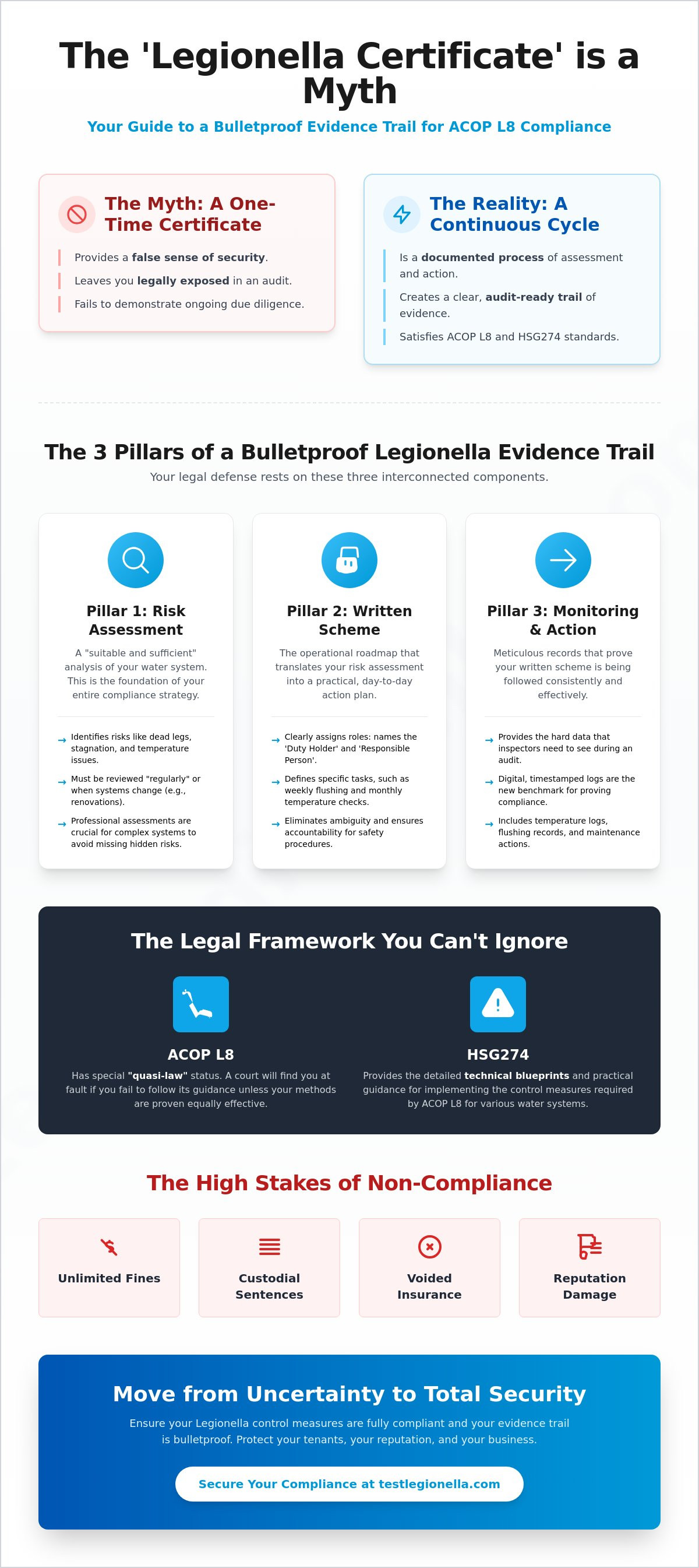
A "Legionella certificate" is a common industry myth that provides a false sense of security while leaving you legally exposed. Under the current ACOP L8 guidelines, compliance isn't a one-time piece of paper; it's a continuous, documented cycle of assessment and action. Proving due diligence for legionella control requires more than just a signature. It demands a clear, audit-ready trail that demonstrates you've identified risks and actively managed them according to the latest HSG274 technical standards.
It's easy to feel overwhelmed by the volume of temperature logs and maintenance records required by UK health and safety law. You want to protect your tenants and your reputation, but the fear of prosecution often stems from simple confusion over what "competence" actually looks like. This guide will help you transform that regulatory burden into a streamlined process for managing records. You'll learn exactly how to construct a bulletproof evidence trail that satisfies inspectors and ensures your property remains safe. We'll explore the essential documents every duty holder needs, from the written scheme of control to precise monitoring data, so you can move from uncertainty to total operational security.
Key Takeaways
- Understand the specific link between ACOP L8 and UK law to ensure your safety measures meet the "reasonable steps" standard for legal protection.
- Identify the essential documentation required for proving due diligence for legionella control, including professional risk assessments and proactive schemes of control.
- Avoid the "competence trap" by learning how to demonstrate that your safety checks are performed by qualified individuals with the skills to find hidden risks.
- Discover why microbiological water sampling serves as the ultimate receipt to prove your control measures are effective in a real-world environment.
- Learn how to transform overwhelming paperwork into a streamlined, audit-ready evidence trail that provides long-term security for your property and tenants.
Understanding Due Diligence Under ACOP L8 and UK Law
In the eyes of a UK court, due diligence isn't a vague feeling of safety. It's a specific legal defense. It means you've taken every "reasonable step" to prevent harm. When it comes to proving due diligence for legionella control, the burden of proof rests squarely on your shoulders. You must demonstrate that you've proactively managed the risks associated with Understanding Legionella bacteria rather than simply reacting to a problem after it occurs.
This requirement is rooted in the Health and Safety at Work etc. Act 1974 and the Control of Substances Hazardous to Health (COSHH) Regulations 2002. These laws mandate that employers and landlords protect people from biological hazards. Claiming you didn't know the rules won't help you. Ignorance is never a valid defense in health and safety litigation. To build a successful defense, you need the "Evidence Trinity": a professional risk assessment, a written scheme of control, and meticulous monitoring records.
The Legal Framework: ACOP L8 and HSG274
ACOP L8 holds a unique "quasi-law" status in the United Kingdom. While it isn't a statute itself, it has special legal standing. If you're prosecuted for a health and safety breach and it's proven you didn't follow ACOP L8, a court will find you at fault unless you can prove your methods were just as effective. Supporting this is HSG274, which provides the technical blueprints for different water systems. By 2026, the standard for proving due diligence for legionella control has shifted heavily toward digital record-keeping. Real-time, timestamped logs are now the benchmark for showing a continuous commitment to safety, replacing the easily manipulated paper folders of the past.
The Consequences of Failing the Due Diligence Test
The stakes are high. Failing to maintain an adequate paper trail can lead to unlimited fines and custodial sentences for duty holders. During an inspection, the Health and Safety Executive (HSE) won't just look at your pipes; they'll interrogate your records. They want to see a consistent history of testing and maintenance. Beyond legal penalties, a Legionella outbreak usually voids your insurance policies and destroys your professional reputation. Without a bulletproof evidence trail, you're left exposed to both the law and financial ruin. Professional Legionella Compliance Testing is the most efficient way to ensure your records stand up to this intense scrutiny.
The 3 Pillars of a Bulletproof Legionella Evidence Trail
To successfully demonstrate compliance, you must move beyond occasional checks and embrace a structured management system. Proving due diligence for legionella control relies on three interconnected pillars that document your awareness, your plan, and your actions. Without these, your safety strategy lacks the necessary legal weight to protect you during an audit. These pillars ensure that every safety evaluation is backed by hard data and professional oversight.
Pillar 1: The Legionella Risk Assessment (LRA)
A "suitable and sufficient" risk assessment is your foundation. While some landlords attempt a DIY approach using generic templates, these often fail to identify the "known unknowns" specific to complex water systems. A professional report provides a granular analysis of dead legs, stagnant sections, and temperature fluctuations that a checklist might miss. Following the 2013 update to ACOP L8 and UK Law, there is no longer a fixed two-year expiry for these assessments. Instead, you must review them "regularly" or whenever the system changes, such as after building renovations or a change in water use. Keeping this document current is the first step in building a defensible position.
Pillar 2: Implementing the Written Scheme
The Written Scheme of Control serves as the operational heartbeat of your compliance strategy. This document translates the abstract findings of your risk assessment into a practical, day-to-day roadmap. It must clearly assign roles, naming the "Duty Holder" and the "Responsible Person" who will oversee the mitigation tasks. This scheme outlines exactly what needs to happen, from weekly outlet flushing to monthly temperature checks. By clearly defining these responsibilities in writing, you eliminate ambiguity and ensure that safety tasks aren't overlooked. If you are unsure if your current plan meets these standards, a professional Legionella Compliance Testing service can help verify your control measures.
Pillar 3: The Golden Thread of Record Keeping
In the world of health and safety, if a task isn't written down, it legally didn't happen. This "golden thread" of evidence links your planning to your physical actions. Auditors look for a consistent history of monitoring and maintenance logs to verify that your written scheme is actually being followed. Key requirements for this pillar include:
- Retention: You must keep monitoring and maintenance records for at least five years.
- Accuracy: Logs should include the date, the specific location tested, the result, and the name of the person who performed the check.
- Competence: You must maintain records proving that the individuals performing these tasks are qualified through training or experience.
Modern compliance favors digital folders with time-stamped evidence over traditional paper logs. This shift toward digital transparency makes proving due diligence for legionella control faster and more reliable, providing you with the tranquility that comes from an audit-ready trail.
Professional Assessment vs. DIY: Proving Competence
The Health and Safety Executive (HSE) suggests that landlords of simple domestic properties can perform their own risk assessments. However, this creates a dangerous "competence trap." If a tenant falls ill, the legal system will demand proof that you possessed the technical expertise to identify every hidden hazard. Proving due diligence for legionella control becomes significantly harder when your primary evidence is a basic DIY checklist. A Professional Assessment carries a weight that self-certification simply cannot match.
A standard landlord checklist often misses the "blind ends" and "dead legs" where bacteria thrive. Professional reports include detailed schematics, temperature stratification analysis, and aerosol risk evaluations. Crucially, a professional report is backed by professional indemnity insurance. This adds a critical layer of protection for the duty holder. It shifts the liability from your personal judgment to a specialist's technical expertise. Even if you believe your system is "low risk," formal validation is the only way to prove that your assessment was accurate and unbiased.
Defining "Competence" in the Eyes of the Law
To be legally "competent," you must understand how water systems function and where bacteria multiply. Missing a single redundant pipe or an incorrectly set thermostatic mixing valve (TMV) can invalidate your entire safety claim. DIY checks often overlook the specific risks of aerosol creation in showers or spray taps. Our experts provide the specific technical competence required for high-level due diligence. We ensure no hidden risk is left undocumented, transforming complex pipework into a clear, manageable safety report.
The Value of Independent Verification
Inviting an external specialist to audit your water system removes internal bias and provides an objective view of your safety standards. This independent verification simplifies your interactions with local authorities and the Care Quality Commission (CQC). It shows you've taken the most robust path possible to protect your occupants. For a deeper dive into these requirements, read our ACOP L8 Explained guide. This independent oversight transforms a regulatory chore into a professional certificate that signals total operational security. It's the most efficient way to ensure your property remains safe and your legal standing remains bulletproof.
Testing and Sampling: The Ultimate Receipt for Due Diligence
Temperature logs show you tried to control your water system. Microbiological sampling proves you succeeded. While many property owners rely solely on monthly temperature checks, these are only proxy indicators of safety. They don't account for biofilm buildup or localized stagnation where bacteria can thrive despite adequate heat. In a legal challenge, proving due diligence for legionella control requires more than just intent. It requires hard data that confirms your control measures are actually working in practice.
Microbiological sampling becomes a legal necessity in specific scenarios. If you manage high-risk systems like evaporative cooling towers, or if your water temperatures consistently fail to meet the 50°C distribution threshold, testing is mandatory. It's also vital in healthcare settings where occupants are more vulnerable. To ensure your results are admissible in court, you must use UKAS-accredited laboratories. These labs provide the specialized analysis needed to verify that your water is safe, providing a level of reliability that non-accredited tests cannot match. If you're ready to secure this level of evidence, you can book your Legionella Compliance Testing today to get an audit-ready report.
Microbiological Sampling as Verification
Laboratory results act as a scientific "receipt" for your disinfection and temperature regimes. These reports measure Colony Forming Units per Litre (CFU/L). A count below 100 CFU/L generally indicates that your system is under control. However, if counts rise toward 1,000 CFU/L or higher, the law expects immediate intervention. Testing provides scientific proof that bacteria levels are controlled. This data bridges the gap between following a process and achieving a safe outcome, giving you the peace of mind that your tenants are protected.
Managing Positive Results Proactively
A positive test result isn't a sign of failure; it's an opportunity to prove your diligence. The HSE doesn't expect water systems to be sterile at all times. They expect you to have a documented "Action Plan" ready for when counts exceed safe limits. Proving due diligence involves showing rapid remedial action, such as system chlorination, followed by re-testing to confirm the issue is resolved. This proactive response demonstrates that you're an active guardian of your property's safety. For help planning your compliance budget, see our Legionella Risk Assessment Cost guide, which includes details on sampling fees. By integrating regular testing into your routine, you transform a complex regulatory burden into a clear, manageable safety record.
Securing Your Compliance with Test Legionella
Compliance shouldn't be a source of stress for busy property managers or landlords. At Test Legionella, we transform the complex task of proving due diligence for legionella control into a streamlined, manageable process. We bridge the gap between high-stakes legal requirements and your daily operational needs. Our specialists act as your efficient partner, ensuring that every safety check is documented with precision and authority.
Our reporting standard is designed to be clear, actionable, and fully compliant with ACOP L8. We don't just provide raw data; we deliver a structured evidence trail that stands up to the most rigorous HSE inspections. Whether you manage a single residential unit or a national portfolio of commercial sites, our UK-wide coverage ensures consistent safety standards across your entire estate. We help you maintain the "Golden Thread" of record-keeping long after our site visit is complete, providing proactive notifications to ensure your assessments never lapse.
Why Professional Testing is a Smart Investment
Hiring a specialist for Legionella Compliance Testing is a strategic move that significantly reduces your administrative burden. It removes the guesswork from safety management and provides the "Peace of Mind" that comes from knowing your liability is capped by professional expertise. Our customized compliance packages are tailored to the specific needs of the residential, commercial, and healthcare sectors. By outsourcing this technical task, you ensure that your tenants remain safe while you focus on your core business activities.
Next Steps: Building Your Evidence Trail Today
Building a bulletproof evidence trail starts with a single, decisive step. Booking a professional assessment or a water sampling session is simple and fast. During a Test Legionella site visit, our technician will conduct a thorough evaluation of your water system, identifying potential dead legs, checking temperature thresholds, and collecting samples for UKAS-accredited lab analysis if required. You'll receive a comprehensive, audit-ready report that confirms your status as a responsible duty holder. Don't leave your legal standing to chance. Secure your Legionella compliance with a professional assessment today and achieve total operational security.
Secure Your Audit-Ready Evidence Trail
Compliance is a continuous cycle of assessment and verification rather than a simple one-off task. By establishing a professional risk assessment, implementing a written scheme, and maintaining meticulous logs, you transform a complex legal burden into a streamlined management system. Proving due diligence for legionella control requires this level of structured evidence to satisfy the Health and Safety Executive and protect your tenants from harm. Scientific water sampling serves as your final receipt, confirming that your temperature controls and disinfection regimes are actually working.
You don't need to manage this heavy regulatory load alone. Our specialist team offers national coverage across the UK, providing ACOP L8 and HSG274 compliant reports that give you total operational security. We utilize UKAS accredited lab analysis to ensure every result is accurate and legally defensible. Take the first step toward stress-free property management and a bulletproof safety record today.
Book Your Professional Legionella Compliance Test Now
Protecting your reputation and your occupants is a smart investment in long-term tranquility. We're here to guide you through every step of the compliance maze with expert precision and reliable support.
Frequently Asked Questions
Is a Legionella risk assessment a legal requirement for all UK landlords?
Yes, a Legionella risk assessment is a legal requirement for all UK landlords. You have a statutory duty under the Health and Safety at Work etc. Act 1974 and the COSHH Regulations to identify and assess risks in your water systems. This applies to all residential and commercial properties where water is stored or used and could potentially create an aerosol risk.
How often do I need to review my Legionella control measures to show due diligence?
You must review your control measures regularly or whenever you suspect they are no longer valid. The 2013 update to ACOP L8 removed the fixed two-year review period. Proving due diligence for legionella control now requires you to update your assessment if the water system changes, the building use evolves, or if monitoring results suggest your current controls are failing.
Can I carry out my own Legionella risk assessment if I own a small flat?
You can legally carry out your own assessment if you are competent to do so. However, the law defines competence as having the technical knowledge to identify risks like dead legs or incorrect temperature stratification. Most landlords prefer professional Legionella Compliance Testing because it removes the "competence trap" and provides a defensible report backed by specialist expertise.
What happens if I don't have a written scheme of control for my business?
Operating without a written scheme of control is a direct breach of ACOP L8 guidelines. If a Legionella outbreak occurs or an inspector visits, you won't have a documented roadmap to prove you were managing risks. This lack of evidence often leads to unlimited fines, custodial sentences, and the total invalidation of your professional indemnity insurance.
Is water testing mandatory for proving Legionella compliance?
Water testing is mandatory for high-risk systems like evaporative cooling towers or when your temperature control measures consistently fail. For standard hot and cold water systems, it isn't always a strict legal requirement. Despite this, microbiological sampling remains the only scientific way to prove your controls are working, making it a vital component of a robust evidence trail.
How long should I keep my Legionella monitoring records?
You must keep your Legionella monitoring and maintenance records for at least five years. This includes temperature logs, flushing records, and any laboratory test results. Your current risk assessment should be retained throughout its period of validity and for at least two years after a new assessment replaces it to ensure a continuous history of compliance.
What is the difference between a 'Responsible Person' and a 'Duty Holder'?
The Duty Holder is the person or organization with ultimate legal responsibility for the premises, such as the employer or landlord. The Responsible Person is a competent individual appointed by the Duty Holder to manage the day-to-day logistics of the written scheme. While the Responsible Person handles the monitoring, the Duty Holder remains legally accountable for any failures.
Does a professional Legionella report guarantee I won't be fined?
A professional report is not a "get-out-of-jail-free" card, but it is your strongest tool for proving due diligence for legionella control. To avoid fines, you must actively follow the recommendations within the report. A court evaluates your compliance based on your actions and your records, not just the existence of a document on a shelf.