
A single oversight in your water safety records can lead to HSE fines exceeding £20,000, even if no outbreak occurs. For many UK landlords and business owners, the 60-page HSE document for acop l8 feels like a wall of dense legal jargon designed to overwhelm rather than help. It's understandable if you feel frustrated by the perceived complexity of staying on the right side of the law while managing a busy property portfolio. You shouldn't have to be a legal expert to keep your building safe and your business protected.
We agree that the current regulations can feel like a heavy burden, but meeting your legal duties doesn't have to be a source of constant stress. This guide shows you exactly how to transform these complex requirements into a simple, manageable compliance programme. You'll gain the confidence that your property is fully protected and your legal obligations are met without the typical headache. Our goal is to provide you with total peace of mind through what we call Compliance Care.
We've broken down the 2026 requirements into a clear checklist of duties and a simplified path to full legal compliance. From understanding risk assessments to organising regular monitoring, we've made the entire process easy so you can focus on your business with absolute certainty.
Key Takeaways
- Master the "Gold Standard" of water safety by understanding the dual legal and practical nature of the Approved Code of Practice.
- Learn how to navigate the relationship between acop l8 and HSG274 to bridge the gap between legal duty and technical execution.
- Identify the five non-negotiable steps every property owner must take to satisfy health and safety inspectors and protect their building users.
- Discover how to simplify your compliance journey by appointing the right "Responsible Person" and securing a professional Legionella Risk Assessment.
- Explore how "Compliance Care" can automate your testing schedule, turning a complex regulatory burden into a stress-free management programme.
What is ACOP L8? Understanding the Gold Standard for Water Safety
ACOP L8 is the primary Approved Code of Practice used by the Health and Safety Executive (HSE) to regulate the control of Legionella bacteria. It's a comprehensive document that carries significant legal weight in the United Kingdom. If you're a landlord or property manager, this is your definitive manual for ensuring water safety and maintaining compliance.
This code is unique because it serves two purposes simultaneously. It's a strict legal requirement that must be followed to avoid potential prosecution, but it's also a practical guide that shows you exactly how to manage your water systems. It applies to every property where water is stored or used, regardless of the size or age of the building.
Landlords often feel overwhelmed by the technical language, but the core principles are actually quite simple. The goal is to prevent the conditions that allow bacteria to thrive and spread. By following these rules, you're not just ticking a box; you're protecting your tenants from serious health risks and securing your own peace of mind.
The Origins and Purpose of the Code
The HSE created L8 to support the Health and Safety at Work etc Act 1974. Since the fourth edition was published in 2013, the focus has been on preventing outbreaks of Legionnaires' disease, which is a severe and potentially fatal form of pneumonia. The code ensures that any water system capable of creating a spray or aerosol is properly managed and monitored.
- Cooling towers and evaporative condensers.
- Hot and cold water systems in residential lets.
- Spa pools, fountains, and even simple showers or taps.
Every system that stores or circulates water between 20°C and 45°C is a potential risk. The acop l8 framework provides the specific steps needed to identify these risks before they become a danger to the public.
Who is the 'Dutyholder' Under L8?
The law identifies a 'Dutyholder' as the person in control of the premises or the employer. For the 4.6 million private rented households in the UK, the landlord is almost always the Dutyholder. This means the legal burden of safety sits directly on your shoulders from the moment a tenancy begins.
You cannot fully delegate this responsibility to a tenant. While you can hire a specialist to carry out the physical risk assessment, the ultimate accountability remains with you. Maintaining acop l8 compliance is a non-negotiable part of your role as a property owner, ensuring your "Compliance Care" is always up to date and your documentation is legally robust.
The Legal Status of ACOP L8: Why Compliance is Non-Negotiable
Compliance with acop l8 isn't a suggestion; it's a legal safeguard for every UK landlord. While the code itself isn't a law, it possesses a "special legal status" under the Health and Safety at Work etc. Act 1974. This means that if you're prosecuted for a breach of health and safety regulations, and it's proved that you didn't follow the relevant provisions of the code, a court will find you at fault unless you can show you complied with the law in another way.
This creates a reverse burden of proof. Under Section 40 of the 1974 Act, the responsibility shifts to the landlord or duty holder to demonstrate their methods were just as effective as those outlined in the guidance. Following the code is your ultimate insurance policy. It transforms a complex regulatory burden into a clear, defensible position that protects your tenants and your business. By adhering to these standards, you move from a state of uncertainty to one of professional security.
Following the Code vs. Doing Something Else
You technically have the freedom to use alternative methods to control Legionella, but this path is complex and risky. HSE inspectors use acop l8 as the primary benchmark during every audit. If your chosen method fails, you'll find it incredibly difficult to defend your actions in a court of law. Sticking to the established code is the safest way to ensure legal protection. Most property owners find that professional compliance care is the most efficient way to meet these high standards without the stress of second-guessing technical regulations.
Consequences of Non-Compliance and Fines
The penalties for failing to manage Legionella risks are severe and immediate. Since the Health and Safety Offences Act 2008, courts have the power to impose unlimited fines and custodial sentences of up to two years for serious failings. In 2016, a single UK organisation was fined £1.8 million following a Legionella outbreak, proving that the financial stakes are massive. Beyond the courtroom, an outbreak causes irreparable reputational damage. A professional risk assessment is a low-cost investment that eliminates these high-cost risks; it's a simple step that ensures your property remains a safe, legal, and profitable asset.
Deciphering the Guidance: ACOP L8 vs HSG274
Understanding the difference between these two documents is the first step toward stress-free management. Think of acop l8 as the legal "what" and "why." It sets out the Approved Code of Practice, giving it a special legal status under the Health and Safety at Work etc. Act 1974. If a landlord is prosecuted for a breach of health and safety law, a failure to follow the provisions of the code is often enough to establish a lack of compliance in court.
HSG274 acts as the "how-to" technical manual. While the Code tells you that you must control the risk, the HSG274 guidance provides the specific engineering and operational instructions to do it. You don't need to memorise these dense volumes to stay safe. They work together as a single framework to keep your tenants protected and your business compliant. Our role is to translate these technicalities into simple, actionable steps for your property.
HSG274: The Technical Three-Part Support
The Health and Safety Executive (HSE) split the technical guidance into three distinct sections to help property owners find what they need quickly. Most residential landlords only ever need to focus on one of them.
- Part 1: Focuses on evaporative cooling systems. This is primarily for industrial sites with cooling towers.
- Part 2: Covers hot and cold water systems. This is the most relevant section for landlords, covering everything from standard boilers to complex water storage tanks.
- Part 3: Details other risk systems. This includes spa pools, fountains, and pressure washers.
When to Consult the Technical Guidance
HSG274 becomes essential when you are performing specific maintenance tasks or troubleshooting a system. It provides the exact temperature regimes required to kill Legionella bacteria. For instance, hot water must be stored at a minimum of 60°C and distributed so that it reaches at least 50°C at the outlets within one minute. Cold water must be maintained below 20°C to prevent the bacteria from multiplying.
The guidance also details how to handle pipework insulation and the removal of "dead legs" where water might stagnate. Because these details are highly technical, we recommend having a professional interpret them for you. A specialist risk assessment will take the complex requirements of acop l8 and HSG274 and turn them into a clear, easy-to-follow report. This ensures you meet your legal obligations without having to become a water safety expert yourself.
The 5 Essential Steps to ACOP L8 Compliance for Property Owners
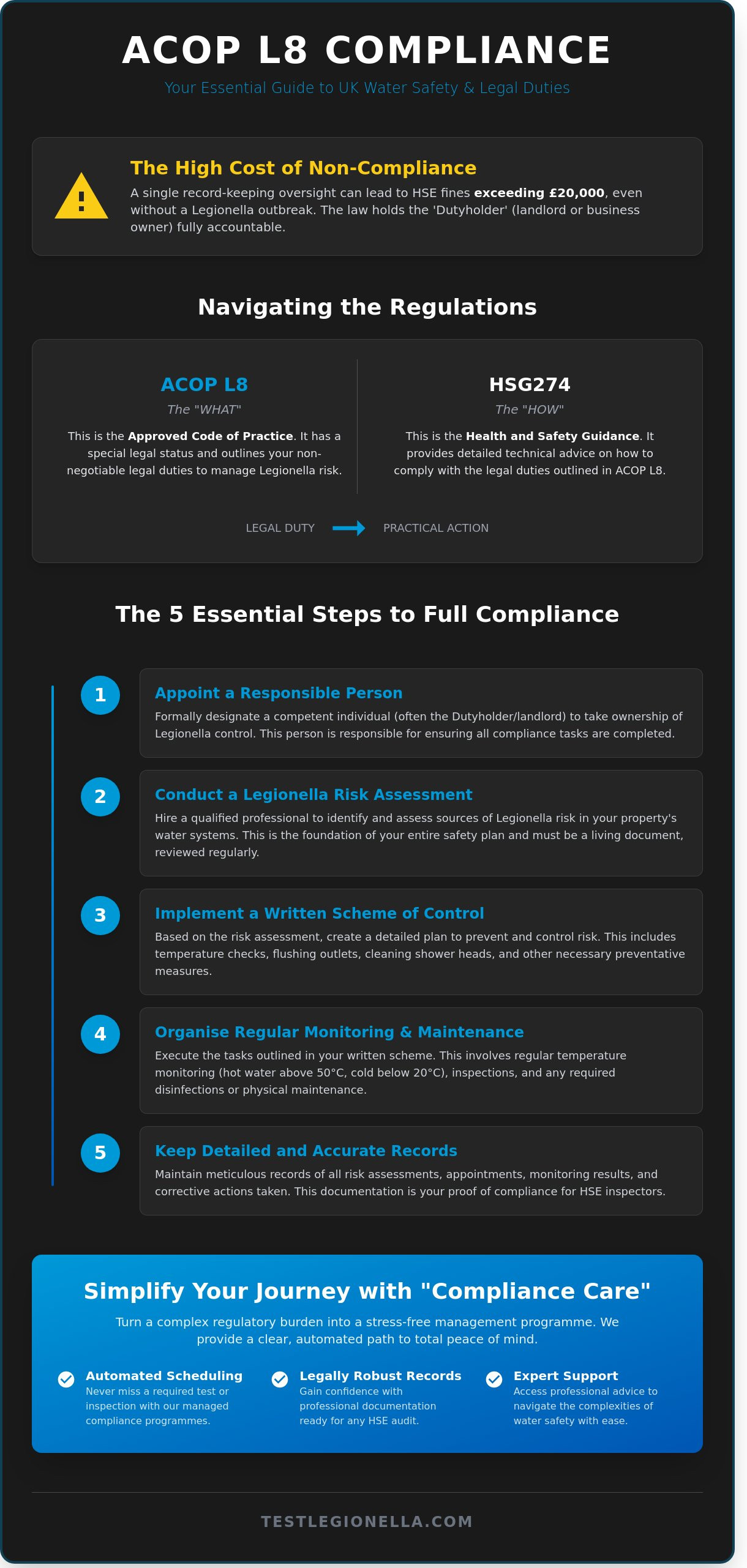
Achieving full compliance with acop l8 doesn't need to be a headache. It's a logical sequence designed to protect your tenants and your reputation. By following these five steps, you transform a complex legal obligation into a streamlined management routine that ensures safety and peace of mind.
Step 1 & 2: Appointment and Assessment
Your first priority is appointing a 'Responsible Person'. This individual must have sufficient authority and knowledge to take ownership of the water safety strategy. Once appointed, you must commission a 'suitable and sufficient' Legionella Risk Assessment (LRA). This survey identifies danger zones like dead legs or stagnant tanks. A Legionella report is a living document that requires regular review to ensure it accurately reflects the current state of your water system.
Step 3 & 4: Control and Action
Next, you need a 'Written Scheme of Control'. This is a simple plan of maintenance that outlines how you'll manage the water system. For many domestic properties, the required actions are minimal but vital for acop l8 adherence. Your scheme will likely include practical tasks such as:
- Descaling and disinfecting showerheads and taps every 90 days.
- Flushing through little-used outlets for at least 2 minutes every week.
- Checking that water heaters stay at 60°C or above to kill bacteria.
- Ensuring cold water remains below 20°C.
We make this process easy by identifying exactly which tasks apply to your specific building, saving you time and unnecessary expense.
The final step is the most critical for legal protection: record keeping. You must keep accurate logs of all monitoring results and inspections for at least five years. This evidence is your ultimate safety net. It proves you've taken proactive steps to manage risks if an inspector ever calls. If you're ready to secure your property and simplify your workload, you can get your compliance quote today and let our specialists handle the details.
Compliance Care: How to Organise Your L8 Requirements with Ease
Managing property safety doesn't have to be a source of constant stress. We've developed "Compliance Care" to transform a complex regulatory burden into an automated, worry-free system. This approach removes the guesswork from acop l8, allowing you to focus on your business while we handle the technical details. Professional testing services provide more than just a result; they offer a clear, digital audit trail that stays ready for any inspection. By moving from reactive fixes to proactive management, you ensure your water systems remain safe year-round.
The Benefits of Professional Testing
UKAS-accredited laboratory analysis remains the gold standard for water safety in the UK. While basic temperature checks are useful, expert assessments identify hidden risks like "dead legs" in pipework or bio-film buildup that an untrained eye frequently misses. Recent data indicates that approximately 12% of domestic rental properties contain plumbing dead ends that can harbour bacteria. A professional certificate provides the ultimate peace of mind, proving you've met your duty of care with scientific precision and reliable data.
Why Expert Support Reduces Long-Term Risk
Consistency is the hardest part of safety management. Our specialist support ensures you never miss a compliance deadline by using proactive reminders and scheduled visits. This level of organisation reduces long-term risk and keeps your records up to date without any manual tracking on your part. Having a dedicated partner manage the acop l8 process means you save time and avoid the potential for costly legal errors. It's about making safety efficient and reliable for every property type, from single flats to large commercial blocks.
Compliance is a path to security, not a hurdle to overcome. By choosing a specialist partner, you ensure that every risk assessment is thorough and every report is actionable. Test Legionella is the partner you need to make safety "Made Easy." You can rest easy knowing your tenants are safe and your legal obligations are fully met. Get your professional Legionella compliance quote today and see how simple safety can be.
Take Control of Your Water Safety Strategy
Navigating the complexities of acop l8 doesn't have to be a burden for landlords or business owners in 2026. Maintaining water safety is a legal mandate under the Health and Safety at Work etc Act 1974; ignoring these duties can lead to unlimited fines or criminal prosecution. By following the 5 essential steps of risk assessment and regular monitoring, you protect your tenants and your reputation from preventable risks. Our specialist team provides professional UKAS-accredited testing and comprehensive compliance reports that remove the guesswork from water management. We've helped more than 1,250 UK property owners transform technical regulatory requirements into a streamlined process we call Compliance Care. You'll receive expert support tailored to your specific building type, ensuring every pipe and tank meets the latest HSE standards. Don't wait for an inspection to find a fault in your system. Take control of your safety obligations now and enjoy the total peace of mind that comes with expert oversight.
Ensure your property is ACOP L8 compliant today
Protecting your people and your business is a simple step away.
Frequently Asked Questions
Is ACOP L8 a legal requirement for all UK landlords?
Yes, compliance with acop l8 is a legal duty for all landlords in the UK who provide residential or commercial accommodation. Under the Health and Safety at Work etc. Act 1974 and the COSHH Regulations 2002, you've a statutory responsibility to identify and control Legionella risks. Failing to meet these standards can lead to heavy fines or prosecution by the Health and Safety Executive.
How often should a Legionella risk assessment be reviewed under ACOP L8?
You should review your assessment regularly or whenever there's a significant change to the water system. While the HSE doesn't set a fixed expiry date, industry best practice suggests a review every 2 years to ensure continued safety. You must also update your records if the building's use changes, if tenants move out for long periods, or if water temperatures fluctuate.
Can I carry out my own ACOP L8 risk assessment?
You can carry out your own acop l8 risk assessment if you're competent to do so. Competence means you have the necessary skills, knowledge, and experience to identify risks and implement effective control measures. Many landlords choose a professional service to ensure total accuracy. Using a specialist ensures your report meets strict HSE standards, providing you with professional protection and peace of mind.
What happens if I don't follow the ACOP L8 guidelines?
Non-compliance with acop l8 can result in severe legal penalties, including unlimited fines or up to 2 years in prison. If a tenant contracts Legionnaires' disease due to your negligence, you'll also face substantial civil compensation claims. In 2023, the HSE issued dozens of improvement notices to property owners, proving that enforcement is a high priority for UK regulators today.
Do I need to test the water for Legionella every year?
Annual water sampling isn't usually required for standard domestic rental properties unless the risk assessment identifies a specific concern. Instead, you should focus on regular monitoring of water temperatures and keeping the system clean. You must ensure hot water is stored at 60°C and delivered at 50°C. Cold water should always remain below 20°C to prevent bacteria from multiplying.
What is the difference between a Dutyholder and a Responsible Person?
The Dutyholder is typically the landlord or employer who holds the ultimate legal responsibility for the property's safety. The Responsible Person is an individual appointed by the Dutyholder to manage the day-to-day control of Legionella risks. This person must be competent and have the authority to take action. In many small residential portfolios, the Dutyholder and the Responsible Person are the same individual.
How much does it cost to become ACOP L8 compliant?
Professional risk assessments for a standard 3-bedroom house typically start from £75 to £120. Total costs for acop l8 compliance depend on the complexity of your water system and any remedial work needed, such as insulating pipes or cleaning tanks. Investing in a professional report is a cost-effective way to secure your Compliance Care status and avoid the much higher costs of legal fines.
What records do I need to keep to prove compliance with ACOP L8?
You must keep records of your acop l8 risk assessment and all monitoring results for at least 5 years. This includes temperature logs, showerhead descaling dates, and details of any remedial work carried out. Keeping these documents organised ensures you can prove your compliance immediately if inspected. Our digital reporting tools make this process easy, providing a clear audit trail that protects your reputation.