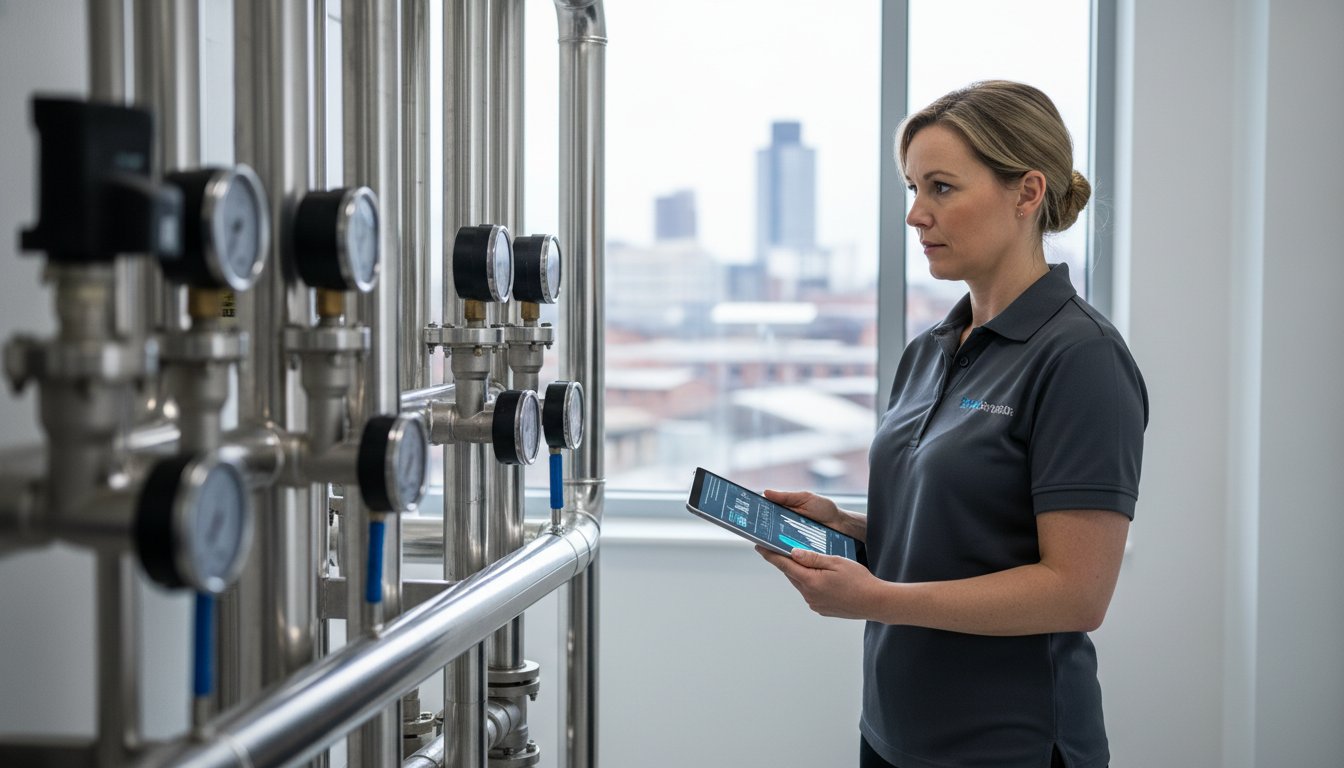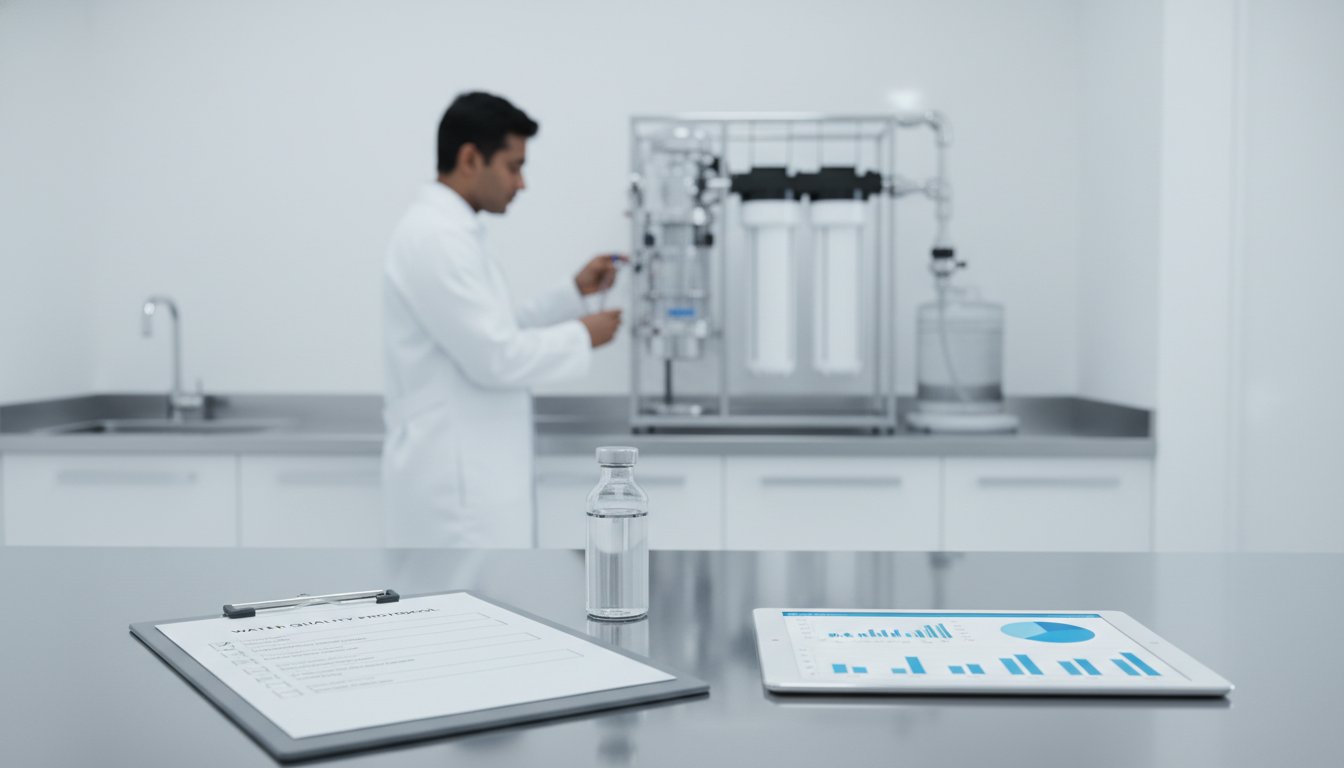
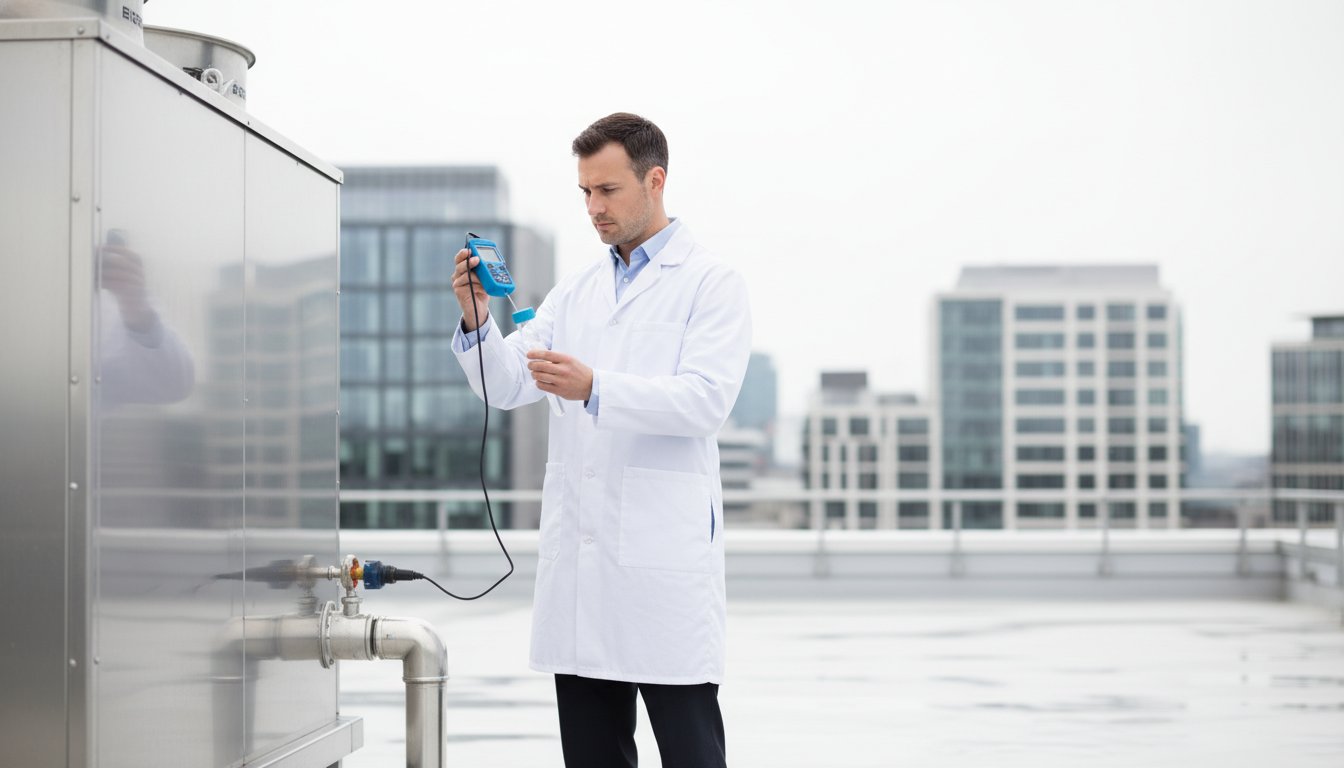
In April 2026, the UK Health Security Agency investigated 21 cases of Legionnaires' disease across London, proving that cooling towers remain a high-stakes risk. With 472 cases reported in 2024 alone, the margin for error effectively disappears when aerosol generation is this significant. Staying ahead of these risks requires more than a checkbox approach; it demands rigorous legionella testing for cooling towers uk that aligns with the latest HSG274 Part 1 standards.
Achieve total legal peace of mind by mastering the complexities of cooling tower safety. You likely feel the weight of responsibility when managing these systems, especially with the threat of unlimited HSE fines for any breach of safety. It's natural to find the technicalities of ACOP L8 and the 2024 updates to HSG274 Part 1 overwhelming. This guide transforms that regulatory burden into a sense of security. You'll learn how to manage mandatory quarterly sampling cycles, interpret UKAS-accredited results, and implement the proactive monitoring strategies needed to protect your staff and the public.
Key Takeaways
- Understand why the high-risk aerosol generation in evaporative systems necessitates a rigorous monitoring cycle to prevent wide-scale bacterial spread.
- Learn why professional legionella testing for cooling towers uk is mandatory for ACOP L8 compliance, as basic DIY dipslides fail to meet legal reporting standards.
- Master the quarterly monitoring requirements set out in HSG274 Part 1 and discover how your risk assessment defines your specific sampling frequency.
- Establish a clear 'Stop and Assess' protocol for handling positive results over 1000 CFU/L to ensure immediate safety and system remediation.
- Transform your regulatory burden into operational security by implementing an expert-led testing framework that prioritizes public safety and legal protection.
Why Cooling Towers Represent the Highest Legionella Risk in the UK
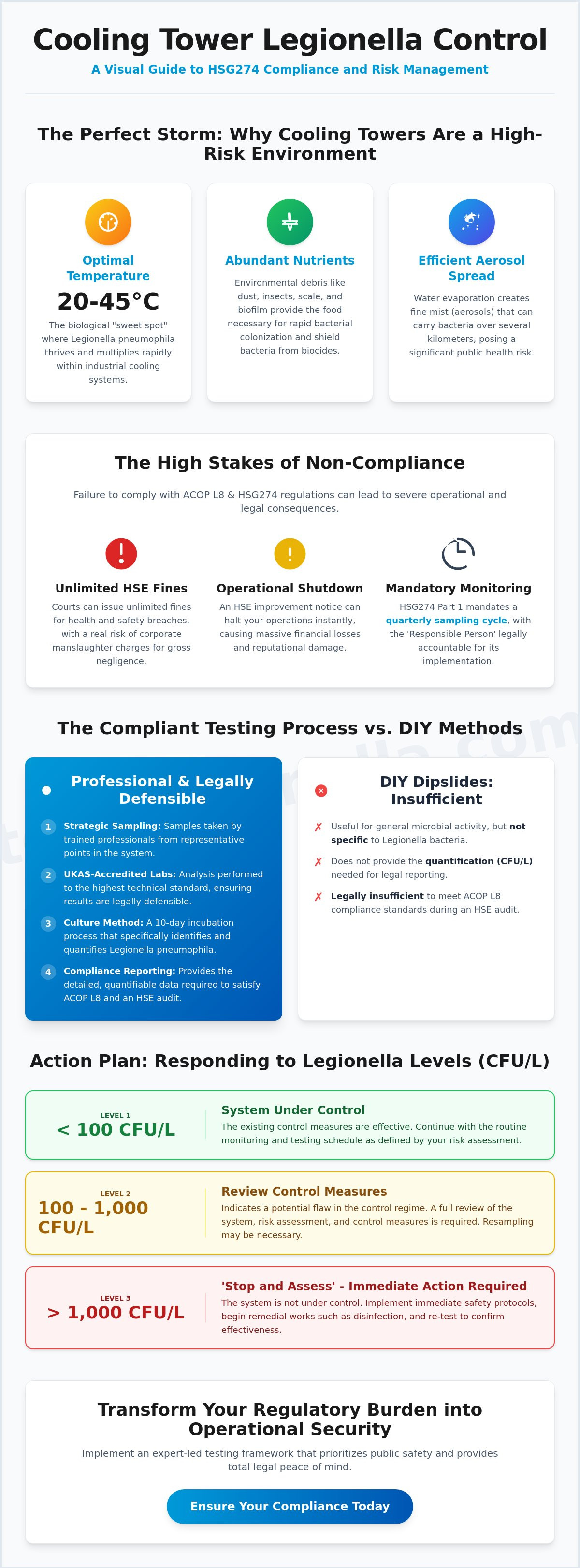
Cooling towers are the most significant risk factor in the UK's industrial water landscape. Unlike standard plumbing, these systems reject heat through evaporation, which creates a "perfect storm" for bacterial growth. They combine the three elements Legionella needs to thrive: optimal temperatures, a steady supply of nutrients, and a highly efficient delivery mechanism. Regular legionella testing for cooling towers uk isn't just a recommendation; it's a critical safety barrier that protects your business from catastrophic failure.
The 20-45°C temperature range common in industrial cooling cycles is the biological sweet spot for Legionella pneumophila. When you add environmental debris like dust, insects, and scale into the mix, you provide the nutrients necessary for rapid colonisation. Without professional monitoring, these microscopic threats can multiply unnoticed until they reach dangerous concentrations. It's a high-stakes environment where a small lapse in control can lead to a major public health incident.
The Science of Aerosol Transmission
The primary reason cooling towers are classified as high-risk is their ability to generate aerosols. As water is sprayed over the internal "fill" to facilitate cooling, tiny droplets known as drift are created. These mist particles are small enough to be inhaled deep into the lungs. If the system is contaminated, this drift can carry bacteria over several kilometres, potentially affecting thousands of people in a very short timeframe.
Understanding What is Legionnaires' disease? helps clarify why this transmission method is so dangerous. Within the tower, bacteria often hide inside biofilm or under layers of scale. This biological slime acts as a protective shield, allowing colonies to survive even when chemical biocides are present. You need precise legionella testing for cooling towers uk to verify that your control measures are penetrating these hidden layers and actually keeping the water safe.
Legal Implications of Non-Compliance in 2026
The legal framework for water safety is demanding and precise. Following the 2024 updates to HSG274 Part 1, the Health and Safety Executive (HSE) has increased its focus on the competency of the "Responsible Person." As a Duty Holder, you're legally accountable for the safety of your site. It's your job to ensure that a competent individual manages the risks and that all testing follows the quarterly mandate.
Negligence leads to severe consequences. Courts now issue unlimited fines for health and safety breaches, and the threat of corporate manslaughter charges is a reality for those who ignore the guidance. An HSE improvement notice can shut down your operations instantly, causing massive financial and reputational damage. Adhering to these standards isn't just about avoiding a fine; it's about establishing a culture of calm competence and operational security.
The Professional Legionella Testing Process for Evaporative Systems
Professional legionella testing for cooling towers uk follows a strict, verifiable sequence that ensures your business remains compliant. It starts with a strategic site visit where samples are taken from representative points, such as the cooling tower pond or the furthest point of the distribution system. This isn't a random exercise; it's a calculated effort to find where bacteria are most likely to hide. Unlike domestic systems, cooling towers require specific sampling techniques to account for the high-risk nature of aerosol generation.
Many managers rely on DIY dipslides for general monitoring. While useful for checking general microbial activity, they're legally insufficient for full ACOP L8 regulations. Dipslides don't specifically identify Legionella pneumophila or provide the quantification needed to satisfy an HSE inspector during an audit. Professional legionella testing for cooling towers uk provides the data needed to prove your biocide levels are effective and your facility is safe.
UKAS Accredited Sampling and Laboratory Analysis
The United Kingdom Accreditation Service (UKAS) is the gold standard for technical competence. When you use a UKAS-accredited laboratory, you're ensuring that the results are legally defensible. The process typically involves the laboratory culture method, which requires a 10-day incubation period. This time is essential to allow viable bacteria to grow so they can be accurately counted. Professionals distinguish between "detection," which confirms the presence of the bacteria, and "quantification," which tells you exactly how much is there. If you're unsure about your current sampling schedule, you can request a professional compliance review to ensure every base is covered.
Interpreting Colony Forming Units (CFU) per Litre
CFU/L is the standard measure of viable bacterial cells in a water sample. For a non-technical manager, these numbers indicate the effectiveness of your biocide regime. The guidance provides clear thresholds for action:
- Under 100 CFU/L: The system is under control. Continue routine monitoring and maintenance.
- 100 to 1000 CFU/L: The system requires a review of the control measures. You should consider a re-test to confirm if levels are rising.
- Over 1000 CFU/L: Immediate action is required. This level triggers a mandatory "Stop and Assess" protocol, including system disinfection and a full investigation into the failure of control measures.
Professional testing acts as the final verification of your water treatment programme. By integrating these results into your site logbook, you create a robust audit trail that transforms a complex regulatory requirement into a streamlined process of operational security.
Monitoring Frequency and Regulatory Standards: ACOP L8 & HSG274
UK law is precise regarding high-risk evaporative systems. For every cooling tower on your site, you must conduct legionella testing for cooling towers uk at least once every three months. This quarterly mandate serves as the baseline for safety, ensuring your water treatment regime effectively controls bacterial growth. While chemical dosing provides the first line of defense, the laboratory test is your final, objective verification of operational security.
Your specific testing schedule isn't a matter of guesswork. It's dictated by your legionella risk assessment. This document evaluates the complexity of your tower, the susceptibility of the surrounding population, and the physical condition of the system. If your assessment identifies heightened risk factors, you may need to increase testing to a monthly cycle to maintain total legal peace of mind. Staying compliant requires this disciplined approach to legionella testing for cooling towers uk, ensuring every sample meets the rigorous standards of HSG274 Part 1.
Effective management also requires rigorous biocide monitoring. Bacterial testing and chemical checks work in tandem; if biocide levels fluctuate, the risk of a positive result spikes. You must maintain a detailed logbook of all results, chemical levels, and remedial actions for at least five years. This audit trail is your primary defense during an HSE inspection, proving that you've acted as a responsible and competent duty holder.
Quarterly Testing vs. Continuous Monitoring
Quarterly sampling is the legal minimum, but it isn't always the best practice for every facility. Older systems or those operating under heavy industrial loads often benefit from more frequent checks. High ambient temperatures can also accelerate bacterial proliferation, making the three-month gap between tests feel like a significant risk. Combining monthly chemical analysis with your quarterly lab tests creates a synergy that prevents small issues from becoming major compliance failures.
When to Increase Testing Frequency
Certain trigger events demand immediate action outside of your regular schedule. You must test your system after any major maintenance or if the tower has been offline for more than seven days. Seasonal changes in the UK also affect your risk profile; warmer summer months often require a more proactive sampling approach. Always re-test following a change in your water treatment chemicals or if the UKHSA reports a nearby outbreak. These proactive steps ensure your environment remains safe and your business stays protected from prosecution.
Action Plan for Positive Legionella Results and Remedial Works
A positive result from your legionella testing for cooling towers uk isn't just a "bad test." It's a clear indicator that your current control system has failed. Whether it's a mechanical breakdown or a chemical imbalance, the presence of bacteria at actionable levels means your environment is no longer protected. You must view this data as a vital safety alert that requires immediate, expert-led intervention to restore operational security.
When results exceed 1000 CFU/L, the "Stop and Assess" protocol becomes mandatory. This isn't a suggestion; it's a critical requirement under HSG274 Part 1. You have a legal duty to communicate these findings to relevant stakeholders, including onsite contractors and staff who may be at risk. In some cases, depending on the severity and local context, you may also need to notify the HSE. Managing this process with calm competence ensures that a temporary failure doesn't escalate into a legal crisis.
Immediate Response Protocols for High Counts
The first 24 hours after receiving a high count are critical. Follow these three steps to regain control:
- Step 1: Audit Records. Immediately review your water treatment records and biocide dosing logs. Look for recent pump failures, empty chemical drums, or temperature fluctuations that could have allowed bacteria to proliferate.
- Step 2: Emergency Disinfection. Implement a shock dose of biocide. This rapid chemical intervention is designed to kill planktonic bacteria and disrupt the early stages of biofilm formation.
- Step 3: Risk Communication. Inform everyone on-site who interacts with the cooling system. Transparency is the best path to tranquility, ensuring that all personnel are aware of the temporary risk and the steps being taken to mitigate it.
If you've received a high count and need to verify the effectiveness of your response, book your professional legionella compliance testing to secure a definitive, UKAS-accredited result.
Cleaning, Disinfection, and Re-testing
Emergency dosing is only a temporary fix. To ensure long-term safety, you likely need a full system clean and disinfection. This technical process involves draining the tower, physically scrubbing the pack and distribution trays, and then re-filling the system with a high-strength chlorine solution. This ensures that the biological "shield" provided by scale and biofilm is completely removed.
Verification is the final, essential step. You must conduct post-disinfection sampling to prove the remedial works were successful. Standard practice suggests waiting between 48 hours and seven days after treatment before taking a new sample to ensure the biocide hasn't simply masked the problem. During this time, conduct a thorough root cause analysis. Was the failure caused by a "dead leg" in the pipework, an undersized dosing pump, or perhaps a change in the local water supply? Identifying the "why" prevents the "what" from happening again, moving you from a state of uncertainty toward total legal peace of mind.
Expert Legionella Compliance Testing with Test Legionella
Test Legionella stands as the national specialist for industrial water safety, providing a level of expertise that general water contractors simply cannot match. We understand that cooling tower management is a high-stakes responsibility where every detail matters to the safety of your site. By choosing our dedicated legionella testing for cooling towers uk, you're moving from a state of regulatory uncertainty toward a position of calm competence. We don't just provide data; we provide the professional assurance that your facility meets every requirement of the current UK legal framework. Our mission is to transform the heavy burden of safety requirements into a streamlined, stress-free management experience that protects your reputation.
Our approach is grounded in reliability and technical precision. We recognise that for a busy professional, the goal is total legal peace of mind. Every sampling exercise we conduct is designed to be as efficient as possible, ensuring your operations continue without unnecessary disruption. By positioning adherence to standards as a path to tranquility, we help you manage your water systems with a sense of security that only comes from working with a trusted partner who understands the logistics of industrial maintenance.
Nationwide Specialist Testing for Industrial Cooling
Our nationwide team is specifically equipped to handle complex, multi-site industrial portfolios across the UK. Unlike a generalist plumber, a specialist understands the unique hydraulics and aerosol risks associated with evaporative cooling systems. Generalists often miss critical sampling points or fail to identify "dead legs" that can harbour bacteria. This focused expertise ensures that ACOP L8 compliance is built into every stage of our process. We prioritise efficiency, delivering rapid turnaround times for laboratory samples to minimise the window of operational uncertainty for your business.
Secure Reporting and Compliance Certification
Compliance documentation should be clear and actionable, not buried in dense technical jargon. We deliver digital reports designed for easy auditing, ensuring you're always prepared for an HSE inspection or an internal safety review. Our support doesn't end when the results are sent; we guide you through the implications of your data and help you plan the next steps if adjustments to your treatment regime are needed. This proactive approach ensures your cooling system remains a safe, productive asset rather than a legal liability. By providing a clear roadmap for every result, we help you maintain a safe environment for your staff and the public.
Secure your cooling tower compliance with Test Legionella today and experience the professional quality and emotional security that comes from working with a national specialist.
Protect Your Facility with Professional Compliance
Managing evaporative cooling systems requires a disciplined approach to safety that prioritises public health and legal protection. By now, it's clear that the high-risk nature of aerosol generation demands more than just basic monitoring; it requires a rigorous cycle of legionella testing for cooling towers uk. You've seen how quarterly sampling, UKAS-accredited laboratory analysis, and proactive biocide management work together to prevent bacterial proliferation and maintain ACOP L8 standards. Transforming these complex regulatory burdens into a state of operational security is the most effective way to ensure long-term peace of mind.
Don't leave your site's safety to chance or settle for generic water services. Our national specialist team provides the authoritative reporting and expert guidance needed to navigate the complexities of HSG274 Part 1. We deliver clear, action-oriented results that simplify your auditing process and keep you prepared for any HSE inspection. Take the next step toward a safer, fully compliant environment today.
Book Your Professional Cooling Tower Testing Now
Your commitment to safety is the foundation of a resilient business, and we're here to ensure that journey is efficient, professional, and entirely stress-free.
Frequently Asked Questions
Is legionella testing for cooling towers a legal requirement in the UK?
Yes, legionella testing for cooling towers uk is a strict legal requirement under the Health and Safety at Work etc. Act 1974 and the COSHH Regulations 2002. These laws mandate that duty holders identify and control risks from hazardous biological agents. Failing to implement a robust testing regime leaves your business vulnerable to unlimited fines and potential prosecution by the HSE.
How often should cooling towers be tested for Legionella according to ACOP L8?
According to ACOP L8 and HSG274 Part 1, you must test cooling tower water for Legionella at least quarterly. However, your site-specific risk assessment might dictate more frequent sampling if your system is particularly complex or prone to contamination. Regular testing ensures that your biocide regime remains effective throughout the year, especially during high-risk summer months when bacterial growth can accelerate.
What should I do if my cooling tower tests positive for Legionella?
You must immediately implement a "Stop and Assess" protocol if a sample exceeds 1000 CFU/L. This involves reviewing your water treatment records, performing emergency shock dosing with biocide, and communicating the risk to all relevant stakeholders. Following disinfection, you're required to re-test the system to verify that the bacterial levels have returned to a safe, controlled state before resuming normal operations.
Can I use a DIY dipslide kit for cooling tower compliance?
DIY dipslides are useful for monitoring general microbial activity, but they cannot replace professional legionella testing for cooling towers uk. Dipslides don't identify Legionella pneumophila or provide the specific quantification required for ACOP L8 compliance. You need UKAS-accredited laboratory analysis to satisfy legal requirements and provide a defensible audit trail during an HSE inspection or audit.
What is the difference between a cooling tower and an evaporative condenser for testing?
Both systems use evaporation to reject heat and generate aerosols, meaning the regulatory requirements for testing are identical. Whether you operate a cooling tower or an evaporative condenser, the risk of Legionella proliferation remains high. Both systems must follow the same quarterly sampling mandate and rigorous monitoring protocols outlined in the current technical guidance to ensure public safety.
How much does a professional Legionella test for a cooling tower cost?
The cost of a professional test depends on the complexity of your cooling system and the number of sampling points required. Factors such as the size of the industrial site and the frequency of visits also influence the final cost. It's best to request a tailored quote that reflects your specific site requirements to ensure you're getting a comprehensive compliance package that meets all legal standards.
Do I need to notify the HSE if I have a cooling tower on my premises?
Yes, you're legally required to notify your local authority or the HSE in writing if you have a cooling tower or evaporative condenser on your premises. This is a requirement under the Notification of Cooling Towers and Evaporative Condensers Regulations 1992. This allows regulatory bodies to maintain a register of high-risk systems, which is vital for investigating outbreaks and ensuring local safety.
How long does it take to get Legionella lab results back?
Standard laboratory culture tests typically take between 10 and 12 days to provide a final, quantified result. This period is necessary to allow the bacteria to grow under controlled conditions so they can be accurately counted. While rapid testing methods are available for supplementary monitoring, the 10-day culture method remains the only legally recognised standard for full ACOP L8 compliance and reporting.