
The Health and Safety Executive (HSE) reported 453 confirmed cases of Legionnaires' disease in England and Wales during 2023, highlighting why legionella control remains a top priority for UK property owners. You likely feel the pressure of keeping people safe while trying to decipher dense health and safety legislation. It's stressful to manage property maintenance when the threat of an unlimited fine or a serious health outbreak hangs over your head. We understand that your priority is protection, both for your residents and your professional reputation.
This guide simplifies the technical jargon to help you manage water safety and meet your 2026 legal duties with total confidence. You'll gain a clear understanding of the bacteria's health implications and the specific legal requirements for your property type. We'll walk you through the essential risk assessment steps and the simple path to achieving what we call Compliance Care. By the end of this article, you'll have a straightforward roadmap to stay on the right side of the law and ensure your water systems are safe, reliable, and fully documented.
Key Takeaways
- Identify how bacteria transition from natural sources into man-made systems to compromise your water safety.
- Recognise the "danger zone" temperature ranges and the hidden risks of water stagnation in rarely used pipes.
- Understand the transmission of Legionnaires’ Disease through aerosols and the health implications for those on your premises.
- Ensure your property meets UK legal standards by mastering your responsibilities under the Health and Safety at Work Act 1974 regarding legionella control.
- Learn the critical difference between a standard risk assessment and laboratory testing to determine the most efficient compliance path for your building.
What is Legionella? Understanding the Bacteria and Its Origins
Legionella is a genus of Gram-negative bacteria found naturally in environmental water sources such as rivers, lakes, and reservoirs. While it exists in low, harmless concentrations in the wild, it poses a significant risk when it colonises man-made water systems. Understanding What is Legionella? requires a clear distinction between the bacteria and the illnesses it causes, such as Legionnaires' disease or Pontiac fever. The bacteria is the biological agent, while the disease is the result of inhaling contaminated water droplets. In 2026, this ancient organism remains a primary concern for UK property managers because it thrives in the very systems designed for our comfort and hygiene.
Transitioning from a natural stream to a commercial plumbing system is simple for this resilient pathogen. It enters buildings through the mains supply, often at levels too low to detect. Once inside, it finds the warmth and nutrients it needs to multiply. Despite the technological leaps in building management systems over the last decade, the fundamental biological threat remains unchanged since its first major identification in 1976. Landlords must recognise that legionella doesn't need a "dirty" environment to survive; it only needs the right conditions.
The Biology of the Bacteria
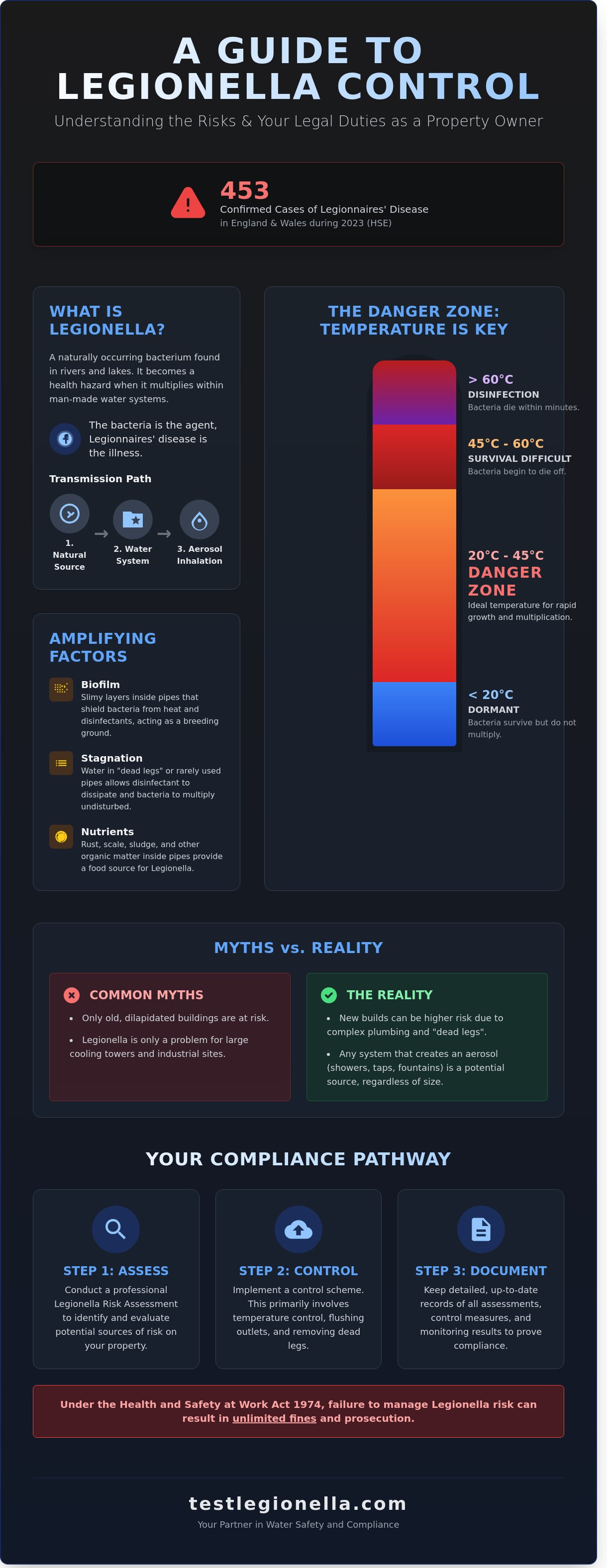
Legionella is a water-borne pathogen that thrives in temperatures between 20°C and 45°C. At temperatures below 20°C, the bacteria survives in a dormant state, waiting for the environment to warm up. Once the water hits that 20°C threshold, growth begins. If the temperature exceeds 60°C, the bacteria typically dies within minutes. This narrow window of vulnerability is why temperature control is the cornerstone of any robust water safety plan.
Biofilms represent the greatest challenge to eradication. These are complex layers of bacteria and organic matter that stick to the internal surfaces of pipes and tanks. They act as a protective shield, sheltering legionella from chemical disinfectants and heat treatments. Because these biofilms are present in almost every water system to some degree, regular monitoring is the only way to ensure they don't become a breeding ground for pathogens.
Common Myths About Legionella Origins
Misconceptions often lead to dangerous complacency. A common myth is that only old, dilapidated buildings are at risk. Data from UK health audits shows that new builds are frequently more susceptible. This is often due to complex modern plumbing designs that include "dead legs" or long pipe runs where water sits stagnant for weeks before the building is fully occupied. Stagnation is the bacteria's best friend, regardless of how new the copper or plastic piping is.
Another dangerous idea is that legionella is only an issue for heavy industrial sites or large cooling towers. While these systems carry high risks, the bacteria is frequently found in small dental practices, boutique hotels, and residential blocks. Any system that creates an aerosol, such as a showerhead or a decorative fountain, can be a source of infection. Whether you manage a single flat or a large Midlands office complex, the responsibility for water safety is the same. Get your compliance score today to see where your property stands and ensure total peace of mind.
Ideal Conditions: Where Legionella Bacteria Thrive
Legionella bacteria are opportunistic. They don't just exist in water systems; they actively seek out environments where they can multiply rapidly. The primary driver for growth is the "Danger Zone," a temperature range between 20°C and 45°C. Within this window, a single cell can multiply into a colony of millions in a matter of days. While the bacteria remain dormant below 20°C and begin to die off above 60°C, the middle ground presents a severe public health risk. Understanding the clinical impact of Legionnaires' Disease and Pontiac Fever is essential for anyone managing a property in 2026.
Temperature isn't the only factor. Stagnation is a silent killer in complex plumbing. When water stops moving in "dead legs" or rarely used pipes, the residual chlorine used for disinfection dissipates. This allows a thick layer of biofilm to coat the inside of the pipes. This slimy matrix protects legionella from heat and chemicals while providing a steady supply of nutrients. Rust, scale, and organic sludge act as fuel, allowing the bacteria to colonise even the most modern systems. A professional legionella risk assessment identifies these hidden vulnerabilities before they become liabilities.
Temperature Control and Its Importance
Maintaining strict thermal boundaries is your first line of defence. Cold water must remain below 20°C to keep the bacteria in a dormant state. This is often challenging in summer months or in buildings with poor insulation where "heat gain" occurs. Conversely, hot water storage units must operate at 60°C. This temperature is high enough to kill bacteria within minutes. By the time that water reaches the outlets, it should still be at least 50°C. Be aware that Thermostatic Mixing Valves (TMVs) are a double edged sword. While they prevent scalding, they create a local environment of 35°C to 45°C. If these valves aren't serviced every six months, they become perfect breeding grounds right at the point of use.
Common Risk Areas in Residential and Commercial Properties
Risk isn't distributed evenly across a building. Showers and taps in guest rooms or vacant office suites are high risk because they aren't flushed regularly. Any outlet not used for seven days should be considered a potential hazard. Beyond standard plumbing, air conditioning condensers and cooling towers pose a significant threat because they naturally create aerosols. These fine mists can carry the bacteria over 500 metres, potentially affecting the wider community. Spa pools and decorative fountains are equally dangerous. They combine warm water, organic matter from bathers, and aeration, which is the exact recipe for a legionella outbreak. Compliance Care ensures these specific assets are monitored and managed with precision.
Health Risks: From Bacteria to Legionnaires’ Disease
Understanding the health implications of legionella is the first step toward effective risk management. Transmission occurs when people inhale microscopic water droplets contaminated with the bacteria. These aerosols are typically generated by everyday fixtures like showerheads, spray taps, or complex cooling towers. It's a common misconception that you can catch the illness by drinking contaminated water; the danger lies almost exclusively in the mist you breathe in.
There's a vital distinction between the two forms of the illness. Legionnaires’ Disease is a severe, potentially fatal form of atypical pneumonia. In contrast, Pontiac Fever is a milder, self-limiting infection that resembles a heavy flu. While Pontiac Fever usually clears up within 3 to 5 days without specific treatment, Legionnaires’ Disease requires urgent medical intervention to prevent respiratory failure.
Risk isn't distributed equally across the population. Data from the UK Health Security Agency (UKHSA) shows that approximately 75% of reported cases involve individuals over the age of 50. Smokers, heavy drinkers, and those with underlying respiratory conditions or compromised immune systems face the highest danger. For these groups, controlling potential Legionella sources isn't just a legal requirement for a landlord; it's a critical life-saving necessity.
Recognising the Symptoms
The initial onset is often deceptive. Patients typically report a high fever, chills, and muscle pain within 2 to 10 days of exposure. As the infection takes hold of the lungs, it progresses to a persistent cough and sharp chest pains. Because these indicators overlap with influenza and COVID-19, many people don't seek the correct help immediately. In 2023, UK clinical reports noted that delays in identifying legionella exposure significantly increased the likelihood of intensive care admission.
The Importance of Rapid Diagnosis
Speed is everything when managing an outbreak. Doctors confirm the presence of the bacteria through specialised urine tests or by analysing lung fluid samples. A chest X-ray is usually required to assess the extent of the pneumonia. Once diagnosed, the standard treatment path involves a course of potent antibiotics, often administered intravenously in hospital settings. While many recover, the long-term impact shouldn't be underestimated. Survivors frequently report chronic fatigue and shortness of breath for up to 12 months following their initial discharge. Our Compliance Care service ensures you never have to worry about these risks on your property.
The Legal Landscape: Your Responsibilities as a Property Owner
Managing water safety isn't just a matter of best practice; it's a strict legal obligation that carries heavy penalties for oversight. The Health and Safety at Work Act 1974 serves as the primary legislation, requiring every UK employer or person in control of premises to protect employees and the public from health risks. Under this framework, the Control of Substances Hazardous to Health (COSHH) Regulations 2002 specifically categorises legionella as a biological agent that you must proactively manage. If you own a building or manage a business, the law views you as the "Duty Holder," meaning the buck stops with you.
The Health and Safety Executive (HSE) provides the roadmap for meeting these duties through the Approved Code of Practice (ACOP L8). Think of ACOP L8 as the legal benchmark for compliance. While it's not a law itself, it has a special legal status. If you're prosecuted for a breach of health and safety law and it's proved you didn't follow the provisions of ACOP L8, a court will find you at fault unless you can prove you complied in some other way. For residential landlords, the Housing Act 2004 adds another layer of responsibility, requiring homes to be free from "Category 1" hazards, which includes biological threats in the water system.
What is a Legionella Risk Assessment?
The law requires you to identify and assess every potential source of risk in your water system. This isn't a "tick-box" exercise; it's a detailed investigation of water temperatures, stagnation points, and aerosol-generating outlets like showers or spray taps. You must appoint a "Competent Person" to oversee this. This individual needs the specific skills and knowledge to spot hidden dangers. For many property owners, hiring a specialist is the safest way to ensure nothing is missed. You can find a deeper dive into these requirements in our ACOP L8 Explained guide.
Record Keeping and Compliance Maintenance
Proving you've taken action is just as important as the action itself. You're legally required to keep records of your legionella risk assessments and any precautionary measures for at least five years. This includes monthly temperature logs and showerhead descaling schedules. If a health inspector visits, "I didn't know" is never a valid defence in a UK court. Failure to comply can lead to unlimited fines, which often start at £20,000 for even minor breaches, and can result in imprisonment for serious negligence. Beyond the legal costs, the reputational damage of an outbreak often proves fatal for a business.
Don't leave your compliance to chance. Get a professional risk assessment quote today and protect your property from legal and health risks.
Professional Compliance: How to Organise Effective Water Testing
Understanding the difference between a visual risk assessment and laboratory water sampling is the first step toward true property safety. A risk assessment is a physical audit of your water system. It identifies "dead legs" in pipework, checks tank conditions, and monitors temperatures. While every UK landlord and employer is legally required to have a risk assessment, laboratory sampling provides the scientific proof that your controls are working. It's the difference between looking at a car's engine and running a diagnostic test.
Professional water testing becomes strictly necessary in specific scenarios. If you manage high-risk systems like cooling towers or evaporative condensers, quarterly sampling is a legal mandate. For standard residential or commercial units, you must test if water temperatures consistently fall within the danger zone of 20°C to 45°C, or if your initial risk assessment identifies a high-risk population, such as in care homes or healthcare settings. Choosing a compliance partner requires looking for UKAS-accredited laboratory links and a proactive "Compliance Care" mindset. Don't settle for reactive fixes that only address problems after they arise. A reliable partner transforms legionella management from a stressful chore into a streamlined, automated process.
The Testing and Sampling Process
Professional sampling follows a strict "cold chain" protocol. Technicians collect water in sterile bottles containing sodium thiosulfate to neutralise any chlorine. These samples are transported in temperature-controlled cool boxes to UKAS-accredited labs. Your report will show results in Colony Forming Units per litre (CFU/L). If your report shows levels above 100 CFU/L, you need to review your control measures. If levels exceed 1,000 CFU/L, the Health and Safety Executive (HSE) guidelines require immediate action. This usually involves isolating the affected outlet, conducting a thermal or chemical shock of the system, and performing a follow-up test to confirm the bacteria is gone.
Creating a Long-Term Management Plan
Effective legionella control relies on consistency rather than one-off checks. For vacant properties or guest rooms, you must implement a weekly flushing regime. Running every tap and shower for at least 2 minutes prevents the stagnation that allows biofilm to grow. Modern compliance has moved away from dusty paper logs. Digital reporting and automated reminders ensure you never miss a deadline, providing a clear audit trail for HSE inspectors. This proactive approach saves time and protects your reputation. Ensure your property is safe with Professional Legionella Compliance Testing today.
Secure Your Water Safety for 2026 and Beyond
Managing water safety is a critical legal duty under the Health and Safety at Work etc Act 1974. As a UK landlord or business owner, you're responsible for preventing the growth of legionella in systems where water temperatures sit between 20°C and 45°C. Failing to manage these risks can lead to severe health outcomes and significant legal penalties. By 2026, regulatory scrutiny is tighter than ever; proactive risk assessments are the only way to ensure total peace of mind for your tenants and employees.
You don't have to navigate these complex HSE guidelines alone. Our team provides UKAS-accredited laboratory analysis and fast, reliable compliance reports that simplify your property management. We've helped thousands of UK businesses transform a technical burden into a streamlined safety process through expert guidance. Taking action today prevents the 10% mortality rate often associated with Legionnaires' disease outbreaks from affecting your site. We'll handle the technical details so you can focus on running your business with confidence.
Protect your property and tenants with our expert Legionella Compliance Testing
Your safety is our priority. Let's get your compliance sorted today so you can rest easy tonight.
Frequently Asked Questions
Is Legionella testing a legal requirement for UK landlords?
Yes, UK landlords have a legal duty to carry out a risk assessment for legionella under the Health and Safety at Work etc. Act 1974. While the law doesn't mandate a specific laboratory test certificate for every domestic property, you're required to identify and manage risks. Failure to comply can lead to heavy fines or prosecution under the 1999 Management of Health and Safety at Work Regulations. It's about ensuring tenant safety and your own peace of mind.
Can you catch Legionnaires’ disease from drinking tap water?
You can't catch Legionnaires’ disease by simply drinking tap water that contains the bacteria. The infection occurs when you breathe in tiny droplets of contaminated water suspended in the air, known as aerosols. This typically happens while showering, using a whirlpool bath, or being near a decorative fountain. If water enters your lungs accidentally while drinking, there's a very small risk, but standard consumption is considered safe for most people.
How often should a Legionella risk assessment be reviewed?
You should review your legionella risk assessment at least every 2 years or whenever there's a significant change to your water system. Changes include installing new pipework, changing the building use, or if the system hasn't been used for 30 days. Regular reviews ensure your Compliance Care remains up to date. This proactive approach prevents small issues from becoming major health hazards or legal liabilities for property owners and managers.
What are the most common places for Legionella to grow in a house?
The most common growth areas are showerheads, spray taps, and cold water storage tanks. Bacteria thrive in dead legs, which are lengths of pipework leading to a closed outlet where water stagnates. Any part of the system that maintains water between 20°C and 45°C is a high risk zone. We often find that 75% of domestic risks are mitigated simply by descaling showerheads and flushing rarely used outlets regularly.
Can Legionella be spread from person to person?
No, Legionnaires’ disease isn't contagious and can't be spread from person to person. You can only contract the illness by inhaling the bacteria from a contaminated source, such as a cooling tower or a poorly maintained hot water system. Because it doesn't spread like a cold or flu, your focus should remain entirely on maintaining water system hygiene. Keeping your property compliant is the only way to stop the bacteria at the source.
What temperature kills Legionella bacteria instantly?
Legionella bacteria are killed instantly when water temperatures reach 70°C or higher. At 60°C, 90% of the bacteria die within 2 minutes; at 50°C, it takes 2 hours to achieve the same result. This is why we recommend storing hot water at 60°C and ensuring it reaches at least 50°C at every tap within one minute of running. Managing these precise temperatures is a fast and reliable way to keep your system safe.
Do I need to test for Legionella if my property has been empty for months?
You must conduct a fresh risk assessment if a property has been vacant for 30 days or more. Stagnant water in empty pipes provides the perfect environment for biofilm to form and bacteria to multiply rapidly. Before new tenants move in, flush the entire system for at least 5 minutes and disinfect all showerheads. This simple step makes compliance easy and protects your tenants from the first day of their new lease.
What is the difference between a risk assessment and a water test?
A risk assessment is a visual and technical survey that identifies potential hazards, while a water test involves laboratory analysis of physical samples. The assessment is a legal requirement for all UK landlords to identify where bacteria might grow. In contrast, sampling is usually only necessary if the risk assessment identifies a specific concern or if the system serves high risk individuals. Both tools work together to provide a clear safety profile.