
Downloading a free sample legionella risk assessment might be the most expensive mistake your business makes this year. If you manage property in the UK, you already know that meeting ACOP L8 requirements is a strict legal mandate under the Health and Safety at Work Act 1974. You want to keep your tenants safe and avoid the heavy fines that follow a compliance failure, but your time is limited. It's natural to look for a quick shortcut when the technical details of water safety feel overwhelming.
A generic template cannot account for the unique pipework or specific water systems of your building. This guide reveals why relying on a standard sample legionella risk assessment leaves you legally vulnerable and how to secure a safer, more reliable future for your property in 2026. You'll discover how to transform a complex regulatory burden into a simple, managed process that provides genuine protection. We'll show you how professional Compliance Care makes safety easy and provides the peace of mind you deserve.
Key Takeaways
- Understand why relying on a generic sample legionella risk assessment can leave you legally vulnerable by missing hidden site-specific hazards like dead legs.
- Discover how professional reports go beyond basic templates to include vital schematic diagrams and asset registers for total system visibility.
- Clarify the legal reality for UK landlords and why even small domestic properties require a professional approach to ensure full compliance.
- Learn the 5-point checklist for a defensible assessment, ensuring every aerosol source from showers to tanks is properly audited.
- See how professional "Compliance Care" transforms a complex regulatory burden into stress-free management and lasting peace of mind.
The Hidden Risks of Using a Generic Sample Legionella Risk Assessment
Downloading a sample legionella risk assessment might feel like a shortcut to compliance. It isn't. These documents are static, one-size-fits-all files that cannot "see" the specific complexities of your property. Every building has a unique circulatory system. A generic template doesn't know if your pipework has been modified or if your water storage tanks are correctly sized for current usage. It's a snapshot of a hypothetical building, not yours.
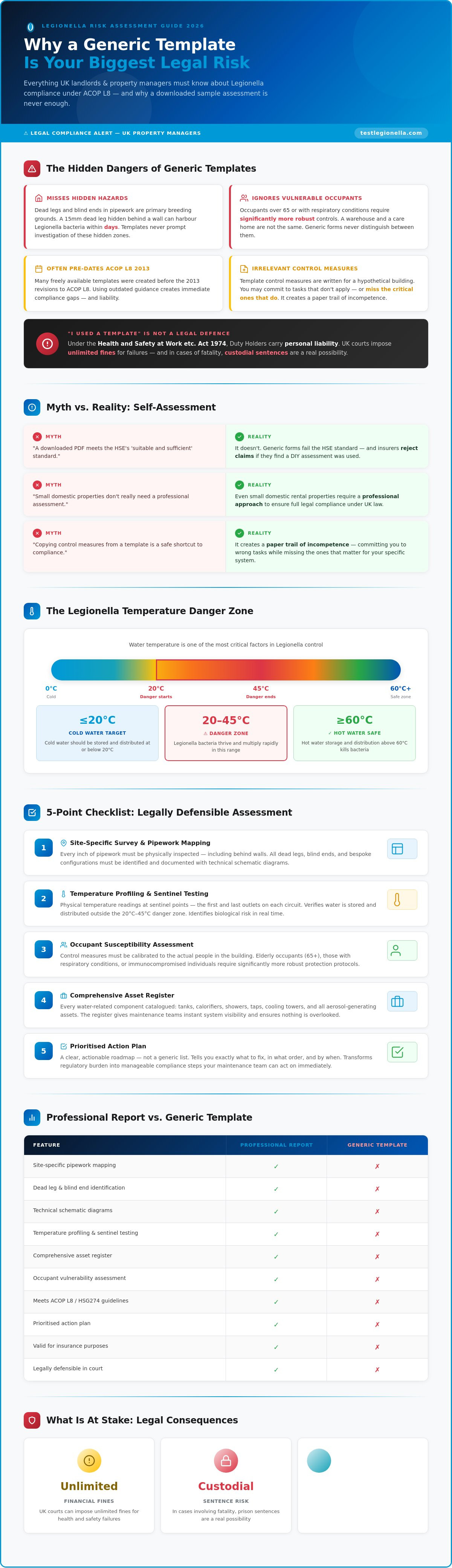
Static templates frequently miss critical hazards like dead legs and blind ends. These are sections of pipework where water stagnates because it no longer leads to an outlet. In a real-world setting, a 15mm dead leg hidden behind a wall can become a breeding ground for Legionella bacteria within days. A generic checklist won't prompt you to investigate these hidden areas. It simply asks you to tick a box, providing a false sense of security while the actual risk remains unaddressed.
The "tick-box" approach also fails to account for the people inside your building. Risk is not just about the plumbing; it's about the users. A template doesn't distinguish between a warehouse and a care home. If your occupants are over the age of 65 or have underlying respiratory issues, your control measures must be significantly more robust. Relying on a generic sample legionella risk assessment ignores these vital biological factors, leaving vulnerable people at risk.
- Templates cannot map complex, bespoke pipework configurations.
- Generic forms often pre-date the 2013 ACOP L8 revisions.
- Control measures in samples are often irrelevant to your specific water system.
- Occupant susceptibility is rarely factored into DIY documents.
The False Security of the DIY Template
A downloaded PDF doesn't meet the "suitable and sufficient" standard required by the Health and Safety Executive (HSE). If you copy and paste control measures from a template, you're likely committing to tasks that don't apply to your system or, worse, missing the ones that do. This creates a paper trail of incompetence. Insurers often reject claims following an outbreak if they find the assessment was a DIY job. They look for professional due diligence, not a generic document that fails to reflect the reality of the site.
Legal Implications of Inadequate Risk Mapping
Under the Health and Safety at Work etc. Act 1974, the Duty Holder carries personal liability for water safety. If a tenant or employee contracts Legionnaires' disease, "I used a template" is not a valid legal defence. UK courts have a history of imposing unlimited fines for health and safety failures. In cases of serious negligence where a fatality occurs, custodial sentences are a real possibility. Professional Compliance Care is the only way to ensure you stay on the right side of the law while protecting lives. Get it right the first time to ensure total peace of mind.
What a Professional Legionella Report Includes (Beyond the Template)
A generic sample legionella risk assessment often feels like a simple checklist. While these templates cover the basic headings, they usually miss the granular detail required by the HSE’s ACoP L8 and HSG274 guidelines. A professional report is a bespoke document that reflects the unique DNA of your building. It provides a clear roadmap for safety, moving beyond "yes or no" answers to provide actionable data. This level of detail ensures you aren't just ticking boxes; you're actively managing a public health priority.
A high-quality assessment is built on four pillars. First, an asset register lists every water-related component on-site. Second, schematic diagrams map the flow of water. Third, temperature profiling identifies biological risks. Finally, a prioritised action plan tells you exactly what to fix and when to do it. This structured approach transforms a complex regulatory burden into a manageable, stress-free process.
Technical Schematic Mapping
A visual map of your pipework is a core legal requirement. It isn't a standard floor plan. It's a technical drawing that tracks water from the mains intake through to every single outlet. Generic diagrams fail because they don't account for "dead legs" or blind ends where water sits stagnant. These areas are primary breeding grounds for bacteria. Our specialists map every inch of your system, which helps your maintenance team locate and flush hidden risks in minutes. This clarity saves time and prevents the guesswork that often leads to non-compliance.
Temperature Profiling and Sentinel Testing
Legionella bacteria thrive in the "danger zone" between 20°C and 45°C. Professional assessments include precise temperature profiling of your entire system. We focus heavily on "sentinel" outlets, which are the nearest and furthest points from the water source or boiler. Under UK regulations, cold water must stay below 20°C, and hot water must reach at least 50°C within one minute of running. Domestic thermometers aren't reliable for this. We use calibrated digital probes to capture data that stands up to HSE scrutiny. If your temperatures are off by even 2 degrees, the risk of bacterial colonisation increases by 40% within days.
Every tank, calorifier, and thermostatic mixing valve (TMV) is logged in a detailed asset register. This creates a permanent inventory for your records, making future audits much faster. You'll receive a tailored action plan that ranks tasks by risk level. High-priority remedial works, such as removing redundant pipework or cleaning a fouled cold water storage tank, are highlighted so you can focus your budget where it matters most. You can book a professional assessment to ensure your documentation provides the protection your business needs.
Myth vs. Reality: Can You Really Self-Assess for Legionella Compliance?
Many landlords assume that a quick download of a sample legionella risk assessment fulfills their legal duty. This is a dangerous misconception. The Health and Safety Executive (HSE) is clear: the responsibility for safety rests with the person in control of the premises. Using a generic form without the right expertise doesn't provide the legal protection you might think.
One common myth is that small domestic properties don't need a professional assessment. This is false. The law applies to all landlords, regardless of the property size or type. Under the Control of Substances Hazardous to Health Regulations 2002 (COSHH), you must identify and manage the risk of exposure. Whether you own a studio flat or a commercial office, the requirement to protect your tenants remains the same.
Another myth is that having a filled-in sample legionella risk assessment means you're legally covered. In reality, a template is just a tool. It isn't a shield against prosecution. If a tenant becomes ill, the authorities won't just look at your paperwork. They'll look at the competence of the person who completed it. If that person lacked the technical knowledge to spot a specific risk, the assessment is effectively void.
Defining the "Competent Person"
The HSE defines competence as having sufficient knowledge, skills, and experience to perform the task safely. It isn't just about ticking boxes on a list. A competent assessor must understand how water systems function and where bacteria thrive. They need to recognize dead legs in pipework, assess the quality of tank insulation, and interpret temperature fluctuations correctly. Most landlords and office managers lack this specific technical training. Relying on a DIY approach often leads to missed hazards that a professional would spot in minutes.
The Reality of Residential Lettings
Low risk does not mean no risk. Modern apartments often feature complex plumbing systems that can harbor Legionella if not managed correctly. Combi-boilers and electric showers are standard, but they can create dangerous aerosols if stagnation occurs. If a property sits empty for 14 days between tenancies, the risk profile changes instantly. Professional assessors look at the unique layout of your specific system rather than a generic model. Our Compliance Care service ensures these nuances are never overlooked. For a deeper look at the rules, read our ACOP L8 Explained: The Complete Guide to Legionella Compliance in 2026. We make staying compliant easy so you can focus on managing your property with total peace of mind.
The 5-Point Checklist for a Legally Defensible Risk Assessment
A professional assessment protects more than just your tenants; it protects your business from legal liability under the Health and Safety at Work Act 1974. While a sample legionella risk assessment provides a basic framework, a defensible document requires site-specific evidence and expert analysis. To move beyond a generic template, you must follow a structured process that leaves no room for error.
First, you must conduct a full audit of the water source. This involves mapping every point where water enters and travels through your building. You need to identify cold water storage tanks, calorifiers, and hidden "dead legs" in the pipework where stagnant water can breed bacteria. Without this physical audit, your assessment lacks the foundation required by ACoP L8 regulations.
Step 1: Assessing Aerosol Risk
Aerosol risk is the potential for Legionella bacteria to be inhaled via fine water droplets created by outlets like showers, spray taps, or cooling towers. Any outlet that creates a mist is a high-risk zone because the bacteria must be breathed in to cause infection. To manage this, you must descale showerheads and tap aerators at least quarterly. Removing scale and biofilm prevents the biological "nest" where Legionella thrives, ensuring the mist produced remains safe for occupants.
Next, you must identify the people at risk. In 2022, data from the UK Health Security Agency confirmed that individuals over the age of 50, smokers, and those with underlying respiratory conditions are the most vulnerable. If your property is a care home or houses elderly residents, your control measures must be significantly more robust than those for a standard office block.
Implementing controls is the practical core of your strategy. This involves a strict regime of temperature checks and flushing. You must ensure hot water is stored at 60°C and distributed at 50°C or higher, while cold water must remain below 20°C. Any outlets used less than once a week should be flushed for several minutes to keep water moving and prevent stagnation.
Step 5: The Importance of the Review Cycle
Your assessment isn't a static document. You need to review it whenever there is a significant change to the water system, a change in building use, or when new tenants move into a property. For high-occupancy buildings or those with complex plumbing, an annual review is the industry gold standard to ensure ongoing safety. Digital tracking makes this process "Made Easy" by providing automated compliance reminders, so you never miss a deadline. This proactive approach transforms a complex regulatory burden into total peace of mind.
Finally, you must record and review everything. You are legally required to keep all logs and reports for at least five years. These records act as your primary proof of compliance if an inspector ever visits. While using a sample legionella risk assessment can help you understand the format, the five-year data trail is what provides your legal shield.
Ensure your property meets every legal requirement with our professional risk assessment services.
Achieving Peace of Mind with Professional Compliance Care
Relying on a sample legionella risk assessment might seem like a cost-cutting win, but it's a significant legal gamble. The Health and Safety Executive (HSE) doesn't accept a generic template as a valid defense during an audit. In the UK, fines for non-compliance under the Health and Safety at Work etc. Act 1974 are often substantial. For small to medium enterprises, these penalties can easily reach £10,000 or more, while larger organizations face unlimited fines for serious negligence. A professional assessment isn't just an expense; it's a vital insurance policy for your business and your tenants.
Our "Compliance Care" approach moves beyond the static pages of a report. We focus on long-term safety and operational continuity. This means we don't just identify risks; we help you manage them through a structured, proactive framework. We track your upcoming review dates and send automated reminders so you never miss a deadline. This level of oversight transforms a complex regulatory burden into a predictable, stress-free routine. You focus on running your property; we ensure the water is safe.
Test Legionella simplifies the entire process for UK property owners by providing clear, actionable data. We avoid the dense jargon found in many industry documents. Instead, we offer a problem-solution framework that tells you exactly what's wrong and how to fix it. This clarity is essential for landlords who need to move quickly to protect their residents and their investment.
The Value of a Specialist Partner
Expert reports provide a robust shield during local authority inspections. When an environmental health officer visits, presenting a professional, UKAS-standard report demonstrates that you take your "Duty of Care" seriously. It ends questioning quickly and builds trust with regulators. You also benefit from having a dedicated contact for all water safety queries. You aren't left searching through forums for answers. You have a specialist on hand who understands the nuances of ACOP L8 and HSG274. For a deeper understanding of your legal obligations, explore What is Legionella? The Complete Guide to Water Safety and Compliance in 2026.
Get Your Professional Assessment Today
Don't leave your safety to a basic sample legionella risk assessment that lacks site-specific detail. Secure a professional, UK-wide assessment today to ensure your property meets every legal requirement. We pride ourselves on the speed and reliability of our service, delivering comprehensive reports that are easy to understand and even easier to implement. Our team handles the technical complexity and the paperwork. You get the peace of mind that comes with total compliance. Find out today how we can secure your property.
Secure Your Property with Professional Compliance Care
Relying on a generic sample legionella risk assessment leaves your business vulnerable to the strict penalties outlined in the HSE's ACOP L8 guidelines. A template can't account for the unique pipework configurations or specific temperature risks found in your building. True safety requires a professional eye to identify hazards like stagnant water or aerosol-generating outlets that generic forms often overlook. By choosing a specialist service, you gain more than just a document; you get a robust legal defense and a clear roadmap for water safety.
Test Legionella delivers expert UK-wide testing and comprehensive ACOP L8 compliant reports designed to keep you on the right side of the law. Our service includes automated compliance reminders to ensure you never fall behind on your obligations. We've made managing your regulatory burden simple and stress-free. Get My Professional Compliance Quote Today and enjoy the confidence that comes with expert protection. Your safety is our priority, and we're here to help you every step of the way.
Frequently Asked Questions
Is a legionella risk assessment a legal requirement for UK landlords?
Yes, carrying out a legionella risk assessment is a legal requirement for all UK landlords under the Health and Safety at Work etc. Act 1974. This duty applies to both residential and commercial property owners who must identify and assess potential risks in their water systems. Failure to comply can lead to fines of up to £20,000 or criminal prosecution if an outbreak occurs due to negligence.
Can I carry out my own legionella risk assessment using a template?
You're allowed to perform your own assessment if you're competent, but using a basic sample legionella risk assessment template often leaves you legally exposed. A generic template doesn't account for the specific complexities of your pipework or provide the technical depth required for full compliance. Professional assessments identify hidden risks like dead legs or stagnant tanks that a simple checklist will likely miss.
How often should a legionella risk assessment be reviewed?
You should review your risk assessment regularly or whenever there's a significant change to the water system or building use. While the law doesn't state a fixed expiry date, industry standards recommend a full review every 2 years to maintain your compliance status. If you install new boilers, change the pipework, or if the property remains vacant for more than 3 weeks, you must update the assessment immediately.
What happens if I don’t have a valid legionella risk assessment?
Operating without a valid assessment puts you at risk of heavy fines and prosecution under the Control of Substances Hazardous to Health Regulations 2002. If a tenant contracts Legionnaires' disease, you'll face unlimited fines and potential imprisonment. Beyond the legal penalties, you lose your peace of mind and face total liability for any health complications arising from poorly managed water systems.
What is the difference between a sample template and a professional report?
A sample legionella risk assessment is a generic guide, whereas a professional report is a bespoke technical document tailored to your property. Professionals use calibrated digital thermometers to test every outlet and identify specific system vulnerabilities. A professional report includes a detailed schematic diagram and a clear remedial action plan, ensuring you're managing risks effectively rather than just ticking a box.
How long does a professional legionella risk assessment take to complete?
A professional assessment for a standard 3-bedroom domestic property typically takes between 30 and 60 minutes to complete. Larger commercial sites or complex Houses in Multiple Occupation (HMOs) can take 2 to 4 hours depending on the number of water outlets and tanks. Our experts work efficiently to minimize disruption, providing you with a digital report shortly after the site visit is finished.
Does a legionella risk assessment include water sampling and testing?
A standard risk assessment focuses on physical inspections and temperature monitoring rather than routine water sampling. Sampling is only required under specific conditions, such as when water temperatures consistently stay between 20°C and 45°C. If your system is high-risk or serves vulnerable people, we'll recommend UKAS-accredited laboratory testing. Most domestic properties achieve compliance through effective temperature control and regular maintenance without needing laboratory samples.
Who is considered a "Competent Person" for water safety?
A "Competent Person" is someone with the necessary skills, knowledge, and experience to manage legionella risks effectively. According to the Health and Safety Executive (HSE), this individual must understand the technical aspects of bacteria growth and the specific layout of your water system. While landlords can take on this role, most choose a specialist partner to ensure every legal detail is covered, making compliance easy and stress-free.