
The official "legionella certificate" you’ve been told to obtain by your letting agent is a legal myth that doesn't exist in any HSE handbook. It's understandable if you feel overwhelmed by conflicting advice while worrying about the potential for heavy fines or legal action. You want to ensure your property is safe and your business is protected, but you don't want to waste money on unnecessary, disruptive water testing that doesn't even guarantee safety.
We're here to turn that regulatory burden into total peace of mind. This article explains why the "certificate" is a misnomer and reveals the exact steps you must take to meet your legal obligations for 2026. You'll discover the professional documents you actually need for insurers, how to secure fixed-fee pricing, and why a specialist risk assessment is your best path to stress-free compliance. By the end of this guide, you'll have a clear roadmap to protecting your tenants and your reputation with absolute confidence.
Key Takeaways
- Understand why an official legionella certificate doesn’t actually exist and learn what documentation insurers and letting agents are really looking for.
- Identify your specific legal obligations under ACOP L8 and the Health and Safety at Work Act to protect your tenants and your business.
- Discover the critical differences between simple domestic landlord duties and the complex compliance requirements for commercial water systems.
- Learn how a professional risk assessment uncovers hidden hazards like "dead legs" and stagnant water that standard DIY templates often overlook.
- Find out why appointing a "Competent Person" is essential for achieving genuine water safety and total peace of mind in 2026.
What is a Legionella Certificate? Debunking the Compliance Myth
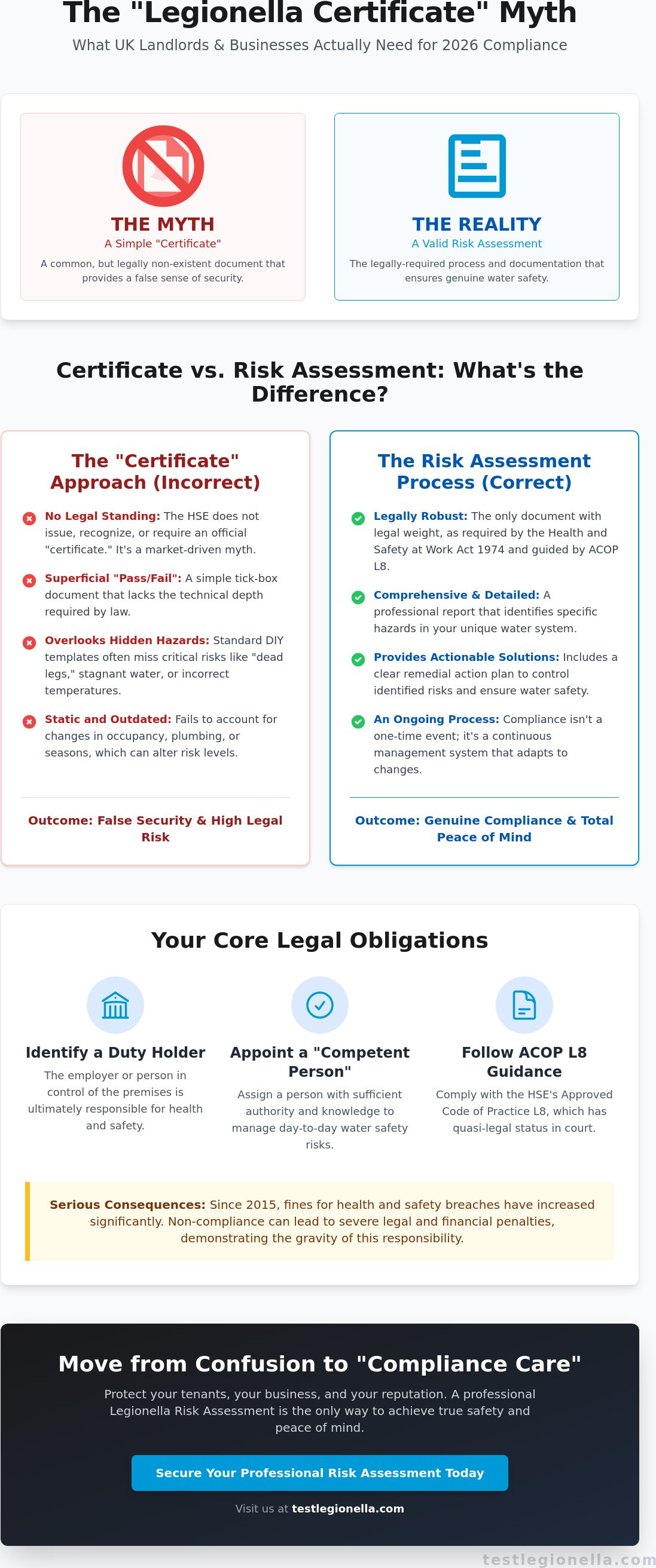
If you're searching for a legionella certificate to satisfy a letting agent or insurer, you aren't alone. Thousands of UK landlords and business owners search for this specific document every month. However, the Health and Safety Executive (HSE) doesn't issue, recognize, or require an official "certificate." It's a common industry myth that can leave you exposed to legal risks if you don't understand what the law actually demands.
The term is frequently used as shorthand by non-specialists. Letting agents and insurance providers often ask for a "certificate" because they want a simple way to verify that a property is safe. Relying on a basic, one-page "pass" document is a mistake. Professional compliance is about the process of risk management, not just a piece of paper. Our goal is to move you from confusion to a state of total "Compliance Care," where your legal duties are handled with expert precision.
The Origin of the "Landlord Legionella Certificate"
The demand for a legionella certificate surged following the 2013 update to the HSE Approved Code of Practice (ACOP L8). This revision made it clear that landlords of residential properties have a legal duty to assess and control the risk of exposure to bacteria. To manage their portfolios efficiently, letting agents began demanding standardized "certificates" to prove a check had been done. This created a market for low-cost, tick-box documents that often lack the technical depth required by law.
A "pass/fail" certificate is particularly dangerous for complex water systems. It fails to account for the dynamic nature of water safety. In a professional setting, a static certificate doesn't reflect changes in occupancy, plumbing modifications, or seasonal temperature shifts. Compliance isn't a one-time event; it's an ongoing responsibility that requires a detailed evidence trail.
Certificate vs. Risk Assessment: Which One Holds Legal Weight?
The only document that carries genuine legal weight in the UK is a valid Legionella Risk Assessment (LRA). You must understand What is Legionnaires' disease? to appreciate why a generic certificate is insufficient. It is a severe, potentially fatal form of pneumonia caused by bacteria that thrive in man-made water systems. A professional LRA identifies specific hazards, such as "dead legs" in pipework or water stored at unsafe temperatures, and provides a clear remedial action plan.
There is also a major difference between an individual's training certificate and a building's compliance report. A training certificate simply proves a person attended a course. It doesn't prove your property is safe. Our professional compliance reports provide the detailed analysis and "peace of mind" that searchers associate with a certificate, but with the legal robustness required by the Health and Safety at Work etc. Act 1974. We make the process easy by providing clear, actionable data that protects your tenants and your business.
Legal Requirements Under ACOP L8 and the Health and Safety at Work Act
Compliance isn't about a single piece of paper or a "quick fix" document. It's about a continuous process mandated by the Health and Safety at Work etc. Act 1974. This primary legislation requires every UK employer and landlord to protect people from health risks. Because Legionella bacteria can cause life-threatening pneumonia, the government treats water safety with extreme seriousness. You don't just need a legionella certificate to show a tenant; you need a robust management system that stands up to scrutiny.
The Approved Code of Practice L8 (ACOP L8) provides the specific framework for this management. While the code itself isn't a law, it has a "quasi-legal" status. This means if you are prosecuted for a health and safety breach, and it's proven you didn't follow the ACOP L8, the court will find you at fault unless you can prove you complied in another, equally effective way. Most businesses find it much simpler to follow the established HSE guidance on managing legionella than to invent their own safety protocols.
Every organization must identify a "Duty Holder," typically the employer or the person in control of the premises. This individual appoints a "Responsible Person" who manages the day-to-day risks. This role requires specific competence and authority. If things go wrong, the consequences are severe. Since the 2015 sentencing guidelines were introduced, fines for health and safety failings have scaled with company turnover. Serious breaches often result in six-figure fines, and in cases of gross negligence, custodial sentences for directors and landlords are a real possibility.
Understanding Your Legal Duty of Care
You have a legal obligation to identify and assess sources of risk in your water systems. This starts with a professional risk assessment. If you employ five or more people, the law is very specific: you must record your significant findings in writing. These records, along with your monitoring data, must be kept for at least five years. A professional assessment serves as your primary evidence of statutory compliance, offering far more protection than a generic legionella certificate ever could. Keeping these records organized ensures your "Compliance Care" remains airtight during inspections.
ACOP L8 vs. HSG274: What Property Owners Need to Know
It helps to think of ACOP L8 as the "what" and HSG274 as the "how." While ACOP L8 sets the legal expectations, the HSG274 technical guidance provides the practical steps for different systems, such as cooling towers or hot and cold water services. ACOP L8 is the "gold standard" for Legionella control in the UK. Following this guidance is essentially mandatory for avoiding legal liability and ensuring the safety of your building's occupants. For a deeper dive into these regulations, you can read our guide on ACOP L8 Explained.
Managing these requirements can feel overwhelming, but it doesn't have to be. You can check your current compliance status to see where you stand and get back to running your business with peace of mind.
The Professional Risk Assessment Process: How to Achieve Real Compliance
Compliance isn't found in a simple legionella certificate bought online. True safety comes from a methodical, professional risk assessment that identifies where bacteria might thrive in your specific water system. Our process transforms a complex legal requirement into a clear, manageable roadmap for your property. We focus on identifying risks before they become liabilities, ensuring your building meets the standards set by the Health and Safety Executive.
Step 1: The Physical Site Inspection
Our specialists begin by mapping your water system from the point of entry to every single outlet. We don't just look at taps. We inspect cold water storage tanks and calorifiers for signs of debris, scale, or corrosion. These are prime breeding grounds for bacteria. We pay close attention to "dead legs," which are redundant pipework sections where water sits stagnant. In roughly 20% of older UK commercial buildings, these hidden sections pose the highest risk because they allow bacteria to grow undisturbed. We also evaluate aerosol risks from showers, spray taps, and cooling towers, as these are the primary ways the bacteria become airborne and inhaled.
Step 2: Temperature Monitoring and Sampling
Temperature control is your first line of defense. Legionella bacteria multiply rapidly in the "danger zone" between 20°C and 45°C. We use professional digital thermometers to get instant, accurate data that DIY methods often miss. While Official government guidance on Legionnaires' disease emphasizes temperature as a primary control, we also determine if water sampling is necessary. Sampling is usually required if your system operates outside safe temperature parameters or if you manage high-risk environments like care homes. We ensure your hot water reaches at least 50°C at the outlet within one minute and cold water stays below 20°C to keep the system safe.
Step 3: The Compliance Report and Action Plan
The final output is far more valuable than a basic legionella certificate. You receive a comprehensive Risk Management Plan that prioritizes remedial actions into high, medium, and low-risk categories. This clarity helps you allocate your maintenance budget where it's needed most. We include a written scheme of control, which is a legal requirement for ongoing management. Our "Compliance Care" reports are designed to be intuitive. They simplify technical findings into actionable steps, giving you total peace of mind that your business is protected and your tenants are safe. We handle the complexity so you can focus on running your business.
Landlord vs. Commercial Duties: Tailoring Your Compliance Strategy
Compliance isn't a one-size-fits-all task. Whether you own a studio flat in Birmingham or manage a large factory in Leicester, the law requires a proactive approach to water safety. You don't need a formal legionella certificate to meet your legal obligations, but you must have a valid risk assessment. Property size never grants an exemption from the Health and Safety at Work Act 1974. If you provide water as part of a service or tenancy, you're responsible for its safety.
Guidance for Domestic Landlords
Simple residential properties still require a formal assessment to stay legally safe. While the risks are generally lower than in industrial settings, they aren't non-existent. The biggest danger often occurs during "void periods" where a property sits empty between tenancies. If water stays stagnant in pipes for more than seven days, bacteria levels can spike. You should educate your tenants on simple prevention. Provide them with a checklist that includes cleaning showerheads every three months and flushing taps after they've been away on holiday. These small steps, documented in your records, demonstrate that you're taking reasonable precautions.
Guidance for Commercial and Industrial Property Managers
Commercial sites involve significantly more complexity. If your building utilizes cooling towers, evaporative condensers, or complex HVAC systems, your risk profile is high. These systems can aerosolise water, potentially spreading bacteria over a wide area. Under ACoP L8, you're legally required to maintain a "Written Scheme of Control." This is a living document that outlines your specific management plan. Unlike domestic settings, commercial sites often require monthly temperature monitoring and quarterly sampling to ensure the system remains within safe limits. We make this process easy by providing clear schedules that keep your business protected and operational.
HMOs and Multi-Occupancy Compliance
Houses in Multiple Occupation (HMOs) present unique challenges because of diverse water usage patterns. One tenant might be away for weeks while others use the system constantly. This creates "dead legs" in the plumbing where water doesn't circulate. As the landlord, you're responsible for the communal areas and the integrity of the entire system. You must ensure all tenants are protected by a single, unified risk management strategy. This prevents gaps in safety that occur when individual units are treated in isolation. A professional assessment will identify these high-risk areas and provide a clear path to compliance.
Ensure your property meets all UK safety standards with our expert support. Get your tailored compliance quote today.
Why Professional Testing Beats the DIY "Certificate" Approach
Downloading a free template and ticking boxes might seem like an easy way to save money. It's a dangerous path that often leaves landlords and business owners legally exposed. A legionella certificate isn't just a piece of paper; it's a verification that a competent person has analyzed your specific water system. When you rely on a DIY approach, you're betting your business on your ability to spot risks that even trained plumbers sometimes miss.
The Risk of the "DIY" Assessment
The Health and Safety Executive (HSE) is clear about the requirement for a "Competent Person." This individual must have the necessary skills, knowledge, and experience to manage the risk effectively. Most property owners don't have the technical training to identify "dead legs" in pipework or recognize temperature fluctuations in hidden storage tanks. These overlooked areas are exactly where bacteria thrive.
Insurers often reject DIY assessments during a claim. If an outbreak occurs, a generic template won't stand up in court. You could face massive fines or even criminal prosecution under the Health and Safety at Work Act 1974. Saving £100 on a professional assessment is a false economy when the Sentencing Council guidelines for health and safety breaches can lead to fines exceeding £100,000 for small businesses. It's simply not worth the gamble.
- Hidden Pipework: Non-experts frequently miss redundant pipes that allow stagnant water to collect.
- Legal Weight: Professional reports provide a "statutory defense" that proves you've taken all reasonable steps to ensure safety.
- Insurance Validity: Most commercial policies require professional risk assessments to remain valid.
The Test Legionella Advantage
We provide more than just a checklist. Our team delivers fast, reliable, and authoritative reporting across the UK. We understand that your time is valuable, so we've streamlined our process to be as efficient as possible. We transform complex HSE L8 and HSG274 regulations into clear, actionable safety steps that you can actually follow. You won't be left guessing what to do next.
Our Compliance Care management system takes the stress out of long-term maintenance. We track your assessment dates and send automated reminders, ensuring you never miss a deadline. Our reports provide the definitive proof of compliance needed for any UK property, giving you total peace of mind. By choosing a specialist, you move from a state of high-risk uncertainty to a position of professional security. Don't leave your legionella certificate to chance.
Take control of your property safety today.
Secure Your Property With Genuine Compliance
True safety goes beyond the hunt for a legionella certificate. Under the Health and Safety at Work Act 1974, UK landlords and business owners must provide a valid risk assessment that follows ACOP L8 and HSG274 guidelines. Relying on unofficial paperwork or DIY checks leaves you vulnerable to legal action and puts lives at risk. Professional assessments provide the only reliable path to meeting your statutory duties while protecting your reputation.
Test Legionella delivers detailed compliance reports accepted by all major UK insurers. Our expert assessors are rigorously trained to ACOP L8 standards, providing you with a clear roadmap for water safety. We offer fast turnaround times and fixed-fee pricing models, so you'll never face hidden costs or long delays. It's time to replace uncertainty with a professional strategy that keeps your water systems safe and your business fully protected.
Secure your property with a professional Legionella assessment today
Take the first step toward stress-free property management and enjoy the peace of mind that comes with expert-led safety.
Frequently Asked Questions
Is a Legionella certificate a legal requirement for UK landlords?
No official Legionella certificate exists under UK law. The legal requirement for landlords is a Legionella risk assessment as mandated by the Health and Safety at Work Act 1974. While many providers issue a document they call a certificate, the law actually requires a thorough assessment process and documented evidence of risk management. Focus on your compliance report rather than a specific piece of paper to stay protected.
How long does a Legionella risk assessment remain valid?
There is no fixed expiry date for a risk assessment in the UK. Industry standards and the HSE suggest a review every 24 months to ensure continued safety. You must also update your records if you change the water system, notice a change in the building's use, or if new health and safety guidance is published. Regular reviews provide peace of mind and keep your property management stress-free.
Can I carry out my own Legionella risk assessment?
You can legally perform the assessment yourself if you are competent to identify and manage the risks. This requires a clear understanding of the HSE L8 Approved Code of Practice and your specific water system. However, most landlords hire a specialist to ensure their compliance report is robust and accurate. Using a professional removes the burden of technical knowledge and ensures you don't miss hidden hazards in the plumbing.
What is the average cost of a professional Legionella assessment in 2026?
Standard residential assessments in the UK typically cost between £50 and £150 depending on the property size and location. Commercial properties or large HMOs with complex water systems often see higher quotes based on the number of outlets. These prices reflect 2024-2026 market data from property service providers. Investing in a professional survey is a cost-effective way to secure your legal standing and protect your tenants' health.
What happens if I don’t have a valid Legionella risk assessment?
Failing to conduct a risk assessment leaves you open to heavy fines and potential prosecution. Under the Health and Safety at Work Act, fines for non-compliance can reach £20,000 or more in the Magistrates' Court. If a tenant contracts Legionnaires' disease at your property, the legal and financial consequences are far more severe. Maintaining your records is the only way to prove you have fulfilled your duty of care.
Do I need to test the water for Legionella bacteria every year?
Annual water sampling is not a legal requirement for most domestic rental properties in the UK. The HSE prioritizes risk management through temperature control and regular maintenance over laboratory testing. You only need to sample the water if your risk assessment identifies a specific problem or if your control measures aren't working. This makes managing your Legionella certificate requirements much simpler and more affordable for the average landlord.
What are the most common remedial actions found in a report?
Reports frequently identify "dead legs," which are sections of redundant pipework where water stagnates. Other common recommendations include descaling showerheads every 90 days and ensuring your water heater reaches at least 60°C. These practical steps are essential for preventing bacterial growth. Our Compliance Care approach highlights these issues clearly so you can fix them quickly and maintain a safe environment for your occupants.
Will a Legionella assessment disrupt my tenants or business operations?
A typical residential assessment takes between 30 and 60 minutes and causes minimal disruption. Our specialists inspect tanks, heaters, and taps without needing to turn off the water supply for long periods. Your tenants or employees can continue their daily routines while we complete the survey. This efficient process ensures you get your professional results quickly without affecting the productivity of your business or the comfort of your home.