
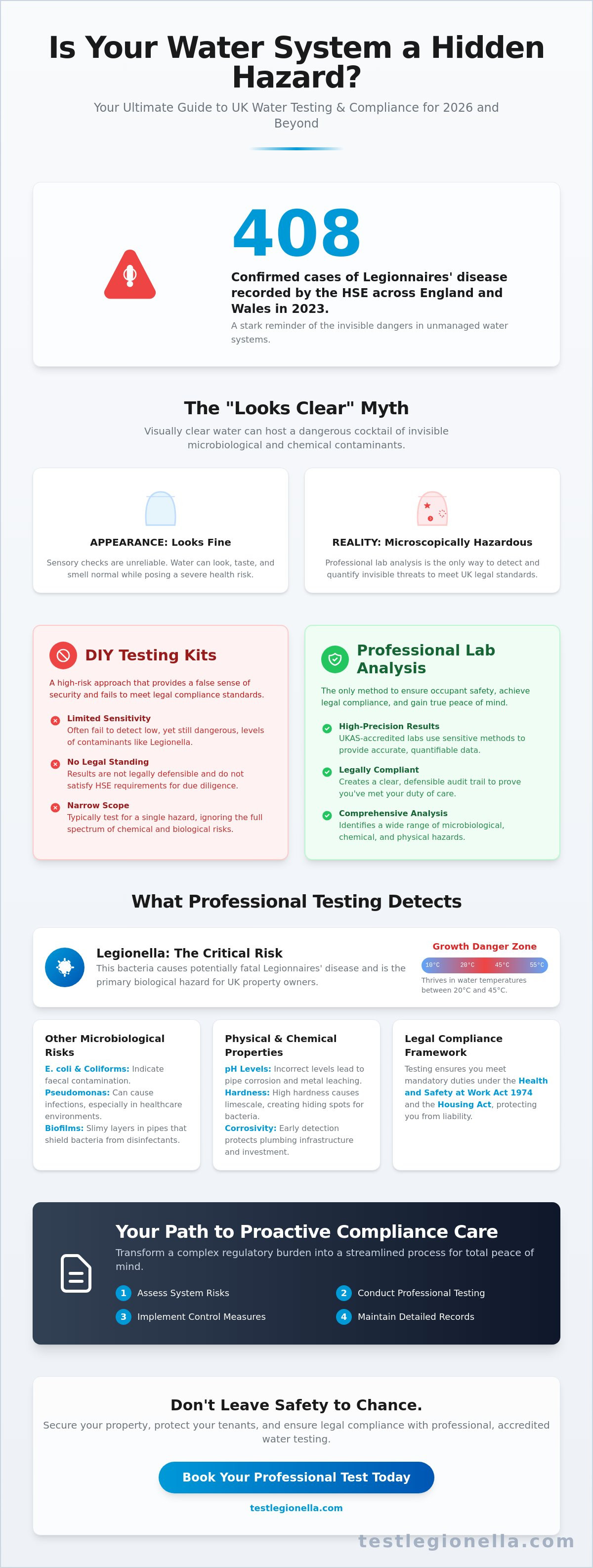
Did you know that the HSE recorded 408 confirmed cases of Legionnaires' disease across England and Wales in 2023? It's a sobering figure that proves what stays hidden in your plumbing can have life-altering consequences for your tenants or employees. You likely already feel the weight of your legal responsibilities, yet the confusion between a basic DIY kit and a rigorous professional water testing regime often creates more anxiety than it solves.
It's time to replace that uncertainty with the peace of mind that comes from specialist Compliance Care. This guide provides everything you need to manage your 2026 obligations, from identifying high-risk contaminants to understanding exactly how often your site requires a specialist review. We'll show you how to transform a complex regulatory burden into a streamlined process that keeps your building safe and your business fully protected. You'll gain a clear understanding of your legal duties and the confidence to choose a testing partner who understands the specific logistics of UK property maintenance.
Key Takeaways
- Move beyond the "looks clear" myth by identifying the hidden microbiological and chemical hazards that threaten your property’s safety.
- Understand the critical limitations of DIY kits and why only professional laboratory analysis meets the strict sensitivity requirements for UK legal compliance.
- Navigate your mandatory duties under the Health and Safety at Work Act 1974 and the Housing Act with our simplified guide to landlord responsibilities.
- Learn how a structured approach to water testing transforms a complex regulatory burden into a streamlined process for long-term peace of mind.
- Get a clear roadmap for interpreting technical laboratory reports and taking immediate, effective action if your water samples return a high contaminant count.
Decoding Water Testing: Why Quality Checks Are Non-Negotiable
Professional water testing is a structured diagnostic process that ensures the safety of your building's occupants. It's more than a simple check; it's a technical validation of your entire water system. Many property owners still rely on the "looks clear, tastes fine" metric, but this is a dangerous misconception. Pathogens like Legionella and harmful chemical contaminants are invisible to the naked eye and often leave no distinct taste. For a comprehensive overview of water testing, experts must analyse specific parameters that sensory checks simply cannot detect.
The Difference Between Mains and Private Water Supplies
In the UK, water companies are only responsible for quality up to your property boundary. Once the supply enters your internal plumbing, the legal duty of care shifts entirely to the landlord or business owner. Even "perfect" mains water can become contaminated within your building's infrastructure. Scale buildup, corroded pipework, and "dead legs" (sections of pipe where water rarely flows) create the perfect breeding ground for bacteria.
For those managing private water supplies like wells or boreholes, the need for frequent, rigorous analysis is even more critical. These sources lack the industrial-scale filtration of the national grid, making them susceptible to seasonal changes and local environmental shifts. Regular water testing identifies these fluctuations before they pose a health risk to your tenants or employees.
The Public Health Impact of Waterborne Pathogens
The human cost of waterborne illnesses is preventable but severe. Legionnaires’ disease remains a significant threat in commercial and residential settings where water temperature and flow aren't managed correctly. Water testing serves as a proactive barrier against microbial and chemical hazards, ensuring every tap provides safety rather than risk.
By 2026, the industry has shifted from reactive repairs to proactive "Compliance Care." This modern approach prioritises regular monitoring and risk assessment, ensuring you stay ahead of regulatory changes while protecting the health of everyone on your premises. It's about turning a complex legal requirement into a streamlined, stress-free part of your property maintenance. Professional testing provides the data needed to move from uncertainty to total peace of mind.
- Proactive Protection: Identify Legionella and other pathogens before they reach dangerous levels.
- Legal Security: Maintain a clear audit trail for health and safety inspectors.
- System Longevity: Detect corrosive elements early to protect your plumbing investment.
Identifying the Hazards: What Does Professional Testing Detect?
Water isn't a simple, static substance. In a commercial or residential plumbing system, it's a complex environment where biological and chemical factors constantly interact. Ensuring your property meets the Water Supply (Water Quality) Regulations 2016 requires a nuanced approach to analysis. Professional water testing identifies hidden threats that visual inspections simply cannot see, transforming a potential liability into a verified safe environment.
Physical properties like pH, hardness, and temperature act as the foundation for water safety. If your pH levels are too low, the water becomes acidic and corrodes metal pipes. If the water is too hard, limescale builds up, creating a rough internal surface where bacteria can hide. Most importantly, temperature control is the first line of defence. Bacteria thrive between 20°C and 45°C; professional monitoring ensures your system stays outside this danger zone to inhibit growth.
Legionella and Microbiological Risks
Legionella is the most critical biological hazard for UK property owners because of its potential to cause fatal pneumonia. It's a specialist risk that demands specialist sampling. Beyond this, we test for E. coli and Coliforms, which indicate faecal contamination, and Pseudomonas aeruginosa, a common culprit for infections in healthcare settings.
A major challenge in modern buildings is the formation of biofilms. These are sticky layers of microorganisms that cling to the inside of pipes and tanks. Biofilms protect bacteria from standard disinfectants, meaning a system can appear clean while harbouring dangerous pathogens. Our sampling techniques target these areas specifically, ensuring your compliance reports reflect the true state of your water system. You can secure your property's safety today with our tailored Compliance Care packages.
Chemical and Heavy Metal Contamination
Chemical hazards often stem from the building's own infrastructure or the surrounding environment. Lead remains a persistent threat in older UK housing stock, particularly in properties built before 1970. Even small amounts of lead leaching from legacy plumbing can have serious long-term health implications. We also monitor for copper and zinc, which are often the first indicators that your internal pipework is corroding and requires remedial attention.
In rural areas of the Midlands and beyond, private water supplies face risks from nitrates and pesticides. Agricultural runoff can seep into groundwater, making water testing essential for those not on the mains grid. Because these contaminants are tasteless and odourless, laboratory analysis is the only way to confirm the water is fit for consumption.
It's a common misconception that a single test can cover every hazard. A microbiological sweep won't detect lead, and a chemical analysis won't find Legionella. Each risk requires different laboratory protocols and sampling containers. We provide a comprehensive suite of tests that are specific to your property type, ensuring no stone is left unturned. This structured approach makes compliance easy and provides the documented evidence you need to protect your tenants and your business.
DIY Testing Kits vs. Professional Laboratory Analysis
The market for "Dip-Wait-Read" water testing kits has expanded rapidly, offering property owners a seemingly easy way to monitor their systems. These kits provide instant feedback on basic indicators like pH levels or hardness. However, convenience often comes at the cost of precision. For a business owner or landlord in 2026, relying on a £15 plastic strip to ensure the safety of a complex plumbing system is a high-stakes gamble. DIY strips lack the sensitivity required to meet UK legal standards, often failing to detect low-level contaminants that still pose a significant health risk.
When is a DIY Kit Sufficient?
Home-based kits have their place in routine maintenance. They're perfect for checking the pH of a swimming pool or verifying that a water softener is functioning correctly. These are operational tasks where a small margin of error won't lead to a legal crisis. You should never use a DIY kit to sign off a Legionella risk assessment. Bacteria tests sold for home use are notorious for false negatives. They often fail to account for the specific incubation periods and temperatures required to identify dangerous pathogens accurately. If you're responsible for the health of tenants or employees, "good enough" isn't an option.
The Professional Laboratory Process
Professional water testing involves a rigorous chain of custody that ensures your samples are representative and uncontaminated. Trained technicians use sterile collection techniques, preventing the cross-contamination that frequently ruins DIY attempts. Once at the facility, samples undergo analysis in a UKAS-accredited environment. This accreditation is vital. It means the laboratory meets the highest international standards for competence and consistency.
- Sterile Collection: Technicians use specialized bottles and neutralising agents to "freeze" the water's state at the moment of collection.
- Legal Defensibility: UKAS-accredited results are the only data sets fully recognized by the Health and Safety Executive (HSE) and UK courts.
- Comprehensive Reporting: You receive a detailed breakdown of findings, not just a colour-coded guess.
Many property managers worry about the cost of professional analysis. It's helpful to view this as an investment in liability protection. A professional test provides a definitive record of safety that shields your business. Under the Health and Safety at Work etc. Act 1974, fines for non-compliance are substantial. In recent years, even small businesses have faced penalties exceeding £20,000 for failing to maintain proper water safety records. A professional laboratory test is always cheaper than a court date. Get the peace of mind that comes from knowing your compliance is handled by experts.
The Legal Landscape: Mandatory Water Testing in the UK
The Health and Safety at Work Act 1974 forms the foundation of all water safety obligations in the UK. This legislation requires employers and those in control of premises to protect the health and safety of employees and the public. Under the Housing Act 2004 and the Landlord and Tenant Act 1985, landlords have a specific duty to ensure properties are free from health hazards. This includes maintaining safe water systems. The Drinking Water Inspectorate (DWI) oversees these national standards, ensuring that water supplied to every tap meets strict quality benchmarks. Ignoring these duties carries heavy penalties. Negligence often leads to unlimited fines, legal action, and severe reputational damage. In recent years, the HSE has tightened enforcement, making professional water testing a non-negotiable part of modern property management.
ACOP L8 and HSG274 Compliance
The HSE provides a clear blueprint for managing Legionella through ACOP L8 and the technical guidance in HSG274. Every business must appoint a "Responsible Person" with the authority and knowledge to oversee water safety. This individual is tasked with implementing a written scheme of control. Regular water testing acts as the pulse check for this scheme. It provides the objective data needed to prove your control measures, such as temperature monitoring or chemical treatments, are actually working. Without regular testing, your written scheme lacks the evidence required to stand up in a court of law. It's about moving from uncertainty to total control.
Statutory Requirements for Landlords and Businesses
Your testing frequency depends entirely on a formal risk assessment. You don't need to guess how often to test; the assessment dictates the schedule based on your specific system. High-risk environments like care homes, hospitals, and hospitality sectors face the most rigorous requirements because they serve vulnerable populations or have complex plumbing. Professional evidence of safety is often referred to as a "Legionella Certificate." While not a single statutory document, it represents the collection of laboratory results and risk assessments that prove your compliance. These records must be kept for at least five years to satisfy inspectors and insurance providers.
Stop worrying about regulatory red tape and start protecting your tenants today. Get My Quote for a fast and reliable compliance check.
From Results to Resolution: Managing Your Water Compliance
Receiving a laboratory report marks the beginning of your safety journey, not the end. While the technical data might look complex, its purpose is to provide a clear roadmap for your property management. Professional water testing results offer the evidence you need to prove your site is safe or to identify exactly where the system is failing. Turning these numbers into a resolution is the final step in securing your property.
Understanding Your Lab Analysis
The most common metric you'll see is CFU/L, which stands for Colony Forming Units per Litre. This tells you the concentration of live bacteria found in your sample. If your report states "Not Detected," it means the levels are below the laboratory's limit of detection, which is typically 100 CFU/L for Legionella in UK labs. A lab report is a snapshot in time and requires regular updates. Relying on a single clear result from two years ago leaves you vulnerable to current risks. Smart landlords use trend analysis to compare current figures against historical data. If your counts are creeping up from "Not Detected" to 200 or 400 CFU/L over several months, your control measures are likely failing, even if you haven't hit a dangerous threshold yet.
Next Steps: Remedial Works and Monitoring
If a sample returns a high count, you must act immediately to protect your tenants and your business. The first step usually involves checking your temperatures; hot water must reach 50°C at the outlet within one minute (55°C in healthcare), while cold water must stay below 20°C. Common fixes include cleaning and disinfecting cold water storage tanks or removing "dead legs," which are redundant lengths of pipework where water stagnates. These simple physical changes often solve 90% of contamination issues found during routine water testing.
Compliance isn't just about fixing problems; it's about proving you've managed them. You're legally required under ACOP L8 and HSG274 to keep a compliance history for at least five years. This record-keeping acts as your insurance policy, showing that you've been proactive rather than reactive. Test Legionella simplifies this entire cycle through our Compliance Care service. We don't just provide a report and leave you to figure it out. We set up automated reminders for your next check and provide clear, actionable steps for any remedial work required. Get your peace of mind today with professional water testing and compliance care and let us handle the logistics of safety for you.
Secure Your Compliance for 2026 and Beyond
Ensuring your property meets the latest safety standards isn't just about ticking boxes. It's about protecting lives and your reputation. Professional water testing provides a level of accuracy that DIY kits simply can't match, identifying microscopic hazards before they become critical health risks. By following HSE guidelines and ACOP L8 standards, you avoid the heavy fines and legal complications that follow non-compliance in the UK.
We make this process simple by handling the technical details so you can focus on running your business. Our UKAS-accredited laboratory analysis ensures total accuracy, while our detailed reports give you the documentation needed to stay on the right side of the law. We provide fast turnaround times to keep your property running safely and efficiently. Transforming a complex regulatory burden into a sense of security is what we do best.
Get a fast, reliable quote for your water testing today
Take the first step toward total peace of mind and let us handle your compliance care with the expertise your property deserves.
Frequently Asked Questions
Is water testing a legal requirement for UK landlords?
Yes, UK landlords have a legal duty to assess and manage the risk of Legionella exposure under the Health and Safety at Work Act 1974. While a physical lab test isn't mandatory for every single domestic property, you must conduct a formal risk assessment to identify potential hazards. If your assessment identifies a high-risk system, regular water testing becomes a vital part of your compliance strategy to protect tenants and meet HSE guidelines.
How much does professional water testing cost in 2026?
Professional water testing typically costs between £45 and £150 per sample in 2026, depending on the complexity of the analysis required. A basic potability test might start around £50, while specialized Legionella analysis often sits at the higher end of the scale. Most commercial property owners opt for bundled compliance packages to reduce the cost per outlet, ensuring full site coverage while keeping the maintenance budget predictable and manageable.
How often should I test the water in my commercial building?
You should conduct a formal risk assessment review every 24 months, but specific water testing frequency depends on your building's unique risk profile. High-risk environments like healthcare facilities often require quarterly sampling; however, standard office blocks might only test annually. You must also perform monthly temperature checks at sentinel outlets to ensure your hot water stays above 50°C and cold water remains below 20°C for consistent safety.
Can I test for Legionella myself using a home kit?
You can purchase DIY home kits, but these rarely provide the legal protection or accuracy required for commercial compliance. Most home kits use lateral flow technology which only detects specific strains and doesn't meet the ISO 11731 standards used by professional labs. To achieve true peace of mind and satisfy HSE inspectors, you need a UKAS accredited laboratory to analyze your samples and provide a certified report.
What happens if my water test fails for bacteria?
You must take immediate remedial action if your water testing results show bacterial counts exceeding 1,000 cfu/l for Legionella or failing potability standards. This usually involves isolating the affected outlets, performing a chemical shock disinfection, and then conducting follow-up samples after 48 hours. Our team helps you navigate this process by identifying the root cause, such as dead legs in pipework or failing water heaters, to prevent recurrence.
What is the difference between UKAS accredited and non-accredited testing?
UKAS accredited testing means the laboratory meets the ISO 17025 standard for competence, providing results that stand up in a court of law. Non-accredited tests lack this independent verification and may use unproven methods that lead to false negatives. Choosing a UKAS lab ensures your data is reliable, accurate, and fully compliant with the ACoP L8 technical guidance, removing the risk of regulatory fines or safety failures.
How long does it take to get water test results back from a lab?
Standard Legionella culture tests take 10 to 14 days because the bacteria must be incubated to grow visible colonies. General microbiology tests for TVCs or E. coli often provide results within 48 to 72 hours. We understand that speed is essential for property managers, so we provide an initial notification if high levels are detected early in the incubation period, allowing you to react quickly to potential risks.
Do I need to test mains water if it comes from a utility company?
Yes, you're responsible for water quality the moment it enters your property's internal plumbing system. While utility companies guarantee safety at the point of entry, issues like old lead pipes, storage tanks, or poor insulation can contaminate the water within your building. Regular testing ensures that the wholesome water provided by the mains hasn't degraded, protecting your occupants from localized bacterial growth or heavy metal leaching.