
A risk assessment without completed remedial works is nothing more than a documented admission of liability. It's a harsh reality that many UK property owners face when they receive a detailed report but fail to act on the specific findings. You likely understand that safety is your primary responsibility, yet the distinction between everyday maintenance and essential remedial works often feels like a moving target. It's stressful to look at a long list of repairs and struggle to identify which ones are legal requirements and which are merely recommendations.
This guide changes that by turning complex regulations into a straightforward path toward safety. You'll discover how to bridge the gap between your initial risk assessment and full legal compliance, ensuring your property meets the standards set by the Health and Safety at Work etc. Act 1974. We provide a clear framework for managing repairs and prioritizing your budget effectively. By the end of this article, you'll have the tools to secure your building and the peace of mind that comes from knowing your compliance is handled by a specialist who values your time.
Key Takeaways
- Identify the critical differences between routine maintenance and essential corrective actions to keep your property legally compliant.
- Learn how to prioritise safety risks from immediate to low, ensuring your budget is directed where it matters most for tenant safety.
- Discover the most common types of remedial works required in UK properties, focusing on high-liability areas like water hygiene and fire safety.
- Follow a practical, step-by-step framework to manage the repair process and vet specialist contractors with total confidence.
- Streamline your path to professional compliance by turning complex risk assessments into clear, actionable plans for long-term peace of mind.
What are Remedial Works? Definition and Scope
Remedial works are the specific corrective actions you take to resolve defects, structural failures, or safety non-compliances identified during a professional inspection. Unlike general improvements or aesthetic upgrades, these works are essential fixes required to bring a property back into a safe, legal, and functional state. When a risk assessment flags a hazard, the resulting remedial works act as the formal response to eliminate that risk. In a professional building survey or environmental report, Remedial Action defines the necessary steps to contain or resolve a hazard, ensuring the site remains fit for purpose.
For property owners and facility managers, understanding the scope of these works is vital for budget planning and liability management. These tasks aren't optional suggestions; they're professional requirements that often follow a failing grade in a compliance audit. Whether it's fixing a faulty fire door or addressing a contaminated water system, the goal is always to restore the safety integrity of the building. By addressing these issues promptly, you protect the health of your tenants and the long-term value of your asset.
Remedial vs. Routine Maintenance
It's easy to confuse these two categories, but the distinction is critical for your compliance records. Routine maintenance is proactive and prevents issues before they start, such as cleaning a tap or checking a boiler's pressure. Remedial work is the bridge between a hazard identified and a hazard removed. It's a reactive necessity triggered by a failure or a breach of standards. For example, while descaling a showerhead is standard maintenance, replacing a heavily corroded or contaminated water tank is a remedial work. One keeps the system running smoothly; the other fixes a specific failure that could lead to illness or legal action.
The Legal Context of Remediation
The foundation for all property safety in the UK is the Health and Safety at Work Act 1974. This legislation places a "duty of care" on employers and landlords to ensure their premises don't pose a risk to people. When it comes to water safety, the acop l8 provides the technical framework you must follow. It dictates specific timelines for addressing risks; ignoring these can lead to severe consequences. If you fail to carry out required remedial actions, you face more than just safety risks. You could deal with heavy fines, criminal prosecution, and the total invalidation of your building insurance. Compliance isn't just about ticking boxes; it's about protecting your business from catastrophic legal and financial fallout.
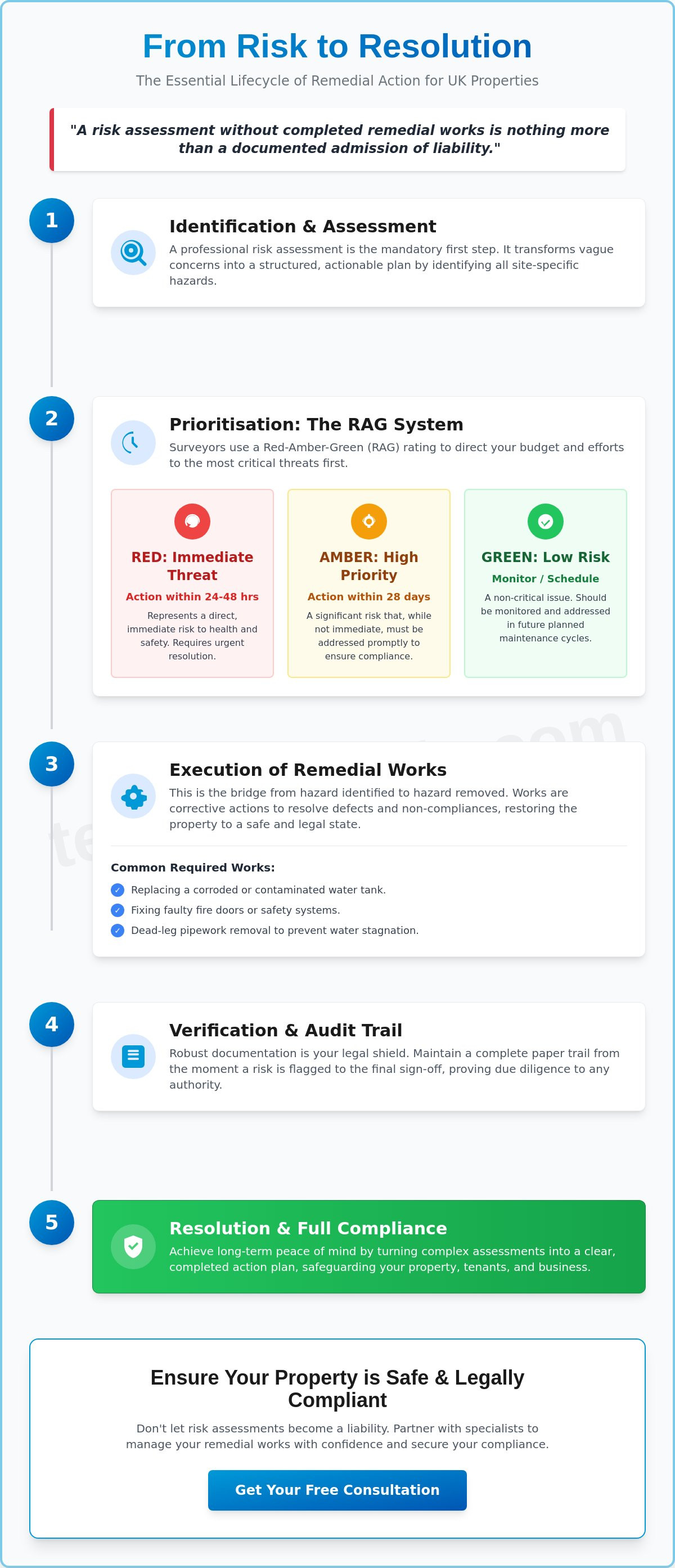
The Lifecycle of Remedial Action: From Risk to Resolution
Every successful compliance journey begins with a professional survey. You can't fix what you haven't identified. A professional risk assessment provides the foundation for all remedial works, transforming vague concerns into a structured checklist. Relying on a generic sample legionella risk assessment is a common mistake that often fails to provide a clear roadmap. These templates lack the site-specific detail required to identify unique system vulnerabilities, leaving property owners with a false sense of security rather than a functional plan.
Maintaining a robust audit trail is the most critical part of this lifecycle. This digital or physical paper trail tracks an issue from the moment a surveyor flags it to the final sign-off. If a health and safety executive visits your premises, they won't just look at your current systems; they'll examine the history of how you handled previous risks. Proper documentation proves you've acted with due diligence, protecting you from legal liability and ensuring nothing slips through the cracks.
Step 1: Identification and Risk Rating
Surveyors typically use a "Red, Amber, Green" (RAG) rating system to help you prioritize your budget. Red items represent immediate threats that require action within 24 to 48 hours. Amber signifies high-priority risks that need resolution within 28 days, while Green covers medium to low risks that you can monitor or schedule for future maintenance. It's important to remember that not all remedial works require immediate building closure, but every single one requires a documented plan for resolution.
Specialist testing is essential because many property threats are "silent." You can't see legionella bacteria in a water tank or detect asbestos fibres in a ceiling tile without professional equipment. These hidden defects often remain unnoticed until they cause a significant health incident or a total system failure. You can start by checking your current status with our free compliance score tool to see where your property stands.
Step 2: Planning and Budgeting
Effective management requires balancing urgent safety repairs with long-term capital expenditure (CapEx) planning. For example, understanding the asbestos survey cost is just the first step. You must also budget for the potential removal or encapsulation if the survey returns a positive result. In the UK, a standard management survey for a small commercial unit might start around £250, but complex industrial sites will require a significantly larger investment.
Industry data suggests that "patch-up" jobs are a false economy. Attempting a temporary fix on a failing boiler or a corroded pipe often leads to a 40% increase in total costs over a three-year period compared to a full professional repair. Research into experiences of remediation shows that property owners who integrate safety works into their annual budget, rather than treating them as emergency expenses, maintain higher property values and lower insurance premiums. Professional remediation isn't just a cost; it's an investment in the longevity of your asset.
Common Types of Remedial Works in UK Properties
Remedial works encompass a wide range of corrective actions designed to restore a property to a safe, compliant state. While the specific tasks vary based on the building type, the goal remains the same: protecting occupants and limiting owner liability. Residential landlords typically deal with issues affecting tenant health, whereas commercial office managers often face more complex engineering challenges involving shared plant rooms and high-occupancy fire routes. Proper management of these tasks ensures your property stays on the right side of the law.
Water Hygiene and Legionella Remediation
Water systems represent a significant area of risk. Stagnant water is the primary cause of bacterial growth, making the removal of "dead legs" a priority. These redundant pipe lengths allow water to sit and warm up, creating an ideal environment for pathogens. Remediation often involves physical pipework removal and the insulation of cold water tanks to keep temperatures below 20°C. You must also recalibrate water heaters to ensure they consistently store water at 60°C or higher to satisfy legionella safety protocols. If a laboratory test confirms a positive bacteria count, a full system chemical disinfection is the only way to guarantee safety.
Structural and Fabric Remediation
Structural issues often start small but can lead to massive liability if ignored. Addressing damp and mould is a legal requirement under the Homes (Fitness for Human Habitation) Act 2018, as these conditions cause chronic respiratory issues. In commercial blocks, remedial work frequently focuses on fire safety. This includes repairing damaged fire doors and filling breaches in fire-stopping walls where cables or pipes pass through. Owners of residential blocks must follow the Code of Practice for Remedial Works to ensure their buildings meet the latest safety benchmarks. Fabric repairs, such as mortar replacement and brick tinting, are also essential to prevent water ingress and maintain the building's structural integrity over time.
Signing off these remedial works requires more than a simple invoice. To achieve true Compliance Care, you need technical documentation that proves the risk has been mitigated. For water hygiene, this involves a certificate of disinfection or an updated risk assessment. For fire safety, a qualified inspector must provide a formal sign-off report. These documents are your shield against legal action and provide the peace of mind that your property is safe. Professional specialists make this process easy by providing clear, digital reports that are ready for any audit or inspection.
How to Manage Remedial Works: A Step-by-Step Guide
Managing remedial works effectively is the difference between a safe building and a legal liability. It's not just about fixing a leak or replacing a valve; it's about a structured process that turns a risk into a resolution. For landlords and property managers, a clear framework reduces the stress of meeting tight deadlines and ensures every action stands up to scrutiny during a health and safety audit.
Sourcing Competent Contractors
General builders often lack the specialist training needed for technical water system modifications or asbestos management. Using a contractor who doesn't understand the specific nuances of ACoP L8 or HSG274 can lead to further contamination or non-compliance. You need specialists who speak the language of safety and understand the gravity of the risks involved.
When vetting your team, focus on these three pillars of competence:
- Industry Accreditations: Verify that the contractor is a member of the Legionella Control Association (LCA) for water works or holds UKAS accreditation for specialist testing.
- Specialist Experience: Ask for evidence of similar work in your specific property type, whether it's a small residential block or a complex industrial site.
- Certification Standards: Ensure they provide a "Certificate of Completion" that explicitly references the faults found in your original risk assessment.
A professional contractor won't just do the job; they'll provide the paperwork required to maintain your compliance trail. This documentation is your first line of defence if an inspector visits your site.
Verifying and Closing the Loop
The repair is only half the battle. You must bridge the gap between the physical fix and your legal records to stay protected. Remedial work is only "done" when the compliance software or logbook is updated. Without this update, your records still show an active risk, regardless of what's happening on-site.
Post-remedial testing acts as your final verification. If you've replaced a dead leg or cleaned a cold water storage tank, follow-up water sampling or temperature monitoring proves the intervention was successful. This data-driven approach removes guesswork and creates what we call a "Compliance Shield." It shows a proactive, rather than reactive, management style that prioritises tenant safety.
Once you've confirmed the fix, your final step is to update the property's risk assessment. This reflects the current, safer state of the building and resets your compliance clock, giving you total peace of mind. Keeping your property safe doesn't have to be complicated when you follow a logical, documented path.
Achieving Peace of Mind Through Professional Compliance
Compliance doesn't have to be a headache for property owners. Test Legionella simplifies the transition from risk identification to the planning of remedial works. Our "Compliance Care" model eliminates the guesswork that often leads to failed HSE inspections or costly legal liabilities. We provide fast, reliable testing with clear, actionable results. This moves you from a state of uncertainty to total property protection. By choosing a specialist partner, you ensure that every safety measure is backed by expert data and professional integrity.
The Value of Expert Testing
You can't fix what you haven't accurately measured. Our specialist assessments go beyond simple pass or fail indicators. We provide the exact technical specifications your contractors need to carry out remedial works efficiently. This precision prevents overspending on unnecessary repairs while ensuring every legal requirement under ACoP L8 is met. Professional reports are your best defense against legal claims. They demonstrate a proactive approach to the Health and Safety at Work Act 1974. Our team understands the nuances of UK law, ensuring your documentation stands up to the highest level of scrutiny. We provide the reassurance that your water systems are managed by experts who value safety as much as you do.
- Detailed Specifications: Clear instructions for contractors to ensure repairs are done right the first time.
- Legal Protection: Robust documentation that serves as evidence of your commitment to tenant safety.
- Nuanced Expertise: Deep understanding of UK-specific regulations and local Midlands property requirements.
Get Your Compliance Score Today
Take the first step toward total safety by booking a professional assessment. We offer national coverage and rapid turnaround times to ensure your property remains compliant without delays. Our team handles the logistics, providing you with a comprehensive compliance score that highlights exactly where you stand. Waiting for an inspection to find a fault is a high-risk strategy. Instead, use our professional diagnostic tools to stay ahead of regulatory changes. We make the process straightforward, from the initial site visit to the final delivery of your digital report. Our goal is to transform a complex regulatory burden into a streamlined part of your property management routine.
Compliance made easy, safety made certain. Don't leave your property's health to chance. Contact our experts today to secure your specialist report and achieve lasting peace of mind.
Secure Your Property with Expert Compliance Care
Managing property safety doesn't have to be a burden. By following the structured lifecycle from risk assessment to resolution, you ensure your building meets strict HSE standards and ACOP L8 regulations. Prompt remedial works turn identified hazards into documented safety, protecting both your tenants and your legal standing. We provide professional UK-wide testing coverage and deliver detailed, easy-to-read compliance reports that take the guesswork out of property maintenance. It's a system designed to transform a complex regulatory burden into a lasting sense of security. Our team acts as your efficient partner, transforming technical requirements into a streamlined process that prioritizes your time.
Don't leave your property's health to chance when authoritative guidance is just a click away. We're here to help you achieve total peace of mind through our dedicated approach to safety. Our experts handle the logistics so you can focus on running your business with confidence. Take the first step toward a safer environment and a stress-free management experience today. You've got the tools to stay compliant; let's make sure your property is fully protected.
Frequently Asked Questions
What happens if I ignore remedial works mentioned in a risk assessment?
Ignoring remedial works leaves you legally vulnerable and liable for any health incidents that occur on your property. Under the Health and Safety at Work etc Act 1974, failing to act on identified risks can lead to unlimited fines or even imprisonment. You also risk invalidating your insurance policies, meaning you'll pay every penny of any claim out of your own pocket.
How long do I have to complete remedial works after an inspection?
Your compliance report will categorise actions into priority levels, typically ranging from 24 hours to 6 months. High-risk "Category A" issues require immediate attention, often within 7 days, to prevent system shutdowns or health outbreaks. Medium risks usually allow 28 to 90 days for completion, depending on the specific threat identified during your site visit.
Can I carry out remedial works myself as a landlord?
You can only perform remedial works yourself if you possess the specific technical competence required for the task. While you might handle basic bypasses, any work involving gas, electrical systems, or complex water disinfection requires a qualified professional. You must produce a clear paper trail of completion to satisfy local authorities and HSE inspectors during a spot check.
Do remedial works always require a new risk assessment afterward?
You don't always need a full new risk assessment, but you must document that the specific risks were mitigated. For significant structural or system changes, a review of the existing assessment is mandatory under ACoP L8 guidelines. This ensures your records reflect the current state of the property and maintain your continuous chain of compliance.
Are remedial works tax-deductible for UK landlords?
Most remedial works are classified as "allowable expenses" and are tax-deductible against your rental income. HMRC distinguishes between repairs, which restore an item to its original state, and capital improvements. Because these works typically address safety defects to maintain the property's habitable status, you can usually claim the full cost of the invoice in your annual Self Assessment.
How do I know if a remedial work quote is fair and accurate?
A fair quote must be fully itemised, showing separate costs for parts, labour, and any necessary testing fees. Check the quote against the specific recommendations in your risk assessment to ensure the contractor isn't adding unnecessary extras. Reliable firms in the UK should provide a fixed price rather than a vague estimate, giving you total budget certainty.
What is the difference between a defect and a remedial action?
A defect is the specific fault identified, such as a dead leg in a pipework system or a broken thermostatic mixing valve. The remedial action is the physical work required to fix that fault and bring the system back into compliance. Think of the defect as the diagnosis and the remedial action as the cure that secures your property's safety.
Who is legally responsible for ensuring remedial works are completed in a commercial lease?
Responsibility typically falls on the "Duty Holder," who is defined by the terms of your specific commercial lease agreement. In a Full Repairing and Insuring (FRI) lease, the tenant usually bears the cost and responsibility for all repairs. However, the landlord often retains ultimate liability for structural safety under the Occupiers' Liability Act 1957 if the lease is silent on specific maintenance.