
Could a single missed deadline really result in a £6,000 fine or even a custodial sentence? For many UK landlords, the annual gas safety certificate feels like a recurring administrative hurdle, yet it's your most critical tool for protecting lives and your legal standing. You likely feel the constant pressure of juggling expiry dates for gas, electric, and water checks, wondering if your current system is robust enough to prevent a costly oversight. It's a common stressor that often makes property management feel more like a legal minefield than a professional venture.
We're here to ensure your compliance is made easy. This guide helps you master your legal obligations with a comprehensive look at Gas Safety Certificates and integrated property safety. You'll gain a clear understanding of the CP12 inspection process, current 2026 market expectations, and a streamlined way to manage all your safety requirements under one roof. We'll break down exactly what an engineer checks during their visit and show you how to build a reliable shield against liability. Let's turn your regulatory burden into lasting peace of mind.
Key Takeaways
- Understand your statutory obligations under the 1998 regulations to ensure your property remains safe and legally compliant.
- Learn exactly what to expect during a professional inspection and how to efficiently secure your annual gas safety certificate.
- Discover the "staying safe" rule for record-keeping and how to manage renewal timelines to avoid unnecessary compliance risks.
- Explore how integrating gas checks with water safety creates a robust "Compliance Care" strategy for total property protection.
- Find out how professional reporting provides a bulletproof audit trail, turning complex regulations into long-term peace of mind.
Understanding the Gas Safety Certificate (CP12) in 2026
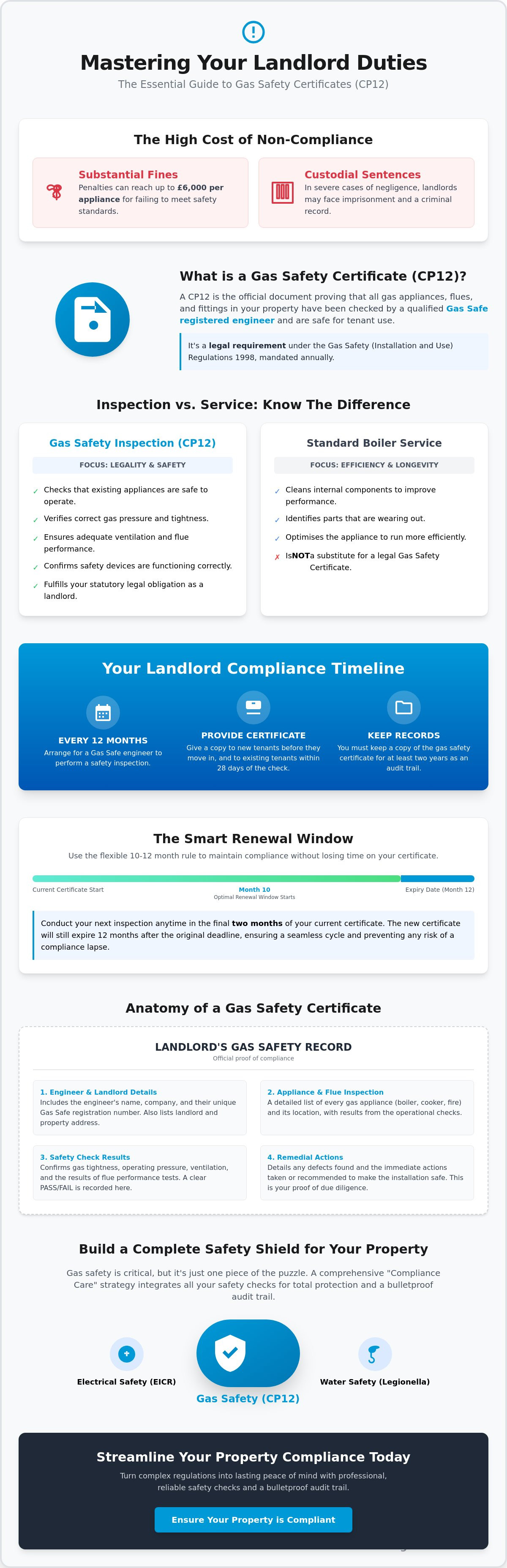
A gas safety certificate, historically referred to as a CP12, is the official record issued after a qualified professional inspects your gas appliances. In 2026, this document remains the backbone of rental property compliance. The Gas Safe Register oversees this process, ensuring that only competent, qualified engineers work on gas systems to prevent carbon monoxide poisoning and explosions. Under the Gas Safety (Installation and Use) Regulations 1998, landlords must complete this check every 12 months. This isn't just a recommendation; it's a legal mandate that protects lives and investments.
Many property owners confuse a standard boiler service with a legal safety inspection. While a service focuses on efficiency and longevity, a safety inspection focuses on risk. The inspector checks ventilation, flue integrity, and safety devices to ensure the appliance won't fail dangerously. Our Compliance Care approach ensures you never miss a deadline, transforming a complex regulatory burden into a sense of security. We make the process simple, providing clear reports that keep you on the right side of the law.
What is a CP12 and Why is it Essential?
A standard report includes the engineer's name, their Gas Safe ID number, the property address, and a detailed breakdown of each appliance. It records whether the appliance passed or failed and identifies any remedial work required. This record protects you from heavy fines or prosecution if an accident occurs. A CP12 is the definitive legal proof that every gas appliance in a property is safe for use.
- Engineer Details: Includes the unique Gas Safe registration number.
- Appliance Results: A clear pass or fail for every gas item in the property.
- Safety Actions: Details of any immediate repairs needed to reach compliance.
- Peace of Mind: Proof that you have met your duty of care as a landlord.
Domestic vs. Commercial Gas Safety Requirements
Residential certificates cover standard boilers, cookers, and fires. Commercial requirements are more complex. Business premises often house high-output boilers or specialised catering equipment that require a different level of expertise. You must hire an engineer with the specific commercial qualification on their Gas Safe ID card. Using an unqualified engineer for commercial appliances voids your insurance and breaches UK safety laws.
We provide a gas safety certificate for both sectors, ensuring the right specialist is dispatched for your specific property type. Whether you manage a single flat or a commercial kitchen, our team handles the logistics. We focus on rapid turnaround and professional quality, making compliance easy for busy property managers across the Midlands. Get your property checked today to ensure total safety and legal adherence.
Legal Obligations and Renewal Timelines for Landlords
Under the Gas Safety (Installation and Use) Regulations 1998, you carry a strict statutory duty of care. This isn't optional. You must ensure all gas appliances, fittings, and flues provided for tenants are safe. The Health and Safety Executive (HSE) provides the definitive framework for landlords' legal obligations to prevent carbon monoxide poisoning and gas-related incidents. You're required to keep a copy of every gas safety certificate for at least two years. This "staying safe" record-keeping rule provides a clear audit trail if an inspection or incident occurs. You must also provide a copy to existing tenants within 28 days of the check. For new tenants, the certificate must be handed over before they move into the property. Failing this can halt your ability to regain possession of the home later.
The 10-12 Month Renewal Rule Explained
The "MOT-style" renewal system allows you to stay compliant without losing any time on your annual cycle. You can arrange your inspection up to two months before the current certificate expires. If the check happens within this 10 to 12-month window, the new expiry date remains 12 months from the original deadline. This logic helps you avoid the last-minute rush and ensures your gas safety certificate never lapses. Don't wait until day 364 to call an engineer. Scheduling early removes the risk of contractor delays or urgent repairs that could push you into a state of non-compliance. It's a simple way to maintain a consistent annual cycle and protect your property investment.
Penalties for Non-Compliance and Invalid Certificates
The risks of ignoring these regulations are severe. Serious negligence can lead to unlimited fines or even a prison sentence. Beyond criminal charges, a missing or invalid certificate has immediate civil consequences. You cannot serve a Section 21 notice if you haven't provided the tenant with a valid certificate at the start of their tenancy. This leaves you unable to regain possession of your property through the standard eviction process. Most landlord insurance policies also become void the moment your compliance expires. If a fire or gas leak occurs, you'll be left to cover the costs alone. Getting your Compliance Care plan sorted today ensures these risks never become a reality. We make it easy to track your dates and stay protected.
The Gas Safety Inspection: A Step-by-Step Breakdown
Achieving your gas safety certificate starts with a methodical assessment by a qualified Gas Safe engineer. The process is designed to be efficient and non-intrusive, usually taking between 30 and 60 minutes depending on the number of appliances. Before the engineer arrives, ensure they have clear access to the gas meter and every gas appliance in the property. If an engineer can't reach a boiler or a gas fire, they can't sign off on the safety of the building, which delays your compliance.
The inspection begins with a visual check for corrosion, leaks, or signs of heat damage. The specialist verifies that every appliance is installed correctly according to modern standards. Following this, operational testing involves checking the flame pattern and ensuring safety devices, such as flame failure sensors, activate within the required timeframes. Finally, the engineer performs a tightness test using a manometer to check for pressure drops in the pipework. This confirms there are zero leaks in the system, providing you with total peace of mind.
What Does a Gas Safe Engineer Actually Check?
The inspection covers every fixed gas appliance including boilers, hobs, and water heaters. For boilers, the engineer checks the flue terminal to ensure waste gases exit the building safely. They also verify that ventilation paths are unobstructed, as blocked vents are a leading cause of carbon monoxide buildup. Testing gas pressure and flow rates ensures your appliances operate at peak efficiency, which helps prevent unexpected breakdowns and high energy bills. This detailed oversight makes safety management simple and keeps your property running smoothly.
Understanding Results: Pass, Fail, and Warning Notices
Compliance is mandatory under the Gas Safety (Installation and Use) Regulations 1998. If an appliance is labeled "Immediately Dangerous" (ID), it poses a life-threatening risk. In these cases, the engineer must cap off the gas supply to that appliance immediately for safety. An "At Risk" (AR) classification means the appliance has a fault that could become dangerous if left unaddressed. It's the landlord's responsibility to rectify these issues to maintain a valid gas safety certificate. Using a professional service makes this process easy, as you'll receive a clear report detailing exactly what needs to be done to stay compliant. We handle the technical details so you can focus on managing your property with confidence.
Beyond Gas: Building a Comprehensive Compliance Strategy
Securing a gas safety certificate is a non-negotiable annual task, but professional landlords recognize it as just one pillar of a broader "Compliance Care" strategy. Safe property management isn't about ticking a single box; it's about creating a shield of protection around your tenants and your investment. When you treat gas, water, and electricity as a unified safety ecosystem, you eliminate the gaps where legal liabilities often hide.
The synergy between gas safety checks and water safety inspections is particularly strong. Both require access to the boiler and internal pipework. By aligning these assessments, you reduce the number of property visits, which keeps tenants happy and lowers your administrative costs. Managing these requirements through a centralized system ensures that no expiration date slips through the cracks, transforming a complex regulatory burden into a streamlined routine.
Integrating Legionella Risk Assessments with Gas Safety
Landlords have a strict legal requirement to assess water systems for Legionella bacteria under the Health and Safety at Work Act 1974. It's a common mistake to assume that a gas engineer will check for waterborne risks during a boiler service. They won't. You need a dedicated risk assessment to ensure the property's water system doesn't harbor life-threatening pathogens. Viewing water and gas safety as a unified strategy provides total peace of mind. For a deeper dive into the technical requirements, read this ACOP L8 explained guide for 2026.
The Landlord’s Essential Compliance Checklist
Tracking multiple expiry dates is the biggest headache for property owners. Missing a deadline doesn't just risk a fine; it can invalidate your insurance. A robust checklist keeps you ahead of the law. Use these standard intervals to plan your maintenance calendar:
- Gas Safety (CP12): Required every 12 months.
- EICR (Electrical Safety): Required every 5 years for most rental properties.
- EPC (Energy Performance): Valid for 10 years, but check for updated minimum rating requirements.
- Legionella Risk Assessment: Recommended every 2 years or whenever there's a change to the water system.
- Fire Safety: Monthly testing of smoke and carbon monoxide alarms.
Professional tracking reduces the administrative burden of property management by up to 40%, allowing you to focus on growth rather than paperwork. If you're planning your budget for the coming year, consult this breakdown of Legionella risk assessment cost to ensure your compliance strategy remains cost-effective.
Streamlining Your Property Safety with Professional Support
Managing property compliance shouldn't feel like a second full-time job. While many landlords start with a simple calendar, the complexity of 2026 regulations means manual systems often fail. A professional compliance partner transforms your approach from reactive firefighting to a streamlined, proactive strategy. This shift protects your tenants and your investment. By consolidating your testing requirements, you reduce the administrative burden and ensure no certificate expires unnoticed.
Professional reporting provides more than just a date on a page. It creates a robust audit trail that serves as a legal shield. In the event of a dispute or a Health and Safety Executive (HSE) inquiry, having time-stamped, professional documentation proves you've met your duty of care. This level of detail is difficult to maintain alone but is standard practice when you work with specialists who understand the gravity of public health safety.
Why Professional Management Beats DIY Tracking
The risk of human error in manual spreadsheet tracking is a significant liability for owners of multiple properties. Missing a single deadline for a gas safety certificate can lead to heavy penalties, including fines that often reach £6,000 or even criminal prosecution under the Gas Safety (Installation and Use) Regulations 1998. Automated reminders remove the "forgetfulness factor" entirely. They ensure you're booked in well before your 12-month deadline expires.
Digital compliance management offers several key advantages:
- Centralised Access: Store every gas safety certificate, EICR, and risk assessment in one secure digital location.
- Instant Retrieval: Access your documents 24/7 during local authority audits or when setting up new tenancies.
- Proactive Scheduling: Transition from "emergency repairs" to "planned maintenance," which typically costs 25% less over a five-year period.
Achieving Total Peace of Mind with Test Legionella
Our commitment at Test Legionella is to provide clear, authoritative, and reliable compliance reporting. We believe safety should be "Made Easy." We help you navigate the overlapping complexities of property law, including helping you understand what Legionella is and how water safety integrates with your overall compliance strategy. This holistic view ensures your portfolio is fully protected from every angle.
We provide what we call Compliance Care. It's a dedicated service that treats your property safety as a long-term commitment rather than a one-off transaction. Our local experts in the Midlands focus on providing fast, tailored results that keep you on the right side of the law. Don't leave your legal obligations to chance. Contact us today for a comprehensive compliance review and secure your property portfolio for 2026 and beyond.
Secure Your Property Compliance for 2026
Maintaining a valid gas safety certificate isn't just a legal checkbox; it's the foundation of responsible property management. Under the Gas Safety (Installation and Use) Regulations 1998, landlords face strict annual requirements to ensure every appliance is safe for continued use. Failing to comply can lead to unlimited fines or even custodial sentences, so staying ahead of your renewal dates is vital. By integrating your gas checks with a broader safety strategy, you eliminate the risk of oversight and protect your investment from legal disputes.
At Test Legionella, we transform complex regulations into clear, manageable steps. Our team provides specialist expertise in water and property safety with national coverage that keeps you audit-ready at all times. We deliver accurate, professional reports that offer total peace of mind for landlords across the UK. Don't let compliance become a burden when expert support is a click away. Get a Professional Compliance Quote Today and experience our signature Compliance Care. It's time to make your property safety simple and secure.
Frequently Asked Questions
Is a gas safety certificate a legal requirement for landlords?
Yes, a gas safety certificate is a mandatory legal requirement for all UK landlords under the Gas Safety (Installation and Use) Regulations 1998. You must provide a copy of this record to your tenants within 28 days of the inspection or at the start of a new tenancy. Failing to comply can lead to unlimited fines or up to 6 months in prison. It's your primary tool for ensuring tenant safety and property compliance.
How much does a gas safety certificate cost in 2026?
A standard gas safety certificate typically costs between £60 and £90 for a residential property with two or three appliances in 2026. Prices vary based on your location in the UK and the number of gas points checked. Larger properties or those requiring additional boiler servicing often see costs rise toward £150. Always ensure your quote includes the VAT and the official Gas Safe Register documentation to avoid hidden fees.
Does a new build property need a gas safety certificate?
Yes, new build properties require a valid gas safety record the moment they are occupied by tenants. While the developer provides an initial commissioning certificate, this doesn't replace the landlord's annual obligation under the 1998 Regulations. You must schedule your first annual inspection 12 months after the installation date. Keeping this schedule ensures your new investment remains fully compliant and your manufacturer warranties stay valid.
What happens if my tenant refuses access for a gas safety check?
You must demonstrate that you took all reasonable steps to gain access, typically involving three written attempts to contact the tenant. Keep a detailed log of every email, letter, and phone call as evidence for local authorities or the Health and Safety Executive. If access is still denied after three attempts, you might need to seek a court injunction. Never force entry. This violates the tenant's right to quiet enjoyment of the property.
Can I do my own gas safety check if I am competent?
No, you cannot perform your own inspection unless you are currently listed on the Gas Safe Register. The law is strict on this point to prevent accidental carbon monoxide poisoning or explosions. Only a qualified engineer with the correct categories on their ID card can legally issue a gas safety certificate. Checking the register takes 30 seconds and protects you from significant legal liability and safety risks.
How long does a gas safety inspection take to complete?
A standard gas safety inspection usually takes between 30 and 60 minutes to complete. This timeframe depends on the number of appliances, such as boilers, hobs, and gas fires, that require testing. The engineer needs to check the gas tightness, ventilation, and safety devices on every individual unit. If repairs are necessary to pass the inspection, the process will take longer depending on the specific parts required for the fix.
Do I need a gas safety certificate for a commercial property with no gas appliances?
You don't need a certificate if there are no gas appliances or gas supply pipes within the commercial unit. However, if a gas meter is present on the premises, even if it's capped, you should maintain a record showing the system is safe. Many commercial landlords choose to have a "dead leg" inspection to prove the pipework is decommissioned. This proactive approach simplifies your annual health and safety audits and provides total peace of mind.
What is the difference between a CP12 and a Gas Safety Record?
There is no functional difference between a CP12 and a Gas Safety Record. The term CP12 is a legacy name from when CORGI was the governing body, standing for "Landlord Gas Safety Record" form 12. Today, the official document issued by a Gas Safe engineer is technically called the Landlord Gas Safety Record. Both terms refer to the same essential document you need to prove your property meets current UK safety standards.