A single management failure in your water system can trigger a fine of up to £20 million and a criminal record that no amount of reputation management can erase. For many directors, the fear of a workplace fatality isn't just about the human tragedy; it's the crushing weight of turnover-linked fines and the threat of prison time. You likely already know that ACOP L8 compliance is a legal requirement, but the sheer scale of the penalties seen in corporate manslaughter legionella cases uk can still feel overwhelming. It's natural to feel anxious when the safety of your staff and the survival of your business depend on complex technical standards.
We're here to transform that regulatory burden into a sense of security. This article will help you understand the severe legal risks and provide actionable steps to protect your organization from prosecution. We'll examine landmark UK cases, break down the 2016 sentencing guidelines, and show you how professional Legionella compliance testing creates a verified safety net for your operations. By the end, you'll have a clear path to peace of mind and the expert knowledge needed to maintain a safe, compliant environment.
Key Takeaways
- Understand how the 2007 Act shifted legal focus toward systemic management failures, increasing the risk of prosecution for modern organizations.
- Learn how UK sentencing guidelines link fines directly to annual turnover, with penalties for high-culpability offenses reaching up to £20 million.
- Analyze landmark corporate manslaughter legionella cases uk to identify the critical maintenance gaps that historically resulted in criminal convictions.
- Identify the specific duties of the 'Responsible Person' to ensure your internal compliance roadmap meets strict ACOP L8 standards.
- Discover how consistent Legionella Compliance Testing creates a verified audit trail to prove due diligence and protect your business from legal claims.
Understanding Corporate Manslaughter in the Context of Legionella
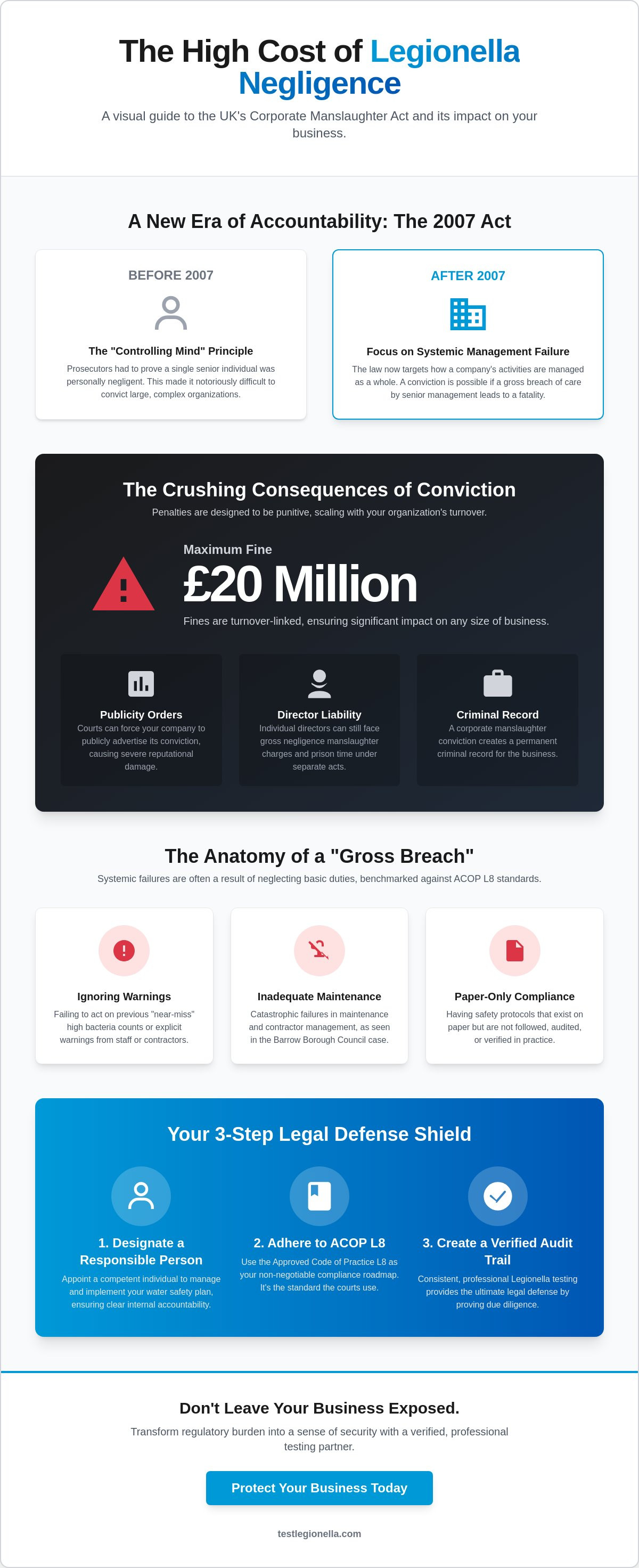
The legal landscape for workplace safety shifted permanently with the introduction of the Corporate Manslaughter and Corporate Homicide Act 2007. Before this legislation, prosecuting a large company was notoriously difficult because of the "identification principle." Prosecutors had to prove that a single "controlling mind" at the top of the firm was personally responsible for the negligence. This often allowed organizations with complex management structures to escape accountability even after fatal incidents.
Today, the law focuses on systemic management failure. A company can be found guilty if the way its activities are managed or organized by senior management causes a person’s death and amounts to a gross breach of a relevant duty of care. When analyzing corporate manslaughter legionella cases uk, it's clear that the courts look for a breakdown in the entire safety culture rather than a one-off technical error. If your water safety protocols exist only on paper but aren't followed in practice, your organization is at high risk.
Your duty of care as an employer or property owner is non-delegable. This means that while you can hire a contractor to perform tasks, you cannot outsource your legal responsibility for the results. Managing a water system requires constant vigilance to prevent the growth of Legionella bacteria. A failure to provide this basic level of safety is often viewed as a fundamental breach of the social contract between a business and the public.
The Threshold for a Gross Breach
A breach is considered "gross" when the conduct falls far below what is reasonably expected in the circumstances. In most corporate manslaughter legionella cases uk, the prosecution will use the Approved Code of Practice L8 (ACOP L8) as the benchmark for acceptable behavior. If you haven't followed this guidance, you're essentially providing the evidence for your own prosecution. The Crown Prosecution Service (CPS) pays close attention to whether an organization ignored previous warnings, failed to act on "near-miss" high bacteria counts, or neglected recommendations from a previous risk assessment.
Impact on Business Continuity and Reputation
The consequences of a conviction extend far beyond the initial fine. Courts frequently issue publicity orders, which require a convicted company to publicize the details of its offense, the fine imposed, and the terms of any remedial order. This public shaming can lead to a total loss of client trust and the cancellation of major contracts. While the company faces unlimited fines, individual directors can still be prosecuted for gross negligence manslaughter or under the Health and Safety at Work Act. Protecting your business starts with professional Legionella Compliance Testing to ensure your safety systems are actually working and your audit trail is bulletproof.
Landmark UK Legionella Cases: Lessons from History
The history of safety legislation is often written in the aftermath of tragedy. Examining high-profile corporate manslaughter legionella cases uk reveals a consistent pattern: these incidents weren't caused by sophisticated technical failures. Instead, they were the result of basic management oversights and a lack of rigorous oversight. Understanding these precedents is the first step toward building a water safety culture that protects both your people and your professional reputation.
When legal experts review past outbreaks, they look for evidence of "systemic failure." This isn't about one person forgetting a single task. It's about an organization failing to implement a robust, verified safety process. The Crown Prosecution Service guidance on corporate manslaughter emphasizes that the way an activity is managed by senior staff is the primary factor in determining criminal liability. These cases serve as a stark reminder that ignorance of the water system's condition is never a valid legal defense.
The Barrow Borough Council Incident
In 2002, an outbreak in Barrow-in-Furness became one of the most significant moments in UK health and safety history. A poorly maintained air conditioning cooling tower at a local arts center led to 179 people falling ill and seven deaths. The investigation uncovered a catastrophic failure in maintenance and contractor management. While the lead architect was eventually acquitted of manslaughter, the council was fined £125,000 for health and safety breaches. This case was a primary catalyst for the 2007 Act. It proved that the old legal framework struggled to hold large organizations accountable for collective negligence, leading to the tougher standards you face today.
The JTF Warehouse Case (Stoke-on-Trent)
The 2012 outbreak at a JTF Wholesale warehouse in Stoke-on-Trent highlighted the dangers of "set and forget" equipment. A hot tub on display, which hadn't been properly filtered or chemically treated, became a breeding ground for bacteria. This incident resulted in 21 people falling ill and three deaths. The company was eventually fined £1 million, later reduced on appeal, but the financial and reputational damage was terminal. This case is a warning for any business that operates non-traditional water features or display units. They require the same level of professional Legionella testing and monitoring as a complex industrial cooling system.
Common themes across these cases include a total absence of a valid risk assessment and a failure to verify that contractors were actually doing the work they were paid for. In many instances, the organizations had the right intentions but lacked the verified data to prove their systems were safe. You don't have to leave your compliance to chance. By implementing a structured testing regime, you create a permanent audit trail that demonstrates your commitment to safety and protects your organization from the devastating consequences of a gross breach.
The Legal Framework: Penalties and Sentencing Guidelines
The 2016 sentencing guidelines changed the stakes for every UK business owner. While Section 3 of the Health and Safety at Work Act (HSWA) penalizes the failure to manage risks, a corporate manslaughter conviction addresses the fatal consequences of systemic management neglect. In corporate manslaughter legionella cases uk, the court's priority is determining the level of culpability at the senior management level. Following the HSE guidance on Legionnaires' disease provides the technical framework you need to avoid being categorized as "high culpability" during a trial.
Sentencing is a mathematical process. Judges look for aggravating factors, such as evidence that you cut costs at the expense of safety or ignored previous warnings from water safety audits. Conversely, proactive risk management serves as a powerful mitigating factor. By maintaining a rigorous regime of professional testing and documentation, you demonstrate a clear commitment to safety that can significantly reduce potential penalties. When investigating corporate manslaughter legionella cases uk, authorities look for proof that you took every reasonable step to prevent an outbreak.
Financial Penalties for Different Business Sizes
The Sentencing Council's Definitive Guideline, which came into force on February 1, 2016, ensures that fines are proportionate to an organization's size and turnover. These fines are designed to be punitive and cannot be written off as a business expense.
- Large Organizations (Turnover over £50m): High culpability starting point is £7.5 million, with a range up to £20 million.
- Medium Organizations (Turnover £10m to £50m): High culpability starting point is £5 million, with a range up to £7.5 million.
- Small Organizations (Turnover £2m to £10m): Fines for high culpability range from £540,000 to £2.8 million.
- Micro Organizations (Turnover under £2m): Even the smallest firms face fines up to £800,000 for high culpability.
It's vital to recognize that criminal fines for safety breaches are rarely covered by insurance policies. This means a conviction could lead directly to insolvency or the total collapse of the business.
Individual Prosecution under Section 7 and 37
A corporate conviction doesn't shield individuals from personal accountability. Under Sections 7 and 37 of the HSWA, directors and managers can face criminal charges if a safety breach is linked to their personal neglect or consent. In the most severe instances, prosecutors may pursue gross negligence manslaughter charges against individuals. This path often leads to significant custodial sentences in prison. Additionally, the courts have the power to disqualify a convicted individual from acting as a company director for up to 15 years, effectively ending their professional career.
A Compliance Roadmap: How to Avoid Prosecution
Turning the lessons from historical corporate manslaughter legionella cases uk into a practical safety strategy is the most effective way to protect your organization. Compliance isn't a one-off event; it's a continuous cycle of assessment and verification. By following a structured roadmap, you transform a complex regulatory burden into a manageable routine. This approach guarantees safety for your occupants and provides legal security for your stakeholders. It moves your business from a state of reactive anxiety to one of proactive control.
Appointing and Training the Responsible Person
The law requires you to appoint a "Responsible Person" to take charge of Legionella control. This shouldn't be a nominal appointment given to someone without the time or authority to act. This individual needs sufficient knowledge of your water systems and the power to implement changes or stop work if risks are identified. They are the frontline defense against the systemic management failures often cited in corporate manslaughter legionella cases uk. Regular competency reviews ensure this person stays updated on evolving safety standards and technical requirements, keeping your organization on the right side of the law.
The Role of Professional Risk Assessments
A valid Legionella Risk Assessment (LRA) is the foundation of your legal defense. While DIY templates might seem cost-effective, they frequently fail to identify site-specific risks, leaving you exposed in court. A professional assessment provides a clear, prioritized list of actions to bring your system into compliance with ACOP L8. You must review this assessment whenever there's a change to the water system, its use, or the building’s occupancy. Even without changes, regular reviews are necessary to account for the natural aging of plumbing and equipment. This structured oversight ensures that no hidden hazards develop over time.
To move from uncertainty to verified compliance, follow these essential steps:
- Conduct a comprehensive, professional Legionella Risk Assessment.
- Maintain an up-to-date schematic diagram of all water systems.
- Implement a written scheme of precautions to control identified risks.
- Monitor water temperatures monthly: keep hot water above 50°C and cold below 20°C.
- Verify the effectiveness of your controls through periodic sampling.
Verification is the final, crucial step in your roadmap. You can't manage what you don't measure. Independent, professional Legionella Compliance Testing provides the scientific evidence that your scheme of precautions is working. It creates a "due diligence" audit trail that is invaluable if your safety protocols are ever scrutinized by the HSE or the courts. Secure your business today by establishing a routine that prioritizes accuracy over guesswork.
Professional Testing as Your Ultimate Legal Defense
Your safety record is your most powerful shield in the event of an investigation. While landmark corporate manslaughter legionella cases uk often highlight management failure, they also reveal a lack of verified data. You can't rely on assumptions when the stakes involve criminal prosecution and massive financial penalties. Professional water sampling provides the scientific evidence needed to prove that your control measures are actually working. It transforms your compliance from a set of intentions into a robust, irrefutable audit trail of due diligence.
Moving from reactive maintenance to proactive compliance is the only way to ensure long-term security. If an outbreak occurs, the HSE will scrutinize your records to see if you took every reasonable step to prevent it. A history of clean, lab-verified test results is the strongest evidence you can present. It shows that you didn't just have a plan on paper, but you actively monitored your system's health. This level of detail is exactly what separates a responsible organization from one facing high-culpability charges in court.
Why Professional Testing Trumps Visual Checks
Legionella bacteria are invisible and can thrive even in systems that appear clean. While temperature monitoring is a vital part of your routine, it isn't a substitute for laboratory analysis. Temperature only tells you if the conditions are right for growth; it doesn't tell you if the bacteria are actually present. Lab-verified results provide the certainty that visual inspections simply can't match. Having a specialist partner manage your testing schedule takes the guesswork out of compliance, ensuring you never miss a critical sampling window and always have the data you need.
Secure Record Keeping and Reporting
The law requires you to maintain accurate records of your Legionella control measures for at least five years. This isn't just a bureaucratic hurdle; it's your primary defense during a safety audit. If you can't produce the records, the law assumes the work wasn't done. Digital compliance reports simplify this process by providing a centralized, easily accessible history of your water safety. During an HSE inspection, being able to instantly produce clear, professional reports demonstrates a level of competence that immediately builds trust with regulators.
Don't leave your organization's future to chance. Expert verification is the final piece of the compliance puzzle that gives you total peace of mind. Protect your business with professional Legionella compliance testing from Test Legionella and ensure your water systems meet the highest standards of safety and legal rigor.
Secure Your Organization with Verified Compliance
Managing water safety is more than a technical requirement; it's a fundamental pillar of your organization's legal and ethical framework. We've seen how the shift toward systemic management failure has redefined the legal landscape, as demonstrated by landmark corporate manslaughter legionella cases uk. Avoiding these severe risks requires a proactive roadmap built on a valid risk assessment and the appointment of a competent responsible person who has the authority to act. Professional verification remains the ultimate safeguard against the threat of unlimited fines and criminal prosecution.
By utilizing expert UKAS-accredited lab analysis and comprehensive compliance reporting, you create a permanent shield of legal protection for your stakeholders. We provide national coverage with a direct, professional service designed to simplify your regulatory obligations and remove the stress of maintenance. Book your professional Legionella compliance testing today to transform your complex safety requirements into a state of total tranquility. Protecting your people and your reputation doesn't have to be a source of anxiety. With the right specialist partner, you can maintain a safe environment and lead your business with absolute confidence.
Frequently Asked Questions
Can a landlord be charged with corporate manslaughter for Legionella?
Yes, any incorporated landlord, such as a housing association or a private property company, can be prosecuted if a tenant's death results from a gross breach of duty. The prosecution must prove that the failure was systemic and managed at a senior level. Individual landlords who aren't incorporated can't be charged under the 2007 Act but may face charges for gross negligence manslaughter instead.
What is the maximum fine for a Legionella-related corporate manslaughter conviction?
There is no statutory limit on the fine a court can impose for corporate manslaughter. Under the 2016 sentencing guidelines, fines are linked to the organization's annual turnover. For a large organization with turnover exceeding £50 million, the starting point for a high-culpability offense is £7.5 million, with the potential for the fine to reach £20 million in the most severe cases.
How does the HSE decide whether to prosecute for manslaughter or a safety breach?
The decision depends on the severity of the negligence and whether a fatality occurred. The HSE and Crown Prosecution Service look for evidence of a "gross" breach, which means the conduct fell far below what is reasonably expected. While many corporate manslaughter legionella cases uk involve fatalities, the HSE may opt for a Section 3 Health and Safety at Work Act prosecution if the systemic failure is clear but doesn't meet the high threshold for manslaughter.
Does having a Legionella risk assessment protect me from prosecution?
A risk assessment only provides protection if its findings are actively implemented and reviewed. Simply owning a document isn't a legal defense if you've ignored the recommended remedial actions or failed to maintain a written scheme of precautions. To avoid prosecution, you must demonstrate that you've followed the assessment's roadmap and maintained a verified audit trail through regular Legionella compliance testing.
What are the most common causes of Legionella-related deaths in the UK?
Most fatalities are linked to poorly managed cooling towers, complex hot and cold water systems in large buildings, and spa pools. For example, the Barrow-in-Furness outbreak was caused by a cooling tower, while the Stoke-on-Trent incident involved a display hot tub. These systems provide the ideal temperature and aerosolization required for the bacteria to spread. Regular testing is the only way to confirm these hidden risks are under control.
Can an individual manager go to prison for a Legionella outbreak?
Yes, individual managers and directors can face custodial sentences if they're found personally liable. While the company faces corporate manslaughter charges, individuals can be prosecuted for gross negligence manslaughter or under Section 7 of the Health and Safety at Work Act. If the court finds that the breach happened with your consent or was attributable to your neglect, you could face imprisonment and a permanent disqualification from acting as a director.
How often should a business conduct water testing to remain compliant?
The frequency of testing is determined by your specific risk assessment and the complexity of your water system. While monthly temperature monitoring is standard for most commercial buildings, high-risk systems or those with vulnerable occupants often require quarterly Legionella sampling. You should also conduct testing after any significant system changes or if previous results show elevated bacteria levels. Consistent testing ensures your safety protocols remain effective and legally defensible.
Is corporate manslaughter insurance available for UK businesses?
Insurance policies can cover the significant costs of legal representation and defense during a trial, but they can't pay criminal fines. In the UK, it's against public policy for an insurer to indemnify an organization against a fine imposed by a criminal court. This means that while your legal fees might be covered, the multi-million pound fines associated with corporate manslaughter legionella cases uk must be paid directly from your organization's own funds.