
What if the biggest threat to your property business isn't a missed rent payment, but a silent compliance gap in your water system? Many UK landlords mistakenly believe that a Legionella check is a "once-and-done" task, only to find themselves facing fines of up to £20,000 from Magistrates' courts. It's completely understandable if you feel frustrated by the conflicting advice surrounding water safety. Unlike gas safety checks, there's no single statutory expiry date, which often leads to the urgent question: how often should a landlord do a legionella risk assessment to remain legally protected?
We're here to turn that regulatory anxiety into total peace of mind. This 2026 guide provides the exact timelines you need to keep your tenants safe and your business compliant with the Health and Safety at Work etc. Act 1974. You'll discover the vital difference between "regular" reviews and industry best practices, the specific triggers that demand an immediate re-assessment, and how to document your "Compliance Care" to satisfy any HSE inspection. Let's make your water safety management simple, certain, and stress-free.
Key Takeaways
- Understand that while there's no fixed expiry date, industry best practices reveal exactly how often should a landlord do a legionella risk assessment to remain legally protected.
- Identify the five critical triggers, such as tenant turnover or plumbing modifications, that immediately void your current assessment and require a professional review.
- Learn the HSE "competent person" requirements to ensure your documentation stands up to legal scrutiny and protects you from prosecution.
- Discover practical maintenance routines, including monthly temperature checks and showerhead hygiene, that maintain safety between formal assessments.
- Shift from reactive stress to proactive security by using a "Compliance Care" system that automates your record-keeping and renewal reminders.
The Legal Frequency: Is There a Legionella Risk Assessment Expiry Date?
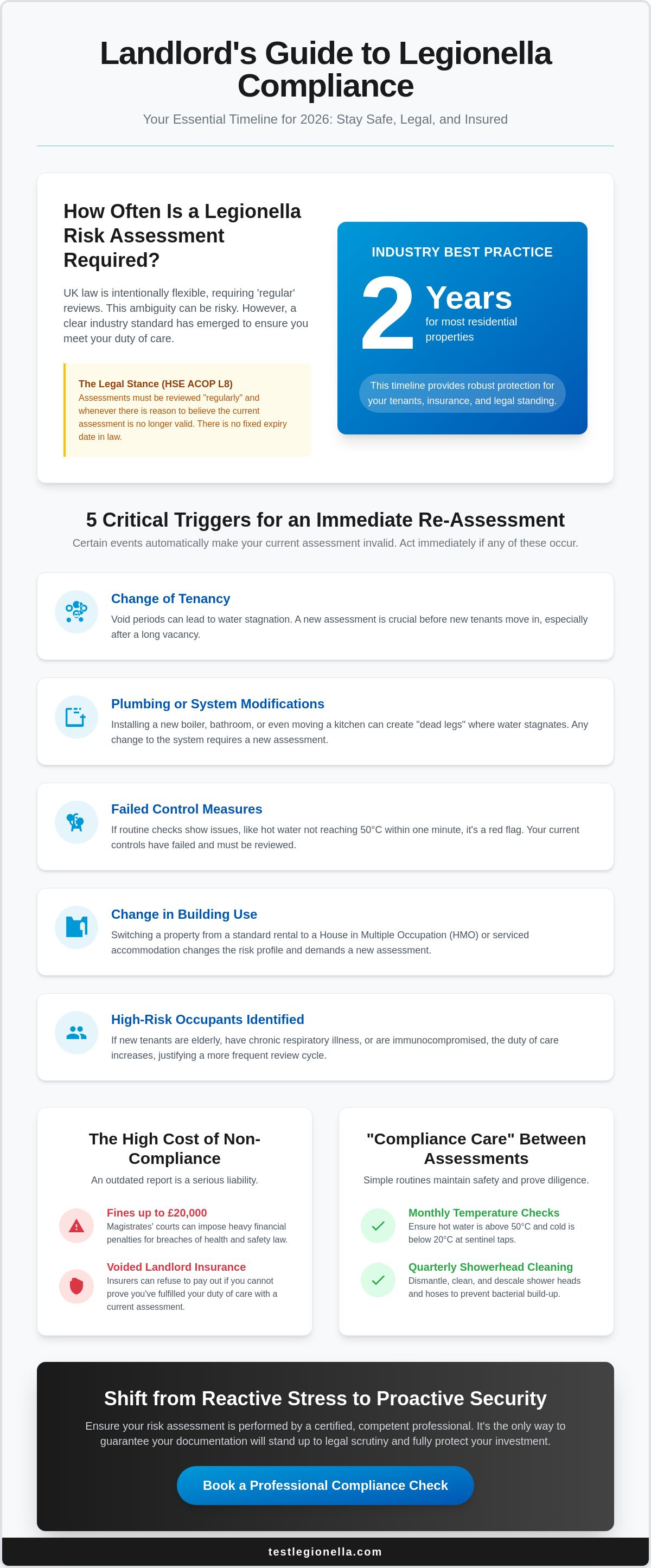
Many landlords search for a specific expiry date similar to the annual Gas Safety certificate (CP12). However, UK law doesn't provide a fixed statutory deadline for water safety. Instead, the Health and Safety Executive (HSE) mandates that your assessment must be reviewed "regularly" or whenever there is reason to believe it is no longer valid. This ambiguity often leaves property owners asking: how often should a landlord do a legionella risk assessment to stay on the right side of the law? For most standard residential properties, a review every two years has become the industry benchmark for safety and compliance.
Your landlord insurance policy is often the most compelling reason to stick to this two-year schedule. If a tenant were to contract Legionnaires' disease at your property, your insurer will immediately ask for your latest compliance report. If your assessment is five years old and hasn't been reviewed, you may find your liability cover is void. An outdated report suggests a failure in your management process, leaving you personally exposed to heavy fines or even criminal prosecution in the Magistrates' court. Keeping your assessments current is the only way to ensure your legal and financial protection remains intact.
ACOP L8 and Your Duty of Care
The Health and Safety at Work etc. Act 1974 applies to all landlords, including those who are self-employed or only own a single property. Under the Approved Code of Practice L8 (ACOP L8), you must show that you've considered the risks. Our "Compliance Care" approach simplifies this by distinguishing between a "Review" and a "Full Re-assessment." A review checks if your existing controls still work, while a full re-assessment is necessary if your water system or tenant profile has changed significantly. This proactive management keeps you compliant without unnecessary complexity.
Why "Once and Done" is a Dangerous Compliance Myth
The biggest mistake is treating water safety as a one-time task. Stagnant water is the primary breeding ground for bacteria, making void periods between tenancies particularly high-risk. If your report is outdated, it loses its legal standing in a courtroom because it doesn't reflect the current state of the property. When considering how often should a landlord do a legionella risk assessment, remember that a "once and done" attitude is a gamble with your reputation. The landlord's primary duty of care is to identify and assess sources of risk, and thereafter implement and maintain measures to control that risk.
The 5 Critical Triggers for an Immediate Risk Assessment Review
While a two-year review is a reliable benchmark for many, you cannot always wait for the calendar to flip. Certain events immediately void your existing documentation. If you're wondering how often should a landlord do a legionella risk assessment, the answer is often "the moment things change." According to official guidance from the Health and Safety Executive, any "significant change" to the water system or the way a building is used requires a fresh look at your safety protocols.
Failed monitoring is another non-negotiable trigger. If your monthly temperature checks reveal that hot water isn't reaching 50°C within one minute at the furthest tap, your current control measures have failed. This is a red flag that demands an immediate review. You must investigate the cause and update your assessment to ensure your tenants remain protected and your legal standing remains secure. Ignoring these warning signs is a fast track to the heavy fines mentioned earlier.
Structural and Systemic Changes
Physical modifications to your property are the most obvious triggers for a re-assessment. Adding a new en-suite, installing a hot water cylinder, or even moving a kitchen can create "dead legs." These are sections of redundant pipework where water stagnates, providing a perfect breeding ground for bacteria. Switching from a traditional gravity-fed system with a cold water storage tank to a modern combi boiler also fundamentally changes your risk profile. If you've recently upgraded your heating or plumbing, you can book a professional compliance check to verify your new setup is safe.
Operational and Occupancy Triggers
Tenant turnover is the most frequent reason for a review in the residential sector. When a property sits empty for as little as 21 days, the lack of water flow leads to stagnation. You should always review your assessment at the start of a new tenancy to ensure the system has been properly flushed and cleaned. Changes in tenant vulnerability also matter. If a new resident is over 65 or has a known respiratory condition, the risk level of the property increases. Furthermore, a change in building use, such as converting a single-family home into a high-occupancy HMO, can spike Legionella risks by significantly increasing the complexity of the internal plumbing and the demand on the system.
Who Can Perform the Assessment? DIY vs. Professional Competence
One of the most common questions regarding how often should a landlord do a legionella risk assessment is who actually has the authority to sign it off. While some industry bodies suggest that landlords can perform their own checks to save on costs, the legal reality is more nuanced. According to the HSE guidance for landlords, the person carrying out the assessment must be "competent." This means they need the necessary skills, knowledge, and experience to identify hazards that aren't always visible to the untrained eye.
Relying on a free online template might seem like a quick fix, but it often creates a false sense of security. These generic tick-box forms rarely account for the specific complexities of your property's pipework or the unique risks posed by aerosol-generating fixtures. If an outbreak occurs, a DIY report may be dismissed in court as "insufficient." Professional testing provides a robust shield of compliance. It delivers an independent, unbiased record that proves you've met your duty of care with technical precision, protecting you from the unlimited fines possible in a Crown court.
The Legal Definition of Competence
Under ACOP L8, competence isn't just about being able to read a thermometer. You must have the technical knowledge to identify risks from aerosols, such as those created by power showers, spray taps, or even decorative water features. The law requires the assessor to have "sufficient authority" to ensure the assessment is carried out effectively. Crucially, professional assessors carry professional indemnity insurance. If you perform a DIY check and miss a hidden "dead leg" or a faulty thermostatic mixing valve, the legal and financial liability rests entirely on your shoulders. Professional competence removes this personal risk from your plate.
The Benefits of Professional Compliance Testing
Our professional approach goes far beyond a simple inspection. We provide accurate temperature profiling across the entire system and create detailed mapping of your property's water assets. This level of detail allows us to provide clear remedial action plans that can actually save you money. Instead of guessing which parts of your system need work, you receive a prioritised list of fixes. We make compliance "Made Easy" by delivering rapid turnarounds and clear, jargon-free reports. When you consider how often should a landlord do a legionella risk assessment, choosing a professional partner ensures that every review is a step toward total peace of mind rather than a legal gamble.
Maintaining Your Property: Best Practice Between Assessments
Compliance is a live process, not a static document. While the legal answer to how often should a landlord do a legionella risk assessment often focuses on a biennial review, your practical duty of care happens every single month. Between professional visits, you must act as the primary guardian of your property's water safety. This involves simple but critical checks that prevent Legionella bacteria from colonizing your pipework. By maintaining a steady routine, you ensure that the findings of your last assessment remain valid and that your tenants stay protected from the risk of aerosol-borne pathogens.
The Landlord’s Monthly Maintenance Checklist
Creating a paper trail is your best defense against liability. If an inspector or insurer asks for proof of your management, a well-documented maintenance log proves you are a responsible property owner. Focus your efforts on these three core areas:
- System Flushing: Any outlet that isn't used for a 7-day period, such as a guest bathroom or an outdoor tap, must be flushed. Run the water for several minutes to clear stagnation and remove potential biofilms.
- Temperature Benchmarks: Use a digital thermometer to check that your hot water reaches at least 50°C at the outlet within 60 seconds. Conversely, cold water should stay below 20°C after running for two minutes.
- Showerhead Hygiene: Showerheads are the most common site for aerosol-borne Legionella because they create a fine mist that is easily inhaled. Clean and descale them at least once every three months to prevent the buildup of scale and slime.
Managing "dead legs" is equally important. If you've capped off a radiator or removed a sink, ensure the remaining pipework is as short as possible. These stagnant branches are breeding grounds that can contaminate the entire system. If you're unsure about the layout of your plumbing, you can book a professional Legionella risk assessment today to identify these hidden hazards before they become a legal or health crisis.
Tenant Communication and Safety
Your tenants are your eyes and ears on the ground. It's vital to educate them on their role in maintaining a safe water system. Provide them with a simple information sheet that explains why they shouldn't adjust the boiler's thermostat settings. Legionella bacteria thrive specifically between 20°C and 45°C, so keeping the water outside of this range is the most effective way to inhibit growth. Encourage them to report "stuttering" taps or sudden changes in water pressure immediately, as these can indicate air pockets or debris in the system that might encourage bacterial colonization. By working together, you create a robust safety culture that makes compliance "Made Easy" for everyone involved.
Secure Your Peace of Mind with Professional Compliance Care
Managing water safety doesn't have to be a source of constant anxiety. While the question of how often should a landlord do a legionella risk assessment can feel complex, partnering with a specialist transforms this regulatory burden into a streamlined management process. At Test Legionella, we don't just provide a one-off report. We offer a comprehensive "Compliance Care" partnership designed to protect your tenants and your reputation. By choosing a professional service, you move from a state of uncertainty to one of total security, backed by expert knowledge and rigorous testing standards.
Our approach is built on transparency and reliability. We understand that landlords and property managers need predictable costs and clear outcomes. That's why we provide fixed-fee pricing for both residential and commercial properties, ensuring there are no hidden surprises in your maintenance budget. We handle the technical details so you can focus on the day-to-day management of your portfolio, knowing that your legal duty of care is fully satisfied and documented.
Our Professional Testing Process
Efficiency is at the heart of our service. Our qualified water safety specialists conduct fast, reliable site visits that minimize disruption to your tenants. Once the assessment is complete, we provide easy-to-understand compliance reports that avoid dense legal jargon. These reports include clear, prioritised remedial actions, allowing you to address any high-risk areas immediately. To ensure you never fall out of compliance, our system tracks your assessment dates and sends automated reminders. This proactive approach takes the guesswork out of how often should a landlord do a legionella risk assessment, as we notify you exactly when a review is due.
Getting Started with Test Legionella
Whether you manage a single domestic property in the Midlands or a large national commercial portfolio, our team is ready to assist. We combine national coverage with expert local knowledge to provide a service that is both personal and professional. Requesting a quote is simple and fast, giving you an immediate path toward full regulatory adherence. Don't leave your property's safety to chance or outdated DIY templates. Protect your tenants and your business—book your professional Legionella risk assessment now. Our specialists are standing by to provide the clarity, competence, and peace of mind you deserve.
Take Control of Your Property Compliance Today
Achieving water safety compliance doesn't have to be a source of constant stress. We've explored the 2026 legal landscape, highlighting that while statutory annual dates don't exist, a biennial review is the safest benchmark for most UK residential properties. You now understand that immediate triggers like tenant turnover or system modifications void your current report. Most importantly, you know that professional competence is the only way to secure a robust legal shield for your business.
Determining exactly how often should a landlord do a legionella risk assessment depends on your unique property profile, but regular, professional oversight is non-negotiable. At Test Legionella, we make this process seamless. Our fast, reliable UK-wide testing and professional compliance reports are designed for busy landlords who value accuracy and speed. We even handle the tracking for you, providing automated reminders so you never miss a critical review date.
Don't leave your legal protection to chance or outdated paperwork. Take the first step toward stress-free management right now.
Get My Fixed-Fee Legionella Assessment Quote
Let us handle the technical details while you enjoy the peace of mind that comes with total compliance.
Frequently Asked Questions
Is a Legionella risk assessment a legal requirement for UK landlords?
It's a mandatory legal requirement for all UK landlords to assess and control the risk of Legionella exposure. You must comply with the Health and Safety at Work etc. Act 1974 and the Control of Substances Hazardous to Health Regulations 2002. This duty applies to all residential properties, regardless of the size or type of tenancy. Failing to provide a safe water system can lead to prosecution even if no one becomes ill.
Can I carry out a Legionella risk assessment myself?
You can carry out the assessment yourself if you are competent to do so. The HSE defines competence as having the necessary skills, knowledge, and experience to manage the specific risks in your water system. However, many landlords choose professional testing to ensure they haven't missed hidden hazards like dead legs or aerosol sources. Professional reports offer a higher level of legal protection and total peace of mind.
Do I need a Legionella certificate for my rental property?
There is no legal requirement for a formal "Legionella certificate" in the same way you need a Gas Safety record. The law requires a valid and sufficient risk assessment and proof that you are managing the risks effectively. While some providers issue a certificate of completion, the actual risk assessment document is what you must produce to demonstrate compliance during an inspection or insurance claim.
What happens if I don’t have a valid Legionella risk assessment?
Failing to maintain a valid assessment can lead to significant penalties, including fines of up to £20,000 in Magistrates' courts. In severe cases involving the Crown Court, fines are unlimited and can include prison sentences of up to two years. Additionally, your landlord insurance may be voided if you cannot prove you met your duty of care. This leaves you personally liable for any legal costs or damages.
How much does a professional Legionella risk assessment cost in 2026?
For a single domestic property in 2026, a professional Legionella risk assessment typically costs between £50 and £200. These prices can vary based on the complexity of the water system and the property location. Many letting agents offer lower rates when booking multiple assessments across a portfolio. Investing in a professional report is a small price to pay compared to the potential £20,000 fine for non-compliance.
What is considered a "low risk" water system in a rental property?
A low-risk system is generally one found in a standard domestic house with a combi boiler and no water storage tanks. If the property has small, simple water systems where outlets are used daily, the risk of bacterial growth is significantly reduced. However, you must still conduct an initial assessment to confirm this status. This helps you decide how often should a landlord do a legionella risk assessment for that specific property.
How long should I keep records of my Legionella risk assessments?
You should keep records of your Legionella risk assessments and all monitoring results for at least five years. This includes temperature logs, flushing records, and any remedial work carried out. Maintaining a clear five-year history provides robust evidence that you have consistently managed the water safety in your property. It's a vital part of your "Compliance Care" strategy to protect against future legal challenges.
Does a flat in a block of flats need its own Legionella risk assessment?
Yes, each individual flat requires its own assessment to cover the internal pipework and fixtures like showers and taps. While the block manager or freeholder is responsible for the communal water storage and rising mains, the landlord is responsible for the system inside the demised property. Ensuring your flat has its own report is essential for meeting your specific duty of care to your tenants.