
Since lockdown restrictions eased, positive Legionella samples in UK buildings have jumped by 20%, making the question of how often should legionella testing be carried out in UK offices more urgent than ever. You probably find that managing safety across a multi-tenanted building is a headache of conflicting codes like ACoP L8 and HSG274. It's frustrating when the law doesn't provide one single date to circle on your calendar, leaving you worried about potential HSE fines or legal action.
This guide cuts through the technical jargon to provide the definitive compliance schedule you need to keep your team safe and your business protected. We'll break down the 2026 requirements, explain the vital difference between monthly monitoring and annual sampling, and help you establish a stress-free maintenance rhythm. Our goal is to transform this complex regulatory burden into total peace of mind through our proven Compliance Care approach. Discover how to stay on the right side of the law while ensuring your office remains a safe place to work.
Key Takeaways
- Identify your legal role as a Duty Holder or Responsible Person to ensure your office remains fully compliant with ACoP L8 and HSG274 standards.
- Understand exactly how often should legionella testing be carried out in UK offices based on your specific water system risk level and usage patterns.
- Learn the five critical trigger events, such as plumbing modifications or building renovations, that require an immediate review of your current risk assessment.
- Master a structured "Compliance Care" calendar to streamline your weekly, monthly, and annual water safety tasks without the stress of manual tracking.
- Discover how to maintain a robust logbook and use professional reporting to turn complex regulatory burdens into a simple path for safety.
Understanding the Legal Requirements for Office Water Safety
Legislation around water safety can feel like a maze, but the foundation rests on two primary roles: the Duty Holder and the Responsible Person. In a typical UK office lease, the Duty Holder is often the employer or the building owner who has control over the premises. Their legal job is to identify and assess risks. The Responsible Person is the individual appointed to manage the day-to-day control measures. Both roles are governed by the Health and Safety Executive’s (HSE) Approved Code of Practice L8 (ACOP L8) and HSG274 guidance. These aren't just suggestions; following them is the standard way to prove you’ve met your legal duties under the Health and Safety at Work Act 1974.
The Legionella Risk Assessment (LRA) vs. Water Testing
One of the most common points of confusion for office managers is the difference between an assessment and a physical test. Think of the Legionella Risk Assessment (LRA) as your strategic blueprint. It identifies where bacteria could grow and outlines how to prevent it. Physical water testing, or microbiological sampling, is the act of sending water to a lab to check for the presence of bacteria. While an LRA is a legal requirement for every business, physical sampling is determined by the risk level found during that assessment. If you're wondering how often should legionella testing be carried out in UK offices, it's vital to remember that monitoring temperatures is a constant legal duty, while lab sampling frequency depends on your specific system’s complexity. You can find more detail in our ACOP L8 guide which outlines these legal nuances.
Understanding Legionnaires' disease is the first step in recognizing why these regulations exist. The bacteria thrive in man-made water systems. Without a clear strategy, your office could unintentionally become a breeding ground.
Why Offices Are Unique Environments for Legionella
Offices present specific challenges that domestic properties don't face. Stagnation is the biggest threat. When an office closes for the weekend or a bank holiday, water sits in the pipes. This allows temperatures to rise and biofilm to form. In multi-storey blocks, complex plumbing creates "dead legs" where water rarely flows. Modern energy-saving measures, like lowering water heater temperatures, can also backfire by keeping water within the 20-45°C danger zone. Whether your building uses chilled beams or traditional cooling towers, the way your HVAC interacts with your water supply dictates how often should legionella testing be carried out in UK offices to ensure total safety and compliance.
Determining Your Office Legionella Testing Frequency
Many property managers fall into the trap of thinking a Legionella Risk Assessment is a "set and forget" task to be revisited every 24 months. However, the current compliance landscape focuses on risk rather than just the calendar. If you're asking how often should legionella testing be carried out in UK offices, the answer depends heavily on your building's specific assets. For high-risk "open" systems like cooling towers, the HSE guidance in HSG274 Part 1 is clear; you must conduct microbiological testing at least quarterly. This frequency ensures that any sudden spikes in bacteria are caught before they pose a threat to your staff or the public.
Standard office environments usually have lower risk profiles, but that doesn't mean you can ignore the schedule. While taps and toilets in a small block might only require annual or bi-annual lab sampling, this is only acceptable if your monthly temperature monitoring remains consistent. If your office includes staff showers, these are considered high-risk due to the spray they create. Showers should be descaled and disinfected at least quarterly to prevent the buildup of organic matter that feeds bacteria.
The "Risk-Based" Approach: When to Test More Often
Your testing frequency must increase if your office features complex water systems or modern amenities. Decorative fountains, spa pools, and humidifiers all create aerosols that can be easily inhaled. If your building is older, the plumbing materials themselves might dictate a tighter schedule. Old galvanized steel pipes are prone to corrosion and scale, providing a perfect environment for bacterial growth. Dead legs in plumbing create pockets of stagnant water that necessitate more frequent flushing and targeted testing to prevent bacterial colonization. If you're unsure about your building's specific risks, you can request a compliance review to identify these hidden danger zones.
Standard Office Water Systems: The Baseline
For a standard office with only basic kitchen and bathroom facilities, the primary defense is a temperature control regime rather than constant lab sampling. You should monitor "sentinel" outlets monthly. These are the taps furthest and closest to your water source. Your hot water must reach at least 50°C within one minute, and cold water should stay below 20°C after running for two minutes. In these low-risk settings, physical water sampling is often performed "by exception." This means you only test if your temperature controls fail or if the system is altered. By maintaining this monthly rhythm, you ensure that how often should legionella testing be carried out in UK offices remains a manageable and cost-effective part of your maintenance strategy.
Triggers for Immediate Legionella Testing and Re-Assessment
While establishing a routine is essential, a fixed schedule only works when your building environment remains static. In reality, modern offices are dynamic spaces. Specific "trigger events" legally override your standard calendar, requiring an immediate review of your safety protocols. If you've recently modified your plumbing or changed how your building is used, the question of how often should legionella testing be carried out in UK offices shifts from a scheduled task to an urgent priority. There are five primary scenarios where you must act: physical system changes, changes in building use, new information about risks, failed control measures, and shifts in key personnel.
A failed temperature check is perhaps the most critical trigger. If your hot water sentinel falls below 50°C or cold water rises above 20°C, your primary defense has failed. In this situation, you shouldn't wait for your next scheduled visit. Immediate professional sampling is required to confirm whether bacteria have colonized the system during the temperature fluctuation. Similarly, if your Responsible Person leaves the business, you must review your assessment to ensure the new appointee understands their duties and the system's specific risks.
Physical Changes to the Water System
Office renovations often introduce hidden dangers. Adding a new coffee station or removing a redundant radiator can create "dead legs", which are sections of pipework where water no longer flows. These stagnant areas are prime breeding grounds for bacteria. Since 2024, the rise of hybrid work has led many businesses to "mothball" entire floors. If a wing of your office has been empty for over a week, you cannot simply turn the taps back on. Re-commissioning requires a thorough flush and, in many cases, microbiological testing to ensure the water is safe for returning employees.
Changes in Building Use or Vulnerable Populations
The risk profile of your building isn't just about pipes; it's about people. If your office space is repurposed to include a medical suite or a daycare center, you're now protecting vulnerable populations. This change necessitates a new Legionella risk assessment to account for the increased health stakes. Transitioning to a multi-tenanted model also complicates your schedule, as different businesses may have varying water usage patterns. In these complex scenarios, professional oversight ensures that your compliance remains "Made Easy" despite the shifting logistics of property management.
The Office Compliance Calendar: A Practical Schedule
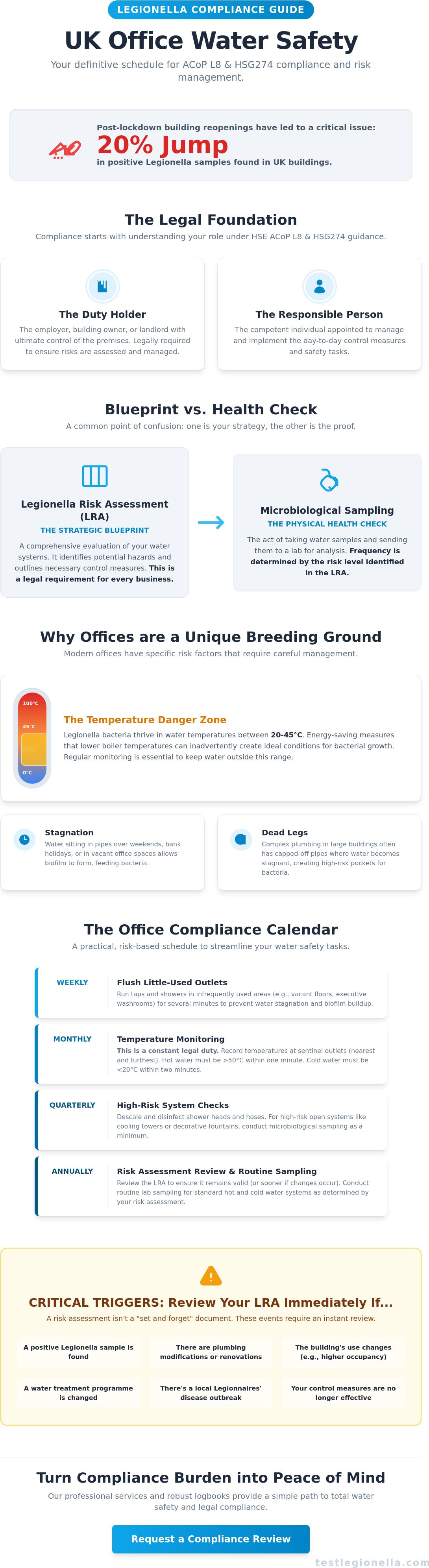
Establishing a clear rhythm for how often should legionella testing be carried out in UK offices ensures you never miss a critical deadline. A central logbook, whether digital or physical, is your most important tool. It acts as a legal shield, proving you've followed ACoP L8 guidelines if an inspector ever visits. All water samples should be processed by UKAS-accredited laboratories to ensure the data is scientifically valid and legally robust. When you receive your report, the results are measured in Colony Forming Units per Litre (CFU/L). A result under 100 CFU/L suggests your system is under control. If a result exceeds 1,000 CFU/L, you must isolate the outlet immediately and perform a system-wide disinfection.
If you encounter a positive test result, the gap between a minor issue and a legal crisis is your response speed. Isolate the affected area, notify your Responsible Person, and arrange for professional chlorination. Documenting this corrective action shows the HSE that your management system is active and effective. To ensure your building meets these high standards, you can book your professional Legionella compliance testing today and let our specialists handle the technical details.
Weekly and Monthly Maintenance Tasks
Consistency is the secret to water safety. You must flush infrequently used outlets, such as guest showers or disabled toilets, for at least two minutes every week to prevent stagnation. Monthly, record temperatures at your sentinel taps, which are the outlets closest and furthest from your water source. Hot water must reach a temperature above 50°C within one minute, while cold water must remain below 20°C after two minutes of flow.
Annual and Professional Requirements
Beyond your monthly checks, certain assets require deeper inspection. If your office uses a cold water storage tank, it needs an internal inspection at least once a year to check for debris or signs of corrosion. Thermostatic Mixing Valves (TMVs), which prevent scalding, should be serviced every six months to ensure they aren't harboring biofilm. For those planning their 2026 maintenance budgets, our Legionella risk assessment cost guide provides a clear breakdown of professional service fees across the UK.
Achieving "Compliance Care" with Professional Support
Managing water safety across a modern building or a multi-site portfolio is a significant administrative burden. Our "Compliance Care" model is designed to lift that weight from your shoulders by turning a complex regulatory requirement into a streamlined, automated process. Once you understand how often should legionella testing be carried out in UK offices, the next challenge is ensuring those dates are never missed. We provide a proactive framework that guarantees your office remains a safe environment for every employee, transforming a legal obligation into a source of professional security.
Adopting a "prevention over cure" mindset is the most effective way to protect your business from the 20% increase in positive samples recorded in UK buildings since 2024. Instead of reacting to failed tests or building closures, professional support focuses on maintaining a steady state of safety. By utilizing automated reminders and professional report tracking, we ensure your digital logbook is always inspection-ready. This level of organization doesn't just shield you from potential HSE fines; it provides the peace of mind that your property is managed by specialists who understand the intricate logistics of property maintenance.
What to Expect from a Professional Testing Service
Our process is built for speed, efficiency, and clarity. From your initial enquiry to the final delivery of your results, we prioritize your time and your building's specific needs. A professional tester identifies risks that an untrained eye will likely miss, such as uninsulated pipework running through warm ceiling voids or poorly positioned expansion vessels that encourage stagnation. These hidden danger zones are often where bacteria thrive. After the site visit, you receive a clear, actionable report that categorizes risks and provides a simple roadmap for any necessary remedial works. Our "Compliance Care" promise means we manage the calendar and the technical details so you don't have to.
Your Next Steps for Office Water Safety
If you're unsure whether your current risk assessment is still valid or if your testing schedule matches the complexity of your building, your first step is a documentation audit. Check the date of your last professional review and ensure it accounts for any hybrid working shifts or plumbing modifications made in the last 12 months. We provide diagnostic tools, including a free compliance score, to help you quickly identify gaps in your current strategy. Don't wait for a failed inspection or a health scare to modernize your approach to water safety. Get a fast, professional quote for your office Legionella testing today and let our experts guide you through the maze of health and safety regulations with ease.
Secure Your Office Water Safety Today
Navigating the complexities of ACoP L8 and HSG274 doesn't have to be a regulatory burden. As this guide has shown, determining how often should legionella testing be carried out in UK offices is a dynamic process driven by your specific building assets and modern usage patterns. From managing the 20% increase in positive samples seen since 2024 to handling the risks of "dead legs" during hybrid work shifts, your safety strategy must stay proactive. Maintaining a robust logbook and recognizing the five major trigger events are your best defenses against HSE fines and potential health risks.
Our Compliance Care approach is designed to transform this technical challenge into total peace of mind. We provide UKAS accredited laboratory testing and a fast turnaround on compliance reports to keep your office running without interruption. Our system includes automated reminders for your next assessment, ensuring you stay ahead of all 2026 requirements. Take the first step toward a safer, stress-free workplace and Get My Office Compliance Quote Today. Professional water safety is finally made easy, allowing you to focus on your business while we protect your people.
Office Water Safety: Frequently Asked Questions
Is Legionella testing a legal requirement for UK offices?
Yes, Legionella testing and risk management are mandatory under the Health and Safety at Work Act 1974 and the COSHH Regulations 2002. Every employer or person in control of a premises must identify and assess the risk of exposure to bacteria. While lab sampling isn't always required for every single tap, maintaining a written risk assessment and a temperature monitoring regime is a strict legal duty.
How often do I need to review my office Legionella risk assessment?
You should review your risk assessment at least every 24 months to ensure it remains current. However, you must update it immediately if there are significant changes to your water system, such as a 10% change in occupancy or a plumbing renovation. High-risk buildings or those housing vulnerable staff often move to an annual review cycle to maintain a higher safety standard.
Can I carry out Legionella testing myself or do I need a professional?
You can perform basic tasks like weekly flushing and monthly temperature checks if you've been trained and deemed competent. However, microbiological lab sampling and the formal risk assessment require specialist knowledge and UKAS-accredited equipment. Professional testing ensures your results are legally defensible and provides the technical expertise needed to spot hidden risks in complex office plumbing.
What happens if Legionella bacteria are found in my office water system?
You must take immediate action if samples return a result higher than 1,000 CFU/L. This involves isolating the affected outlets, notifying your Responsible Person, and carrying out a system-wide disinfection or chlorination. You'll then need to conduct follow-up testing to prove the bacteria levels have dropped below the safety threshold before the water system is returned to normal use.
Do small offices with only a kettle and a toilet need Legionella testing?
Every workplace must have a valid Legionella Risk Assessment, even if the water system is very simple. In a small office, the risk is naturally lower, but you still need to document that the risk has been considered. When deciding how often should legionella testing be carried out in UK offices of this size, the focus is usually on annual temperature checks rather than monthly laboratory analysis.
How long should I keep my Legionella testing records for compliance?
You must keep records of all monitoring inspections, tests, and maintenance for at least 5 years. Your current risk assessment should be kept throughout the period it's active and for at least 2 years after it's replaced. Keeping these records in a digital logbook ensures they're easily accessible during an HSE inspection and provides a clear audit trail of your "Compliance Care" efforts.
What is the difference between ACOP L8 and HSG274?
ACOP L8 is the Approved Code of Practice that outlines your high-level legal responsibilities for controlling Legionella. HSG274 is the technical guidance that explains exactly how to meet those legal requirements in practice. It's helpful to view ACOP L8 as the legal "what" and HSG274 as the technical "how," with the latter providing specific temperature and maintenance schedules for different water systems.
Does my landlord have to provide a Legionella certificate for the office?
Responsibility is determined by your lease agreement, but the "Duty Holder" is generally the person who controls the water system. In many multi-tenanted offices, the landlord is responsible for the main plant room and cold water tanks, while the tenant is responsible for the outlets within their own demised space. You must check your contract to confirm who is liable for the shared and private sections of the building's plumbing.