
Since May 1, 2026, failing to manage water safety is no longer just a technical oversight; it's a criminal offense under the Renters' Rights Act. With the UK Health Security Agency reporting 472 cases of legionellosis in 2024, including 13 fatalities, the pressure to maintain strict compliance has never been higher. You likely feel stuck between the roles of Duty Holder and Responsible Person, worrying about personal liability and the £20,000 fines now being issued by magistrates' courts. Understanding the requirements for legionella testing for responsible persons uk is the first step toward removing that stress and ensuring your property remains safe.
You deserve a clear, jargon-free path to meeting ACOP L8 training standards without the guesswork. This guide provides a complete roadmap to achieving and proving competence, whether you're looking at an £87 online awareness course or a comprehensive £495 virtual training session. We'll break down the specific technical knowledge you need to identify risks and the practical experience required to manage them. By the end of this article, you'll have a professional strategy to handle your legal duties with total confidence and peace of mind.
Key Takeaways
- Clarify the legal distinction between Duty Holders and Responsible Persons to ensure your appointment is formal and HSE-compliant.
- Master the technical requirements of ACOP L8 and HSG274 to build a deep understanding of Legionella control and bacteria growth factors.
- Identify the three pillars of competence, knowledge, skills, and experience, required to oversee legionella testing for responsible persons uk.
- Establish a proactive schedule for refresher training and learn which operational changes trigger a legal need for immediate retraining.
- Explore the benefits of a hybrid compliance model that combines your internal authority with professional specialist sampling and audits.
Defining the Legionella Responsible Person: Roles and Legal Authority
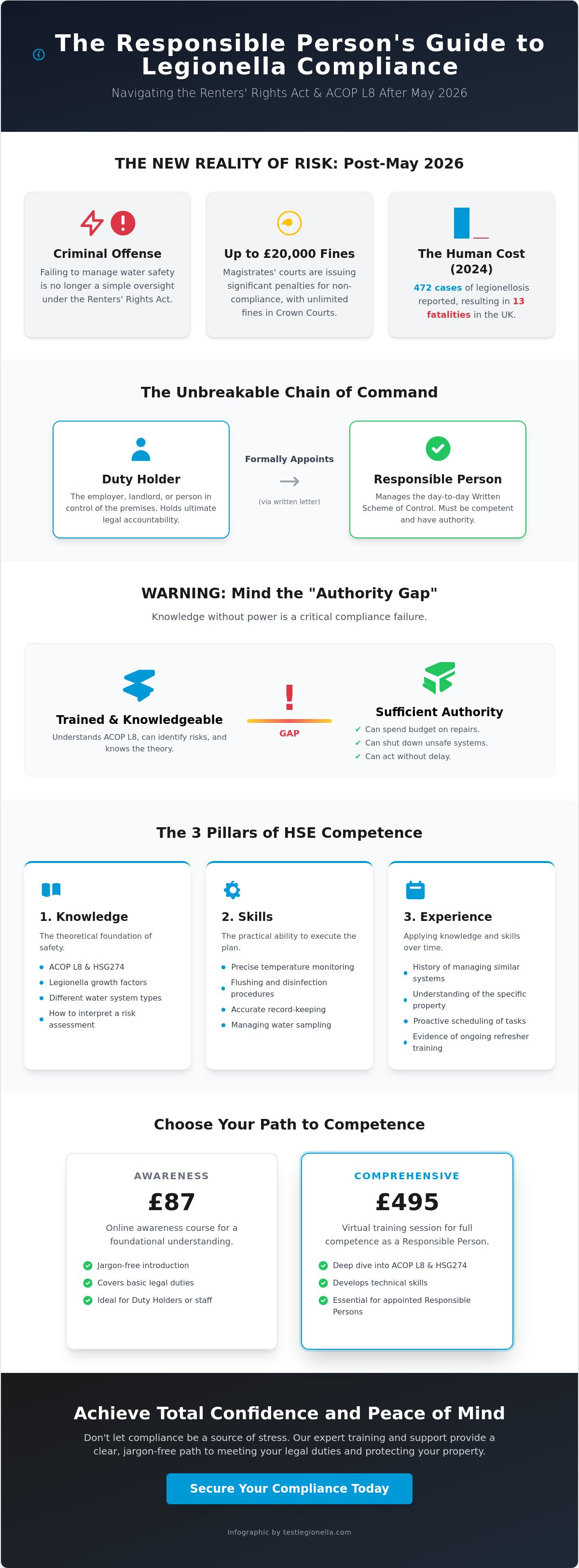
Legionella management isn't a suggestion; it's a statutory requirement. If you're managing a property in the UK, you need to know exactly where the legal buck stops. Under the ACOP L8 guidelines, the hierarchy is clear, but many businesses stumble by treating the 'Responsible Person' role as a minor administrative task. It's a formal appointment that carries significant weight. Failure to appoint a competent person can lead to unlimited fines in Crown Courts or the £20,000 penalties now common in Magistrates' courts following the May 2026 legislative updates. To stay protected, you must understand that competence is a blend of technical knowledge and the power to act.
Duty Holder vs. Responsible Person: Who is Who?
The Duty Holder is typically the employer, the self-employed person, or the person in control of the premises, such as a landlord. They hold the ultimate legal accountability. However, the Duty Holder often appoints a 'Responsible Person' to handle the day-to-day management of the written scheme. This isn't an informal agreement or a "by the way" task. You must document this through a formal, written letter of appointment. This document should outline their specific duties, from overseeing What is Legionnaires' disease? prevention strategies to managing legionella testing for responsible persons uk. If the primary person is away, you should name a Deputy to ensure no gaps in your safety protocols.
The 'Authority Gap': Why Knowledge Isn't Enough
One of the biggest mistakes we see is the "Authority Gap." This happens when a junior staff member is given the title but zero power. To be compliant with HSE guidelines, the Responsible Person must have "sufficient authority." This means they can spend the budget required for remedial works without waiting weeks for a director's signature. They must have the power to shut down a contaminated water system immediately if a risk is identified. If your appointed person can't authorize a £300 repair today, they aren't legally competent for the role. You must document this delegation of financial and operational authority to survive a compliance audit. Without it, the Duty Holder remains wide open to personal liability for health and safety breaches.
Choosing the right person means looking for someone who understands the logistics of your property. They need to be proactive, organized, and, most importantly, empowered. When the HSE or a local authority inspector asks to see your records, they'll look for evidence that the Responsible Person has the autonomy to maintain safety standards. If the role is just a title on a piece of paper, your compliance is a house of cards.
Core Training Requirements for Legionella Competence in 2026
A Responsible Person doesn't just watch from the sidelines. They're the technical engine of the property's safety strategy. By 2026, the HSE expects a high level of literacy regarding the HSE Approved Code of Practice (ACOP L8). This document, alongside the three parts of HSG274, forms the backbone of your legal defense. You must understand how to translate these regulations into a site-specific Written Scheme of Control. It's not enough to have a generic folder; the scheme must reflect the actual pipework, storage tanks, and outlets in your building. Understanding these requirements is vital for anyone overseeing legionella testing for responsible persons uk in commercial or residential settings.
The Theoretical Foundation: ACOP L8 and HSG274
Your theoretical training must distinguish between different system types. Hot and cold water systems are the most common, but you may also manage cooling towers or "other" risk systems like spa pools or decorative fountains. Each has unique growth factors and requires a tailored management plan. Biology plays a central role here. You must recognize that Legionella bacteria aren't just a random threat; they're a manageable biological risk. They flourish in water temperatures between 20°C and 45°C, especially where there's scale, rust, or bio-film to feed on. Learning to interpret a water risk assessment helps you spot these vulnerabilities before they become a health crisis.
Technical Skills: From Temperatures to Testing
Your training must include the "how" of monitoring. This includes the precise method for monthly temperature checks. You're looking for hot water to hit 50°C (or 55°C in healthcare settings) within one minute and cold water to remain below 20°C after two minutes of running. If these numbers drift, your training should empower you to take immediate action, such as adjusting calorifiers or flushing infrequently used outlets. Documentation is key; every check must be recorded in a logbook to prove ongoing compliance during an audit.
Accuracy in Legionella water testing is another critical pillar. Sampling isn't just about filling a bottle; it's about following sterile procedures to ensure the lab results are valid. This technical proficiency is a non-negotiable part of legionella testing for responsible persons uk. If the process feels overwhelming, you can get a professional compliance score to see where your current knowledge stands. Mastering these physical tasks transforms a complex regulatory burden into a predictable, manageable routine that protects both your tenants and your reputation.
The 3 Pillars of Competence: Knowledge, Skills, and Experience
A training certificate is a starting point, but it's not a shield against legal liability. To meet the standards set by the 2026 Renters' Rights Act, competence must be a living integration of three distinct pillars. If any of these are missing, your compliance strategy is vulnerable. With the UK Health Security Agency reporting 472 cases of legionellosis in 2024, the HSE no longer accepts "I didn't know" as a valid defense. True competence means you have the technical knowledge to understand the risk, the practical skills to manage it, and the site-specific experience to apply it to your building's unique plumbing.
Pillar 1 & 2: Beyond the Classroom
There's a significant gap between a basic awareness course and the training required for a Responsible Person. While an online awareness module might cost between £87 and £160 plus VAT, it rarely provides the depth needed for high-level management. A designated Responsible Person often requires virtual or in-person training, which typically ranges from £375 to £495 plus VAT. This level of investment ensures you move beyond theory and master the "how" of system management. You must be able to demonstrate practical tasks like descaling showerheads and performing legionella testing for responsible persons uk with precision. Proving competence often requires documenting supervised task completion to show you can execute the written scheme effectively.
Pillar 3: The Importance of Site Familiarity
You cannot manage what you haven't mapped. A generic training certificate is insufficient without a site-specific induction. Every building has its own quirks, such as "dead legs" (lengths of pipe where water no longer flows) or "blind ends" that can become breeding grounds for bacteria. As the Responsible Person, you have a duty to maintain an up-to-date schematic diagram of the entire water system. This isn't just a drawing; it's a vital tool for identifying sentinel points, which are the outlets furthest and closest to the water source used for temperature monitoring.
Experience also involves understanding the people inside the building. Are there "at-risk" occupants, such as the elderly or those with respiratory issues? Your management strategy must adapt to these factors. If your building layout changes or you take over a new property, your previous experience must be refreshed with a deep dive into the new infrastructure. This site-specific pillar ensures that your theoretical knowledge is actually protecting the people under your roof, rather than just ticking a box on a compliance report. Without this hands-on familiarity, even the most expensive training remains purely academic.
Maintaining Compliance: Refresher Training and CPD
Compliance isn't a one-time event; it's a continuous commitment to safety. The HSE requires Duty Holders to "regularly" review the competence of their appointed staff. While the law doesn't specify a rigid expiration date for certificates, industry best practice and insurance requirements typically dictate a formal refresher every 2 to 3 years. This ensures that your approach to legionella testing for responsible persons uk remains aligned with the latest technical standards and the 2026 legislative landscape. Staying updated through Continuous Professional Development (CPD) transforms a reactive "tick-box" exercise into a proactive safety culture.
When is Retraining Necessary?
Certain events demand an immediate review of competence, regardless of when your last course took place. If you've recently modified your pipework or installed a new plant, like a water heater or cooling tower, your Responsible Person needs a fresh induction into that specific system. Staff turnover is another critical trigger; you can't assume a new hire's previous experience perfectly fits your building's unique risks. A positive Legionella sample from a lab should also prompt an urgent training review. It's the most effective way to determine if the contamination resulted from a technical failure or a gap in the management of the written scheme. Similarly, if a building's occupancy changes, such as a commercial office being repurposed for residential use, your team must be retrained to handle the specific needs of the new inhabitants.
Evidence and Record Keeping
In the eyes of a health and safety inspector, if it isn't documented, it didn't happen. You must maintain a central training matrix that tracks every staff member involved in water safety. This matrix should include the date of their last training, the course provider, and the specific learning outcomes achieved. Don't just file away the certificates; keep the course syllabuses and notes from any practical assessments to prove the depth of the training. This level of detail is essential for a successful Legionella compliance audit. If you're ever faced with a health and safety breach, this paper trail is your primary defense to show you've taken all reasonable steps to ensure competence.
Proving competence is about more than just avoiding fines; it's about the confidence that your property is managed by experts. If your training records are looking dated or you've recently changed your water system, it's time to act. Get your free compliance score today to identify any gaps in your team's knowledge and ensure your records are ready for inspection.
Professional Support: When to Appoint an External Specialist
Managing water safety doesn't mean you have to work alone. While you've appointed an internal Responsible Person to oversee the daily written scheme, a hybrid approach often provides the strongest legal protection. This model combines your team's site-specific knowledge with the technical depth of a specialist. It's a strategy that transforms a heavy regulatory burden into a streamlined, manageable process. By integrating external expertise, you ensure that high-risk tasks are handled by professionals while your internal team maintains daily oversight. This partnership is particularly effective when managing legionella testing for responsible persons uk, where precision is paramount.
The Role of the External Contractor
Complex technical procedures shouldn't be left to chance. Tasks like tank disinfections, chemical dosing, or cleaning calorifiers require specialized equipment and training that most internal teams don't possess. An external specialist provides an independent set of eyes, auditing your internal records to ensure no sentinel points or temperature checks have been missed. This independent verification is a powerful tool during an HSE inspection, as it proves a commitment to rigorous standards. While you can delegate specific tasks, the Duty Holder always retains ultimate legal accountability. Using professional reporting simplifies this oversight, giving the Duty Holder clear, actionable data to review without needing to be a technical expert themselves.
Compliance Care: Your Partnership with Test Legionella
Our "Compliance Care" service is designed to be the backbone of your water safety strategy. We don't just provide numbers; we provide the clarity you need to make informed management decisions. By using UKAS-accredited testing, we ensure your results are legally robust and scientifically accurate. This level of professional backing gives your internal Responsible Person the peace of mind they need to sign off on compliance reports with confidence. We handle the logistics of sampling and auditing, so you can focus on running your business or managing your property portfolio.
The transition from confusion to total property safety is easier than you think. We help you bridge the gap between having a written scheme and actually executing it to the highest professional standard. Don't leave your legal standing or tenant safety to guesswork. Book your professional Legionella compliance audit today and secure your property's future with a partner who understands the law and the logistics.
Secure Your Property with Professional Competence
Mastering your role as a Responsible Person means moving beyond simple awareness to a state of total operational authority. You've learned that legal compliance in 2026 requires a formal appointment, the financial power to act, and a deep understanding of your building's unique plumbing. By balancing technical knowledge with practical skills and regular refresher training every 2 to 3 years, you transform a complex regulatory burden into a reliable safety routine. Proactive legionella testing for responsible persons uk is the foundation of this strategy, ensuring you stay ahead of the £20,000 fines now issued by Magistrates' courts.
At Test Legionella, we specialize in taking the stress out of water safety. Our 'Compliance Care' approach provides specialist UK-wide compliance testing and expert reports delivered fast to your inbox. We act as your efficient partner, giving your internal team the UKAS-accredited data they need to manage risks with absolute certainty. Get your professional Legionella compliance quote today and let us help you achieve lasting peace of mind. You don't have to navigate these regulations alone; we're here to make total property safety easy and manageable.
Frequently Asked Questions
Is Legionella training a legal requirement for UK landlords?
Yes, training is a legal necessity to ensure you are "competent" under the Health and Safety at Work etc. Act 1974. Following the Renters' Rights Act which came into force on May 1, 2026, landlords now face criminal charges if they fail to assess and control risks. You don't necessarily need a university degree, but you must have sufficient technical knowledge to identify hazards and implement a written scheme of control effectively.
How long does a Legionella Responsible Person training certificate last?
A training certificate typically remains valid for 2 to 3 years before a formal refresher is required. While the HSE ACOP L8 doesn't set a hard expiration date, it demands that competence is reviewed regularly. Most insurance providers and local authorities expect to see evidence of updated training every 24 to 36 months to ensure your knowledge aligns with current safety standards and legislative updates.
Can one person be both the Duty Holder and the Responsible Person?
Yes, it's common for one individual to hold both roles, particularly in smaller businesses or for domestic landlords. In these cases, the person in control of the premises remains legally accountable while also managing the day to day tasks of the written scheme. If you take on both roles, you must ensure you have the technical skills to oversee legionella testing for responsible persons uk without professional gaps.
What happens if a Responsible Person is found to be incompetent?
The Duty Holder faces personal legal liability and significant financial penalties if an incompetent person is appointed. Magistrates' courts can impose fines of up to £20,000 for Legionella related offenses, while Crown Courts can issue unlimited fines and prison sentences of up to 2 years. With 472 cases of legionellosis reported in 2024, the HSE is increasingly strict about verifying that appointed persons have genuine, documented expertise.
Does the Responsible Person need to be on-site every day?
No, a daily on-site presence isn't legally required, but the Responsible Person must maintain effective oversight of the water system. They are responsible for ensuring that all monitoring tasks, such as monthly temperature checks and weekly flushing, are completed and recorded. If the building is large or complex, they may delegate physical tasks to staff while retaining the authority to manage the overall compliance strategy.
What is the difference between Legionella awareness and Responsible Person training?
Awareness training is a basic introduction for general staff, whereas Responsible Person training is a management-level qualification. Awareness courses, often costing between £87 and £160 plus VAT, cover the basics of bacteria growth. In contrast, training for a Responsible Person focuses on legal accountability, budget authority, and the technical management of legionella testing for responsible persons uk. It provides the tools needed to lead a compliance strategy.
Do I need a specific qualification to carry out a Legionella risk assessment?
There's no mandatory national "license" required to carry out an assessment, but you must be "competent" to do so. The HSE defines competence as a combination of training, technical knowledge, and practical experience. If your water system is complex, such as those with cooling towers or large storage tanks, you'll likely need specialized training or the support of an external specialist to meet the required legal standard.
How often should the competence of the Responsible Person be reviewed?
Competence should be formally reviewed every 2 years or immediately following a significant change to the property. Trigger points for an urgent review include the installation of new pipework, a change in building occupancy, or a positive lab result from legionella testing for responsible persons uk. These reviews ensure that the appointed person's skills haven't faded and that they remain capable of managing the specific risks present in the current water system.