What if the most significant risk to your rental business isn't a missed payment, but a microscopic hazard hidden in your water system? While most owners focus on gas and fire safety, failing to carry out a legionella risk assessment for landlords can lead to unlimited fines or even criminal prosecution under the Health and Safety at Work Act 1974. You've likely felt the pressure of keeping up with complex ACOP L8 regulations, and it's frustrating when the rules feel like a moving target. We understand that you want to protect your tenants without getting bogged down in dense legal jargon.
This is why we've created the definitive 2026 guide to help you master every legal obligation. Our aim is to make your compliance journey simple, fast, and completely stress-free. By the end of this 5-minute read, you'll have a clear roadmap to securing a valid compliance report and the peace of mind that comes from knowing your property is safe. We'll walk you through the latest HSE requirements, the three specific steps for 2026 inspections, and how to transform a regulatory burden into a streamlined part of your maintenance routine.
Key Takeaways
- Understand your mandatory legal obligations under the Health and Safety at Work Act 1974 and the essential ACOP L8 standards for rental properties.
- Discover why a professional legionella risk assessment for landlords offers critical liability protection that generic DIY templates simply cannot provide.
- Learn the technical process for inspecting water systems, including how to correctly trace pipework and measure temperatures at sentinel points.
- Master our "Compliance Care" approach to turn complex safety regulations into a simple, proactive monitoring strategy for your property portfolio.
- Secure total peace of mind with expert insights on creating a robust audit trail that satisfies both insurers and health and safety inspectors.
What is a Legionella Risk Assessment for Landlords?
A Legionella risk assessment is a systematic review of water temperatures, stagnation, and aerosol production. This formal identification and evaluation of potential Legionella bacteria sources in a water system isn't just a recommendation. It's a mandatory requirement under the Health and Safety at Work Act 1974. For property owners across the UK, a legionella risk assessment for landlords serves as the primary tool to demonstrate they've fulfilled their legal duty of care. It transforms a complex regulatory burden into a clear, manageable record of safety.
You don't need to be a scientist to manage your property effectively. You simply need a reliable process. This assessment ensures you've identified where risks exist and what steps you're taking to mitigate them. It's about professional accountability and, ultimately, peace of mind for both you and your tenants. Our Compliance Care approach ensures that these technical requirements are handled with expert precision, making your management journey stress-free.
The Science of Legionella in Rental Properties
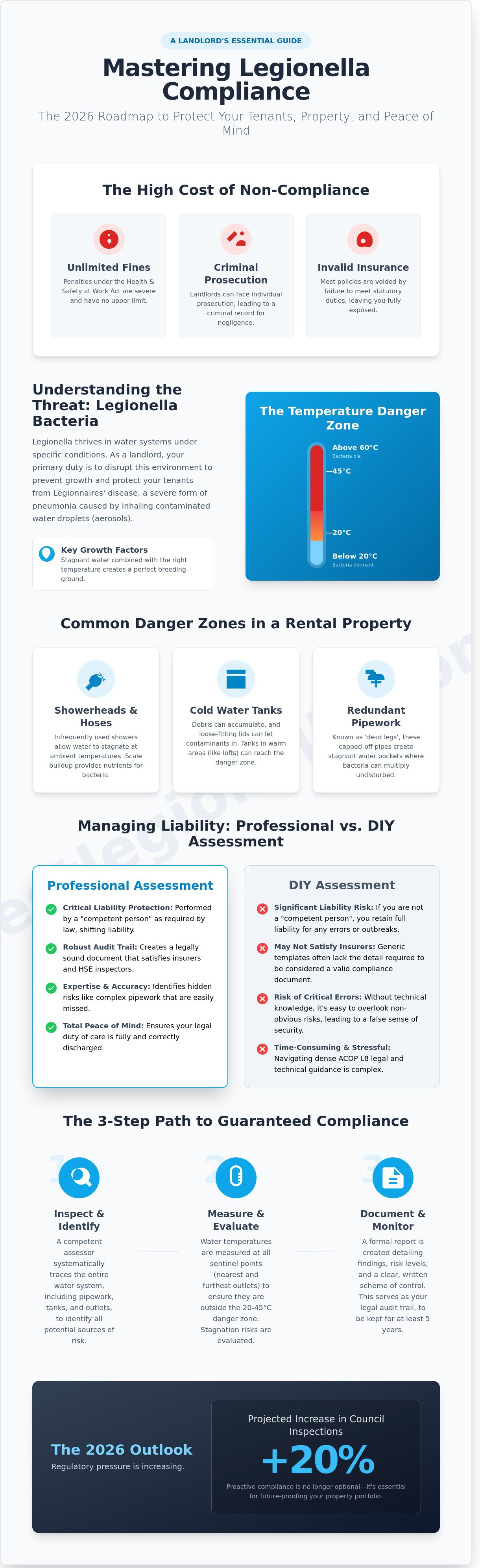
Legionella bacteria thrive in specific environments, particularly stagnant water maintained between 20°C and 45°C. In a typical rental home, risks often hide in plain sight. Common danger zones include showerheads that haven't been used for a week, cold water storage tanks with loose lids, and redundant pipework known as "dead legs." The danger occurs when these bacteria are inhaled through tiny water droplets, or aerosols. Understanding What is Legionnaires' disease? is vital, as this severe form of pneumonia can be fatal for vulnerable individuals. Keeping water moving and at the correct temperature is your best line of defence.
Why Landlord Compliance Matters in 2026
The regulatory landscape is shifting. By 2026, local authorities are projected to increase property inspections by 20% to ensure higher safety standards in the private rented sector. If an outbreak occurs and you haven't conducted a legionella risk assessment for landlords, your insurance validity is at immediate risk. Most standard landlord policies require proof of statutory compliance to pay out on claims. Beyond the financial risk, professional compliance protects your tenants from avoidable illness. Taking action today means you're prepared for stricter enforcement while providing a safe, high-quality home for your residents.
Legal Duties and ACOP L8 Compliance Requirements
Managing a rental property involves more than just collecting rent. You're legally responsible for tenant safety. The Health and Safety Executive (HSE) enforces strict standards to prevent Legionnaires' disease through the Health and Safety at Work Act 1974. You must follow the ACOP L8 Compliance Requirements and the technical guidance in HSG274. These documents outline how to control bacteria in water systems. They provide a clear framework for identifying risks in both simple and complex plumbing setups.
The law requires a competent person to carry out the assessment. This means someone with the right skills, knowledge, and experience to recognise the conditions where bacteria thrive. While some landlords try a DIY approach, most prefer the security of a professional legionella risk assessment for landlords to avoid errors. Expertise ensures you don't miss hidden risks like dead legs in pipework or stagnant tanks. Our expertise is available nationwide, providing comprehensive support that keeps you on the right side of the law.
You must keep your records for at least five years. This includes the assessment itself, any monitoring results, and records of any remedial work. If an inspector visits, having an organised paper trail provides immediate proof that you've taken your duty of care seriously. It's about building a history of safety that protects you as much as your tenants. This record-keeping is a vital part of your peace of mind.
Your Responsibilities as a Duty Holder
As the duty holder, you must identify every water source that could pose a risk. This includes cooling towers, hot and cold water systems, and even spa pools. Once identified, you need a written scheme to manage these risks. This might involve checking water temperatures monthly or descaling showerheads quarterly. You can check your compliance status to see where your property stands. We make this process simple by providing clear, actionable reports that ensure safety management is made easy.
Consequences of Non-Compliance
Ignoring these duties carries heavy penalties. Under the Health and Safety at Work Act 1974, courts can impose unlimited fines. In 2023, failing to manage legionella risks led to significant legal action against several UK housing providers. If a tenant falls ill due to gross negligence, you could face criminal prosecution or a massive civil litigation claim. Our team provides a comprehensive legionella risk assessment for landlords that covers every legal base. We call this Compliance Care. It's the fastest way to ensure your property meets every legal benchmark while protecting your bank balance.
Professional Assessment vs DIY: Managing Liability
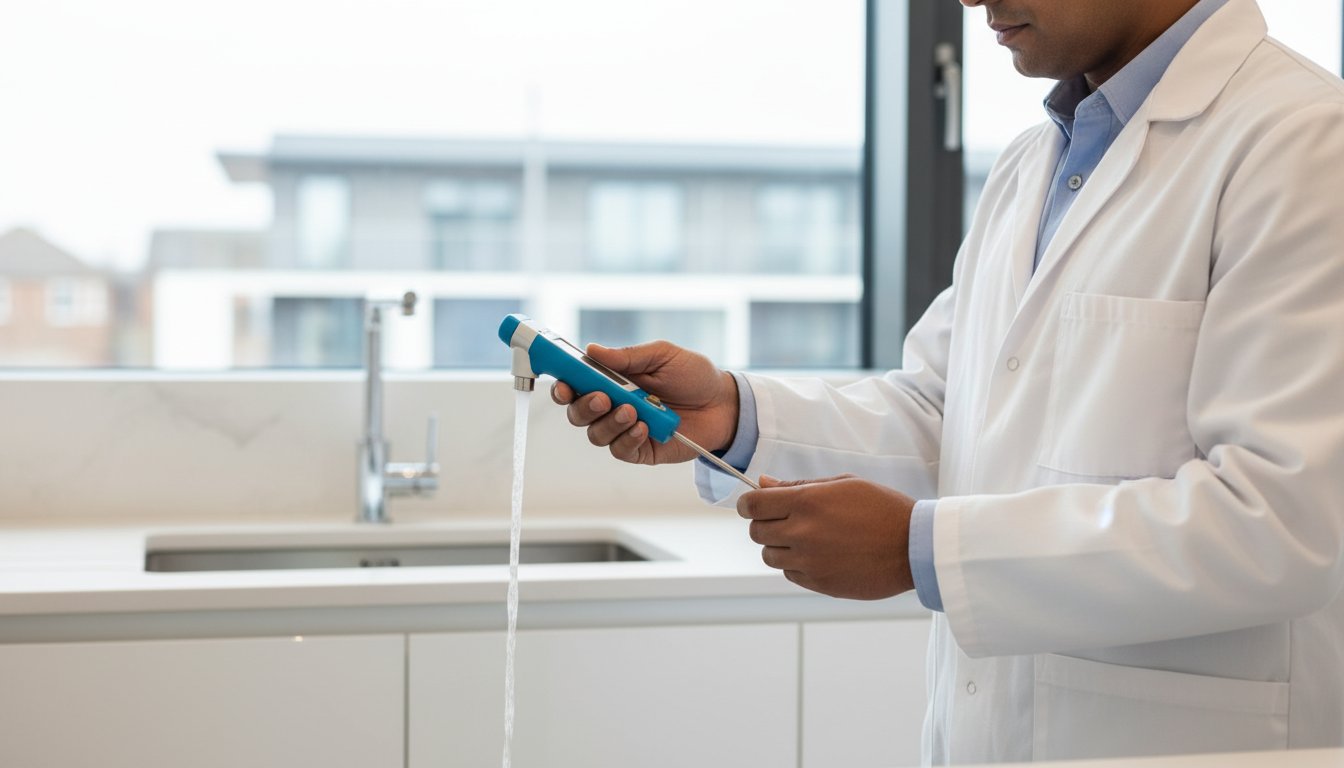
Choosing between a DIY approach and hiring a specialist isn't just about the £100 difference in upfront cost. It's about where the liability sits if a tenant contracts Legionnaires' disease. Generic DIY templates found online often lack the site-specific detail required by insurers and the courts. A professional legionella risk assessment for landlords creates a robust audit trail that shifts the burden of proof away from you. We use specialist equipment, including industrial thermometers calibrated to 0.1°C accuracy, to catch risks that standard household tools would miss. Failing to provide a valid assessment can lead to fines exceeding £20,000, making professional compliance a vital insurance policy for your property portfolio.
Professional assessments offer a layer of protection that generic forms cannot match. When an expert visits your property, they provide an independent audit. This is crucial for your insurance validity. Most landlord insurance policies require you to follow all HSE guidance for landlords to remain covered. If you can't prove a competent person conducted the survey, your provider might refuse to pay out in the event of a claim. Professional testing removes this ambiguity, providing a clear, dated, and signed document from a qualified technician.
When a DIY Assessment Might Suffice
Small properties with high water turnover, such as a modern one-bedroom flat with a combi-boiler and no cold water storage tank, represent the lowest risk level. You can carry out your own assessment if you're competent to identify every potential hazard. However, you must be thorough. You'll need to check for dead legs in the pipework and ensure water temperatures remain within safe limits. Even in these low-risk scenarios, 85% of UK letting agents now insist on a professional certificate. They understand that a DIY form rarely stands up to legal scrutiny during an inspection or a liability claim.
The Advantages of Professional Compliance Testing
Professional compliance testing delivers a level of detail that a landlord simply can't replicate. You'll receive a full digital report with photographic evidence of every water outlet and storage tank. Our Compliance Care service includes automatic reminders 30 days before your expiry date, so you never miss a deadline. If your property has complex plumbing or older water tanks, we provide access to UKAS accredited laboratory testing. This ensures every water sample is analysed under strict scientific conditions, giving you total peace of mind and a clear path to safety.
- Detailed reports with photographic evidence of all assets.
- Remedial recommendations with clear, prioritised actions.
- Automatic re-assessment reminders to maintain 100% coverage.
- Access to UKAS accredited laboratory analysis if samples are required.
How to Conduct a Legionella Risk Assessment: A Step-by-Step Guide
Performing a thorough legionella risk assessment for landlords is a logical process of mapping your property's water system to eliminate biological hazards. The inspection begins at the point of entry, typically the internal stopcock, and follows the pipework to every single outlet. This physical trace is vital for identifying "dead legs," which are lengths of redundant pipework where water no longer flows. Stagnant water in these sections provides the perfect breeding ground for bacteria, especially if the pipe exceeds 2 metres in length.
- System Mapping: Trace the entire water circuit from the mains entry to the furthest tap or showerhead.
- Temperature Monitoring: Measure temperatures at sentinel points, which are the outlets closest and furthest from the boiler or cylinder.
- Tank Inspection: Check cold water storage tanks for debris, vermin ingress, and proper thermal insulation to prevent solar gain.
- Redundancy Check: Locate and mark any pipework that leads to capped-off appliances or unused sinks.
Step-by-Step Physical Inspection
Your inspection must focus on the "Kill Zone" for bacteria. Verify that hot water cylinders store water at 60°C or above. At this temperature, 90% of Legionella bacteria die within two minutes. You must also ensure cold water remains below 20°C to inhibit growth. Check showerheads and taps for limescale and biofilm build-up. These organic materials provide nutrients for bacteria. Descaling these fixtures every 3 months reduces the risk of aerosolized bacteria by approximately 45%.
Tailoring the Assessment to Property Types
Every building presents unique challenges. HMOs often feature complex plumbing to serve multiple tenants, increasing the risk of lukewarm water pockets in shared pipework. Commercial units require a deeper look at cooling towers and humidification systems, which are high-risk aerosol generators. For vacant properties, stagnation is the primary threat. Implementing a weekly flushing regime, where every tap runs for 5 minutes, is a critical step in maintaining a safe legionella risk assessment for landlords during void periods.
Compliance Care doesn't have to be a burden. Our specialist team transforms complex health and safety laws into a straightforward, stress-free process for your peace of mind. Get your professional compliance report today and protect your tenants with ease.
Streamlining Your Property Compliance with Test Legionella
Managing a property portfolio is demanding. Test Legionella simplifies the legal burden by converting dense ACoP L8 regulations into clear, actionable data. Our "Compliance Care" strategy provides proactive monitoring and a rapid 24-hour turnaround on documentation. This ensures you're never left waiting for vital safety paperwork while a new tenancy is pending. We operate a national network of qualified assessors, maintaining identical safety standards across every UK postcode from London to Leeds. Landlords benefit from our transparent fixed-fee pricing. This eliminates the risk of hidden surcharges, allowing for precise annual budgeting without unexpected costs.
The Test Legionella Professional Process
Our workflow is built for speed and reliability. You can book an inspection online in 90 seconds. A qualified assessor visits your property within a 48-hour window to conduct a thorough site survey. Following the visit, we deliver a digital, insurer-approved compliance report directly to your inbox. This document outlines exactly what you need to do to stay safe. If we identify risks, our team provides immediate support and guidance for necessary remedial works, ensuring your legionella risk assessment for landlords is both thorough and practical.
- Easy online booking and rapid on-site assessment
- Digital delivery of comprehensive, insurer-approved compliance reports
- Ongoing support and guidance for necessary remedial works
Secure Your Peace of Mind Today
More than 8,500 UK landlords rely on us for their annual water safety checks. We've built this trust through clear, jargon-free communication and a commitment to operational excellence. We don't just perform a test; we manage your ongoing compliance dates and send automatic reminders 30 days before your certification expires. This proactive approach transforms a complex legal requirement into a stress-free management routine. It's about protecting your tenants and your reputation with minimal fuss. Your legionella risk assessment for landlords doesn't have to be a source of stress.
Secure Your Property Portfolio and Ensure 2026 Compliance
Meeting your legal duties under ACOP L8 isn't just about ticking a box; it's about safeguarding tenant health and protecting your business from significant liability. As we head into 2026, the requirements for a legionella risk assessment for landlords remain a non-negotiable aspect of property management. You've learned that while simple systems might seem manageable, professional assessments provide the robust legal paper trail needed to satisfy Health and Safety Executive expectations. Professional reports eliminate the ambiguity that often leads to non-compliance fines or legal disputes.
Test Legionella simplifies this process with expert assessors trained specifically in ACOP L8 standards. We offer national coverage across the UK and provide fast turnaround compliance reports that translate complex regulations into clear, actionable steps. Our team handles the technical details so you don't have to worry about the legal fallout of an incomplete assessment. We've built our reputation on transforming a technical burden into a streamlined, stress-free experience for landlords with any size of portfolio. We're ready to help you manage your risks with absolute precision.
Take the proactive step today to secure your properties and protect your tenants. Book your professional Legionella Risk Assessment now and let our specialists provide the total peace of mind you deserve.
Frequently Asked Questions
Is a Legionella risk assessment a legal requirement for landlords?
Yes, a legionella risk assessment for landlords is a mandatory legal requirement under the Health and Safety at Work etc. Act 1974. You must identify and assess potential sources of exposure to Legionella bacteria in your rental properties. This duty applies to all residential landlords who provide water as part of a tenancy agreement. Failing to comply can lead to fines exceeding £20,000 or even imprisonment for serious safety breaches.
How often should a landlord carry out a Legionella risk assessment?
You should review your assessment every 2 years or whenever there's a significant change to the water system. The Health and Safety Executive (HSE) requires assessments to be kept up to date, especially if a property is left vacant for 30 days or more. Regular reviews ensure your Compliance Care remains valid and your tenants stay safe from harm. We provide automated reminders to keep your properties fully protected year after year.
Can I do my own Legionella risk assessment as a landlord?
You can legally carry out your own assessment if you're competent to do so, but most landlords prefer professional help. Competence means having the technical knowledge to identify risks like stagnant water or scale build-up in pipework. Professional assessors provide a detailed compliance report that offers a higher level of legal protection if an investigation occurs. Our team makes this process easy by handling the technical details for you.
Do I need a Legionella certificate for a property with no water tank?
You still need a risk assessment even if your property has no cold water storage tank and uses a combi-boiler. While the risk is lower in direct-feed systems, Legionella can still grow in showerheads, long pipe runs, or outside taps. An assessment confirms these risks are managed, providing you with the necessary documentation to prove you've met your duty of care. It's about ensuring every part of the system is safe.
What happens if a tenant contracts Legionnaires’ disease in my property?
If a tenant contracts Legionnaires’ disease, you'll likely face an immediate investigation by the Health and Safety Executive or local authority. If you can't produce a valid legionella risk assessment for landlords, you're liable for prosecution under the 1974 Act. Penalties include unlimited fines and potential civil claims from the tenant. Having a professional report ensures you have a robust legal defence and provides total peace of mind during difficult times.
How much does a professional Legionella risk assessment cost in 2026?
In 2026, a professional Legionella risk assessment for a standard 3-bedroom domestic property typically costs between £85 and £135 plus VAT. Prices vary based on the property size and the complexity of the water system. Investing in this service once every 24 months is a small price for total regulatory compliance and the safety of your occupants. Get your quote today for an accurate fixed price and a rapid turnaround.
What is the difference between a risk assessment and water testing?
A risk assessment is a physical survey of the water system to identify hazards, while water testing involves taking samples for laboratory analysis. For most domestic properties, the HSE doesn't require monthly water testing if the risk assessment shows the system is well-managed. The assessment is the legal foundation of your compliance, whereas testing is usually reserved for high-risk settings like hospitals. We help you determine exactly which service your property requires.
Do I need to test for Legionella if the property is newly built?
You must assess a newly built property before the first tenant moves in. Construction sites often have long periods where water sits stagnant in pipes for 60 days or more during the final stages of the build, creating a perfect breeding ground for bacteria. Don't assume new means safe; ensure your new investment is compliant from day one with a professional check. We specialise in helping landlords launch their new tenancies with confidence and safety.