
Could a single neglected showerhead or an unused guest room tap really lead to a £20,000 fine under the Health and Safety at Work Act 1974? You already understand that managing a property comes with a heavy weight of responsibility, and the pressure to maintain a valid legionella risk assessment can often feel like a complex regulatory burden. It's natural to feel a sense of unease when the safety of your tenants or staff is on the line, especially when 2024 HSE guidelines demand such strict adherence to water safety protocols.
It's time to transform that anxiety into a sense of total security. This guide helps you master your legal duties and understand the assessment process, ensuring your water systems are 100% safe. You'll gain a clear path to total compliance and an actionable safety report that protects both your people and your reputation. We're providing a straightforward breakdown of current UK safety standards and the exact steps you need to take to make compliance easy and stress-free.
Key Takeaways
- Understand your mandatory legal obligations under the Health and Safety at Work Act 1974 to protect your property and its occupants.
- Identify hidden hazards within your water system, such as "dead legs" and low-usage areas, where dangerous bacteria are most likely to thrive.
- Evaluate your "competence" against HSE standards to decide if a professional legionella risk assessment is required to ensure full legal compliance.
- Learn exactly what to expect during a site inspection, including the physical tracing of pipework and the testing of water outlets.
- Discover how a "Compliance Care" approach transforms complex health and safety burdens into a simple, stress-free management process.
Understanding the Legionella Risk Assessment: Legal Duties and Safety
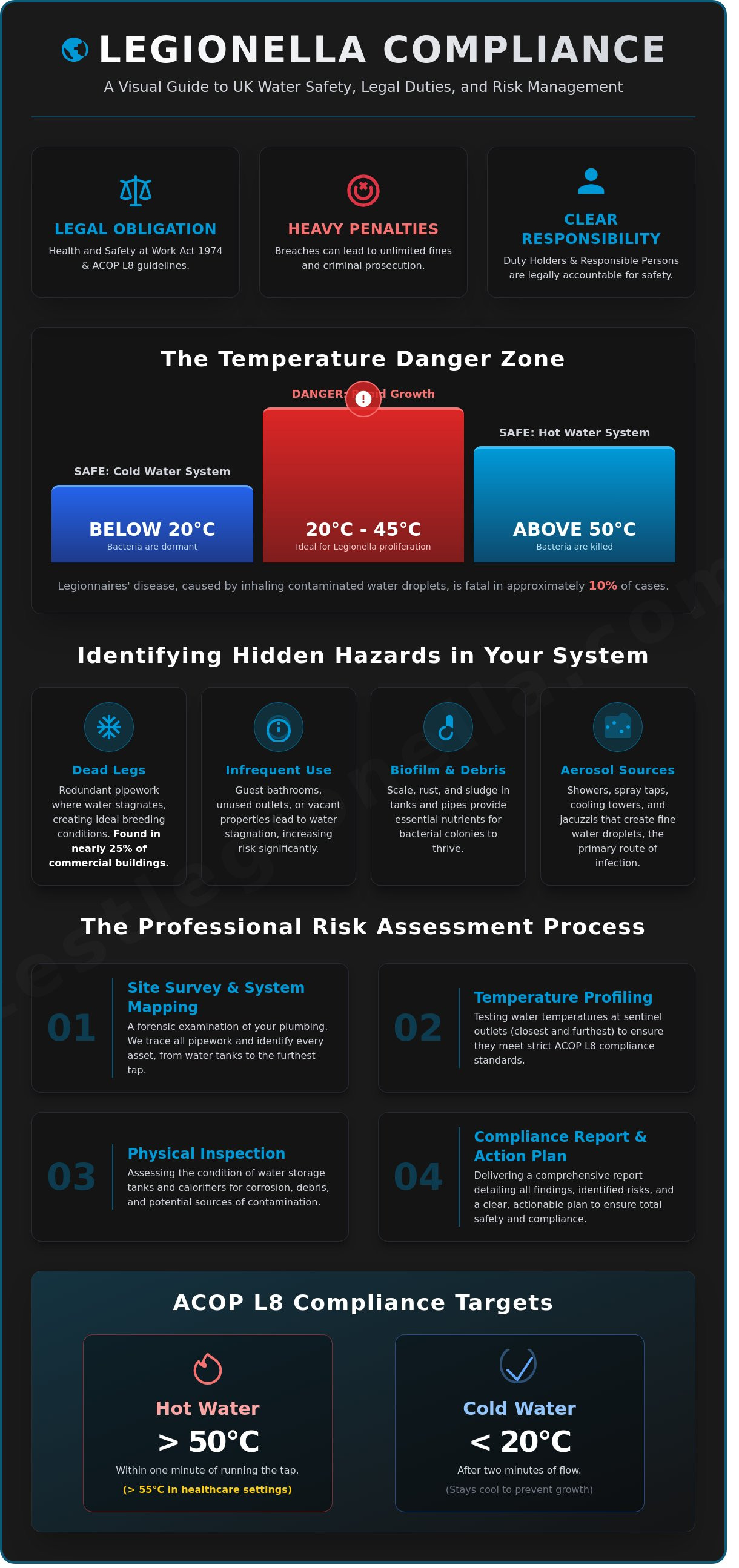
A legionella risk assessment is the fundamental starting point for water safety in any UK property. It's a statutory requirement under the Health and Safety at Work Act 1974, which places a clear duty on employers and those in control of premises to protect people from health risks. To meet these obligations, the Health and Safety Executive (HSE) provides the Approved Code of Practice L8 (ACOP L8). This document serves as the gold standard for compliance, detailing exactly how to manage and control the risks associated with legionella bacteria.
Failing to adhere to these regulations carries heavy consequences. The legal liability rests squarely with the property management or business owner. In recent years, UK courts have moved away from fixed penalties toward unlimited fines for health and safety breaches. In 2023, several organisations faced six-figure fines for failing to maintain adequate water safety regimes. Beyond the financial impact, non-compliance can lead to criminal prosecution and irreparable damage to your professional reputation. Professional Compliance Care transforms this complex legal burden into a straightforward path to safety.
Who is Responsible for Water Safety?
The law distinguishes between the "Duty Holder" and the "Responsible Person." The Duty Holder is typically the employer or the person in control of the premises, such as a landlord. They hold ultimate legal accountability. They must appoint a "Responsible Person" who has the competence and authority to oversee day-to-day control measures. For domestic landlords managing HMOs or residential lets, the duty involves ensuring tenants aren't exposed to risks. In commercial settings, employers must manage more complex systems like cooling towers or industrial processes, where the potential for bacterial spread is significantly higher.
The Science of Risk: Why Legionella Matters
Legionella bacteria are common in natural water sources but become a threat when they enter man-made systems. They proliferate rapidly in temperatures between 20°C and 45°C, especially where nutrients like scale or biofilm are present. Stagnation in "dead legs" or unused pipework allows colonies to grow undisturbed. Risk occurs when these systems create fine droplets of water, known as aerosols. If inhaled, these droplets can cause What is Legionnaires' disease?, a severe and potentially fatal form of pneumonia. Data shows the disease is fatal in roughly 10% of cases, with individuals over 45 or those with weakened immune systems being most vulnerable. Effective legionella risk assessment focuses on temperature control and preventing water stagnation to keep your occupants safe.
Identifying the Hazards: What a Professional Risk Assessment Uncovers
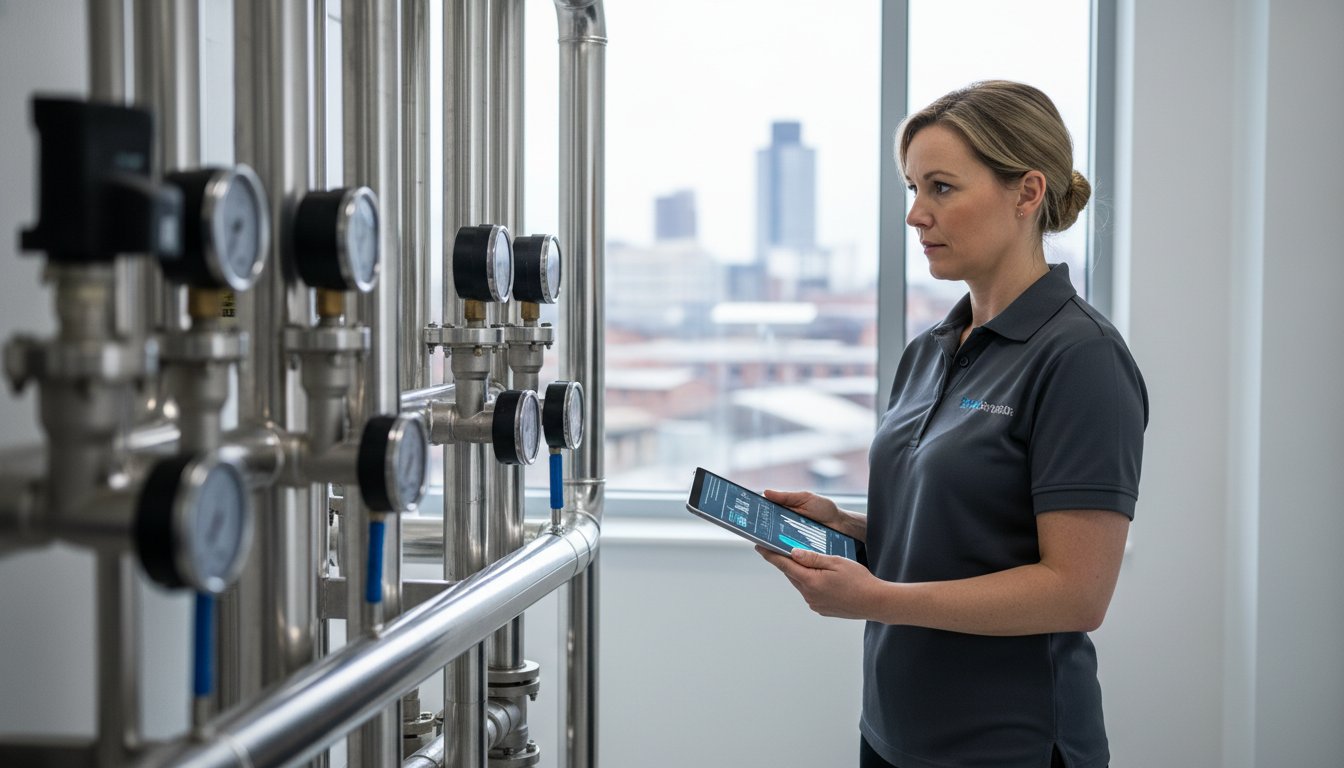
A professional legionella risk assessment is a forensic examination of your building's internal plumbing. It starts with a comprehensive survey of all hot and cold water systems to map out every pipe, tank, and outlet. Our specialists look for "dead legs," which are redundant lengths of pipe where water stagnates. According to industry data from 2022, nearly 25% of commercial buildings contain at least one dead leg that hasn't been flushed in over six months. These areas are prime breeding grounds for bacteria. We also evaluate the physical condition of water storage tanks and calorifiers, looking for corrosion or debris that provides nutrients for colony growth. Because Legionnaires' disease is contracted through inhalation, we pay close attention to any equipment that creates an aerosol, such as showers, spray taps, or cooling towers. Understanding Landlords' responsibilities for legionella is the first step toward total site safety and legal peace of mind.
Temperature Monitoring and Control
Bacteria thrive in the "danger zone" between 20°C and 45°C. To keep your property compliant with the 2013 ACoP L8 guidelines, we test sentinel points. These are the taps located closest to and furthest from your water source. If you're managing a commercial site, your hot water must reach a minimum of 50°C within one minute of running the tap. In healthcare settings, this requirement rises to 55°C to protect vulnerable residents. Simultaneously, cold water must remain below 20°C after two minutes of flow. If a cold water tank sits in a loft space reaching 30°C during a summer heatwave, the risk of bacterial multiplication increases by 40% within 48 hours.
System Design and Maintenance Review
Our team ensures your legionella risk assessment identifies non-approved materials like certain rubber washers or hemp joints that can actually feed bacteria. We check that showerheads are descaled and disinfected at least four times a year, as 70% of legionella samples are found in poorly maintained shower systems. Finally, we review your current maintenance logs. If your records show gaps of more than 30 days in temperature monitoring, your legal protection is compromised. Our Compliance Care service helps you organise these records so you never miss a deadline. This proactive approach turns a complex legal burden into a simple, manageable routine for your team.
Professional vs. DIY Assessments: Navigating Your Compliance Options
Many landlords believe a quick walk-through of a property constitutes a valid check. This is a dangerous misconception. To meet UK legal requirements for Legionella, the person carrying out the work must be "competent." The Health and Safety Executive (HSE) defines competence as having sufficient skills, knowledge, and experience. If you can't identify "dead legs" in plumbing or calculate the exact temperature drop in a 50-metre pipe run, you aren't competent in the eyes of the law.
Generic online templates often fail to account for the unique layout of a building. Using a one-page "free" PDF for a converted Victorian flat with three separate water tanks leaves you exposed. In 2023, failing to demonstrate a robust legionella risk assessment led to fines exceeding £20,000 for some UK property managers. Professional certification acts as your primary legal shield. It proves you've taken every reasonable step to ensure tenant safety, providing a solid defence if an incident occurs.
The Benefits of Professional Accreditation
Professional assessors use calibrated digital thermometers and ultrasonic flow meters to get precise data. We provide independent, impartial reports that satisfy the strict criteria of 95% of UK commercial insurance providers. Our "Compliance Care" service means you won't miss a deadline. We send automatic reminders 30 days before your next review is due. This keeps your records current and your liability low. It's about turning a complex legal burden into a managed process.
When is a Professional Assessment Essential?
While simple domestic properties have lower risks, professional intervention is vital in specific scenarios:
- Buildings with cooling towers or complex HVAC systems that create aerosols.
- Properties housing vulnerable residents, such as care homes or healthcare facilities.
- Multi-occupancy blocks where pipework is shared across five or more units.
- Commercial sites with large water storage tanks or redundant pipework.
If you lack the 10 to 15 hours required to properly study the ACoP L8 technical guidance, outsourcing is the safest choice. A professional legionella risk assessment ensures you aren't guessing with public health. We handle the technical details so you can focus on running your business. Get your compliance score today and see where you stand.
From Inspection to Report: What to Expect During the Process
Booking your legionella risk assessment is the first step toward total compliance. Once you've scheduled a visit, prepare the site by ensuring the surveyor has keys to all plant rooms, roof voids, and storage cupboards. The physical inspection is a meticulous process. Our specialist traces every inch of pipework from the rising main to the cold water storage tanks and out to the final sentinel points.
During the walk-through, the surveyor records temperatures at representative outlets. Cold water must stay below 20°C, while hot water should reach at least 50°C within 60 seconds of running the tap. This data forms your asset register, which is a comprehensive list of every water-related fixture on your property. We identify dead legs where water stagnates and check for scale or debris in tanks that could harbour bacteria.
The Anatomy of a Professional Legionella Report
A high-quality report translates complex findings into a clear action plan. You'll receive a risk rating of High, Medium, or Low for every area of the system. We include photographic evidence of non-compliance, such as uninsulated pipes or corroded tanks, alongside a schematic diagram. This visual map helps your maintenance team locate issues instantly. Most reports highlight that 85% of risks can be mitigated through simple mechanical fixes or improved temperature control.
Post-Assessment: Remedial Works and Monitoring
Compliance doesn't end when the surveyor leaves. If your report identifies high-risk areas, you must act. Common remedial works include removing dead legs or installing lids on water tanks to prevent contamination. You'll need to implement a monthly monitoring programme, logging temperatures at your nearest and furthest outlets. UK guidelines recommend reviewing your legionella risk assessment every two years, or sooner if you make significant changes to the plumbing system.
Ready to secure your property? Get your professional compliance report today.
Securing Your Property with Expert Legionella Compliance Testing
Managing water safety shouldn't feel like an administrative burden. Test Legionella streamlines the entire process, ensuring your legionella risk assessment meets every HSE requirement without the typical stress. We've refined our "Compliance Care" model to move beyond the standard one-off inspection. This proactive approach provides ongoing support, tracking your re-assessment dates automatically so you never fall behind on your legal duties.
Our network of certified assessors operates across the UK, providing national coverage with a local touch. This footprint allows us to offer rapid response times, often visiting sites within 48 hours of an enquiry. We prioritise financial transparency through a fixed-fee pricing structure. You'll receive a clear quote upfront with no hidden costs, whether you manage a single residential flat or a complex commercial portfolio. Our pricing starts from just £50 for standard domestic properties, making professional safety accessible to everyone.
- Total water safety management through a single point of contact.
- 24-hour digital report turnaround following site visits.
- Automated reminders for biennial reviews and annual testing.
- Fixed-fee guarantees to protect your maintenance budget.
Why Choose Test Legionella?
Our assessors are industry veterans who understand the nuances of diverse property types. They deliver professional, authoritative reports that skip the confusing jargon and focus on actionable steps. By prioritising clarity, we help you maintain a safe environment for tenants and employees alike. We've supported over 5,000 UK clients in achieving total compliance, ensuring that every legionella risk assessment we produce stands up to the strictest regulatory scrutiny.
Get Started with Your Compliance Score
Peace of mind starts with knowing your current standing. Requesting a tailored quote is a straightforward process that takes less than two minutes. Our experts evaluate your specific property needs to provide a bespoke safety plan that fits your schedule. Don't leave your health and safety obligations to chance; let our specialists handle the technical details while you focus on your business. Ensure your property is safe and compliant with Test Legionella today.
Secure Your Property and Achieve Total Compliance
Protecting your water system isn't just a recommendation; it's a critical legal obligation under the Health and Safety at Work Act 1974. A professional legionella risk assessment identifies 14 specific hazard categories that untrained eyes often miss, ensuring your building meets the strict ACOP L8 standards. By moving beyond basic DIY checks, you eliminate the risk of HSE fines that can exceed £20,000 and ensure the safety of every person on your premises.
Test Legionella provides the expertise you need to manage these duties without the stress. Our expert assessors offer national coverage across the UK, delivering detailed compliance reports with a rapid 24 hour turnaround after inspection. We believe in total financial transparency, which is why we provide fixed-fee pricing starting from £85 for residential properties. We've supported 1,200 businesses in maintaining their safety records over the last 12 months, turning complex regulations into manageable steps.
Don't leave your safety to chance or struggle with complicated paperwork. Get your professional Legionella risk assessment quote today and enjoy the peace of mind that comes with expert Compliance Care. Your property is in safe hands with us.
Frequently Asked Questions
Is a Legionella risk assessment a legal requirement for all landlords?
Yes, a legionella risk assessment is a legal requirement for all UK landlords. Under the Health and Safety at Work etc Act 1974, you've a duty to ensure the safety of tenants by identifying and managing risks. The HSE’s L8 Approved Code of Practice specifically requires landlords to carry out these assessments. Failing to comply can lead to prosecution and fines reaching £20,000 in local courts.
How much does a professional Legionella risk assessment cost in the UK?
For a standard domestic property, a professional assessment typically costs between £50 and £125. Larger commercial sites or complex Houses in Multiple Occupation (HMOs) often range from £200 to £550 depending on the number of water outlets. These prices provide you with a comprehensive compliance report and the peace of mind that your property meets all current UK safety standards.
How often should a Legionella risk assessment be reviewed or repeated?
You should review your assessment every 2 years to maintain your compliance status. You must also repeat the process if there's a change to the water system, such as a new boiler installation or a change in the building's use. If 12 months pass without a check in high-risk settings, a new review is strongly advised. Regular updates ensure your safety records remain valid and protective.
Can I carry out a Legionella risk assessment myself if I own the property?
You can legally perform the assessment yourself if you're "competent" to do so. This means you must have the technical knowledge to identify risks like stagnant "dead legs" or incorrect water temperatures. Most owners prefer using a specialist to eliminate the risk of an inadequate report. A professional assessment ensures your documentation is legally robust and protects you from personal liability if an issue arises.
What happens if Legionella bacteria are found during the water testing?
If bacteria levels exceed 1,000 cfu/l, you must take immediate remedial action to protect occupants. This usually involves a chemical disinfection using 50mg/l of chlorine for 1 hour or a thermal shock treatment. After the cleaning process is finished, you'll need a follow-up test to confirm the system is clear. Taking these steps fast prevents a minor hazard from turning into a serious public health incident.
Do I need a Legionella assessment if my property has been vacant for a while?
Yes, vacant properties are high-risk zones because water stagnation allows bacteria to multiply in as little as 7 days. If a building has been empty for over 14 days, you should flush all taps and showers for at least 2 minutes. A fresh assessment before new tenants move in is the best way to ensure the system is safe. It's an essential part of your "Compliance Care" strategy for empty units.
What is the difference between a risk assessment and water sampling?
A risk assessment is a physical survey of the entire water system to find potential hazards like rust or scale. Water sampling is a laboratory test where we take 1-litre samples to check for the actual presence of bacteria. While the assessment is a mandatory legal requirement, sampling is usually only necessary for high-risk systems like cooling towers. Both services work together to provide a complete safety profile.
Does a Legionella risk assessment cover all types of water systems?
The assessment covers every component of your water infrastructure, including storage tanks, calorifiers, and all pipework. It also extends to specialised equipment like hot tubs, pressure washers, and decorative fountains that create water droplets. Any system that stores or circulates water and could produce an aerosol spray is included under UK regulations. Ensuring every part of your system is checked is vital for 100% safety.