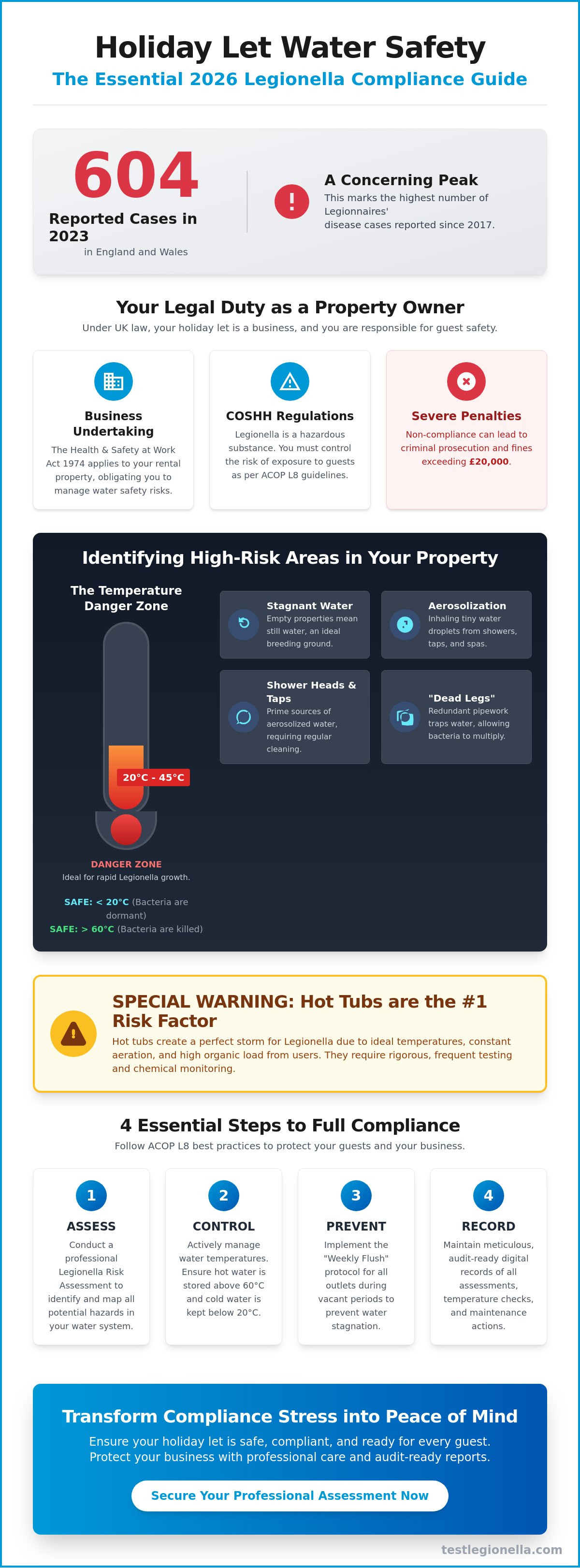
Did you know that 2023 saw 604 reported cases of Legionnaires' disease in England and Wales, marking the highest peak since 2017? For property owners, securing a professional legionella risk assessment for holiday lets uk is no longer just a recommendation; it's a mandatory legal requirement under the Health and Safety at Work Act 1974. We understand that managing water safety during seasonal vacancies can feel like a complex regulatory burden. You likely worry about legal liability or, worse, the risk of a guest falling ill while staying at your property.
Our 2026 compliance guide transforms this stress into a sense of security. You'll discover exactly how to meet your water safety obligations and protect your business from fines that can exceed £20,000. We'll walk you through the essential steps to achieve full legal compliance, from temperature controls to proactive risk management, ensuring your holiday let remains a safe haven for every visitor.
Key Takeaways
- Understand your legal status as a business owner and why the Health and Safety at Work Act 1974 applies to your rental property.
- Identify the specific "danger zones" in your plumbing where bacteria thrive and learn why a legionella risk assessment for holiday lets uk is your best defense.
- Master the practical steps for water system mapping and temperature monitoring to ensure your property meets 2026 safety standards.
- Establish a routine maintenance schedule, including the "Weekly Flush" protocol, to manage water safety during seasonal vacancies effectively.
- Explore how professional compliance care and digital audit-ready reports transform a complex legal burden into stress-free property management.
Understanding Your Legal Obligations as a Holiday Let Owner
Owning a holiday let is more than just managing bookings and cleaning linens; it is legally classified as running a "business undertaking." This distinction is critical for your safety strategy. Under the Health and Safety at Work etc. Act 1974, you have a statutory duty to ensure the health and safety of anyone using your premises. This isn't a suggestion. It is a legal mandate that requires you to identify and control any potential risks within your property.
The Control of Substances Hazardous to Health (COSHH) Regulations 2002 specifically focus on biological risks. Because Legionella bacteria can cause a severe and potentially fatal form of pneumonia, it falls squarely under these regulations. Understanding What is Legionnaires' disease helps clarify why the government enforces such strict standards. The bacteria thrive in man-made water systems, and if guests inhale contaminated water droplets, the consequences can be life-threatening. A legionella risk assessment for holiday lets uk is the foundation of your compliance, acting as a documented plan to prevent these incidents before they happen.
Is a Legionella Risk Assessment Mandatory for Airbnbs?
Many owners wonder if short-term platforms have different rules. They don't. The law makes no distinction between a traditional cottage let and a modern Airbnb listing. You owe a duty of care to every guest who steps through your door. If you fail to manage these risks, you face significant penalties. In 2026, non-compliance can result in criminal prosecution and fines exceeding £20,000. Professional compliance isn't just about ticking boxes; it's about protecting your guests and your business from devastating legal and financial fallout.
The Role of ACOP L8 in Holiday Let Safety
The Health and Safety Executive provides the acop l8 guidelines as the definitive code of practice for water safety. We consider this the gold standard for any holiday let owner. While the code provides a framework for compliance, following it serves as your best legal defense. It helps you understand the difference between your "Statutory Duty," which is the minimum legal requirement, and "Best Practice," which offers the highest level of protection. By implementing a legionella risk assessment for holiday lets uk based on these guidelines, you ensure your property is managed with calm competence and professional care.
Identifying High-Risk Areas in Short-Term Rental Properties
Legionella bacteria don't just appear by chance; they thrive in very specific environments. In a holiday rental, the biggest threat is stagnation. When your property sits empty for a week or even just a few days between bookings, water sits still in your pipes. If that water remains within the "danger zone" of 20°C to 45°C, you've created an ideal breeding ground for bacteria to multiply. This is why a legionella risk assessment for holiday lets uk is so vital. It helps you map out where water might be sitting too long and where temperatures aren't being managed correctly.
Risk isn't just about the presence of bacteria; it's about how your guests interact with the water. The primary way people contract the illness is through aerosolization. This happens when guests breathe in tiny, invisible droplets of contaminated water. Any outlet that creates a spray or mist is a potential point of infection. In older holiday cottages, we often find "dead legs," which are lengths of redundant pipework leading to nowhere. These sections trap water that never gets flushed, allowing bacteria to grow undisturbed before eventually leaching back into the main system. Understanding these legal obligations for holiday let owners is the first step toward a safer property. If you're unsure about your current setup, you can request a professional review to identify these hidden hazards.
The Hidden Danger: Hot Tubs and Spa Baths
Hot tubs are the number one risk factor for Legionella in the holiday let industry. They provide the perfect storm of conditions: water maintained at roughly 37°C, constant aeration, and a high organic load from bathers. The bubbles that guests love are actually aerosols that can carry bacteria directly into their lungs. Because of this, leisure facilities require much more frequent testing and chemical monitoring than standard domestic plumbing. You must ensure your maintenance logs are impeccable to protect your guests and your business reputation.
Showers, Taps, and Outdoor Hoses
Showers are a primary concern because they naturally create a fine mist. Over time, scale and biofilm build up in showerheads, providing both a home and a nutrient source for bacteria. This risk is amplified in en-suite bathrooms that guests rarely use. Even outdoor items pose a threat. Garden irrigation systems or jet washes that have been sitting in the sun can reach the exact temperatures Legionella needs to flourish. Regular descaling and flushing are simple but essential tasks in your water safety routine.
How to Conduct a Legionella Risk Assessment for Your Property
Conducting a legionella risk assessment for holiday lets uk requires a methodical approach to every water outlet in your property. You can't simply glance at the boiler and call it a day. The process starts by mapping the entire water system, tracing the flow from the point of entry to every single tap, shower, and appliance. Once you have a clear map, you must measure temperatures at "sentinel taps." These are the outlets closest to and furthest from your heat source. Hot water should reach at least 50°C within one minute, while cold water must stay below 20°C after running for two minutes.
Next, inspect your cold water storage tanks for signs of debris, rust, or vermin ingress. These contaminants provide the nutrients bacteria need to multiply. You also need to evaluate the aerosol risk at every point of use, focusing on anything that creates a fine spray like showers or decorative fountains. Finally, you must document every finding. This documentation forms your "written scheme of control," which is your roadmap for ongoing safety. Following the official guide on Conducting a Legionella Risk Assessment ensures you don't miss these critical technical details.
DIY vs. Professional Assessment: Which is Right for You?
HSE guidelines state you can perform the assessment yourself if you are "competent." However, competence involves more than just owning a thermometer. It means having the technical knowledge to identify risks like dead legs or thermostatic mixing valve failures. When weighing the legionella risk assessment cost against the potential for a flawed DIY report, many owners choose professional testing. Choosing a professional legionella risk assessment for holiday lets uk ensures every technical nuance is captured correctly. Most insurance providers now insist on a professional certificate to validate your holiday let cover, making expert assessment a smart business move.
What Should Your Final Report Include?
Your final compliance report should be a comprehensive tool for property management. It must include a clear executive summary of the risk level and a detailed asset register of all water-related equipment. Demand photographic evidence of the system’s condition, especially for hidden areas like loft tanks. A professional report provides a prioritized list of remedial actions, telling you exactly what to fix first. This structured approach turns a complex legal requirement into a manageable task, giving you total peace of mind and an audit-ready trail for inspectors.
Essential Water Safety Maintenance for Busy Rental Seasons
Creating a safe environment for your guests requires consistent action. Once your initial legionella risk assessment for holiday lets uk is complete, your focus shifts to ongoing maintenance. Stagnation is the biggest threat during seasonal gaps, but a structured routine keeps your water system healthy. You need to treat water safety as a dynamic part of your property management, not a one-off task. This proactive approach transforms a complex legal burden into a simple, manageable routine that protects your business reputation.
Quarterly descaling is a non-negotiable part of this routine. Limescale and scale build-up provide a porous surface where bacteria can hide and feed. Every three months, you should remove all showerheads and tap inserts to soak them in a professional descaling solution. Annually, perform a more detailed inspection of your water heaters and storage tanks. Look for signs of corrosion or sediment at the base of the tank, as these materials provide the nutrients Legionella needs to multiply. If you find significant debris, the system may require a professional clean and disinfection.
Your compliance is only as good as your record-keeping. Maintain a dedicated log book to record every flush, every temperature check, and every descaling session. This document is your shield if an inspector visits or if an insurance claim arises. It provides the physical proof that you have met your legal duty of care. If it isn't written down, in the eyes of the law, it didn't happen. Keeping these records clear and up-to-date ensures you are always audit-ready.
Managing Vacancies and Low-Season Risks
If your property is empty for more than 7 days, you must flush the system to prevent water from sitting stagnant in the pipes. Start with the taps closest to the water entry point and work your way out to the furthest sentinel points. Run both hot and cold water for at least two minutes at each outlet. To minimize the risk of inhaling aerosols during this process, place a cloth over the tap or showerhead to catch the mist. For properties coming back into use after a long winter break, a "thermal shock" can be an effective precaution. This involves heating the water to 60°C or higher and running it through all outlets, though you must take care to prevent scalding risks.
Educating Your Guests and Housekeeping Staff
Your housekeeping team is your first line of defense. Train them to spot red flags like discolored water, leaking tanks, or failing water heaters during their changeover cleans. Provide simple instructions for guests so they don't inadvertently create risks. For example, explicitly ask guests not to adjust the water heater settings. During the low season, the temptation to turn off the water heater to save on energy bills is high, but you must resist this. Water heaters must maintain a storage temperature of at least 60°C to kill bacteria effectively. If you want to ensure your maintenance schedule meets every legal requirement, book your compliance testing today for total peace of mind.
Professional Legionella Compliance for Peace of Mind
Managing a holiday let involves juggling many responsibilities. While water safety is critical, it doesn't have to be a source of constant stress. Test Legionella specializes in transforming this complex legal requirement into a streamlined experience. By choosing a professional legionella risk assessment for holiday lets uk, you move beyond simple guesswork and into a state of total security. We provide the expertise needed to navigate 2026 regulations, allowing you to focus on delivering a five-star guest experience while we handle the technical details of water safety.
Our service is built around the concept of Compliance Care. This means we don't just provide a one-off document; we offer a long-term safety partnership. After our specialists inspect your property, you receive a digital, audit-ready compliance report. This report is clear, professional, and easy to share with insurance providers or local authorities. To ensure you never fall behind on your legal duties, we provide automated reminders for your next assessment date. This proactive approach protects your reputation and ensures your guests are always safe from the hidden risks of contaminated water.
Our National Compliance Testing Service
We provide a nationwide reach with a specific focus on the unique needs of rental properties. Whether you manage a single cottage or a portfolio of urban apartments, our team delivers a fast turnaround for both assessments and final reports. We understand that time is money in the hospitality industry, so we work efficiently to minimize disruption to your booking calendar. Our pricing is completely transparent. You'll never encounter hidden fees or unexpected costs. You get a tailored service that matches your specific property type, backed by the reliability of a specialist who understands the law inside and out.
Ready to Secure Your 2026 Compliance?
The safety of your guests and the longevity of your business are too important to leave to chance. A professional legionella risk assessment for holiday lets uk is the most reliable way to prove you've met your duty of care. It replaces uncertainty with a documented, professional standard of safety. Don't wait for an inspection or an incident to find out if your water system is safe. Take a proactive step today to secure your property and enjoy the peace of mind that comes with professional Compliance Care.
Get My Professional Legionella Assessment Quote
Secure Your Property and Your Peace of Mind
Ensuring your holiday rental remains a safe destination for guests is your highest priority. Meeting your legal obligations isn't just about a one-off check. It's about active management of risks like stagnation and temperature control. By securing a professional legionella risk assessment for holiday lets uk, you protect your business from legal penalties and ensure your insurance remains valid. You've worked hard to build your rental business, and we're here to help you protect it.
Our team at Test Legionella provides UK-wide specialist coverage, delivering detailed compliance reports that turn health and safety laws into clear steps. We believe that professional water safety should be made easy. This gives you the freedom to focus on your guests while we handle the technical requirements. With our peace of mind guarantee and automated reminders, you'll never worry about missing a compliance deadline again.
Don't leave your reputation to chance. Book Your Professional Holiday Let Legionella Assessment Today and take the first step toward stress-free property management. We're ready to help you stay compliant and stay safe.
Frequently Asked Questions
Is a Legionella risk assessment a legal requirement for holiday lets?
Yes, it's a mandatory legal requirement for all UK holiday lets in 2026. This is enforced under the Health and Safety at Work etc. Act 1974 and the Control of Substances Hazardous to Health Regulations. As a landlord, you have a statutory duty to identify and manage the risks of exposure to Legionella bacteria for your guests. Failing to provide this document can lead to severe penalties.
How often does a holiday let Legionella assessment need to be reviewed?
You should review your assessment at least every two years to maintain compliance. However, you must update it sooner if there are significant changes to your water system, such as new pipework or a new boiler. If your property remains vacant for an extended period, a new legionella risk assessment for holiday lets uk is often necessary to address stagnation risks effectively.
Can I carry out the Legionella risk assessment myself?
You can conduct the assessment yourself if you are competent to do so. This means you must have a proper understanding of your water system and the potential hazards involved. While a DIY approach is possible, many owners choose a professional service to ensure total accuracy and to provide a robust legal defense in the event of an inspection or guest illness.
What happens if a guest contracts Legionnaires' disease at my property?
Failure to manage these risks can lead to severe legal and financial consequences. You could face criminal prosecution and fines that often exceed £20,000. Beyond the legal penalties, a guest illness can lead to significant insurance claims and permanent damage to your business reputation. This makes professional compliance care a vital investment for any serious property owner.
Do I need to test the water for Legionella bacteria in my holiday cottage?
A risk assessment is mandatory, but actual water sampling isn't always required. Testing is usually only necessary if your assessment identifies a specific high-risk area or if your control measures aren't working. For most standard holiday lets, a thorough physical assessment and temperature monitoring are the primary focus of a legionella risk assessment for holiday lets uk.
Are hot tubs included in a standard Legionella risk assessment?
Yes, hot tubs are considered high-risk environments and must be managed strictly. They require daily chemical monitoring and regular disinfection because they create a perfect environment for bacterial growth. If your property features a hot tub, your assessment must include specific, detailed controls to manage the increased risk of aerosolization and ensure guest safety during their stay.
What is the average cost of a professional Legionella assessment in the UK?
Professional costs vary depending on the size and complexity of your property's water system. While a basic DIY registration can cost around £14.99, an expert assessment provides a much higher level of protection. Most property owners find the cost of a professional report is a small price to pay for the security of a specialist's signature on their safety documents.
Does my holiday let insurance cover Legionella-related claims?
Most holiday let insurance policies require you to comply with all health and safety regulations to remain valid. If you don't have an up-to-date risk assessment, your insurer may refuse to cover any claims related to guest illness. Always check your policy wording to ensure your water safety protocols meet their specific requirements for coverage and legal protection.