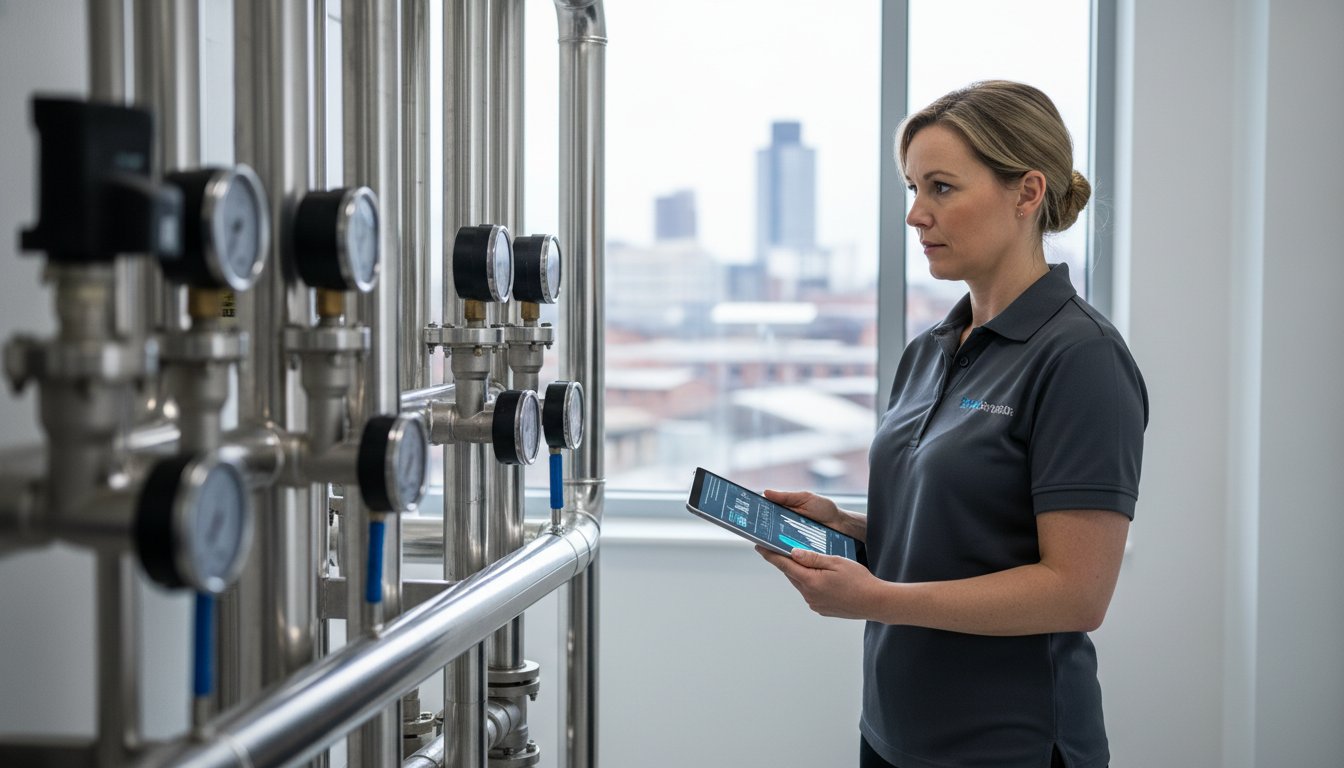
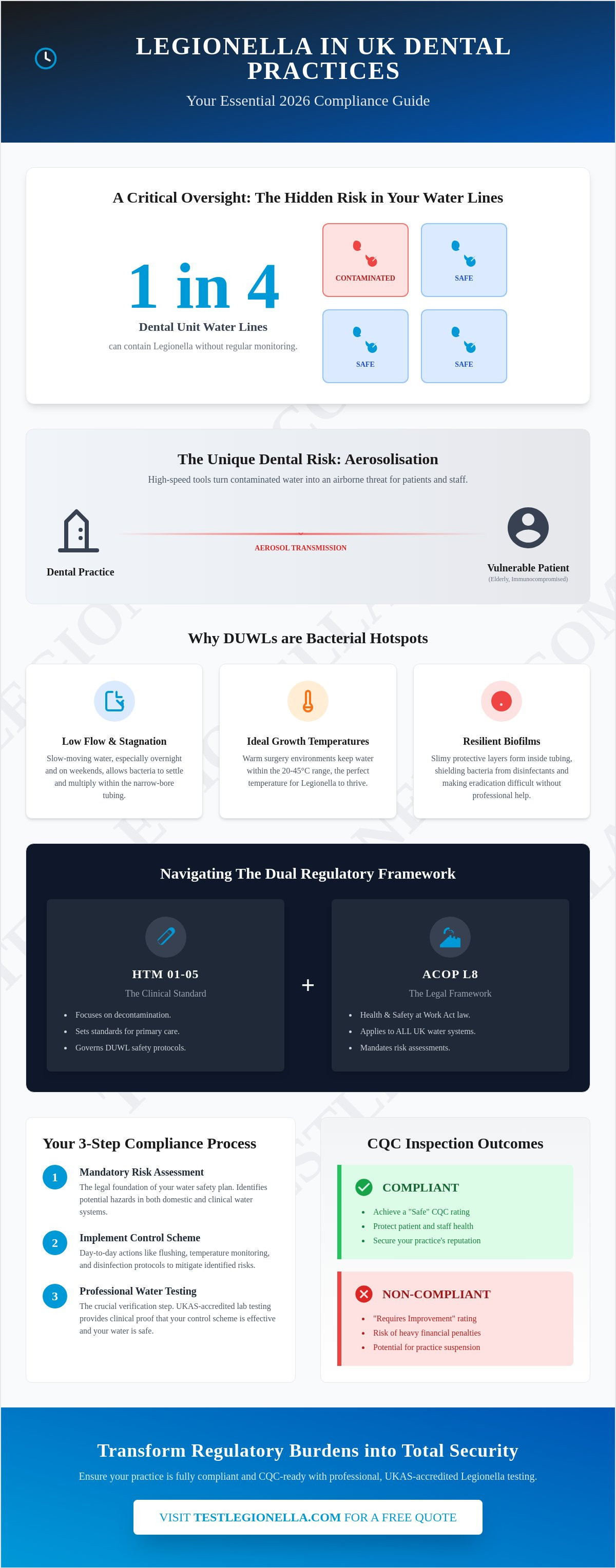
Did you know that research has shown Legionella bacteria can be present in as many as one in four Dental Unit Water Lines (DUWLs) in the UK when regular monitoring is not in place? This statistic highlights why legionella testing for dental practices uk remains a critical priority for every practice manager. You likely feel the pressure of an impending CQC inspection and the complexity of managing water safety alongside a busy clinical schedule. It's common to feel frustrated by conflicting advice regarding how often you need to test or how to manage the unique aerosol risks inherent in dental equipment.
We understand that regulatory burdens shouldn't get in the way of patient care. This 2026 compliance guide transforms these complex requirements into a streamlined, stress-free management plan. You'll learn how to master your water safety obligations, satisfy HTM 01-05 standards, and ensure your practice remains a safe environment for everyone. We'll explore the dual-track approach to managing both the building hierarchy and DUWL safety, giving you the specialist expertise needed to achieve total compliance with confidence.
Key Takeaways
- Understand how aerosolisation from drills and scalers creates unique risks, making clinical-grade water monitoring essential for patient and staff safety.
- Learn to navigate the dual requirements of HTM 01-05 and ACOP L8 to ensure your practice meets both clinical and legal safety standards.
- Discover the difference between mandatory risk assessments and legionella testing for dental practices uk, ensuring you remain fully compliant without unnecessary complexity.
- Master the step-by-step methodology for sampling sentinel outlets and dental unit bottles to maintain a streamlined, CQC-ready verification process.
- Secure your practice's reputation with professional risk ratings and documentation designed to transform regulatory burdens into total operational security.
Why Legionella Testing is Critical for UK Dental Practices
Effective legionella testing for dental practices uk involves more than a cursory glance at your water heater. It requires a dual-track approach that monitors both your domestic plumbing and your clinical lines. In a dental setting, the risk isn't just about ingestion; it's about inhalation. Every time you use a high-speed drill, an ultrasonic scaler, or an air-water syringe, you create a fine mist of water droplets. If your water system is colonised, these aerosols become a direct delivery vehicle for bacteria into the respiratory systems of your patients and staff.
The stakes are high because many dental patients belong to vulnerable groups. The elderly or those with compromised immune systems are at a significantly higher risk of developing Legionnaires' disease, a severe and potentially fatal form of pneumonia. While your domestic taps pose a standard risk, the narrow-bore plastic tubing within your dental chairs provides the perfect environment for complex "biofilms" to thrive. These slimy layers of microorganisms cling to the inner walls of the tubing, protecting bacteria from standard flushing and making them incredibly difficult to eradicate without professional intervention.
The High-Risk Nature of Dental Unit Water Lines (DUWLs)
Dental Unit Water Lines are unique biological hotspots. They use extremely narrow tubing which has a high surface-area-to-volume ratio, encouraging rapid bacterial attachment. Several factors exacerbate this risk:
- Low Flow Rates: Water moves slowly through these lines, and stagnation occurs every evening and weekend.
- Ambient Temperatures: Surgery environments are kept warm for patient comfort, which keeps the water in the plastic tubing within the ideal growth range for legionella.
- Biofilm Resilience: Once a biofilm matures, standard chemical disinfectants often fail to penetrate the core.
Without regular legionella testing for dental practices uk, you cannot verify if your daily flushing protocols or chemical tablets are actually working. Professional sampling provides the clinical proof that your water safety measures are effective.
CQC Inspections and Water Safety Compliance
The Care Quality Commission (CQC) views water safety as a fundamental component of the "Safe" key question during inspections. They don't just look for a certificate on the wall; they look for evidence of a living, breathing management system. Inspectors expect to see a clear audit trail that includes a current risk assessment and a consistent monitoring log. Failing to demonstrate this control can lead to "Requires Improvement" ratings, heavy financial penalties, or even temporary practice closure. A professional management plan transforms this regulatory burden into a streamlined process, giving you the peace of mind that your practice is always inspection-ready.
The Regulatory Framework: HTM 01-05 and ACOP L8
Managing a dental surgery means balancing clinical excellence with strict legal compliance. Two primary documents govern your water safety: HTM 01-05 and ACOP L8. While HTM 01-05 focuses on decontamination and clinical standards within primary care, the ACOP L8 guidance provides the overarching legal framework for controlling Legionella in all UK water systems. These documents work in tandem. HTM 01-05 sets the clinical expectations for your surgery, while ACOP L8 establishes the health and safety law you must follow as an employer. Together, they form a safety net that protects your patients and your professional registration.
You must identify specific roles within your practice to remain compliant. The "Duty Holder" is typically the practice owner or employer who carries ultimate legal responsibility. They must appoint a "Responsible Person" who has sufficient authority, competence, and knowledge to implement the control scheme. This person ensures that legionella testing for dental practices uk is carried out correctly and that all monitoring logs are maintained with precision. Clear accountability is the foundation of a safe practice.
Mandatory Requirements for Dental Water Systems
Every practice needs a "suitable and sufficient" Legionella risk assessment. This isn't a one-off task. You should review it annually or whenever there's a significant change to your water system or its use. Alongside this, you must maintain a written scheme of control. This document is your practice's "how-to" guide for water safety, detailing specific maintenance tasks, disinfection schedules, and emergency procedures. Record-keeping is non-negotiable. You must keep your monitoring logs and inspection results for at least five years. If you're concerned about the state of your current records, you can request a professional compliance audit to identify any hidden gaps before your next inspection.
Recommended Best Practices for Clinical Settings
Temperature monitoring is your first line of defence against bacterial growth. Cold water should stay below 20°C, and hot water should reach at least 50°C at the outlet within one minute of running. For infrequently used outlets, implement a weekly flushing protocol to prevent stagnation. Dental chairs require even stricter care. You should flush lines daily to combat the biofilm buildup discussed in the previous section. Always ensure you work with acop l8 compliant specialists who understand the unique plumbing of a dental surgery. This ensures your legionella testing for dental practices uk provides the clinical evidence needed for absolute peace of mind and full CQC compliance.
Legionella Risk Assessment vs. Water Testing: What Do You Need?
Understanding the difference between a risk assessment and water sampling is the first step toward true compliance. A risk assessment is a comprehensive physical survey of your entire water system. It identifies potential dead legs, assesses temperature controls, and maps out every outlet. It's your legal blueprint for safety. In contrast, legionella testing for dental practices uk is the laboratory analysis of physical water samples. While the assessment tells you where the risks might be, the testing confirms whether your control measures are actually working. Think of the assessment as the diagnosis and the testing as the clinical proof of health.
A common misconception in the dental industry is that "clean" waterlines mean zero risk. Because Legionella bacteria are microscopic and often hidden within the complex biofilms of your dental unit water lines (DUWLs), visual clarity is no guarantee of safety. You cannot see, smell, or taste the bacteria. Professional sampling provides the only definitive way to verify that your water is safe for aerosolisation during patient procedures.
When is Professional Water Sampling Mandatory?
While a risk assessment is always a legal requirement, specific "trigger points" make professional sampling essential for your surgery. HTM 01-05 requires an annual sample of water from the water heater drain to monitor the building's domestic system. However, your clinical lines require more frequent attention. You must arrange for sampling if:
- Your temperature monitoring logs show consistent failures (hot water below 50°C or cold water above 20°C).
- You've recently completed remedial work, such as replacing pipework or water heaters.
- You've modified the system or brought new dental chairs into service.
- A suspected case of Legionnaires' disease is associated with your practice.
Sampling is also the most effective way to validate your DUWL disinfection regime. It proves that your daily flushing and chemical treatments are successfully penetrating the biofilms in those narrow-bore tubes.
The Limitations of DIY Testing Kits
Don't rely on generic "dipstick" kits found online. These DIY tools often lack the sensitivity required to detect low levels of bacteria and won't stand up to CQC scrutiny. For legal defensibility, you need UKAS-accredited laboratory analysis. This provides a certified audit trail that proves you've met your duty of care. When you consider the legionella risk assessment cost, it's a minor investment compared to the devastating financial and reputational impact of a health and safety breach. Professional legionella testing for dental practices uk transforms a "paper exercise" into absolute patient safety and operational security.
Step-by-Step: The Dental Legionella Testing Process
Moving from regulatory theory to practical implementation requires a clear, methodical approach. The process of legionella testing for dental practices uk starts before the specialist even arrives at your surgery. You'll need to ensure all clinical areas, plant rooms, and water storage tanks are accessible. This preparation minimizes downtime and allows for a comprehensive survey of your facility's unique plumbing layout. Our specialists work around your patient schedule, performing the necessary sampling with clinical precision and minimal disruption.
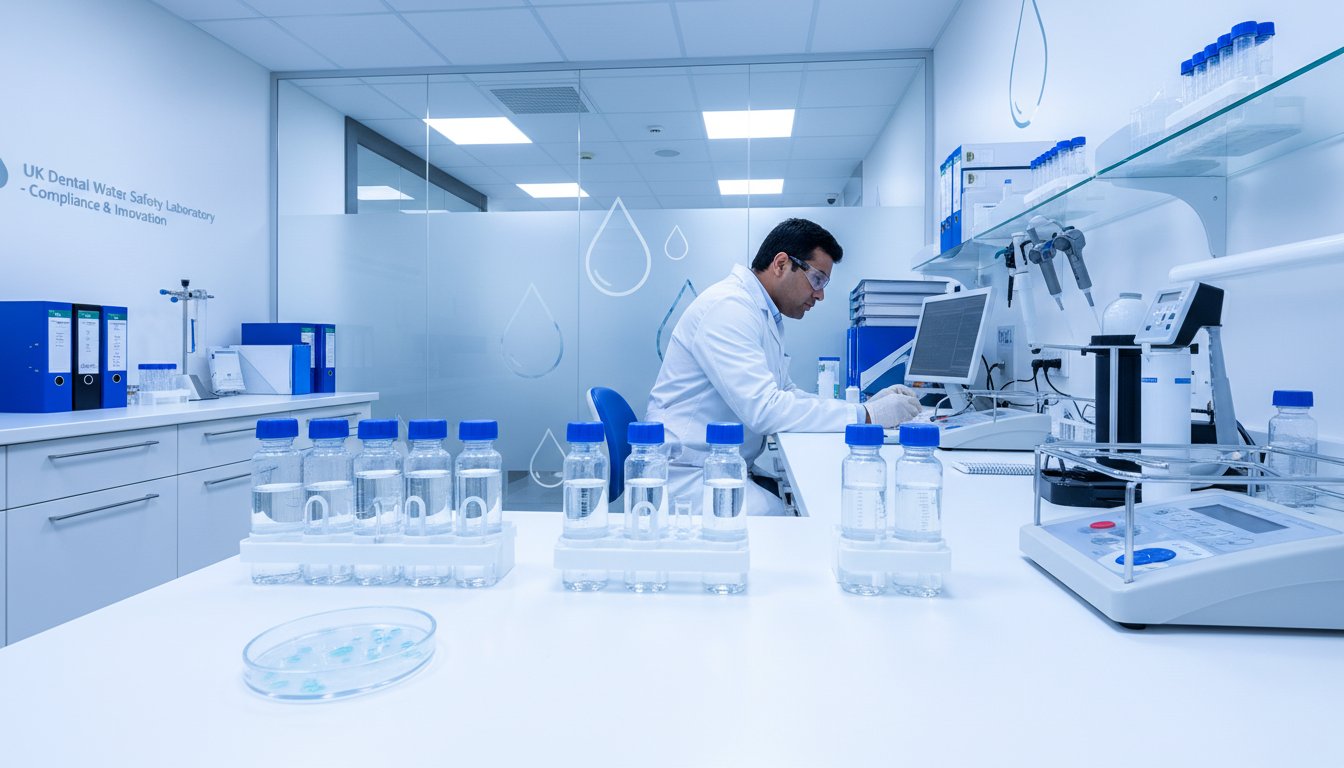
The core of the visit involves collecting water from "sentinel" outlets, which are the points closest to and furthest from your water source. This helps identify if a problem is localized or systemic. Every sample follows a strict "Chain of Custody" protocol. We seal each bottle and transport it in temperature-controlled containers to a UKAS-accredited laboratory. You should expect an incubation period of 10 to 12 days, as the lab must allow any present bacteria time to grow for accurate quantification. Once complete, you'll receive a detailed report that serves as your professional proof of compliance.
Sampling the Dental Unit Water Lines (DUWLs)
Clinical lines require a specific diagnostic approach. We take samples directly from the 3-in-1 syringe and high-speed handpiece lines, as these are the primary sources of aerosolisation. We often use a "first-flush" technique to capture the highest concentration of potential bacteria that may have settled in the tubing overnight. In some cases, we also take a "post-flush" sample to verify that your daily purging protocols are effective. This dual-sampling method provides a complete picture of your chair's safety. If you're ready to secure your practice's water safety, you can book your professional sampling visit today to ensure total clinical security.
Interpreting Your Lab Results and Remedial Actions
Your report will display results in "CFU/L", which stands for Colony Forming Units per Litre. This measurement tells us exactly how many viable Legionella bacteria are present in a specific volume of water. Understanding these action levels is vital for your safety management:
- Under 100 CFU/L: The system is under control. You should continue with your current written scheme and monitoring.
- 100 to 1,000 CFU/L: Bacteria levels are rising. You must review your control measures, check temperatures, and consider a targeted system disinfection.
- Over 1,000 CFU/L: This is a high-risk result. You must isolate the affected outlets immediately, perform a full system chlorination, and arrange for re-testing to verify the bacteria have been eradicated.
By following this structured response, you transform a potentially alarming result into a managed, professional resolution. This proactive approach keeps your practice safe, your staff protected, and your CQC documentation impeccable.
Test Legionella: Expert Compliance Support for UK Dentists
Test Legionella serves as the national specialist for dental water compliance, delivering authoritative reassurance to practice managers across the UK. We transform the complex burden of legionella testing for dental practices uk into a streamlined, managed process that protects your patients and your professional reputation. By utilizing an extensive network of UKAS-accredited laboratories, we ensure every water sample is analysed to the highest scientific standards. Our fixed-fee pricing model provides nationwide consistency, allowing you to manage multiple surgery locations without the worry of hidden costs or regional price variations.
We don't just provide raw data; we deliver CQC-ready documentation. Every report includes professional risk ratings and clear, actionable advice designed to satisfy the most rigorous inspections. This approach moves you beyond mere "paper compliance" and into a state of total operational security. You'll receive a comprehensive water safety file that serves as a robust legal defence, proving your commitment to the highest standards of clinical hygiene.
Why Choose a Specialist for Your Dental Practice?
General water safety companies often lack the nuanced understanding required for clinical environments. Our team possesses deep expertise in HTM 01-05 and the unique biological challenges posed by narrow-bore dental unit water lines. We understand that your primary focus is patient care, not plumbing. That's why we act as your efficient partner, handling the technical logistics and regulatory nuances on your behalf. Whether you operate a single-chair surgery or a large dental group, our nationwide reach ensures you receive a consistent, high-quality service that prioritizes your time and your practice's safety.
Get Your Compliance Certificate Today
Securing your practice's safety is a straightforward, professional process. From your initial enquiry, we move quickly to schedule a visit that fits your clinical calendar. Once sampling is complete and our UKAS-accredited labs have verified the results, you'll receive your final compliance report and certificate. This document provides the "peace of mind" that your water systems are under control and fully compliant with ACOP L8 and HTM 01-05. Don't leave your next CQC inspection to chance. Secure your dental practice compliance with Test Legionella and experience a faster, more reliable path to water safety.
Secure Your Practice’s Future with Professional Water Safety
Managing water safety is a fundamental pillar of clinical excellence. You've seen how aerosolisation risks and complex biofilms make dental chairs a unique challenge that requires specialized attention. By aligning your surgery with HTM 01-05 and ACOP L8 standards, you protect more than just your patients; you protect your professional registration and your team's health. Professional legionella testing for dental practices uk provides the definitive evidence you need to transform a complex regulatory burden into a state of total operational security.
Don't let the fear of a CQC inspection disrupt your focus on patient care. Our specialists provide the authoritative reassurance you need through UKAS-accredited laboratory testing and CQC-compliant reporting. We offer a fixed-fee nationwide service that removes the guesswork from your compliance budget. Take the first step toward a stress-free management plan and a safer clinical environment today. Book Your Professional Dental Legionella Assessment Now and enjoy the tranquility that comes from having a trusted specialist by your side. Your path to absolute compliance starts here.
Frequently Asked Questions
How often should a dental practice carry out a Legionella risk assessment?
You should review your Legionella risk assessment annually or whenever a significant change occurs in your water system. While the previous mandatory two-year review cycle was removed from ACOP L8, industry best practice for clinical environments dictates a yearly check. This ensures your control scheme remains valid as your practice equipment and plumbing layout evolve over time.
Is Legionella testing mandatory for all UK dental surgeries?
While a risk assessment is always a legal requirement, specific legionella testing for dental practices uk is primarily used as a verification tool. However, HTM 01-05 specifically requires an annual water sample from the water heater drain. You must also conduct sampling if your temperature controls fail or if you've recently completed major remedial work on your plumbing system.
What is the difference between ACOP L8 and HTM 01-05 for dentists?
ACOP L8 is the overarching legal requirement that applies to all UK employers regarding the control of Legionella bacteria. HTM 01-05 is the specific clinical guidance for decontamination in primary care dental practices. Think of ACOP L8 as your legal health and safety foundation, while HTM 01-05 provides the clinical framework for managing your dental unit water lines.
Can I perform my own Legionella testing in the practice?
You shouldn't rely on DIY testing if you want to remain CQC compliant. Home-style "dipstick" kits lack the sensitivity required for clinical diagnostics and don't provide the UKAS-accredited laboratory evidence needed for legal defensibility. Professional testing ensures your samples are handled under a strict chain of custody and analysed to the highest scientific standards.
What happens if Legionella bacteria are found in my dental unit water lines?
You must isolate the affected dental chair immediately to stop the risk of aerosolisation. Once the chair is out of service, perform a targeted system disinfection and arrange for professional legionella testing for dental practices uk to verify the bacteria have been eradicated. You shouldn't resume patient treatments until you have a clear laboratory report confirming the lines are safe.
Does the CQC check for Legionella certificates during an inspection?
Yes, CQC inspectors evaluate water safety under the "Safe" key question of their inspection framework. They'll expect to see your current risk assessment, a written scheme of control, and an up-to-date monitoring log. Providing professional certificates and laboratory results demonstrates a proactive approach to safety that can significantly improve your practice's overall inspection rating.
How long do I need to keep my water safety and testing records?
You must maintain your water safety records, including monitoring logs and laboratory reports, for at least five years. This historical data creates a vital audit trail that proves your consistent adherence to safety standards. Keeping these records well-organized ensures you're always ready for a spot check from the CQC or the Health and Safety Executive.
What are the symptoms of Legionnaires’ disease for dental patients?
Legionnaires' disease is a severe form of pneumonia that typically causes a high fever, a persistent cough, and shortness of breath. Some patients may also experience muscle aches and headaches. Because these symptoms can be life-threatening, particularly for those with compromised respiratory systems, your water safety protocols are a critical part of your practice's duty of care.