If a tenant falls ill, is your current risk assessment strong enough to keep you out of court? It is a question every responsible property owner dreads: what happens if a tenant gets legionnaires' disease on your watch? With the Renters' Rights Act 2026 now in full effect, the legal landscape has shifted, making water safety compliance a vital shield for your business rather than just a routine chore.
You likely feel the weight of your duty of care, especially with the threat of £20,000 fines or even imprisonment hanging over the industry. It's natural to feel concerned about the complexity of HSE requirements and the pressure to prove you've done everything right. We believe that while an infection is a medical crisis, your documentation is your ultimate legal defense. We're here to help you turn that regulatory burden into long term peace of mind and stress free management.
This guide clarifies the investigation process, breaks down the financial risks, and shows you exactly how to document your compliance to protect your tenants and your reputation. We will walk you through the essential steps to ensure your property meets the latest 2026 standards with confidence and professional clarity.
Key Takeaways
- Understand how a reported case triggers a formal HSE inquiry and what inspectors look for when entering your property.
- Discover what happens if a tenant gets legionnaires' disease, including the reality of £20,000 fines and potential criminal prosecution under 2026 regulations.
- Learn how to create a legal shield for your business by documenting risk assessments and temperature monitoring every two years.
- Identify why professional compliance testing is the most reliable way to meet the competent person standard and protect your reputation.
Understanding the Immediate Fallout of a Legionnaires’ Case
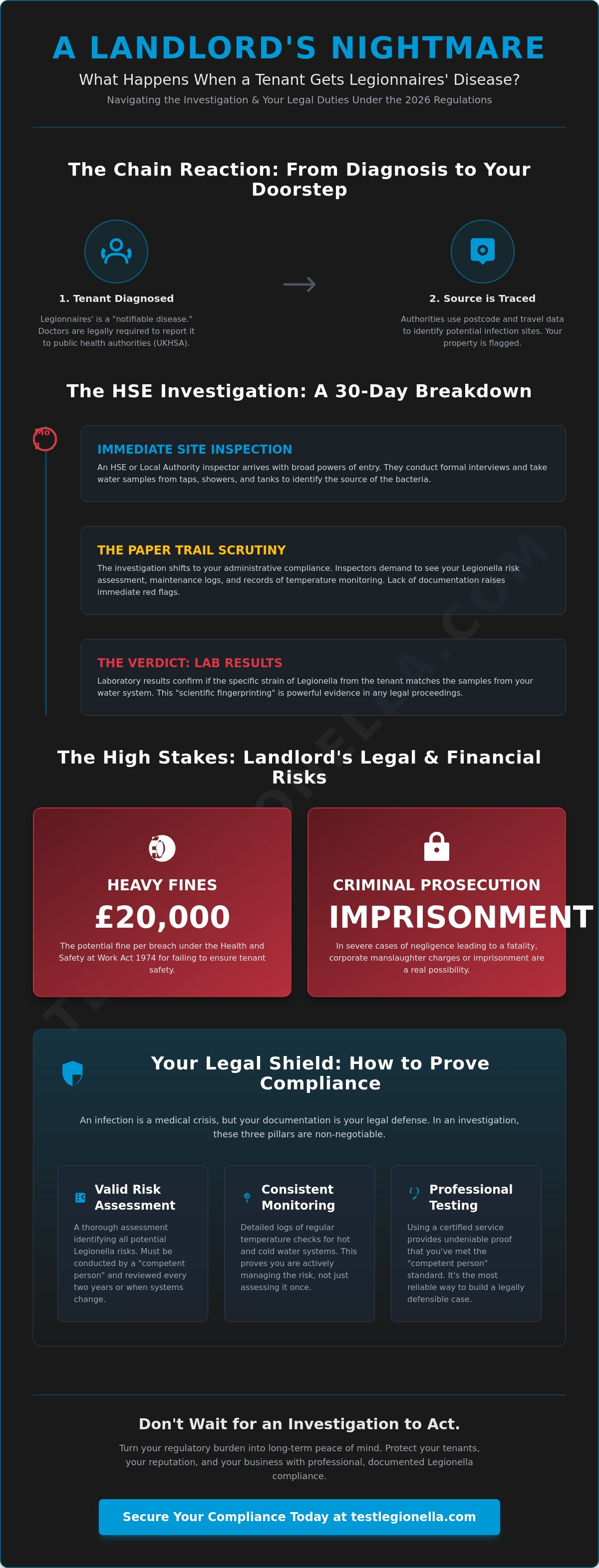
When a tenant is diagnosed with Legionnaires' disease, the clock starts ticking immediately. This isn't a private matter between a patient and a doctor; it's a notifiable disease under UK law. This means medical professionals must report the case to the UK Health Security Agency (UKHSA), who then work to trace the source of the infection. If you're wondering what happens if a tenant gets legionnaires' disease, the first reality is a sudden, high-stakes investigation into your property's water system.
Under Section 3(2) of the Health and Safety at Work etc. Act 1974, landlords have a legal duty to conduct their undertakings in such a way as to ensure, so far as is reasonably practicable, that tenants are not exposed to risks to their health or safety. Many landlords assume their properties are exempt because they are "low-risk" domestic settings. While it's true that regular water turnover reduces risk, that argument evaporates the moment a tenant tests positive. Once an infection is confirmed, the system is no longer low-risk by definition; it's a potential source of harm. The focus shifts entirely to identifying the specific water droplets that carried the bacteria into the tenant's lungs.
The Reporting Chain: From Doctor to Landlord
You might not be the first person to know your tenant is ill. When a case is identified, the Consultant in Communicable Disease Control (CCDC) leads the response. They use postcode data and travel history to map out potential infection sites. If your property is flagged, the local authority or the Health and Safety Executive (HSE) will contact you directly. This process is clinical, fast, and focused on public safety, often leaving landlords scrambling to find their latest risk assessment. Under the Renters' Rights Act 2026, this transparency is even more critical, as authorities now have clearer pathways to enforce safety standards.
Immediate Practical Steps for Property Managers
If you receive that call, your response must be measured and professional. Don't panic and flush the system with chemicals immediately. Doing so could be seen as destroying evidence during an active investigation. Understanding what happens if a tenant gets legionnaires' disease is the first step toward managing the situation effectively. Focus on these immediate actions:
- Secure the system: Restrict access to high-risk areas like showers or spa baths where aerosolized water is common.
- Document everything: Gather your existing risk assessments, maintenance logs, and communication records with the tenant.
- Notify professionals: Contact your insurance provider and legal counsel to ensure you're following the correct procedural steps.
- Communicate: If you manage a multi-occupancy building, you must inform other tenants about the situation without causing unnecessary alarm, focusing on the steps being taken to ensure their safety.
Acting quickly and following a structured plan shows you take your responsibilities seriously. It's the first step in demonstrating that you've prioritised tenant safety through proper compliance care.
The HSE Investigation: What to Expect When a Case Is Reported
Within 48 hours of a report, an inspector from the HSE or your local authority will likely arrive at your property. They possess broad powers of entry, meaning they can access the premises to protect public health without waiting for a landlord's invitation. This initial phase is fast-paced and focused on containment. They'll conduct formal interviews with you and your maintenance team to understand your water management history. The core of their inquiry rests on whether you met landlords' legal responsibilities by following the ACOP L8 guidelines.
Understanding what happens if a tenant gets legionnaires' disease requires knowing the investigation timeline. In the first few days, the focus is physical: inspectors take water samples from taps, showers, and water tanks. By the second week, the investigation turns to your administrative trail. If you can't produce a clear history of compliance, the pressure from authorities intensifies. By the end of the first month, laboratory results usually confirm if the bacteria in your system matches the patient's infection. This scientific "fingerprinting" is hard to dispute without your own professional records.
The Evidence Audit: What Inspectors Will Ask For
Inspectors will demand a paper trail that proves you've been proactive rather than reactive. They'll look for a valid Legionella risk assessment, which should be reviewed every two years or whenever the tenancy changes. They also check maintenance logs for consistent water temperature checks and showerhead descaling. If a previous report suggested remedial works, like removing "dead legs" in the pipework, you'll need to show proof that this work was completed. Gaps in these records are often where legal liability begins to solidify, making your documentation your most important asset.
Water Sampling and Lab Analysis
Forensic water testing is often the deciding factor in a case. Scientists use DNA sequencing to match the bacteria strain found in the tenant to the samples taken from your property. It's vital to distinguish between a "presence of bacteria" and a "systemic failure." Low levels of Legionella can exist in many systems, but a systemic failure suggests your control measures were inadequate. A professional Legionella report serves as your best defence, providing clear evidence that you maintained a safe environment. This professional documentation can transform a potential prosecution into a manageable situation by proving you met the "competent person" standard.
Legal Liability, Fines, and Civil Claims for Landlords
Understanding what happens if a tenant gets legionnaires' disease requires looking beyond the medical recovery. It's a dual-track legal nightmare involving both criminal and civil courts. Since the Renters' Rights Act came into force on May 1, 2026, the threshold for prosecution has lowered, and the penalties have become significantly more transparent. You don't just face trouble if a tenant falls ill; you face prosecution for the mere failure to manage the risk effectively.
Criminal prosecution is led by the HSE, and it's a common misconception that an actual infection is required for a day in court. If an inspector finds that you've ignored HSE guidance for landlords, they can prosecute based on the potential for harm. In cases where a tenant's death is caused by the disease, landlords now face the very real possibility of imprisonment. This legal shift reflects a growing trend toward total accountability in the private rental sector.
Beyond the courtroom, the Homes (Fitness for Human Habitation) Act provides tenants with a powerful lever. A water system contaminated with Legionella renders a property legally "unfit," allowing tenants to seek rent rebates and contract terminations. The reputational damage is equally severe. In a digital age, a single documented case of waterborne illness can permanently devalue a property and collapse your rental yields as potential tenants look elsewhere for safety.
The Scale of Potential Fines in 2026
Fines are no longer a slap on the wrist. Under the 2026 regulations, landlords who fail to comply with their legal duties face fines of up to £20,000. These aren't flat rates; they're often calculated based on your rental income or total turnover, ensuring the penalty is felt. For large scale providers, the stakes are even higher. We saw this in 2024 when Sanctuary Housing was fined £900,000 for poor risk management. Claiming you didn't know the law isn't a valid defence. The courts expect you to be a proactive professional who understands every risk within your four walls.
Civil Litigation and Tenant Rights
Civil claims are separate from HSE fines and often more expensive. A tenant only needs to prove their case on the "balance of probabilities" rather than "beyond a reasonable doubt." They can sue for medical costs, pain and suffering, and loss of earnings. If you lack a professional legionella risk assessment, your position is virtually indefensible. Most landlord insurance policies require proof of statutory compliance to pay out. Without that documentation, you're not just facing a lawsuit; you're facing it alone, with your personal assets on the line.
How to Prove Compliance and Protect Your Reputation
Proactive management is the only way to transform a potential legal crisis into a manageable event. If an investigation begins, your defense rests entirely on the quality of your records. While we've discussed what happens if a tenant gets legionnaires' disease, the focus now shifts to how you prove you fulfilled your duty. You must demonstrate that you took every reasonably practicable step to prevent the outbreak, especially under the stricter 2026 enforcement rules.
Follow these four critical steps to build your defense:
- Step 1: Conduct a professional risk assessment every two years or whenever there is a change in tenancy. This ensures your data is current and relevant to the property's specific water system.
- Step 2: Implement a simple, documented regime for water temperature monitoring. Bacteria multiply fastest between 20°C and 45°C; proving you kept water outside this range is vital for your case.
- Step 3: Provide tenants with written "Water Safety Instructions" in their move-in pack. This shifts the focus toward shared responsibility for daily water hygiene.
- Step 4: Act immediately on any remedial works identified in your reports. Leaving a "dead leg" or a faulty heater in place after a professional warning is a significant legal liability.
The "Paper Trail" as a Legal Shield
Handwritten notes on a notepad won't stand up in a 2026 court. Digital, time-stamped reports are superior because they provide an immutable record of when the assessment took place. Organise your compliance folder to include your latest risk assessments, certificates, and maintenance logs. When an HSE inspector asks for proof, being able to produce a structured, professional report immediately demonstrates that you are an organised landlord who values safety. This level of care is what we call Compliance Care, and it's designed to give you total peace of mind.
Educating Your Tenants
You cannot control how a tenant uses the water system every day, but you can document the advice you gave them. Explain the risks of stagnant water, especially if they've been away on holiday for more than a week. Advise them on the importance of keeping showerheads clean and not adjusting boiler temperatures below safe levels. By documenting that this safety advice was provided and understood, you protect your reputation. It shows the authorities that you didn't just check the pipes; you managed the human element of the risk too.
Don't wait for an investigation to start. Get your professional compliance quote today and secure your property's future with a specialist who understands the law.
Ensuring Water Safety with Professional Compliance Testing
While the law technically allows landlords to perform their own risk assessments, the "competent person" requirement is a high bar to clear in a legal setting. A DIY approach often misses subtle risks like thermal gain in cold water pipes or the specific mechanics of aerosol creation in modern power showers. If you're ever forced to explain what happens if a tenant gets legionnaires' disease to a judge, your self-certified notes might not provide the protection you expect. A professional report carries the weight of an expert witness, proving you prioritised tenant safety by hiring a specialist.
Our Compliance Care approach moves you from a state of uncertainty toward total security. We don't just hand you a certificate and walk away. We handle the technical complexities of water system architecture and bacterial growth patterns so you can focus on the day to day management of your properties. By using a professional service, you shift the burden of technical accuracy onto us, creating a robust layer of protection for your business and your reputation.
The Test Legionella Difference
We've made compliance easy and efficient because we know landlords are busy. Our process is built on speed and clarity, providing everything you need to satisfy HSE inspectors and insurance providers. You won't find confusing jargon in our documentation. Instead, we provide clear, action-oriented reports that highlight exactly what's needed to stay safe. We also track your compliance dates and send automated reminders, ensuring you never miss a review period or let a certificate expire.
- Fast turnaround: We provide rapid response times to keep your tenancies moving forward without delay.
- Reliable expertise: Our specialists understand the unique requirements of the Midlands rental market and the latest 2026 regulations.
- Tailored solutions: Whether you manage a single domestic flat or a large multi-occupancy block, our testing is adapted to your specific property type.
Get Your Professional Compliance Score
Uncertainty is the biggest risk in property management. If you don't have a clear picture of your current safety status, our free tools help you identify gaps before they become legal liabilities. You'll get direct access to specialists who understand the logistics of water safety and the gravity of public health. Don't leave your future to chance or a DIY checklist. Protect your tenants and your business. Book your assessment today.
Protect Your Tenants and Your Peace of Mind
The legal landscape for property owners has shifted, but managing water safety doesn't have to be a source of constant stress. We've explored the procedural fallout and investigative hurdles that define what happens if a tenant gets legionnaires' disease, and the solution always returns to one core principle: proactive documentation. By maintaining a clear audit trail and prioritising professional risk assessments, you transform a potential legal crisis into a professional, managed process.
You don't have to navigate these technical regulations alone. Our team specialises in UK landlord regulations to ensure your properties remain safe and fully compliant. We provide a fast turnaround on compliance reports, offering the same high standard of service trusted by national property managers across the country. Let us handle the complexities of water safety so you can focus on growing your business with confidence.
Secure Your Property with Professional Legionella Testing
Take the first step toward total peace of mind today. Your business is worth protecting, and we're here to help you do it right.
Frequently Asked Questions
Can a tenant sue me if they catch Legionnaires’ disease in my property?
Yes, a tenant can pursue a civil claim for damages, medical costs, and loss of earnings if they fall ill. Under civil law, they only need to prove their case on the balance of probabilities. If you haven't conducted a recent risk assessment or followed safety guidelines, defending against such a claim becomes almost impossible. Maintaining professional documentation is your only reliable shield against these potentially bankrupting lawsuits.
Does landlord insurance cover Legionella-related claims and legal fees?
Most landlord insurance policies only provide cover if you can prove you've met all statutory health and safety obligations. If you don't have a valid, documented risk assessment, your insurer may refuse to pay out for legal fees or settlements. It's vital to check your policy for specific clauses regarding "pollution or contamination" and ensure your compliance records are up to date to keep your cover valid.
What is the maximum fine for a landlord who fails a Legionella audit?
Under the Renters' Rights Act 2026, landlords face fines of up to £20,000 for failing to manage Legionella risks. These penalties apply even if no one has fallen ill, as the HSE prosecutes based on the failure to control the risk itself. For larger organisations or cases involving severe negligence, fines can be significantly higher, as demonstrated by the £900,000 penalty issued to Sanctuary Housing in 2024.
Do I need a Legionella certificate for every new tenancy in 2026?
You must review your Legionella risk assessment whenever there is a change to the tenancy or the water system. While there isn't a "certificate" in the same legal sense as a Gas Safety record, the documented assessment is a mandatory requirement. Providing a copy of this assessment to new tenants as part of their move-in pack is a best practice that demonstrates you've fulfilled your duty of care.
What happens if a property is vacant for several weeks before a tenant moves in?
Risk levels increase significantly during vacancies because stagnant water allows bacteria to multiply, especially if temperatures sit between 20°C and 45°C. You must thoroughly flush all outlets, including taps and showers, for several minutes before a new tenant moves in. Documenting this flushing process in your maintenance log is essential to prove you managed the increased risk during the period the property was empty.
Is a Legionella risk assessment mandatory for a single-room rental?
Yes, the legal duty to conduct a risk assessment applies to all residential lettings, including single-room rentals and HMOs. The law doesn't distinguish between the size of the property; if you're a landlord, you have a duty of care to your tenants. While the assessment for a single room might be simpler than for a large house, you still need to document that you've identified and controlled potential hazards.
How do I prove to the HSE that I have met my legal obligations?
You must provide a clear audit trail consisting of a professional risk assessment and consistent maintenance logs. This documentation is exactly what happens if a tenant gets legionnaires' disease and an official investigation begins. Digital, time-stamped reports are the most effective way to prove you took "reasonably practicable" steps. Showing that you've monitored water temperatures and descaled showerheads regularly will satisfy inspectors that you've met your obligations.
What are the first signs that a water system might be contaminated?
You cannot see, smell, or taste Legionella bacteria, which makes professional testing so important. Physical indicators of high risk include the presence of slimy "biofilm" on showerheads or water temperatures that consistently stay within the dangerous 20-45°C range. If your boiler isn't reaching 60°C or your cold water feels lukewarm, your system is at an elevated risk of contamination and requires immediate attention to ensure tenant safety.