
Did you know that an atypical outbreak in London during March 2026 resulted in 8 confirmed cases of Legionnaires’ disease in just a few weeks? While the total number of cases in England and Wales dropped by 22% in 2024, the risk to your reputation and your occupants remains a constant priority. It's natural to feel concerned about technical jargon or the threat of HSE fines. You need a way to manage water safety that's efficient and easy to track without it taking over your entire schedule.
This guide provides a definitive legionella compliance checklist for businesses designed to transform complex regulations into a manageable routine. We'll help you secure the legal protection you need through proper documentation and professional oversight. You'll learn how to meet the ACOP L8 standards and the March 2024 HSG274 Part 1 updates with total confidence. We are going to break down your legal duties into a clear, actionable list that ensures your building stays safe and your business stays protected.
Key Takeaways
- Understand your statutory duties under ACOP L8 to protect your building and avoid costly HSE legal action.
- Learn why a "suitable and sufficient" risk assessment is the mandatory starting point for every UK property owner.
- Use our definitive legionella compliance checklist for businesses to simplify your monitoring and temperature control regime.
- Discover how UKAS-accredited laboratory testing provides the ultimate layer of protection and professional peace of mind.
- Master record-keeping techniques that ensure your Compliance Care documentation is always accurate and ready for inspection.
Understanding Your Legal Obligations under ACOP L8
ACOP L8 is the primary regulatory framework for Legionella control in the United Kingdom. While many business owners view it as a thick manual of suggestions, it's actually an Approved Code of Practice with unique legal weight. If you are prosecuted for a health and safety breach, a court will look at whether you followed ACOP L8. If you didn't, you must prove that you achieved the same level of safety through other means. For most, following a legionella compliance checklist for businesses is the only reliable way to stay on the right side of the law. This framework is designed to help you manage the risks associated with Understanding Legionnaires' disease, a severe form of pneumonia caused by bacteria that thrive in poorly managed water systems.
Legionella compliance is a statutory requirement under the Health and Safety at Work etc. Act 1974 and the Control of Substances Hazardous to Health Regulations 2002 (COSHH). These laws don't just apply to large factories or hospitals. They apply to every employer or person in control of a premises where water is used or stored and where there is a risk of exposure to Legionella bacteria. Don't mistake the technical guidance for optional advice. Failing to maintain your water systems is a direct violation of your legal duty of care to employees, tenants, and the public.
Who is the 'Responsible Person' in Your Business?
The duty holder, usually the employer or property owner, must appoint a "Responsible Person" to take day to day charge of Legionella control. This individual needs sufficient authority and "competence," which means they must have the right training and experience to understand the risks. You can't just pick a name at random; they must be able to identify potential hazards and take action. While you can hire a specialist for legionella compliance checklist for businesses tasks, you cannot delegate your legal responsibility to a third party. You remain accountable for ensuring the work is done correctly. Our Compliance Care approach ensures your designated person has the professional support they need to succeed.
The Legal Consequences of Non-Compliance
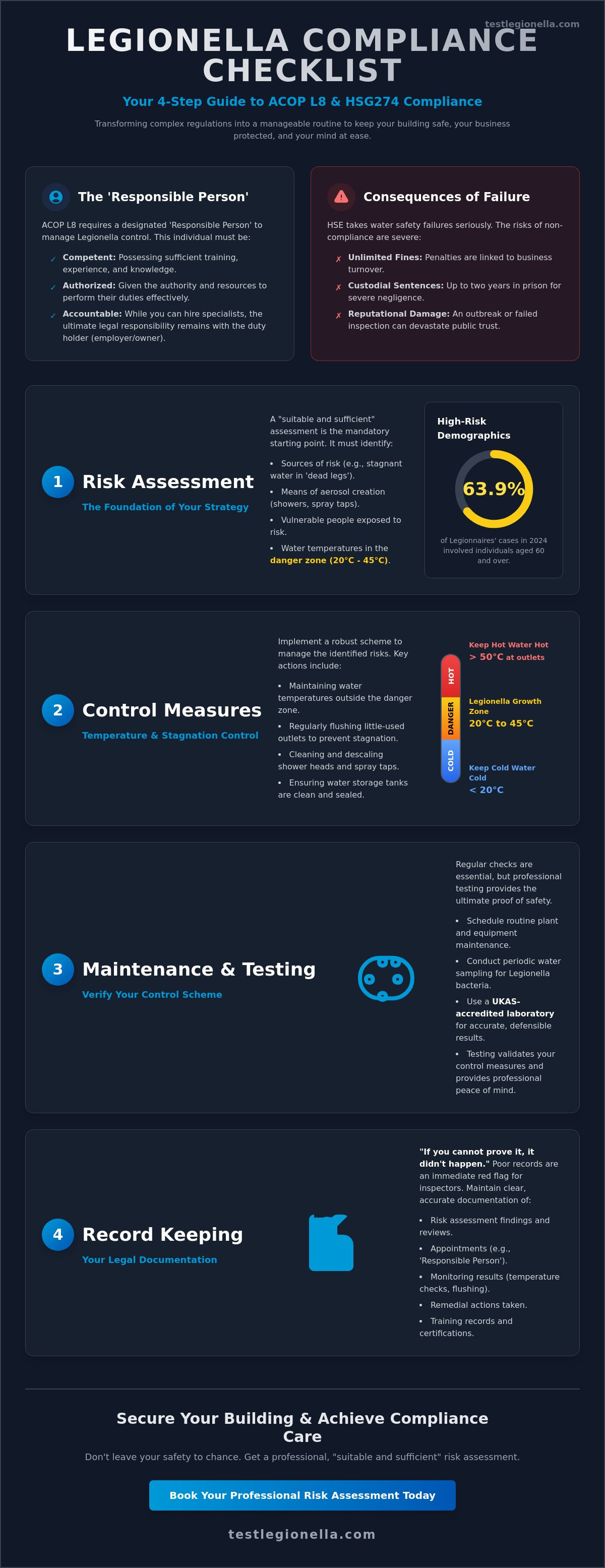
The Health and Safety Executive (HSE) takes water safety failures very seriously. Since the 2016 sentencing guidelines update, fines for health and safety offences are now linked to business turnover, often leading to unlimited financial penalties. In severe cases of negligence, custodial sentences of up to two years are a real possibility for directors. Beyond the courtroom, an outbreak or a failing inspection can devastate your business reputation and may even void your insurance policies. Poor record-keeping is often the first thing an inspector looks for. If you cannot prove your monitoring took place, the law assumes it didn't happen. Professional testing and clear documentation are your best protection against these risks.
Step 1: The Legionella Risk Assessment (The Foundation)
The risk assessment isn't just the first step; it's the foundation of your entire safety strategy. Without a "suitable and sufficient" assessment, any further actions you take are just guesswork. This document identifies where the bacteria could grow and how people might be exposed to it. It's the core component of any legionella compliance checklist for businesses. To meet your Legal Obligations under ACOP L8, this assessment must be carried out by a competent person. This is someone with the specific technical knowledge to spot risks that an untrained eye would miss, such as "dead legs." These are sections of redundant pipework where water stagnates, creating the perfect breeding ground for bacteria.
A professional assessment also identifies aerosol-generating outlets. These include showers, spray taps, and even cooling towers. These outlets are critical because they turn water into fine droplets that can be inhaled. If you're unsure where your building stands, booking a professional Legionella Risk Assessment is the most efficient way to secure your premises. It transforms a complex regulatory requirement into a clear, actionable plan for your team.
Identifying Hazards in Your Water System
Mapping your system is essential for total clarity. We trace the water from the point it enters your building to the very last outlet. We look specifically for the "danger zone" temperatures between 20°C and 45°C, where Legionella thrives. We also evaluate the susceptibility of your occupants. For instance, data from 2024 showed that 63.9% of Legionnaires' cases involved individuals aged 60 and over. If your business serves a vulnerable demographic, your legionella compliance checklist for businesses must reflect a higher level of scrutiny to ensure everyone remains protected.
When to Review Your Assessment
Your risk assessment isn't a "one and done" document. You must review it if there are significant changes to your plumbing, the building's use, or if you receive positive test results. Even without these specific triggers, an annual review is the industry gold standard for maintaining a sense of security. It ensures your records stay current and your legal protection remains ironclad. Understanding the legionella risk assessment cost helps you budget for this essential service, ensuring your business stays compliant without financial surprises. This proactive approach is the heart of our Compliance Care philosophy, making safety easy and manageable for every property owner.
Step 2: Implementing Control Measures & Temperature Monitoring
Identifying risks is only half the battle. You need a proactive strategy to keep bacteria at bay. A legionella compliance checklist for businesses provides the structure needed to manage these tasks across a busy work week. Temperature control is the most effective way to prevent bacterial growth. By keeping water outside the range where Legionella thrives, you eliminate the risk at its source. This isn't just about ticking boxes; it's about creating a hostile environment for pathogens within your pipes.
Beyond temperature, physical maintenance is vital. Scale and biofilm act as nutrients and shelter for bacteria. You must descale and clean showerheads and spray taps at least quarterly. If your building has high-use areas, you might need to do this more often. This simple step significantly reduces the risk of aerosol-generating outlets becoming a health hazard. It's a key part of our Compliance Care approach, ensuring your hardware doesn't work against your safety goals. Professional legionella compliance checklist for businesses protocols always prioritize these high-risk areas to ensure total protection.
The Hot and Cold Water Temperature Rules
Precision is your best friend when it comes to monitoring. Cold water must stay below 20°C to keep any present bacteria in a dormant state. Hot water requires a two-stage approach. Store it at 60°C in the calorifier to kill bacteria, then ensure it reaches your outlets at 50°C within one minute of turning on the tap. In healthcare settings, this distribution temperature must be at least 55°C. Use a calibrated digital thermometer for your monthly readings to ensure your data is legally defensible. If your readings drift into the danger zone, you must investigate the cause immediately.
Preventing Stagnation: The Flushing Regime
Stagnant water is a major risk factor for bacterial colonisation. Any outlet used less than once a week is considered "infrequently used" and needs a regular flushing schedule to keep water moving. You should implement the following protocols:
- Flush taps for at least 2 minutes at both high and low temperatures.
- Run showers for at least 5 minutes, ideally with the head contained to prevent aerosol spread.
- Keep a clear, dated log of every flushing event in your compliance file.
Recording these activities is non-negotiable. If an inspector visits, your flushing log serves as evidence of active management. It proves you aren't just reacting to problems but are proactively preventing them. This level of detail provides the peace of mind that your building remains safe for everyone who enters. It transforms a technical requirement into a reliable safety net for your property.
Step 3: Routine Maintenance and Professional Water Testing
Many business owners struggle to draw the line between tasks they can handle in-house and those requiring a specialist. A robust legionella compliance checklist for businesses clearly separates simple visual checks from technical laboratory analysis. While your staff can monitor temperatures, they cannot verify the absence of bacteria without UKAS-accredited testing. This professional analysis is the only way to get a definitive result that stands up in court. Professional testing provides what we call Compliance Care, transforming a stressful regulatory burden into verified peace of mind.
Sampling becomes a legal necessity, rather than an option, in specific scenarios. If your system fails to maintain the required temperatures or if you're managing high-risk equipment like cooling towers, professional sampling is mandatory. Following the March 2024 update to HSG274 Part 1, the scrutiny on evaporative cooling systems has intensified. If you manage complex buildings or serve vulnerable people, regular water sampling is your most reliable safety net. In 2024, 472 cases of legionellosis were reported in England and Wales, proving that the risk is persistent and requires professional oversight to manage effectively.
Monthly and Quarterly Tasks for Businesses
Your internal team should focus on high-frequency monitoring that maintains the temperature regime. Monthly checks must include sentinel outlets, which are the outlets closest to and furthest from your water source. These provide a representative snapshot of your entire system's health. Every three months, your team should descale and disinfect all showerheads and hoses. This prevents the buildup of biofilm and scale that protects bacteria from heat. Additionally, perform a visual inspection of your cold water storage tanks. You are looking for signs of debris, sediment, or vermin that could contaminate your supply.
Annual Professional Inspections
Some tasks require specialized equipment and deeper technical knowledge. Once a year, you must perform a calorifier blowdown to remove accumulated sediment from the bottom of your water heater. This sediment acts as a nutrient source for bacteria and reduces heating efficiency. Annual inspections also include a thorough check of thermal insulation on pipework to prevent heat gain in cold pipes. For complex buildings, annual water sampling is considered best practice to validate that your control measures are working. Accurate documentation of these annual checks is the backbone of your legal defense.
Ensure your building is fully protected by booking your Professional Legionella Compliance Testing today.
Step 4: Record Keeping and Achieving Compliance Care
In the world of water safety, the mantra is simple: if it isn't written down, it didn't happen. You might be diligent with your temperature checks and flushing, but without a robust record-keeping system, you have no legal defense. If an inspector from the HSE arrives at your door, the first thing they will ask for is your compliance file. A complete legionella compliance checklist for businesses must culminate in a well-organized logbook that tracks every action taken to mitigate risk. This documentation is your proof of active management and your primary shield against prosecution.
The law is very specific about how long you must store this data. Under the current version of acop l8, you must legally retain your safety records for at least five years. This includes your risk assessments, monitoring logs, and any certificates for remedial work or disinfection. Keeping these records organized doesn't just satisfy the law; it allows you to spot trends in your water system, such as a gradual drop in hot water temperatures that might signal a failing calorifier. It's about turning data into a proactive safety tool.
The Anatomy of a Professional Compliance Report
A professional report shouldn't be a generic stack of papers. It needs a clear executive summary that highlights immediate risks and required remedial actions. High-quality reports include photographic evidence of your system's condition, documenting everything from scale buildup on showerheads to the state of your cold water tanks. We prioritize tasks into High, Medium, and Low risk categories so you know exactly where to focus your budget first. This structured approach ensures that a legionella compliance checklist for businesses remains a practical management tool rather than an overwhelming burden.
Partnering with Professional Testing Specialists
Self-auditing often leads to internal bias or missed details due to familiarity with the building. Bringing in an external specialist ensures an objective, expert view of your safety standards. At Test Legionella, we specialize in making the complex easy. We provide the professional oversight needed to transform your regulatory duties into a state of total security. We track your compliance dates and send reminders, acting as your partner in long-term safety rather than just a one-off service provider. This is the essence of Compliance Care: professional quality, clear reports, and total peace of mind.
Ensure your business is protected with professional Legionella testing today and secure your property for the future.
Secure Your Business with a Proactive Safety Cycle
Managing water safety effectively requires more than just a passing glance at your pipes. By following a structured legionella compliance checklist for businesses, you transform a complex regulatory burden into a streamlined cycle of safety. You've learned that a suitable risk assessment is your mandatory starting point and that maintaining the correct temperature regime is your most powerful tool for bacterial control. When you pair these actions with meticulous record-keeping and professional laboratory analysis, you secure both your building and your legal reputation.
Don't let the fear of HSE fines or technical jargon slow you down. Test Legionella offers UK-wide professional testing coverage and specialist UKAS-accredited laboratory analysis to ensure your results are ironclad. We prioritize a fast turnaround on compliance reports so you can move forward with total confidence. Achieving full regulatory adherence is the most reliable way to protect your occupants and your future.
Get My Professional Compliance Quote Today and experience how we make Compliance Care simple and effective. You've got the knowledge; now take the final step toward complete peace of mind.
Frequently Asked Questions
Is a Legionella risk assessment a legal requirement for all businesses?
Yes, conducting a Legionella risk assessment is a statutory legal requirement for every business in the UK that manages a premises. This duty falls under the Health and Safety at Work etc. Act 1974 and COSHH regulations. Whether you're a small office or a large industrial site, you must identify potential risks to ensure the safety of your employees and visitors.
How often should a business carry out Legionella water testing?
The frequency of testing depends on the specific risks identified in your assessment and the type of water system you manage. While monthly temperature checks are standard for many, professional water sampling is typically conducted annually for complex systems or quarterly for high-risk equipment. Using a legionella compliance checklist for businesses helps you track these dates so you never miss a mandatory testing window.
Who can carry out a Legionella risk assessment in a workplace?
A competent person with the necessary technical knowledge and experience must carry out the assessment. You can appoint an internal staff member if they have received adequate training, but many businesses choose an external specialist. A professional partner ensures the report is "suitable and sufficient" to meet HSE standards, providing an objective view that internal audits might miss.
What happens if Legionella is found in my business water system?
You must immediately implement your emergency procedures to protect building occupants. This usually involves isolating the affected area, performing a professional chemical or thermal disinfection, and conducting follow-up UKAS-accredited testing. Once the system is clear, you must review your risk assessment to identify the cause of the colonisation and update your control measures to prevent it from happening again.
Do small businesses with simple water systems still need a checklist?
Yes, even small businesses with basic plumbing must have a legionella compliance checklist for businesses to prove they're managing risks. While your control measures might be as simple as descaling showerheads and monitoring water heater temperatures, the law requires you to document these actions. A clear checklist ensures you don't overlook simple tasks that could lead to bacterial growth in stagnant areas.
How long do I need to keep Legionella compliance records for?
You must legally retain your Legionella records for a minimum of five years. This includes your current and previous risk assessments, all temperature monitoring logs, and laboratory test results. Maintaining this five-year audit trail is essential for demonstrating your long-term commitment to safety if you are ever inspected by the Health and Safety Executive or local authorities.
Can I do my own Legionella risk assessment for my business?
You can conduct your own assessment if you are truly competent to identify all potential hazards. However, it's risky because you must be able to spot technical issues like dead legs or incorrect pipework insulation. Most business owners prefer professional testing because it provides a legally defensible document and the peace of mind that a specialist has thoroughly examined the entire system.
What are the symptoms of Legionnaires’ disease I should be aware of?
Legionnaires' disease is a severe form of pneumonia that usually starts with flu-like symptoms. Look out for a high fever, persistent cough, muscle aches, and shortness of breath, which typically appear 2 to 10 days after exposure. Given the 2.8% case fatality rate reported in 2024, it's vital that anyone showing these symptoms seeks medical attention immediately and mentions potential exposure.