
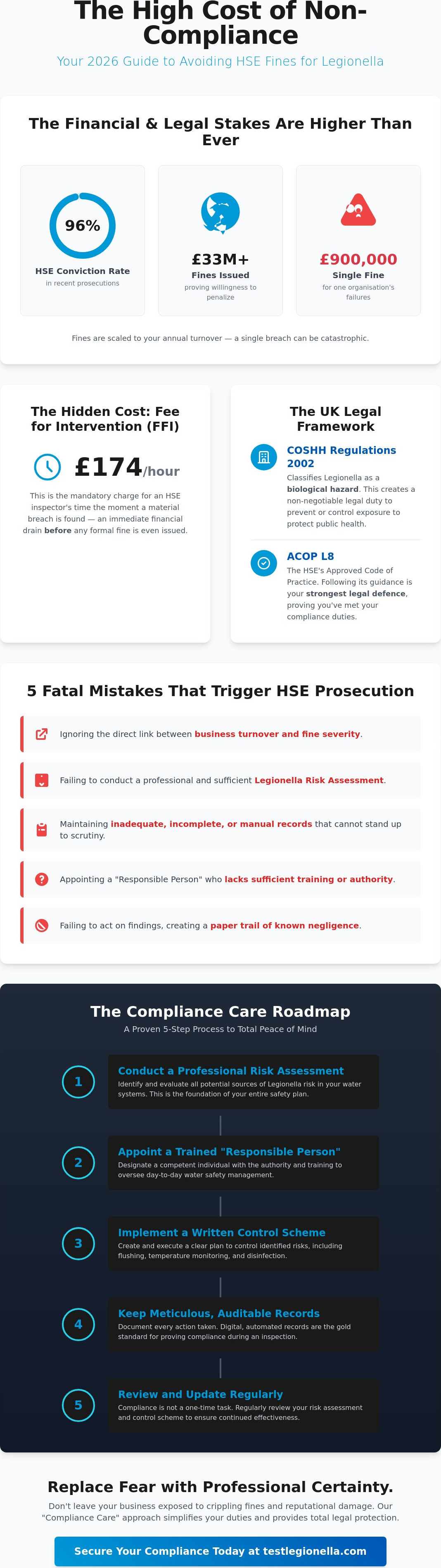
Did you know the HSE secured a 96% conviction rate across its recent prosecutions, resulting in over £33 million in fines? With one UK organization recently hit by a £900,000 penalty for water safety failures, avoiding HSE fines for legionella has become a critical priority for every property owner in 2026. We understand that the complexity of ACOP L8 and COSHH regulations often feels overwhelming, especially when manual record keeping takes up hours of your valuable time. It's natural to feel concerned about the threat of unlimited fines or the reputational damage of an outbreak, like the eight confirmed cases seen in London during March 2026.
The good news is that compliance doesn't have to be a source of stress. You can protect your business and your tenants by implementing a fail-safe strategy we call Compliance Care. This guide walks you through a streamlined water safety routine that replaces fear with professional certainty. You'll learn how to master your legal duties, automate your documentation, and ensure your property remains a safe, fine-free zone throughout 2026 and beyond. By the end of this article, you'll have a clear, actionable roadmap to total legal protection and the peace of mind you deserve.
Key Takeaways
- Understand how HSE fines are now linked to business turnover and why the 'Fee for Intervention' can impact your bottom line before a fine is even issued.
- Master the core requirements of ACOP L8 and COSHH to ensure your property meets the 2026 legal definition of a safe water system.
- Identify the five fatal mistakes in record-keeping and risk management that most frequently trigger HSE investigations and criminal charges.
- Follow a proven five-step roadmap for avoiding HSE fines for legionella through professional risk assessments and trained responsible persons.
- Discover how a "Compliance Care" approach simplifies your regulatory duties, providing a manageable routine and total peace of mind for landlords.
The Financial and Legal Stakes: Why Avoiding HSE Fines for Legionella is Critical
The HSE doesn't just issue slap-on-the-wrist warnings anymore. Under current sentencing guidelines, fines are directly scaled to a company's annual turnover. This means for a large business, a single failure in water safety can result in a multi-million pound penalty. Avoiding HSE fines for legionella isn't just about public health; it's about protecting your company's solvency and future. In the 2024/2025 period alone, the HSE completed 246 criminal prosecutions with a staggering 96% conviction rate, proving that they're both willing and able to penalize those who cut corners.
Even before a judge sees your case, you'll likely encounter the Fee for Intervention (FFI). If an HSE inspector identifies a material breach during a visit, they charge for every minute of their time spent identifying the fault and overseeing the resolution. It's an immediate financial drain that starts the moment they walk through your door. Beyond the bank balance, there's the human factor. What is Legionnaires' disease? It's a severe, potentially fatal form of pneumonia. If an outbreak occurs due to negligence, you face corporate manslaughter charges and permanent reputational ruin that no marketing budget can fix.
The Cost of Non-Compliance in 2026
The courts now categorize breaches by the level of culpability and the potential for harm. You don't need an actual outbreak to be prosecuted; the mere presence of a risk is enough to trigger a massive fine. Ignorance of the law is never a valid defense in a UK court. As of 2026, the HSE Fee for Intervention remains a mandatory charge of £174 per hour for any inspection where a material breach is discovered.
Criminal Liability for Duty Holders
You can't hide behind a corporate shield. Under the Health and Safety at Work Act 1974, individual directors and managers can be held personally liable for safety failures. This moves the issue from civil litigation, where insurance might cover the costs, to criminal prosecution, where the penalty is a prison sentence. An HSE Improvement Notice can also freeze your operations, causing massive service disruptions while you scramble to meet their demands. While these stakes are high, compliance is a manageable path to total peace of mind when you have the right systems in place.
The UK Legal Framework: Understanding ACOP L8 and COSHH
The Health and Safety at Work etc. Act 1974 is the bedrock of your legal obligations as a property owner or employer. It mandates that you protect employees and the public from health risks arising from your activities. Under the COSHH Regulations 2002, Legionella is explicitly classified as a biological hazard. This classification means you have a specific, non-negotiable duty to prevent or control exposure. Avoiding HSE fines for legionella starts with acknowledging these statutes. If you can't prove you've taken reasonable steps to manage this biological risk, the legal consequences are severe.
To help you meet these high standards, the HSE provides ACOP L8. While it's an Approved Code of Practice rather than a law itself, it holds a unique legal status. If you're prosecuted for a health and safety breach, following the guidance in ACOP L8 is considered evidence that you've complied with the law. Conversely, if you haven't followed it, you'll need to prove to a court that you've done something equally effective. It's far simpler and safer to stick to the established code. You can find broader context on surveillance and investigation in the UK government guidance on Legionnaires' disease.
Duty Holder vs. Responsible Person: Who is Liable?
The Duty Holder is typically the employer or the person in control of the premises. While you can't delegate your ultimate legal liability, you're required to appoint a competent Responsible Person to manage day-to-day controls. This person must have sufficient Legionella knowledge to make informed safety decisions. Appointing someone without the right training or authority is a common mistake that leads to prosecution. If you're unsure about your current delegation, you can book a professional consultation to clarify your position.
Statutory Requirements for Risk Assessments
Every man-made water system requires a risk assessment by law. This isn't a one-off document you can file and forget. The HSE requires it to be "suitable and sufficient," meaning it must be thorough, documented, and tailored to your specific building. You must review this assessment whenever there's a significant change to your water system, such as new pipework or changes in building usage. Professional testing and documented reports are your primary evidence of avoiding HSE fines for legionella during an inspection.
5 Fatal Mistakes That Lead to HSE Prosecution
HSE inspectors don't just look for the presence of bacteria. They look for management failures. Avoiding HSE fines for legionella is impossible if your paperwork is a mess or your physical system is neglected. Most prosecutions in 2026 stem from five specific, avoidable errors that signal a lack of control to an inspector. If you're making these mistakes, you're leaving your business exposed to the 96% conviction rate seen in recent criminal health and safety cases.
- Failing to conduct a professional risk assessment: A DIY attempt rarely meets the "suitable and sufficient" legal standard.
- Incomplete documentation: Missing a "Written Scheme of Control" is often the first thing an inspector flags.
- Neglecting physical maintenance: Allowing "dead legs" or redundant pipework creates stagnant zones where bacteria thrive.
- Poor monitoring regimes: Skipping monthly temperature checks or weekly flushing of low-use outlets breaks the chain of compliance.
- Delayed remedial action: Failing to act on recommendations within the timeframe specified in your report suggests willful neglect.
The Danger of 'Generic' Risk Assessment Templates
A generic template downloaded from the internet is a fast track to an Improvement Notice. The HSE rejects off-the-shelf checklists because they lack a site-specific asset register. Every building has a unique footprint. You need a document that maps every tank, calorifier, and thermostatic mixing valve in your specific system. While some try to save money with a DIY form, the cost-benefit of professional assessments far outweighs the risk of an unlimited fine. Following the HSE's Approved Code of Practice (ACOP L8) requires technical detail that generic forms simply cannot provide.
Record Keeping: The First Thing the HSE Asks For
When an inspector walks through your door, they'll ask for your logbook before they even look at a tap. You're legally required to keep records of all control measures for at least five years. Our Compliance Care approach simplifies this burden by ensuring every temperature check and disinfection is documented clearly. Digital records are now the gold standard for audit trails because they can't be lost, damaged, or easily backdated. A perfect compliance folder shows a consistent, proactive routine. It proves you're avoiding HSE fines for legionella by staying organized, rather than scrambling to fix problems only when an inspection is announced.
The Compliance Care Roadmap: 5 Steps to Immunity from Fines
Achieving total legal protection isn't about luck; it's about following a structured process. We call this our Compliance Care Roadmap. It transforms the daunting task of avoiding HSE fines for legionella into a series of manageable, logical steps. By moving from a reactive "fix-it" mindset to a proactive safety culture, you secure your reputation and your bank balance simultaneously. This roadmap ensures you meet every expectation of the HSE before an inspector even sets foot on your property.
- Step 1: Commission a professional risk assessment. This must be a UKAS-standard assessment that identifies every potential hazard in your specific water system.
- Step 2: Appoint a competent Responsible Person. You need someone with the authority and knowledge to oversee the control scheme effectively.
- Step 3: Create a Written Scheme of Control. This is your operational manual. It details exactly who does what, when, and how to keep the water system safe.
- Step 4: Establish monitoring and maintenance. This is the heartbeat of compliance, involving regular checks to ensure bacteria cannot colonize.
- Step 5: Conduct regular reviews. The HSE expects you to update your assessment annually or whenever building usage changes significantly.
Implementing a Robust Monitoring Regime
Monitoring is where most businesses fail during an inspection. To stay compliant, you must check temperatures at 'sentinel' outlets monthly. Hot water must store at 60°C or higher and reach outlets at 50°C within one minute. Cold water must remain below 20°C. You also need a quarterly schedule for descaling and cleaning showerheads and hoses to remove the scale that shelters bacteria. For buildings affected by hybrid working, a weekly flushing protocol for infrequently used outlets is essential to prevent water stagnation. You can get a professional compliance quote today to automate these reminders and stay on track.
Training and Competence: Bridging the Knowledge Gap
The HSE prioritizes evidence of competence. If your staff manages the water system, they must have documented Legionella awareness training. This isn't just a box-ticking exercise; it's a vital tool for reducing human error. A trained team understands why a temperature check matters, making them your first line of defense against an outbreak. Professional support simplifies this burden by providing the technical expertise your team might lack, ensuring your business remains protected by a specialist who understands the law and the logistics of property maintenance.
Professional Compliance Made Easy: Why Partner with Test Legionella?
Managing water safety doesn't have to be a full-time job. While the legal stakes we've discussed are undeniably high, the process of avoiding HSE fines for legionella becomes remarkably simple when you have a specialist in your corner. At Test Legionella, we've developed our signature Compliance Care service to transform a complex regulatory burden into a streamlined, stress-free routine. We don't just provide a report and walk away; we act as your long-term partner in safety, ensuring your property remains a fine-free zone year after year.
Speed and reliability are the cornerstones of our service. Landlords and business owners often face tight deadlines, whether it's for a new tenancy agreement or an upcoming HSE audit. Our professional reports are designed for clarity and rapid turnaround, giving you the documented evidence you need to prove compliance instantly. By removing the guesswork from water safety, we provide the peace of mind that comes from knowing every tap, tank, and calorifier has been assessed by an expert who understands both the law and the logistics of maintenance. Our team values your time and prioritizes operational excellence in every inspection.
Beyond Testing: A Partnership in Safety
Compliance isn't a one-off event; it's a continuous cycle. To help you stay on top of this, our Compliance Care framework includes automated reminders and tracking for all your key safety dates. You'll never have to worry about missing a quarterly descale or an annual review. We also help you prioritize remedial works based on actual risk levels, ensuring you spend your maintenance budget where it matters most. Whether you manage a single local property or a national portfolio, our blend of local Midlands expertise and national coverage ensures consistent, high-quality protection tailored to your specific building type.
Get Your Compliance Score Today
Don't wait for an HSE inspector to point out the gaps in your water safety strategy. Take proactive control by auditing your current status now. Our no-nonsense approach provides an immediate, clear picture of your existing water systems and highlights exactly where you stand against 2026 regulations. It's the fastest way to replace uncertainty with a concrete plan for total protection and avoiding HSE fines for legionella. By identifying risks before they become liabilities, you protect your tenants, your reputation, and your business's financial future.
Protect your property and avoid HSE fines—Get a professional quote now
Secure Your Business Future with Compliance Care
The 96% conviction rate for HSE prosecutions in 2024/2025 sends a clear message to property owners: passive management is a gamble you can't afford to take. With fines now linked to turnover and the Fee for Intervention set at £174 per hour, the financial risks of stagnation are significant. You now have the roadmap to move from uncertainty to total legal protection by following the ACOP L8 framework. Mastering your water safety routine is the most effective method for avoiding HSE fines for legionella while ensuring the safety of your tenants and your professional reputation.
Partnering with a specialist makes this transition simple and efficient. We provide expert UKAS-standard compliance reports and national coverage for all commercial property types. Our automated compliance tracking ensures you never miss a critical deadline, giving you one less thing to manage in your busy schedule. You don't have to navigate these complex regulations alone. Take the first step toward stress-free management and professional certainty today.
Secure your peace of mind; Book your professional Legionella assessment today
Frequently Asked Questions
Can a landlord be fined if their tenant gets Legionnaires' disease?
Yes, landlords are legally responsible for the health and safety of their tenants under the Health and Safety at Work Act 1974. If a tenant contracts the disease due to a failure in your water management, you face unlimited fines and potential imprisonment. The HSE prosecutes these cases aggressively, and claiming you were unaware of the risk is never an acceptable defense in a UK court.
How much are the average HSE fines for Legionella non-compliance?
Fines vary because they're directly linked to your business turnover, meaning there's no fixed "average" cap. For instance, a car parts manufacturer was recently fined £800,000, while a care home operator faced a £150,000 penalty plus £30,000 in costs. These figures don't include the £174 per hour Fee for Intervention (FFI) that the HSE charges for their time spent identifying and resolving a breach.
Is a Legionella risk assessment a legal requirement for small businesses?
Yes, a Legionella risk assessment is a mandatory requirement for all businesses and landlords, regardless of the size of the premises. If you have five or more employees, you're legally required to keep a written record of this assessment. For smaller operations, while a written record isn't strictly mandated, it's the only reliable way to prove you've met your legal duties during an inspection.
What happens if an HSE inspector finds a dead leg in my water system?
An inspector will likely classify a dead leg as a material breach of safety regulations. This usually triggers an immediate Fee for Intervention and an Improvement Notice requiring you to remove the redundant pipework within a specific timeframe. Because stagnant water in dead legs is a primary breeding ground for bacteria, it's one of the first things an inspector looks for to gauge your level of control.
How often should I review my Legionella risk assessment to stay compliant?
You must review your assessment whenever there's a significant change to your water system or building usage. This includes modifications to pipework, changes in water temperature, or if a building has been vacant for an extended period. Most property owners opt for an annual review to ensure they're consistently avoiding HSE fines for legionella and keeping their safety documentation up to date.
What documentation do I need to show the HSE during an inspection?
You need to present your current risk assessment, a comprehensive written scheme of control, and a logbook of monitoring results. This logbook must cover at least the last five years of data, including monthly temperature checks and quarterly showerhead descaling records. You should also provide evidence of competence or training for your appointed Responsible Person to show they understand their duties.
Can I do my own Legionella risk assessment to avoid fines?
You can legally perform your own assessment if you're "competent," but the HSE standard for a "suitable and sufficient" report is incredibly high. Most landlords lack the technical equipment and industry knowledge to identify every risk, such as hidden dead legs or thermal gain in cold water pipes. Professional testing is the most reliable way of avoiding HSE fines for legionella and ensuring your documentation is legally robust.
What is a 'written scheme of control' and why is it mandatory?
A written scheme of control is a mandatory operational document that details exactly how you manage your water safety risks. It acts as your building's safety manual, listing the specific maintenance tasks, their frequencies, and the names of those responsible for the work. Without this document, you have no evidence of a proactive control strategy, which is a criminal breach of COSHH regulations and ACOP L8 guidance.