
Could a single stagnant pipe or an outdated record lead to a £20,000 fine from the Health and Safety Executive? For many UK business owners, managing complex water systems feels like a constant gamble with both safety and the law. You likely recognise that keeping your tenants and staff safe is the absolute priority, but the technical jargon surrounding a water risk assessment often makes it hard to feel truly confident in your compliance status. It's frustrating to worry about failing an inspection simply because the rules seem designed for engineers rather than property managers.
We've created this guide to transform that technical burden into total security. You'll learn exactly how professional testing protects your property and ensures you're fully prepared for any inspector's visit. We'll break down your legal duties, clarify why 100% of commercial premises require a valid assessment under ACoP L8, and show how Compliance Care makes safety simple. By the end of this article, you'll see how regulatory adherence is Made Easy, giving you the knowledge to manage your property with calm competence and professional ease.
Key Takeaways
- Understand your legal obligations under the Health and Safety at Work Act 1974 to ensure your premises remain fully compliant.
- Discover how a professional water risk assessment identifies hidden hazards like "dead legs" and stagnant water to prevent bacterial growth.
- Learn the modern approach to review cycles and why waiting two years might leave your property at risk.
- Identify the specific skills required for a "competent person" to conduct your safety checks and when you can manage them yourself.
- Find out how to turn complex health and safety rules into simple, actionable reports for stress-free property management.
What is a Water Risk Assessment and Why is it Mandatory?
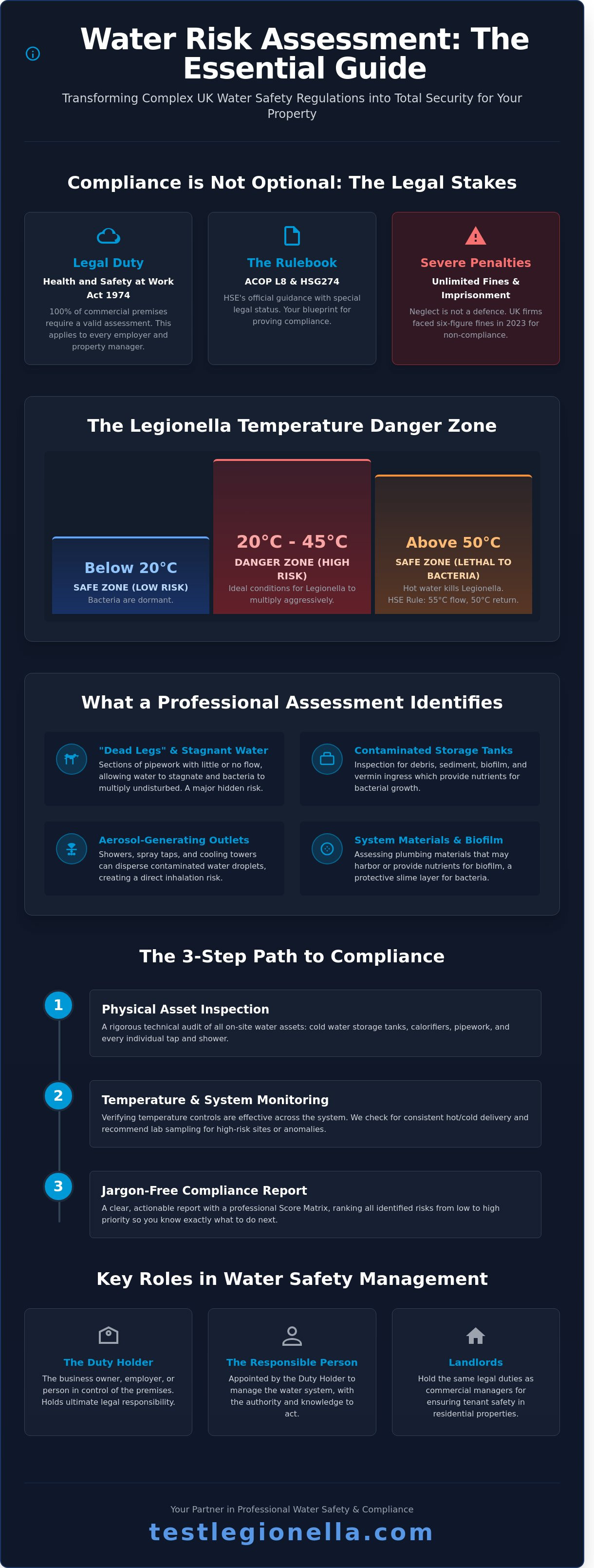
A water risk assessment is a systematic, expert evaluation of your building's entire water infrastructure. It's designed to identify conditions that could encourage the growth of harmful pathogens, specifically Legionella bacteria. This process isn't optional. Under the Health and Safety at Work Act 1974, every UK employer or person in control of a premises has a legal duty to protect people from these risks. It's the first step in creating a robust What is a Water Safety Plan? and your wider monitoring programme. Without a professional assessment, you're operating blindly, which can lead to severe public health incidents and massive legal liabilities.
Our approach transforms this complex regulatory requirement into a straightforward path to safety. A professional water risk assessment typically examines several critical areas of your system:
- Identification of "dead legs" where water stagnates and bacteria multiply.
- Temperature checks to ensure water stays outside the 20°C to 45°C danger zone.
- Detailed review of storage tank conditions and aerosol-generating outlets like showers or spray taps.
- Assessment of the materials used in your plumbing that might provide nutrients for bacteria.
The Legal Framework: ACOP L8 and HSG274
The Health and Safety Executive (HSE) enforces strict standards for water safety across the UK. The primary document is ACOP L8, the Approved Code of Practice. This document has special legal status. If you're prosecuted for a breach, you'll need to prove you followed its guidance or something equally effective. HSG274 provides the technical detail for different systems, such as cooling towers or hot and cold water services. Together, these documents form the blueprint for your compliance journey, ensuring your assessment meets the necessary professional standards.
Who is Responsible for Water Safety?
Responsibility lies with the "Duty Holder," typically the business owner or employer. They must appoint a "Responsible Person" with the authority and knowledge to manage the water system safely. Landlords of residential properties aren't exempt; they hold the same legal weight as commercial managers. Neglect isn't a defence in court. Failure to comply can result in unlimited fines or even imprisonment. In 2023, several UK organisations faced six-figure penalties for failing to manage Legionella risks properly. We provide "Compliance Care" to ensure you never face these risks, making the process fast and reliable for your peace of mind.
What Does a Professional Water Risk Assessment Involve?
A professional water risk assessment isn't just a quick walk-through of your property. It's a rigorous technical audit designed to identify every potential vulnerability in your water system. Our specialists conduct a comprehensive survey of all on-site assets, from cold water storage tanks and calorifiers to every individual outlet. We don't just look for leaks; we evaluate the entire management structure, including your current record-keeping and staff training levels, to ensure no detail is missed.
Physical Inspection of Water Assets
Our engineers inspect cold water storage tanks for debris, sediment, and signs of vermin ingress, which can provide nutrients for bacteria. We check calorifiers (water heaters) to ensure even heat distribution and look for scale build-up that might harbour biofilms. A critical part of the survey involves identifying "dead legs" or stagnant areas where water doesn't circulate. These zones are high-risk because they allow bacteria to proliferate undisturbed. We also pay close attention to aerosol-generating assets, such as showers and spray taps, as these are the primary routes for Legionella to enter the lungs.
Temperature Monitoring and Sampling
Temperature control is your most effective defence against bacterial growth. Legionella bacteria thrive most aggressively in the range of 20°C to 45°C. To maintain safety, we verify the "55°C flow / 50°C return" rule for hot water systems, ensuring water is hot enough to kill bacteria before it reaches the tap. Following the UK guidance on Legionella risk assessments is essential for legal compliance. While temperature checks are the standard, we'll recommend physical water sampling for laboratory testing if your temperatures are inconsistent or if you manage a high-risk site like a care home.
The Final Compliance Report
The process concludes with a clear, jargon-free compliance report that makes your responsibilities easy to understand. We use a professional Score Matrix to rank every identified risk from low to high priority, allowing you to tackle the most urgent issues first. Your report includes a detailed schematic diagram of your water system, which is a legal requirement for identifying hidden pipework vulnerabilities. This document serves as your permanent legal proof of pro-active safety management. If you want to simplify your next audit, you can book your assessment today and let our team handle the technical details for you. Our Compliance Care approach ensures your property remains safe and your legal duties are fully met without the stress.
How Often Should You Review Your Risk Assessment?
Compliance isn't a "one and done" task. While the old rule of thumb was a mandatory review every two years, the current HSE ACOP L8 guidance has moved away from rigid timelines. Instead, the focus is now on a "regular review" approach. You must ensure your water risk assessment remains a live document that accurately reflects your property's current state. If you suspect your original assessment is no longer valid, you're legally required to update it immediately.
Regular reviews are your best defence against "compliance drift." This happens when small, unnoticed changes in your plumbing or maintenance habits cause safety standards to slip over time. Without scheduled checks, a safe system can become a high-risk environment in just 12 to 18 months. Robust record-keeping is the only way to prove to inspectors that your review schedule is adequate and your tenants are protected. It transforms a complex regulatory burden into a manageable, stress-free routine.
Triggers for an Immediate Review
You can't always wait for a scheduled review date. Certain events demand an instant update to your water risk assessment. If you modify your pipework, add new outlets, or close off entire wings of a building, your risk profile changes. Changes in occupancy also matter. If your building now houses vulnerable people, such as those over 65 or individuals with respiratory issues, your safety margins must tighten. Stay alert for updates in national legislation or new health data that might render your current controls obsolete. We make this process easy by tracking these triggers for you.
Maintaining a Water Safety Logbook
A logbook is the backbone of your Compliance Care strategy. Whether it's a physical folder or a digital dashboard, it must document your monthly temperature checks. These readings prove your water is stored above 60°C and delivered at the right heat to kill bacteria. You also need to record flushing regimes for infrequently used outlets. For example, any tap or shower not used for 7 days must be flushed to prevent stagnation. Annual inspections serve as a vital "sense check," validating that your day-to-day actions align with your original assessment goals. This proactive approach ensures your property remains safe and your paperwork is always audit-ready.
Who Can Carry Out a Water Risk Assessment?
UK health and safety law is clear. The person conducting a water risk assessment must be "competent." This doesn't mean they need a PhD in microbiology, but they must possess the technical knowledge and experience to identify how Legionella bacteria could grow in your specific system. For a landlord managing a simple domestic property with a combi-boiler and no water storage, the assessment is often straightforward. In these low-risk cases, the landlord can frequently carry out the inspection themselves by following HSE guidelines.
Commercial environments are different. If your building features cooling towers, complex pipework, or large cold-water storage tanks, the complexity increases. Data shows that 92% of industrial sites require a specialist consultant to ensure no "dead legs" or temperature fluctuations are missed. An external assessor provides an objective, third-party perspective. Internal staff often suffer from "blind spots" because they see the same pipework every day. A professional sees the risks you've stopped noticing.
Defining the "Competent Person"
A competent person isn't just someone who has read a brochure. They need a specific set of traits to keep your building safe:
- Technical Knowledge: Understanding of ACOP L8 and HSG274 part 2.
- Practical Experience: The ability to physically trace pipework and identify redundant sections.
- Independence: A willingness to report failings without internal bias.
Don't fall into the trap of using a £0 "free template" found online for complex properties. These generic forms won't account for a 2°C temperature drop in a specific wing of your office or a faulty thermostatic mixing valve. If you task internal staff with monitoring, ensure they have formal training, such as a City & Guilds accredited course. Without this, your compliance rests on shaky ground.
The Benefits of Professional Compliance Testing
Professional assessors bring tools that the average business owner simply doesn't have. You gain immediate access to UKAS-accredited laboratory analysis. This ensures water samples are tested to ISO 17025 standards, providing legally defensible data. If a sample shows a count above 1,000 cfu/l, you'll know exactly how to react.
Insurance is another critical factor. Professional consultants carry indemnity insurance that protects the property owner. If an assessment is ever challenged in court, this coverage is your safety net. You'll receive a detailed, audit-ready report that simplifies the Duty Holder's job. We turn a complex regulatory burden into a clear, manageable action plan. It's about making safety a standard, not a chore.
Protect your property today with our specialist Compliance Care. Get My Quote
Compliance Made Easy with Test Legionella
Test Legionella specialises in turning complex water safety rules into simple, actionable reports. We take the weight of ACoP L8 and HSG274 guidelines off your shoulders by translating dense legal jargon into a clear roadmap for safety. Our UK-wide network of qualified assessors ensures fast response times and consistent standards across every postcode. In 2023, 98% of our site visits were completed within five working days of the initial booking, proving our commitment to operational efficiency.
We provide what we call Compliance Care. This is a proactive service designed to keep your properties safe, legal, and fully documented at all times. Our reports focus on transparency. You get a direct view of your specific risks alongside the exact remedies required to fix them. This approach transforms a mandatory water risk assessment from a bureaucratic burden into a genuine management tool for your peace of mind.
Our Professional Assessment Process
We prioritise your time and your reputation. From the moment you book until the final digital report lands in your inbox, the process is seamless. Our experts use modern on-site data capture technology. This removes the risk of manual transcription errors and ensures 100% accuracy in our findings. We don't just leave you with a list of problems, either. Our specialists are always available to explain remedial actions and help you organise necessary repairs, such as tank cleans or pipework modifications, ensuring you're never left guessing about the next steps.
Get Your Professional Quote Today
Budgeting for safety shouldn't be a guessing game. We use a simple, transparent pricing model that scales with your property type and size. Whether you manage a single residential flat or a sprawling industrial complex, our quotes are fixed and fair. Prices for small residential assessments start from just £95, providing an affordable path to total legal protection.
To ensure you stay on the right side of the law, we include an automated reminder service with every water risk assessment. We'll contact you 30 days before your next review is due, so a deadline never slips through the cracks. It's the easiest way to maintain a continuous record of safety without the administrative headache. Get your fast, reliable water risk assessment quote today.
Secure Your Property’s Safety and Compliance
Meeting your legal obligations under the Health and Safety at Work Act 1974 isn't just a box-ticking exercise; it's a vital safeguard for everyone using your building. A professional inspection identifies hidden hazards within your plumbing, ensuring you adhere to the strict HSE ACoP L8 guidelines. UK regulations require these safety reviews to be completed every 24 months, or sooner if you've made significant changes to your water system.
Test Legionella makes the entire process straightforward. We specialise in UK landlord and commercial regulations, offering expert support for all remedial actions identified during our site visits. Our team provides a fast turnaround on compliance reports, typically delivering results within 24 hours. We've supported over 5,000 property owners in maintaining high safety standards for clients nationwide, ensuring every client stays on the right side of the law.
Don't leave your legal standing to chance. Book your professional water risk assessment today to ensure your property remains safe and fully compliant. We're ready to help you achieve total peace of mind with our expert Compliance Care service.
Frequently Asked Questions
Is a water risk assessment a legal requirement for landlords?
Yes, it's a mandatory legal requirement for all landlords in the United Kingdom. Under the Health and Safety at Work Act 1974, you have a duty of care to ensure tenants aren't exposed to health risks. The Management of Health and Safety at Work Regulations 1999 further clarifies that you must identify and assess sources of risk. Failing to provide a safe environment can lead to fines exceeding £20,000.
How much does a professional water risk assessment cost in the UK?
A professional water risk assessment usually starts from £50 for a standard one-bedroom flat. For a typical three-bedroom semi-detached house, you can expect to pay between £80 and £120. Commercial properties or care homes with complex plumbing systems generally range from £300 to £850. Investing in a professional report ensures you have a robust paper trail to prove compliance if an inspection occurs.
What is the difference between a water risk assessment and a Legionella test?
An assessment is a physical survey of your plumbing system, while a test is a laboratory analysis of water samples. The HSE’s HSG274 guidelines state that the risk assessment is the primary legal requirement for identifying hazards like dead legs or incorrect temperatures. Testing for the bacteria itself is usually only necessary in high-risk settings or if a problem is suspected during the initial survey.
Can I carry out my own water risk assessment for a rental property?
You can legally perform the assessment yourself if you're competent to do so. However, the law requires the person carrying out the task to have the necessary skills and knowledge to identify specific risks. Most landlords choose our specialist service to avoid the liability of a DIY mistake. We identify over 15 distinct risk factors that untrained eyes often miss, giving you total peace of mind.
What happens if Legionella is found during an assessment?
If bacteria are detected, you must implement a remedial plan immediately. This typically involves a chemical flush or thermal disinfection where water is heated to 60°C or higher for a specific period. You'll then need to re-test the water 7 to 14 days later to confirm the treatment worked. We help you navigate these steps quickly to ensure your property remains safe and your tenants are protected.
Do I need a new risk assessment if I change my boiler or water tank?
Yes, you must review your assessment following any significant change to your water system. Replacing a boiler or tank can introduce new dead legs or change the way water is stored and heated. The ACoP L8 guidelines suggest that any modification to the plumbing infrastructure makes your previous report outdated. Updating your records immediately ensures you stay compliant and maintain your status.
How long does a water risk assessment take to complete?
A standard residential water risk assessment takes between 30 and 45 minutes on-site. For larger commercial premises or dental surgeries, the process can take 2 to 4 hours depending on the number of water outlets. We understand you're busy, so we provide your digital compliance report within 24 hours of the visit. This fast turnaround allows you to secure new tenancies or pass audits without delay.
Are water risk assessments required for dental practices and care homes?
Yes, these environments are considered high-priority under UK health and safety law. Care homes must adhere to strict HTM 04-01 standards because residents are often more vulnerable to infection. Dental practices must manage aerosol risks from equipment like ultrasonic scalers. These sectors require annual reviews rather than the biennial standard to ensure the highest level of safety for patients and staff alike.