
Did you know that an inadequate energy rating could result in a civil penalty of up to £150,000 for your business premises? As we approach the April 2026 deadline, a valid commercial epc with at least a Grade C rating is becoming the new baseline for legal operation. You’ve probably noticed the goalposts moving as the UK government tightens its net zero targets. It's natural to feel concerned about the cost of required upgrades or the risk of your property becoming unlettable overnight.
We believe compliance should offer you peace of mind, not a headache. This guide simplifies the latest MEES regulations so you can protect your investment and secure lower energy overheads without the stress. You'll learn exactly how to navigate the 2026 standards, understand the assessment process, and discover how to book a professional survey that guarantees a smooth transaction for your next lease or sale.
Key Takeaways
- Navigate the 2026 MEES landscape with confidence to ensure your business property meets the latest UK energy efficiency standards.
- Prepare for your commercial epc assessment by understanding the physical inspection process and the vital role of a qualified NDEA.
- Determine if your property qualifies for specific exemptions, such as low energy demand industrial sites, to streamline your compliance strategy.
- Implement high-ROI improvements like LED lighting and modern HVAC upgrades to boost your rating and lower your long-term overheads.
- Integrate energy performance with water safety protocols to create a total compliance framework that protects your building and your peace of mind.
Commercial EPCs and MEES: The 2026 Regulatory Landscape
A commercial EPC is a legal requirement for almost all non-domestic buildings in the UK. This document rates a property’s energy efficiency on a scale from A to G, providing a clear picture of potential energy costs and carbon emissions. Since 2008, an Energy Performance Certificate (United Kingdom) has been mandatory for property owners. It serves as a vital benchmark for sustainability in the built environment. In the current 2026 landscape, these certificates are no longer just administrative paperwork. They are the primary tool used to enforce environmental standards across the private rented sector.
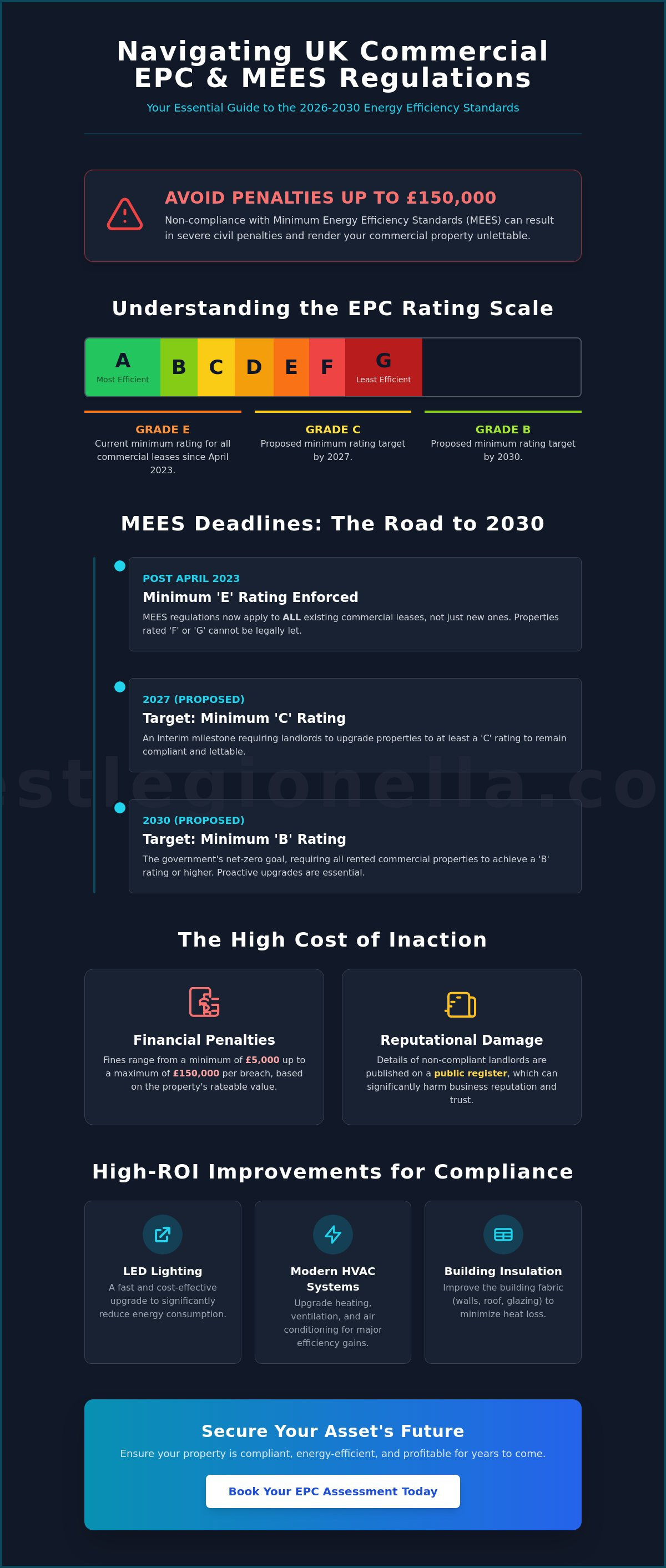
Minimum Energy Efficiency Standards (MEES) currently dictate that any commercial property must hold a rating of "E" or higher to be legally let. If your property falls into the "F" or "G" brackets, you are prohibited from granting a new lease or continuing an existing one. The financial risks of non-compliance are substantial. Local authorities have the power to issue penalties based on the rateable value of the property. These fines range from a minimum of £5,000 up to a maximum of £150,000 per breach. Beyond the financial impact, the government publishes details of non-compliant landlords on a public register, which can lead to significant reputational damage.
The trajectory for the next decade is clear and demanding. The government has set a firm target for all commercial lets to achieve a "B" rating by 2030. This transition is expected to include an interim milestone of a "C" rating by 2027. Proactive landlords are already using a commercial epc assessment to identify the most cost-effective fabric and services improvements. Taking action now transforms a regulatory burden into a strategic advantage, ensuring your assets remain let-able as the "legal floor" for energy performance continues to rise.
The Legal Triggers: When is an EPC Mandatory?
You must commission a commercial epc whenever a building is sold, rented, or newly constructed. Compliance starts early in the process. The "7-day rule" requires you to have an EPC in place within seven days of the property first being marketed. If the certificate is not secured after 21 days of marketing, you are in breach of the law. While most certificates remain valid for 10 years, you must renew them early if you undertake significant renovations. Changes to the building envelope, heating systems, or air conditioning can drastically alter the rating, making an old certificate inaccurate and legally unreliable.
MEES Deadlines: 2026 and Beyond
The regulatory landscape reached a major turning point on 1 April 2023. From that date, the MEES requirements expanded to cover all existing commercial leases, not just new ones. This means that even if a tenant has been in place for years, the landlord is still liable if the rating is below an "E". Looking forward, the proposed 2027 and 2030 targets will require a phased approach to building upgrades. MEES serves as the legal floor for energy performance in UK rentals. Our Compliance Care approach ensures that these deadlines are met with precision, making the transition to higher standards simple and stress-free for property owners.
The Commercial EPC Assessment: What to Expect
Your commercial epc assessment begins with a physical inspection conducted by a qualified Non-Domestic Energy Assessor (NDEA). These professionals must be accredited by a government-approved scheme, such as Elmhurst Energy or CIBSE, to ensure their reports meet legal standards. During the site visit, the assessor examines the building fabric, including wall construction, glazing types, and insulation levels. They also audit the fixed services: the efficiency of your heating systems, cooling units, and lighting controls. This data is then processed through specialized software to calculate your building's carbon dioxide emissions and energy performance.
Most properties use the Simplified Building Energy Model (SBEM) for these calculations. It's the standard tool for the majority of UK business premises. However, complex structures with high levels of glazing or sophisticated climate control systems may require Dynamic Simulation Modelling (DSM). This advanced method provides a more granular analysis of how heat moves through a building over time. For a deeper dive into the evolving legislative landscape, refer to this Complete Guide to Commercial EPCs, which details the upcoming 2027 and 2030 MEES targets. Our goal is to make your Compliance Care as straightforward as possible by handling these technical complexities on your behalf.
Preparation Checklist for Property Managers
Efficiency starts with preparation. To avoid delays and ensure the most accurate rating, you should have specific documentation ready for your NDEA. Information gaps often lead to "worst-case" assumptions by the software, which can drop a rating by 10 or 15 points. Collect the following items before the site visit:
- Updated floor plans and elevation drawings.
- Operation and Maintenance (O&M) manuals for HVAC and lighting.
- Previous commercial epc certificates or air conditioning inspection reports.
- Full access to plant rooms, roof voids, and basement areas.
Understanding Your Recommendation Report
The final certificate provides an Asset Rating on an A to G scale, where A is highly efficient and G is poorly performing. This rating reflects the building's potential energy performance rather than actual utility usage. Alongside the certificate, you'll receive a separate recommendation report. This document lists cost-effective improvements tailored to your specific site. Recommendations are categorized by their payback period. Short-term suggestions typically have a payback of less than 7 years, while long-term investments may take more than 7 years to recoup through energy savings. Implementing these changes is often the fastest route to meeting the strict MEES compliance deadlines approaching in 2027.
Exemptions and Special Cases in Commercial EPCs
Not every building requires a commercial epc. Understanding these carve-outs protects you from unnecessary costs and administrative lag. Places of worship, detached buildings under 50 square metres, and temporary structures with a planned use of less than two years are generally exempt. Industrial sites and workshops with low energy demand also fall outside the requirements. This usually applies if the space doesn't use energy to condition the indoor climate, such as a warehouse without a fixed heating system. If your building doesn't have a roof or walls, it doesn't need an assessment.
Listed buildings and those in conservation areas occupy a complex grey area. You only need a commercial epc if the energy improvements wouldn't unacceptably alter the building's character. If solar panels or external wall insulation would ruin the aesthetic of a Grade II listed asset, you might be exempt. However, you must prove this. Many landlords mistakenly assume listed status equals a default exemption. This isn't the case. You should check the RICS guidance on MEES and EPCs to understand how these regulations impact property valuations and legal obligations. Professional advice ensures you don't fall foul of local planning authorities.
The 7-year payback rule is a vital safeguard for your cash flow. If the cost of an energy improvement doesn't pay for itself through energy savings within seven years, you don't have to install it. You'll need three separate quotes from qualified installers to prove the high cost versus the predicted savings. This ensures that landlords aren't forced into economically unviable upgrades.
Registering an Exemption
Exemptions aren't automatic. You must register them on the PRS Exemptions Register to avoid heavy fines. A successful application grants a five-year stay of execution, giving you breathing room to manage your portfolio. You'll need to provide robust evidence, such as surveyor reports or specialist quotes. Keep in mind that these exemptions are personal to the landlord. If you sell the property, the exemption doesn't transfer to the new owner. They'll need to apply for their own five-year grace period or bring the building up to standard immediately.
The "Devaluation" and "Consent" Exemptions
In specific cases, making energy upgrades could actually harm your asset. If an independent surveyor proves that the required works would reduce the property’s market value by more than 5%, you can claim a devaluation exemption. There's also the Consent clause. If a sitting tenant refuses to allow the necessary energy-related works, you can register an exemption. This lasts until the tenant’s lease ends or for five years, whichever is shorter. [verify] Currently, the High Cost exemption for commercial properties is often superseded by the 7-year payback rule, unlike the £3,500 cap found in domestic regulations, but you should check the latest 2026 updates for specific capital expenditure thresholds.
Strategic Improvements: Boosting Your EPC Rating
Improving your commercial epc rating isn't just about avoiding government fines; it's about protecting your asset's marketability and long-term value. The most effective way to climb the rating scale is by addressing lighting. Replacing old fluorescent tubes with LED systems integrated with PIR (Passive Infrared) sensors provides the fastest return on investment. These sensors ensure lights only operate when spaces are occupied. This simple change can slash lighting energy consumption by 60% or more in a typical office environment.
HVAC systems represent the next major hurdle for UK landlords. While gas boilers were once the standard, the 2026 regulatory environment heavily favors electrification. Swapping an aging gas boiler for a modern air-source heat pump can leapfrog a property's rating by two full grades. This shift is essential because the carbon intensity of electricity has dropped significantly as the UK grid continues to decarbonise. Heat pumps deliver three to four units of heat for every unit of electricity used, making them vastly more efficient than any combustion-based system.
Don't overlook the building fabric. High-performance double glazing and cavity wall insulation are vital for retaining heat. If your building loses thermal energy through the walls, your expensive HVAC system will work twice as hard for half the result. For those looking for top-tier ratings, on-site renewables like solar PV panels offer a decisive advantage. Generating your own green electricity directly offsets the carbon footprint recorded during your commercial epc assessment, often pushing a property into the coveted 'A' or 'B' brackets.
Low-Cost "Quick Wins" for Immediate Impact
You don't always need a six-figure budget to see progress. Start with draft proofing and insulating exposed pipework; these are inexpensive fixes that stop easy energy loss. Installing a Building Management System (BMS) or smart meters allows you to track usage patterns and eliminate waste. Another smart move is replacing large, inefficient central water cylinders with point-of-use electric heaters. This eliminates the energy lost while hot water sits in long pipe runs, providing a cleaner, more efficient solution for staff kitchenettes.
Long-Term Capital Investment and ROI
The cost of these upgrades must be weighed against the "void" risk. From 2030, properties with a rating below B may become legally unrentable under proposed MEES updates. This creates a "brown discount" for inefficient buildings, while high-performing assets enjoy a "Green Premium" that can boost valuations by 10% or more. When planning your maintenance budget, ensure you account for all regulatory requirements. You can check the Legionella risk assessment cost to keep your total compliance spend transparent and predictable.
Total Compliance: Integrating EPCs with Water Safety
Securing a high-rated commercial epc is a priority for every UK landlord facing the 2026 MEES deadline. However, energy efficiency shouldn't exist in a vacuum. True property compliance requires a dual-track approach that balances thermal performance with public health safety. Your HVAC systems and water heaters are the primary drivers of your energy bills; they're also the most common sites for Legionella colonization. By integrating these two workflows, you protect your tenants and your bottom line simultaneously. We view energy efficiency and water safety as the twin pillars of professional property management. When you address both, you move from mere "ticking boxes" to genuine operational excellence.
The Synergy of Building Maintenance
Technical upgrades often serve two masters. Insulating hot water tanks and pipework is a prime example of this synergy. Effective insulation reduces heat loss, which boosts your commercial epc score and lowers operational costs. Critically, it also ensures that water remains at temperatures above 60°C throughout the system. This kills bacteria and prevents the danger zone between 20°C and 45°C where Legionella thrives. While some landlords attempt to use DIY risk assessment templates, these often lack the technical depth required for commercial safety. Professional testing provides the rigorous data needed to satisfy HSE inspectors and insurance providers. For a deeper dive into the legal requirements, you can read our ACOP L8 Explained guide.
Simplifying Your Compliance Journey
Managing multiple certificates is a logistical headache for many property owners. We recommend adopting a central compliance calendar to align your EPC, Gas Safety, and Legionella Risk Assessments. This proactive strategy prevents lapsed certificates and reduces the cost of multiple site visits. Using a specialist for your mandatory reporting provides a level of security that general contractors simply can't match. We call this Compliance Care. It's about transforming a complex regulatory burden into total peace of mind. You get clear, professional reports that prove your building is both efficient and safe. Our team acts as an efficient partner, guiding you through the maze of health and safety regulations with a no-nonsense approach. We prioritize your time and ensure your property remains a safe, compliant asset for years to come. Contact Test Legionella for your professional compliance quote today.
Future-Proof Your Portfolio for the 2026 MEES Transition
The regulatory clock is ticking toward the 2026 milestones. Failing to meet the tightening MEES standards puts your rental income at risk and could lead to civil penalties of up to £150,000 based on the property's rateable value. Securing a valid commercial epc is the first step in a broader strategy to reach a Grade C rating by 2027 and a Grade B by 2030. You shouldn't view these changes as a burden; they're an opportunity to enhance asset value and operational efficiency. Integrating your energy assessment with mandatory water safety protocols ensures a seamless, stress-free approach to property health.
Test Legionella makes this transition effortless. We operate a UK-wide professional testing network and stand as recognized specialists in ACOP L8 and health and safety compliance. Our team provides a rapid turnaround on professional compliance reports, so you're never left waiting for the documentation you need to trade or lease. We transform complex legal mandates into straightforward, manageable tasks that protect your bottom line and provide total peace of mind.
Get a Professional Compliance Quote from Test Legionella
Take the proactive step today to ensure your buildings stay compliant, safe, and profitable for years to come.
Frequently Asked Questions
Is a Commercial EPC the same as a domestic one?
No, a commercial EPC uses the Simplified Building Energy Model (SBEM) rather than the RdSAP method used for residential homes. While domestic assessments focus on basic heating and insulation, commercial surveys analyze complex HVAC systems, specialized lighting, and power usage. You can't use a residential certificate for business premises. It's a specialized report designed for non-domestic structures to ensure accurate energy reporting.
What happens if my commercial property gets an F or G rating?
You cannot legally grant a new lease or continue an existing one if your property is rated F or G. Under the Minimum Energy Efficiency Standards (MEES) updated on 1 April 2023, landlords face financial penalties of up to £150,000 for non-compliance. You must implement energy-saving improvements to reach at least an E rating. Our Compliance Care approach helps you identify the most cost-effective upgrades to protect your investment and avoid these heavy fines.
How much does a Commercial EPC cost in the UK in 2026?
Prices vary based on floor area and complexity, but industry averages for 2026 typically start around £150 for small retail units. Larger offices or warehouses exceeding 500 square meters often see costs ranging from £300 to £1,000. These figures reflect current market rates for accredited energy assessors. Get a tailored quote today to ensure your specific building size is accurately priced without any hidden surprises.
Can I lease my commercial property while waiting for an EPC?
No, you must have a valid commercial epc before you even begin marketing the property for lease or sale. Regulation 6 of the Energy Performance of Buildings Regulations 2012 requires the certificate to be available to prospective tenants at the earliest opportunity. Failing to provide one results in a fixed penalty notice, usually calculated at 12.5% of the property's rateable value. We make compliance easy by providing fast turnarounds to keep your deal on track.
Do I need an EPC for a warehouse or unheated storage unit?
You don't need an EPC for a warehouse if it uses no energy to condition the indoor climate. If the unit lacks fixed heating, mechanical ventilation, or air conditioning, it's generally exempt from these regulations. However, if you install a small office heater or a cooling system, the exemption disappears immediately. Always check your specific layout with a specialist to avoid gaps in your legal documentation.
Who is responsible for the EPC: the landlord or the tenant?
The landlord or property owner is legally responsible for providing the commercial epc. This duty applies whenever a building is constructed, sold, or rented out to a new occupant. While tenants don't pay for the assessment, they use the data to understand their potential energy overheads. Landlords should track their expiry dates every 10 years to maintain seamless compliance and ensure stress-free property management.
How long does a Commercial EPC assessment take on-site?
An on-site survey usually takes between 1 and 4 hours for standard commercial premises. A small retail shop might only require 45 minutes, while a multi-story office complex often takes a full day to inspect. The assessor needs to visit every room, measuring floor areas and recording details of the building fabric and machinery. Providing your floor plans in advance helps speed up the process and ensures a more efficient visit.
What is a Display Energy Certificate (DEC) and do I need one instead?
A Display Energy Certificate (DEC) shows the actual energy used by a building, whereas an EPC measures the building's potential efficiency. You only need a DEC if your building is over 250 square meters, frequently visited by the public, and occupied by a public authority. Private sector businesses don't require DECs. They must stick to standard EPC requirements to meet current UK property laws.