

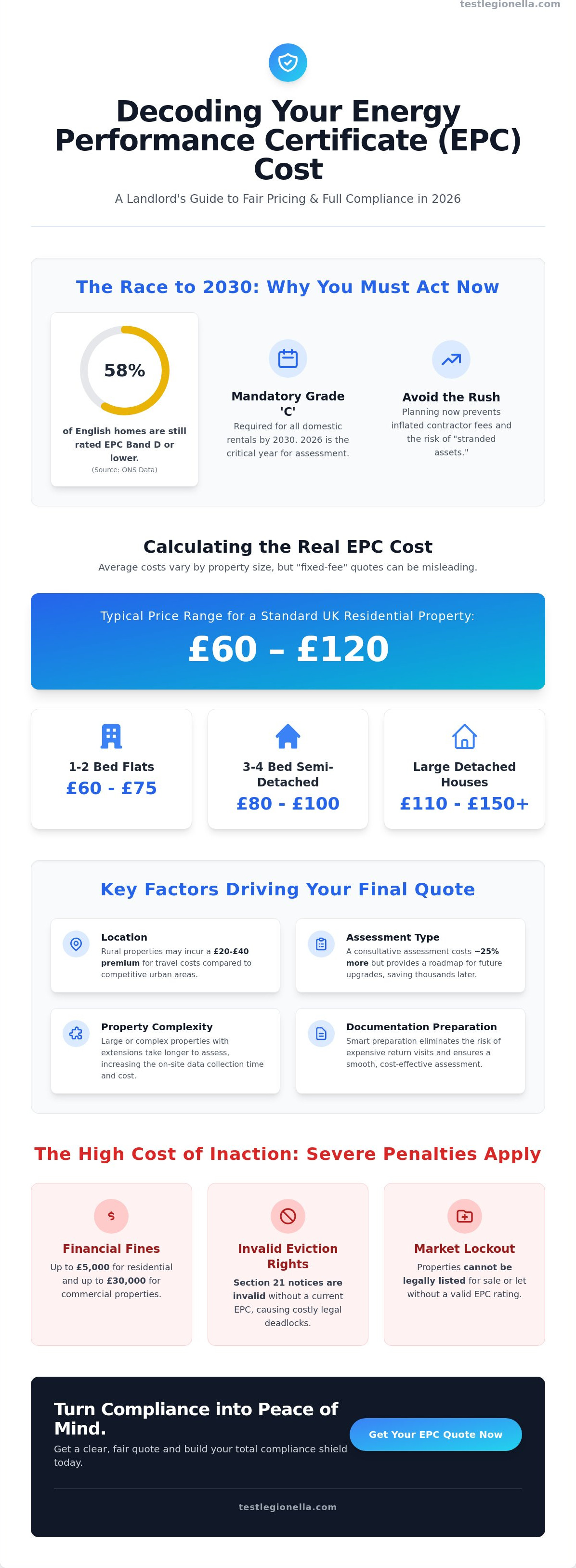
With 58% of English homes still rated EPC Band D or lower according to the latest ONS data, the race to meet the mandatory 2030 "C" rating is officially on. You've likely noticed that the energy performance certificate cost varies wildly across the UK, leaving many landlords feeling overcharged and confused by inconsistent quotes. It's frustrating to manage multiple safety requirements while trying to protect your investment. We understand that regulatory fatigue is real, especially when the rules feel like a moving target.
You deserve a straightforward path to legal safety without the guesswork. This guide reveals the exact factors driving EPC prices in 2026 and provides a clear strategy to secure your certificate at a fair price. We'll show you how to avoid non-compliance risks and identify the most cost-effective ways to boost your rating. It's time to turn a complex burden into total peace of mind through professional Compliance Care. We're breaking down current market rates, upcoming regulatory shifts, and our signature approach to making property management easy.
Key Takeaways
- Identify the current energy performance certificate cost range for 2026 and learn how to avoid the "fixed-fee" traps that often catch UK landlords off-guard.
- Learn the critical methodological differences between domestic and commercial assessments to ensure you secure the correct certification for your specific property type.
- Discover how to streamline the assessment process and eliminate the risk of expensive return visits through smarter documentation preparation.
- Build a total "Compliance Shield" by understanding the synergy between energy efficiency mandates and essential water safety audits for your portfolio.
- Gain professional peace of mind by navigating the latest 2026 regulations with a clear, step-by-step path to full property compliance.
EPC Costs in 2026: Why Compliance Matters More Than Ever
Securing an Energy Performance Certificate (EPC) is a legal requirement for almost every property transaction in the UK. In 2026, this document does more than just list energy usage; it serves as a vital benchmark for property value and rental viability. As the UK moves toward stricter net-zero targets, the What is an Energy Performance Certificate? question becomes central to every landlord's financial strategy. The energy performance certificate cost is now a minor operational expense compared to the massive equity loss seen in low-rated buildings.
The UK property market has shifted. Efficiency ratings now directly dictate rental yields. Properties with higher ratings attract 10% to 15% higher premiums as tenants seek protection from volatile energy prices. For landlords, energy efficiency has transitioned from an optional upgrade to a mandatory standard. Compliance Care ensures your assets remain marketable and profitable in an increasingly regulated environment. We make the transition to 2026 standards simple and stress-free.
The 2030 Roadmap: Minimum Energy Efficiency Standards (MEES)
The government has set a firm target for all domestic rental properties to achieve an EPC Grade C by 2030. This makes 2026 the critical year for assessment. Waiting until the 2030 deadline creates a bottleneck of demand, likely driving up the energy performance certificate cost and contractor fees. Planning your upgrades now prevents the financial risk of "stranded assets" that cannot be legally let. Proactive landlords are already using 2026 to audit their portfolios and secure their "Compliance Care" status before the rush.
Legal Consequences of an Expired or Missing EPC
Failing to provide a valid EPC carries heavy penalties. Local authorities can issue fines of up to £5,000 for domestic properties and up to £30,000 for commercial units. Beyond the immediate financial hit, a missing EPC prevents you from serving a Section 21 notice to regain possession of your property. This legal deadlock can cost thousands in lost rent and legal fees. Your certificate remains valid for 10 years, but you must renew it immediately if you make significant structural changes or install new heating systems. Find out today if your current rating protects your investment or leaves you exposed to litigation.
- Residential Fines: Up to £5,000 per breach.
- Commercial Fines: Up to £30,000 based on rateable value.
- Eviction Rights: Section 21 notices are invalid without a current EPC.
- Marketability: Properties cannot be legally listed for sale or let without a valid rating.
Compliance is the central pillar of modern property management. By addressing your EPC requirements now, you choose a path of calm competence over last-minute panic. Get your quote today and ensure your property meets the 2026 standards with ease.
Calculating the Real Energy Performance Certificate Cost
Budgeting for property compliance requires transparency. In 2026, the average energy performance certificate cost for a standard UK residential property typically falls between £60 and £120. While these figures provide a reliable baseline, "fixed-fee" quotes often come with caveats. Most baseline prices apply to standard 1 or 2-bedroom properties. Larger homes or those with complex extensions frequently incur additional charges because the on-site data collection takes the assessor significantly longer to complete.
Location remains a decisive factor in your final quote. In high-density urban areas like Birmingham or Manchester, a large pool of local assessors keeps prices competitive. If your property is in a remote rural area, expect to pay a premium of £20 to £40 to cover the professional's travel time and fuel costs. You should also decide between a basic compliance check and a consultative assessment. A consultative approach costs roughly 25% more but provides a detailed roadmap to reach future MEES targets, potentially saving you thousands in unplanned retrofitting costs later.
Property Size and Type: The Primary Price Drivers
Property dimensions directly dictate the assessor's workload and the eventual energy performance certificate cost. Standard pricing tiers in the current market usually follow this structure:
- 1-2 Bed Flats: £60 to £75
- 3-4 Bed Semi-Detached: £80 to £100
- Large Detached Houses: £110 to £150+
Multi-unit blocks or HMOs require a more technical strategy. Assessing a converted building with multiple self-contained units involves complex thermal boundary calculations for each individual space. Complex floor plans with multiple levels or non-standard construction materials add significant time to the survey. The assessor must accurately record every deviation from the building's original footprint to ensure the final rating is legally valid and defensible.
Assessor Accreditation and Professional Indemnity
Don't hire an assessor based on the lowest price alone. You must verify their credentials on the official government register. Using an unregulated individual might save you £15 today, but it exposes you to significant risk. Professional assessors carry Professional Indemnity insurance. This protects you if the report is later challenged or found to be inaccurate during a local authority audit, which could otherwise result in fines of up to £5,000.
High-quality reports create a defensible audit trail for landlords. This documentation is a cornerstone of professional property management, ensuring your compliance is an investment in security rather than just a tick-box exercise. For those managing multiple safety requirements across a portfolio, you can get a tailored quote to streamline your total compliance needs and gain true peace of mind. Professional reports ensure that your data is handled with the precision required for modern UK regulations.
Domestic vs. Commercial EPC Costs: A Comparative Guide
Calculating the energy performance certificate cost depends entirely on whether your property is a home or a place of business. These two categories use different assessment methodologies. Residential properties use RdSAP (Reduced Data Standard Assessment Procedure), while commercial buildings require SBEM (Simplified Building Energy Model). This distinction is the primary reason for the price gap you'll see in quotes. While a domestic survey might take 45 minutes, a commercial audit can span several hours or even days.
Commercial EPCs start at a higher baseline because they require more time on-site and more complex software calculations. An assessor must map out different zones based on usage, such as separating a retail floor from a storage room. They also have to account for high-capacity HVAC systems and intricate lighting setups. If your building has centralized air conditioning or specialized industrial boilers, the data entry alone takes hours. Business owners should plan for a re-check every 10 years, but any major modification to the heating or cooling systems usually triggers the need for a fresh assessment to stay compliant and accurate.
Residential Pricing: Direct vs. Agent Booking
Many homeowners book through an estate agent or a management firm. This often results in an "Agent Markup" where you pay an extra £20 to £50 for the convenience. Booking a Domestic Energy Assessor (DEA) directly is a smarter way to manage your budget. You get the same legal document without the administrative surcharge. Look for bundled compliance deals to save even more. It's common to find packages that combine an EPC with a gas safety certificate or a legionella risk assessment. This approach provides total peace of mind while keeping your costs predictable and your paperwork in one place.
Commercial Complexity and Quote Variations
Commercial properties are categorized into Levels 3, 4, and 5. Most small shops and simple offices fall under Level 3. Larger buildings with complex HVAC systems require a Level 4 assessor. High-tech or architecturally unique structures need Level 5 expertise. Because of these variables, commercial quotes are almost always bespoke. An assessor needs to see the floor plan and mechanical specs before they can provide a firm price. You'll find that site surveys for Level 4 buildings take significantly longer than a standard residential walk-through. Managing these requirements is part of a broader safety strategy. It's helpful to view your commercial EPC as one piece of the compliance puzzle, alongside asbestos and fire safety checks. This holistic view makes property management stress-free and efficient.
How to Minimise Your EPC Expenses and Maximise ROI
Securing a low energy performance certificate cost is a priority for most landlords, but the cheapest upfront price often leads to the highest long-term expense. If an assessor spends only fifteen minutes on-site, they likely lack the data needed for an accurate report. This forces them to use "default" values based on the property’s age, which are always the worst-case scenarios. A poor rating can devalue your property or prevent you from legally renting it out under 2026 Minimum Energy Efficiency Standards (MEES). Real savings come from a precise assessment that reflects your actual improvements.
Preparation Checklist for a Faster Assessment
Assessors operate on tight schedules. You can ensure the job is finished in a single visit by having all physical evidence ready. If an assessor can't see it or prove it exists, they can't include it in the software. This simple preparation prevents "assumed" data from dragging down your score.
- Insulation Evidence: Keep receipts or building control certificates for cavity wall or solid wall insulation. If you've topped up the loft to the recommended 270mm, clear a path to the hatch so the assessor can measure it safely.
- Clear Access: Ensure every room, the boiler, and the hot water cylinder are accessible. If the assessor can't inspect the cylinder's 80mm factory-fitted foam or jacket, they'll record it as uninsulated.
- Technical Manuals: Have the make and model of your boiler ready. This allows the assessor to find the exact efficiency rating in the PCDB (Product Characteristics Database) rather than relying on generic age-based estimates.
Low-Cost Improvements to Boost Your Rating
You don't always need solar panels to see a jump in your rating. Focus on high-impact, low-cost upgrades before the assessor arrives. Switching to 100% LED lighting is the most cost-effective move you can make. It's a small investment that provides an immediate boost to the lighting section of the report. Similarly, fitting a £25 thick thermal jacket to your hot water tank or installing draught-proof strips on older window frames can provide the few extra points needed to move from a 'D' to a 'C' rating.
Smart landlords also save money by bundling their compliance requirements. You can often lower your asbestos survey cost or Legionella risk assessment fees by coordinating site visits for the same day. This reduces the "call-out" overheads that multiple contractors charge. Once you receive your report, use the "Recommendations Report" as a roadmap. It lists exactly which upgrades provide the best return on investment for your specific building fabric.
Don't leave your property's compliance to chance. Get My Quote today and ensure your assessment is handled by a specialist who understands the 2026 regulations.
Beyond the EPC: Building a Total Compliance Shield
Securing a high EPC rating is a major milestone for any landlord or business owner, but it's only one pillar of a safe property. While you're budgeting for your energy performance certificate cost, remember that safety is multi-dimensional. A warm, energy-efficient home is still a liability if the water system is neglected or asbestos remains unmanaged. True property protection requires a total compliance shield that covers every legal requirement simultaneously. This holistic strategy prevents the "silo" effect, where one area of safety is perfected while another leaves you exposed to heavy fines or litigation.
Integrating Energy, Legionella, and Asbestos Safety
A holistic approach to acop l8 and EPCs ensures your building is as safe as it is efficient. Professional legionella testing is about more than just a certificate. It's about tenant health and your legal standing. Many landlords attempt to cut corners by using a sample legionella risk assessment, but a generic template isn't a compliance shield. The Health and Safety Executive (HSE) requires assessments to be site-specific. Using a professional service ensures your risk management is robust enough to withstand scrutiny if an incident occurs. This synergy between energy and water safety creates a comprehensive profile of property health that protects your reputation.
Streamlining Your Property Management in 2026
Managing a portfolio in 2026 involves juggling varying expiry dates for different certifications. Our "Compliance Care" service transforms this administrative stress into a streamlined, automated process. We provide reminders and a clear roadmap for all your safety obligations, ensuring you're never caught off guard. This shift from reactive fixes to proactive management protects your bottom line. It ensures your energy performance certificate cost stays predictable by avoiding the "emergency" premiums often charged for last-minute inspections.
- Automated Reminders: Never miss a renewal date for EPCs, gas safety, or water audits.
- Expert Oversight: Access to specialists who understand the latest UK regulations.
- Reduced Liability: Comprehensive reporting that meets all HSE and local authority standards.
- Peace of Mind: Knowing your properties are fully compliant and your tenants are safe.
Stop worrying about missed deadlines or changing regulations. We act as your trusted specialist and efficient partner, providing the peace of mind that comes with expert oversight. Secure your property’s future today by booking a comprehensive audit. Let's make your compliance journey easy, fast, and completely reliable. Get your free compliance score today and take the first step toward stress-free property management.
Secure Your 2026 Compliance Strategy Now
Navigating the shifting landscape of UK property regulations requires more than just a tick-box approach. With the government aiming for higher MEES standards by 2026, staying ahead of the energy performance certificate cost is a strategic necessity for every landlord and business owner. Efficient property management means understanding that a domestic assessment differs significantly from complex commercial requirements. By addressing these needs early, you'll avoid the rush of last-minute surcharges and ensure your portfolio remains legally let.
Compliance doesn't have to be a burden when you have the right partner. Test Legionella provides UK-wide professional compliance testing and specialist reports for landlords and businesses, ensuring you meet every statutory obligation with ease. Our Compliance Care service gives you total peace of mind, allowing you to focus on your core operations while we handle the technical details. You don't need to navigate these legal mazes alone.
Get your professional compliance quote from Test Legionella today and take the first step toward a stress-free, fully compliant future. You've got the tools to succeed and we're ready to help you protect your investments.
Frequently Asked Questions
Is an EPC a legal requirement if I am not selling my house?
No, you don't need an EPC if you're just living in your home and have no plans to move. However, you must have a valid certificate if you intend to rent the property to tenants. Under current UK law, rental properties must meet a minimum rating of E, though government proposals for 2026 suggest this may rise to a C rating. Always check your expiry date to ensure total compliance and peace of mind.
Can I do my own EPC assessment to save on costs?
You cannot legally carry out your own EPC assessment. All certificates must be issued by an accredited Domestic Energy Assessor registered with a government-approved scheme like Elmhurst Energy or Quidos. While you might want to reduce your energy performance certificate cost by doing it yourself, an unofficial report isn't legally valid for property transactions or letting. Professional accreditation ensures your data is accurate and compliant with the Energy Performance of Buildings Regulations 2012.
How long does an Energy Performance Certificate assessment take?
A standard residential assessment typically takes between 45 and 90 minutes to complete. The assessor needs to inspect every room, the loft space, and the heating system to gather accurate data. Larger properties with extensions or complex layouts may require up to two hours on-site. Once the visit is finished, your specialist usually uploads the data to the national register within 24 hours to provide your final rating and clear compliance report.
What happens if my property gets a failing EPC grade?
You cannot legally rent out a property that fails to meet the Minimum Energy Efficiency Standards. If your rating is below an E, you must implement the energy-saving improvements recommended in the report before a new tenancy begins. Failure to comply can result in financial penalties from local authorities. For residential properties, these fines can reach £5,000 per breach under the MEES regulations, so it's vital to address issues quickly.
How much does a commercial EPC cost compared to a residential one?
Commercial EPCs generally cost more than residential assessments due to the complexity of business premises. While a standard three-bedroom house assessment might range from £60 to £120, commercial quotes often start at £150 and scale upwards based on square footage. Large warehouses or office blocks require Level 4 or Level 5 assessments. These involve detailed thermal modeling and higher professional fees compared to simple domestic surveys because the technical requirements are much stricter.
Do I need a new EPC if I install a new boiler or double glazing?
You aren't legally required to get a new certificate after making improvements if your current one is still within its 10-year validity period. However, it's highly beneficial to commission a new assessment to reflect your property's improved efficiency. An updated rating showing a new A-rated boiler or 2024-standard double glazing can increase your property's market value. It also appeals to energy-conscious tenants looking for lower utility bills and better comfort.
Is the cost of an EPC tax-deductible for landlords?
Yes, the energy performance certificate cost is a tax-deductible business expense for UK landlords. Because an EPC is a legal requirement for letting a property, you can claim the full fee against your rental income when filing your Self Assessment tax return. This falls under the category of professional fees. It helps reduce your overall tax liability while ensuring you remain fully compliant with UK property laws and safety regulations.
Can I get a refund if I am unhappy with my EPC rating?
You cannot get a refund simply because you're unhappy with the final grade your property received. The fee covers the assessor's time and the professional data entry required by law. If you believe the data is factually incorrect, you should first contact the assessor to request a review. If the dispute remains unresolved, you can escalate the matter to their accreditation scheme, such as Elmhurst Energy, for a formal investigation into the report's accuracy.