
What if a single missing piece of paper could invalidate your right to reclaim your property, even if your tenant hasn't paid rent for months? Under current Section 21 rules and the evolving Renters’ Rights Bill 2024, missing just one of your mandatory landlord certificates can leave you legally stranded and facing civil penalties of up to £30,000.
It's a frustrating reality that UK rental legislation feels like it's constantly shifting beneath your feet. You want to provide a safe home and protect your investment, but keeping track of overlapping renewal dates and technical safety reports is a difficult task. We understand that the pressure to remain 100% compliant is high, especially when the safety of your tenants is the priority.
This guide changes that by making compliance care simple. We've compiled the definitive 2026 checklist to help you master the complex requirements of gas, electric, and water safety with total confidence. You'll get a clear, actionable breakdown of every mandatory document you need to stay legal, avoid heavy penalties, and gain the peace of mind that comes from professional property management.
Key Takeaways
- Understand how maintaining up-to-date landlord certificates is the only way to protect your legal right to serve Section 21 or Section 8 notices in 2026.
- Identify the specific technical standards required for gas and electrical safety to ensure your property meets the latest professional testing benchmarks.
- Discover your legal duties regarding water safety and why a professional Legionella risk assessment is a non-negotiable part of your safety portfolio.
- Master the logistics of property management by implementing a streamlined "Compliance Calendar" to eliminate renewal stress and missed deadlines.
- Evaluate the risks of DIY templates versus professional assessments to build a robust "due diligence" defense that protects your liability.
The 2026 Mandatory Landlord Certificates Checklist
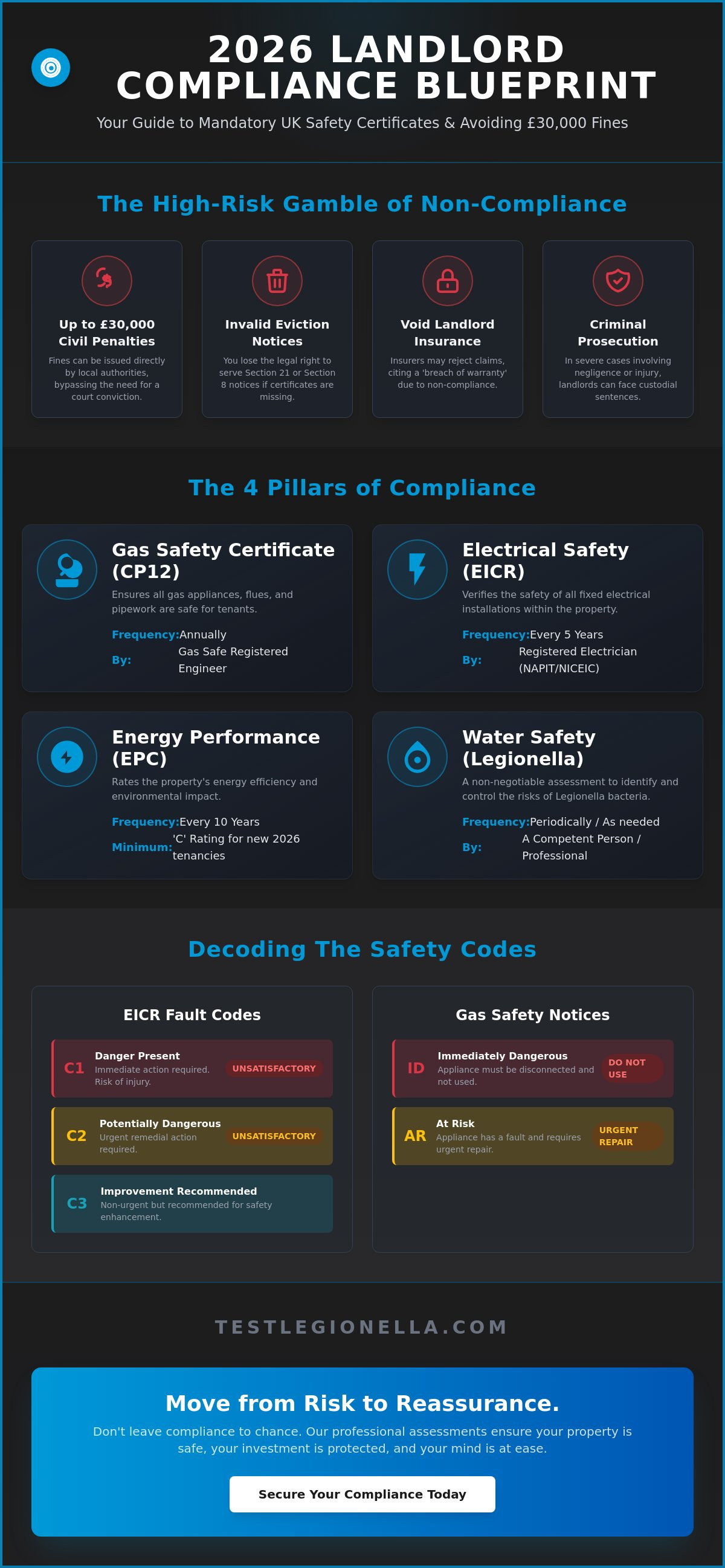
The UK rental market entered 2026 with the strictest compliance standards ever recorded. Local authorities now use integrated digital databases to track property safety in real-time, making manual oversight a thing of the past. For property owners, keeping up with landlord certificates isn't just a administrative task; it's the foundation of a legal tenancy. If your paperwork isn't in order, your right to regain possession of your property is effectively frozen. Under current regulations, you cannot legally serve a Section 21 or Section 8 notice if you failed to provide valid safety records at the start of the tenancy. Compliance provides a shield against legal challenges. The four non-negotiable safety documents every landlord needs include a valid Landlord's gas safety certificate, an Electrical Installation Condition Report (EICR), an Energy Performance Certificate (EPC) rated C or above for new tenancies, and a comprehensive Legionella Risk Assessment. While these requirements might feel like a burden, professional certification offers a significant return on investment through total peace of mind. Our Compliance Care approach ensures you're protected, moving you from a state of risk to a position of security.The Consequences of Non-Compliance
Ignoring your legal obligations leads to severe financial and legal penalties. Local authorities can issue civil penalties of up to £30,000 for housing act breaches without needing a court conviction. Beyond fines, missing landlord certificates often trigger a "breach of warranty" clause in landlord insurance policies. This means if a fire or accident occurs, your insurer will likely refuse to pay the claim. In the most serious cases involving negligence or injury, landlords face criminal prosecution and potential custodial sentences. We make compliance easy so you never have to face these risks.
Who is Responsible for Certification?
The ultimate legal liability always rests with the property owner. You might hire a letting agent to manage the day-to-day tasks, but the law holds the landlord accountable for the safety of the premises. If an agent forgets to book an inspection, it's the landlord's name on the fine. You must ensure you receive digital and physical copies of every report. Best practice in 2026 requires keeping these records for at least six years to defend against retrospective claims. Get your compliance score today to see where you stand and ensure your records are audit-ready.
Deep Dive into Essential Safety Certifications
Securing the correct landlord certificates ensures your property remains a safe environment for residents and a protected asset for you. Professional testing must be carried out by registered experts, specifically engineers on the Gas Safe Register for gas works or contractors registered with bodies like NAPIT or NICEIC for electrical systems. The Electrical Installation Condition Report (EICR) is a mandatory safety check for fixed electrical installations that must be completed every five years. Understanding your landlord's safety responsibilities is the first step toward stress-free management.
Gas Safety Certificate (CP12)
You're legally required to arrange an annual inspection for every gas appliance, flue, and pipework in your rental property. During this visit, a Gas Safe engineer checks for carbon monoxide leaks and correct operating pressures. If an appliance is flagged, it receives a code: "Immediately Dangerous" (ID) means it's a life-threat and must be disconnected, while "At Risk" (AR) indicates a fault that could become dangerous. You must provide a copy of this certificate to existing tenants within 28 days of the check or to new tenants before they move in.
Electrical Installation Condition Report (EICR)
Following the 2020 regulations, all private tenancies in England require a valid EICR every five years. The report categorizes issues using "C" codes. A C1 code indicates immediate danger, requiring urgent action. C2 means potentially dangerous, while C3 is a recommendation for improvement. Both C1 and C2 codes result in an "unsatisfactory" result, meaning you're non-compliant until repairs are made. For furnished rentals, adding Portable Appliance Testing (PAT) for items like kettles or microwaves adds an extra layer of protection. It's often easier to get a professional compliance review to ensure no wires are crossed.
Energy Performance Certificate (EPC)
As of 2026, the Minimum Energy Efficiency Standards (MEES) require most rental properties to hit specific rating targets to remain legally let. Your EPC is valid for 10 years and ranks your property from A (most efficient) to G (least efficient). Currently, a rating of 'E' or higher is required, but the UK government has proposed raising this threshold to 'C' for new tenancies by 2028. Reading your report carefully reveals "Recommended Improvements" which can help you boost your score and reduce energy bills for your tenants. Maintaining valid landlord certificates for energy efficiency protects you from fines that can reach £5,000 for non-compliance.
The Legionella Requirement: Managing Water Safety
While gas and electric checks are standard features of most landlord certificates, water safety is frequently misunderstood. Under the Health and Safety at Work Act 1974, you have a legal duty to protect your tenants from the risks of Legionella bacteria. This responsibility is detailed in the Health and Safety Executive’s (HSE) Approved Code of Practice L8 (ACOP L8). Ignoring these regulations doesn't just put lives at risk; it leaves you legally vulnerable to heavy fines or prosecution.
Securing a professional legionnaires risk assessment for landlords is the most effective way to demonstrate you've met your obligations. A common misconception is that modern properties or small domestic systems are exempt. This is false. Legionella can grow in any water system where temperatures stay between 20°C and 45°C. Even a brand-new apartment block built in 2025 can harbour bacteria if water stagnates in "dead legs" or unused showers during a void period.
Landlord Duties Under ACOP L8
As a landlord, the law identifies you as the "Duty Holder." This means you're responsible for identifying and managing the risks associated with your property's water system. You must ensure that a competent person conducts a thorough assessment to identify potential hazards. This includes checking for aerosol-generating outlets, like showerheads and spray taps, where bacteria could be inhaled. The National Residential Landlords Association provides guidance on why maintaining these records is vital for your broader safety portfolio. For a deeper look at your specific legal requirements, read our guide on ACOP L8 Explained to stay ahead of 2026 standards.
Practical Water Safety Measures
Effective water management relies on temperature control. You must ensure hot water is stored at 60°C and reaches at least 50°C at the tap within one minute of running. Cold water must remain below 20°C to prevent bacteria from multiplying. You should also advise tenants to flush through any outlets that aren't used regularly, especially after they've been away on holiday. While a simple visual check might feel sufficient, it won't stand up in court. A professional compliance report provides the documented evidence you need for your landlord certificates file. We call this Compliance Care, and it's designed to make your management process stress-free while ensuring your tenants remain safe. It's safety made easy.
Managing Expiry Dates and Renewal Cycles
Managing a single property is straightforward, but as your portfolio grows, tracking various landlord certificates becomes a complex logistical puzzle. Each document operates on a different timeline, and falling behind creates more than just admin stress; it introduces significant legal risk. A proactive Compliance Calendar is your best defense against the "last-minute booking" panic that often leads to premium emergency fees or, worse, expired coverage. You need a system that alerts you at least 90 days before any document expires to ensure you have time for both the inspection and any necessary remedial works.
A dangerous misconception persists in the UK rental market: the "grace period" myth. There is no legal leeway once a certificate expires. Your property must remain compliant 365 days a year to satisfy both local authority regulations and your landlord insurance requirements. If a claim arises and your paperwork is even one day out of date, your policy may be voided. To help manage this, the law allows for flexibility with gas. You can complete your Gas Safety checks up to two months early while keeping the original expiry date, allowing you to stay ahead of the curve without losing any days of coverage.
Certificate Validity Cheat Sheet
Keep this quick reference guide handy to ensure your renewal cycles remain on track:
- Annual: Gas Safety Certificate (CP12) is a mandatory yearly requirement.
- 5-Yearly: Electrical Installation Condition Report (EICR) and the recommended frequency for a professional Legionella Risk Assessment to ensure water safety.
- 10-Yearly: Energy Performance Certificate (EPC), though you should renew this sooner if you perform major energy-efficiency upgrades.
Digital Record Keeping in 2026
The days of keeping dusty folders of paper landlord certificates are over. By 2026, the shift toward paperless compliance is absolute. Utilizing a digital Compliance Care portal allows you to centralize your documents, set automated reminders, and access files from any device. This is particularly vital for the 28-day window you have to provide new tenants with their required safety documentation.
Security is another major factor. Digital systems allow you to share encrypted links with tenants and local authorities, providing a clear audit trail. Ensure your system stores time-stamped evidence for all remedial works. If an inspector questions a repair, having a dated, digital report showing the transition from "at risk" to "compliant" provides the ultimate peace of mind. This level of organization transforms compliance from a burden into a streamlined part of your business operations.
Ready to simplify your property management? Get My Quote and start your journey toward stress-free compliance today.
Professional Assessments vs. DIY: Protecting Your Liability
Using "free" online templates for risk assessments might save you £50 today, but it creates a massive legal vulnerability for the future. These generic forms often fail to account for specific property layouts or the updated 2026 safety standards required by UK law. If a health and safety incident occurs, a self-signed PDF won't stand up in court. Professional landlord certificates serve as your primary "due diligence" defense. They prove you took every reasonable step to ensure tenant safety by hiring a qualified expert to identify and mitigate risks.
Our "Compliance Care" approach removes the guesswork from property management. We handle the technical complexity so you can focus on growing your portfolio. A professional report isn't just a piece of paper; it's a legal shield that demonstrates proactive management. When an assessor from Test Legionella visits your property, they provide a level of scrutiny that DIY checks simply cannot match. This professional oversight transforms a complex regulatory burden into total peace of mind.
Choosing a Competent Person
Don't settle for "handyman" level inspections for critical safety systems. When hiring for water safety or electrical works, verify that your inspector holds valid industry credentials. For water systems, always choose specialists who utilize UKAS-accredited laboratory testing. This ensures that any water samples are analyzed to the highest scientific standards, providing data that is legally robust. Understanding the specific risks involved is the first step toward safety; you can learn more about what is Legionella? to understand the bacteria we test for and why professional precision is vital.
Your Next Steps for 100% Compliance
Securing your landlord certificates before a new tenancy begins is a non-negotiable part of modern property management. Before you hand over the keys, follow these final steps to ensure you're fully protected:
- Audit your current portfolio against the latest 2026 requirements to identify any expired documents.
- Book any outstanding assessments immediately to close the compliance gap before the next inspection.
- Verify that your EICR, Gas Safety Record, and Legionella Risk Assessment are all stored in a digital format for easy access.
- Test every smoke and carbon monoxide alarm on the actual day the tenancy starts and record the result.
Don't leave your liability to chance or rely on outdated paperwork. We make the process fast, reliable, and clear for every property owner. Get My Professional Compliance Quote Today and experience safety made easy.
Future-Proof Your Property Compliance Today
Staying ahead of UK regulatory shifts ensures your rental business remains profitable and protected. By 2026, the standard for landlord certificates will require even tighter adherence to safety cycles, specifically regarding the Health and Safety Executive's ACOP L8 guidelines. Managing these expiry dates isn't just about avoiding a fine; it's about tenant safety and professional integrity. Moving from DIY checks to expert assessments eliminates the risk of oversight and provides a robust paper trail for local authorities.
Don't let water safety become a legal liability for your portfolio. We provide expert UK-wide compliance testing with a rapid turnaround on all professional safety reports. You'll receive detailed ACOP L8 compliant documentation that keeps you on the right side of the law while offering total peace of mind. It's time to simplify your management process and focus on growth while we handle the technical details. Secure your property with a professional Legionella Compliance Report today. Your compliance journey is easier with a specialist partner by your side.
Frequently Asked Questions
Do I legally need a Legionella certificate as a landlord?
You're legally required to conduct a Legionella risk assessment under the Health and Safety at Work Act 1974. While the law doesn't name a specific "certificate," you must have a documented record of the assessment to prove compliance. Maintaining these landlord certificates ensures you've identified risks and implemented control measures to protect your tenants from waterborne bacteria.
How much do landlord certificates cost in 2026?
Expect to pay between £60 and £100 for a standard Gas Safety Certificate in the current market. An Electrical Installation Condition Report (EICR) for a typical three-bedroom house usually ranges from £150 to £280. Total compliance costs for a single property often sit between £350 and £550 depending on your location and the complexity of the building's systems.
Can I carry out a Legionella risk assessment myself?
You can perform the assessment yourself if you're competent, but most property owners hire specialists to guarantee accuracy. A professional assessor understands the technical nuances of water systems that untrained eyes might miss. Our Compliance Care service makes this process easy, providing a professional report that offers total peace of mind and clear evidence of your safety efforts.
What happens if my Gas Safety certificate expires while a tenant is in the property?
Letting a Gas Safety record expire is a criminal offense that carries the risk of unlimited fines or custodial sentences. You'll also lose the right to serve a Section 21 notice if you haven't kept your landlord certificates up to date. Arrange your next inspection 10 to 12 months after the last one to ensure you never have a gap in coverage.
Is an EICR mandatory for all rental properties in the UK?
An EICR is mandatory for all private tenancies in England following regulations introduced on 1 April 2021. You must ensure a qualified professional inspects the electrical installations at least every 5 years. You're also required to provide a copy of this report to existing tenants within 28 days of the inspection to remain fully compliant with the law.
Do I need to provide a copy of the Legionella risk assessment to my tenant?
You aren't legally obligated to give the full assessment document to your tenants, but you must inform them of any risks found. It's helpful to provide a summary of their responsibilities, such as cleaning showerheads every 3 months. This proactive approach ensures everyone knows how to keep the water system safe, reducing the likelihood of bacterial growth in stagnant pipes.
How often should a landlord’s EPC be renewed?
An Energy Performance Certificate is valid for 10 years. You must ensure the property maintains a minimum rating of E to meet current UK standards. If you install new insulation or a more efficient boiler, renewing the EPC early is a smart move. This updated rating can improve your property's marketability and help tenants manage their energy costs more effectively.
What is the difference between a landlord certificate and a leaseholder deed of certificate?
Landlord certificates focus on operational safety like gas, fire, and electrics, while a leaseholder deed of certificate is a legal document under the Building Safety Act 2022. The deed identifies whether a leaseholder is responsible for cladding remediation costs in buildings over 11 metres tall. One ensures the property is safe to inhabit daily, while the other manages long-term financial liability for structural defects.