
Did you know that the Health and Safety Executive (HSE) prosecuted 322 cases in 2022/23, resulting in total fines of £35.7 million for safety failings? It's a staggering figure that highlights the risk of getting your water safety wrong. Choosing between various legionella risk assessment companies isn't just about ticking a box. It's about finding a partner who understands that a single oversight can lead to heavy penalties or a public health crisis.
You likely feel the weight of these UK regulations and the frustration of trying to decipher complex ACoP L8 requirements. We promise to clear the fog by teaching you exactly how to evaluate a provider's competence, ensuring your property remains safe and your legal obligations are fully met. You'll learn the five critical criteria for selecting a specialist, how to spot low-quality reports that fail audits, and why a proactive partner is your best asset for total peace of mind.
Key Takeaways
- Understand why your choice of partner is your primary legal defence under the Health and Safety at Work Act 1974, moving beyond simple "tick-box" exercises.
- Discover how to evaluate professional legionella risk assessment companies by verifying LCA registration and UKAS-accredited laboratory analysis.
- Learn to spot "cowboy" assessors and avoid the hidden risks of "free" assessments that often lead to unnecessary and expensive remedial work.
- Follow our 5-step checklist to ensure your provider delivers property-specific reports rather than generic, pre-filled templates that fail safety audits.
- See how "Compliance Care" can streamline your water safety obligations, transforming complex regulations into a fast, stress-free management process.
Why Your Choice of Legionella Risk Assessment Company Dictates Your Legal Safety
Your legal safety rests on more than a piece of paper. Under the Health and Safety at Work Act 1974, you're responsible for the health and safety of anyone on your premises. Hiring the wrong team from the wide range of legionella risk assessment companies doesn't just waste money; it leaves you personally exposed. A "tick-box" exercise won't stand up in a health and safety audit. If an inspector finds your assessment is generic or inaccurate, it's treated as if no assessment exists at all.
A generic document isn't a valid defence. High-profile cases prove the cost of failure. In 2016, the HSE fined G4S Cash Solutions £1.8 million after they failed to properly manage Legionella risks at their facilities. These penalties are often accompanied by devastating reputational damage that takes years to repair. Professional legionella risk assessment companies act as your shield, ensuring that every pipe, tank, and outlet is accounted for in a way that satisfies the strictest regulatory scrutiny.
Hiring a specialist simplifies your life as a Duty Holder. It transforms a complex set of technical requirements into a clear, manageable action plan. You get peace of mind knowing that your compliance is handled by experts who understand the nuances of the law. This partnership moves you from a state of potential risk to a position of total control.
The Role of the Duty Holder vs. The Risk Assessor
You're the Duty Holder. Whether you're a landlord or a business owner, this title carries personal liability. You can delegate the task of checking your water systems, but you can never delegate the ultimate legal responsibility. If things go wrong, the authorities will look at your decision-making process first.
The HSE is clear about your obligations. You must appoint a "competent person" to help you comply with health and safety duties. If you hire an assessor who lacks the necessary training or equipment, you've failed in your primary duty to select a qualified partner. This makes the selection process the most critical step in your compliance journey.
Beyond the Certificate: What a Real Assessment Achieves
A real assessment is a bespoke blueprint for your specific building. It identifies hidden vulnerabilities in your unique water system design, such as dead legs where water stagnates or areas where temperatures fluctuate. Understanding What is Legionella? is the first step in recognising why these technical details matter for public health. A professional assessor doesn't just find problems; they create a tailored scheme of control that fits your operational needs.
Competence is the specific blend of technical water chemistry knowledge and practical experience in property maintenance.
By focusing on a bespoke approach, you avoid the pitfalls of generic templates. Your final report should include:
- A detailed asset register of all water sources.
- Site-specific photographs of high-risk areas.
- Clear, prioritised remedial actions with deadlines.
- A scheduled review date to maintain ongoing compliance.
The Non-Negotiable Credentials of Professional Water Safety Specialists
Selecting from the available legionella risk assessment companies requires more than a simple price comparison. You're hiring a partner to manage a significant health risk and ensure your legal safety. In the UK, the Health and Safety at Work etc. Act 1974 places the burden of proof on the duty holder. If an outbreak occurs, you must prove you took every reasonable precaution. Professional credentials provide the evidence you need to demonstrate due diligence.
LCA Registration: The Industry Gold Standard
The Legionella Control Association (LCA) isn't just a club; it's a voluntary code of conduct that sets the benchmark for service delivery. While membership is common, you must verify that a provider is registered for the specific category you require. There are nine distinct categories, including Risk Assessment Services and Hot and Cold Water Monitoring. A company registered for cleaning and disinfection might not be qualified to conduct your assessment. You can verify a firm's current status on the official LCA register, which is updated monthly to ensure only compliant firms remain listed. This registration ensures the provider follows the 2024 LCA Code of Conduct, offering you a clear layer of consumer protection.
Laboratory Standards and Sampling Accuracy
Accuracy in water sampling determines your entire safety strategy. Professional legionella risk assessment companies must use laboratories accredited by the United Kingdom Accreditation Service (UKAS) to ISO/IEC 17025 standards. Testing water isn't as simple as a "DIY" kit might suggest. These retail kits often lack the sensitivity to detect low-level colonisation and don't provide the legal chain of custody required for compliance. A professional assessor ensures samples are transported in temperature-controlled environments and processed within 24 hours. This rigorous process prevents false negatives that could leave your tenants or employees at risk. Check your current status with a free compliance score to see where your property stands today.
Beyond technical testing, look for these three pillars of operational excellence:
- Insurance Coverage: A competent partner holds at least £5 million in Professional Indemnity and Public Liability insurance. This protects your business if the assessment advice is flawed.
- ISO 9001 Certification: This ensures the company has a robust quality management system, meaning your reports are consistent, accurate, and delivered on time.
- ISO 14001 Certification: This demonstrates a commitment to environmental management, particularly important when the provider handles chemical treatments or water disposal.
Don't settle for vague promises of "compliance." It's your responsibility to ensure your chosen specialist has the right paperwork to back up their claims. High-quality assessors will proactively share their certificates and insurance documents during the quoting process. This transparency is the hallmark of an efficient partner who values your peace of mind as much as your safety.
Red Flags vs Gold Standards: Evaluating Legionella Service Providers
Selecting from the vast pool of legionella risk assessment companies requires more than a glance at a price tag. In 2024, the Health and Safety Executive (HSE) emphasised that inadequate risk assessments remain a primary factor in Legionnaires' disease outbreaks across the UK. You need a partner who provides a forensic audit, not a generic, pre-filled template that fails to reflect your specific site. Many "cowboy" assessors offer cut-price services but deliver reports that wouldn't hold up in a court of law. It's about protecting lives and ensuring your legal safety, not just ticking a box.
One major trap involves "free" assessments. These are often used as loss-leaders by companies that profit from remedial plumbing work. If your assessor is also the contractor who will quote for the repairs, their independence is compromised. You might find yourself facing a bill for £2,000 in "essential" tank cleaning that a truly independent specialist would deem unnecessary. Professionalism means providing an unbiased view of your water system. Always ask if the company has a financial interest in the remedial actions they recommend. True compliance care starts with honest, impartial advice.
Warning Signs of a Poor Quality Assessment
A low-quality assessment is easy to spot if you know where to look. If an assessor spends less than 30 minutes on-site for a complex commercial property, they haven't conducted a thorough investigation. A professional audit requires time to inspect every asset. You should worry if the final report lacks photographic evidence of your cold water tanks, calorifiers, and showerheads. It suggests the inspector didn't actually open the lids or check the internal condition of your plant. Furthermore, failing to check "sentinel points", the outlets closest to and furthest from the heat source, or ignoring stagnant "dead-legs" in the pipework are critical failures. These omissions leave you exposed to significant health risks and legal liability.
What a High-Quality Legionella Report Actually Looks Like
A gold-standard report turns a complex regulatory burden into a clear, manageable action plan. It should feature a clear prioritisation of remedial actions using a Red, Amber, and Green (RAG) system. This allows you to tackle high-risk issues immediately while budgeting for lower-priority improvements. Every high-quality report includes a schematic diagram of the water system, which is a specific requirement under the ACOP L8 and HSG274 guidelines. You should also expect a comprehensive asset register and detailed temperature logs for every point tested. This level of detail provides the peace of mind that your property is fully compliant. It makes your ongoing management stress-free and keeps your tenants or employees safe.
Professional legionella risk assessment companies should act as your efficient partner, guiding you through the maze of health and safety law. By choosing a specialist who focuses on quality over speed, you ensure that your compliance is handled correctly the first time. Don't settle for a generic service when your safety and reputation are on the line.
The 5-Step Checklist for Hiring a Competent Person or Company
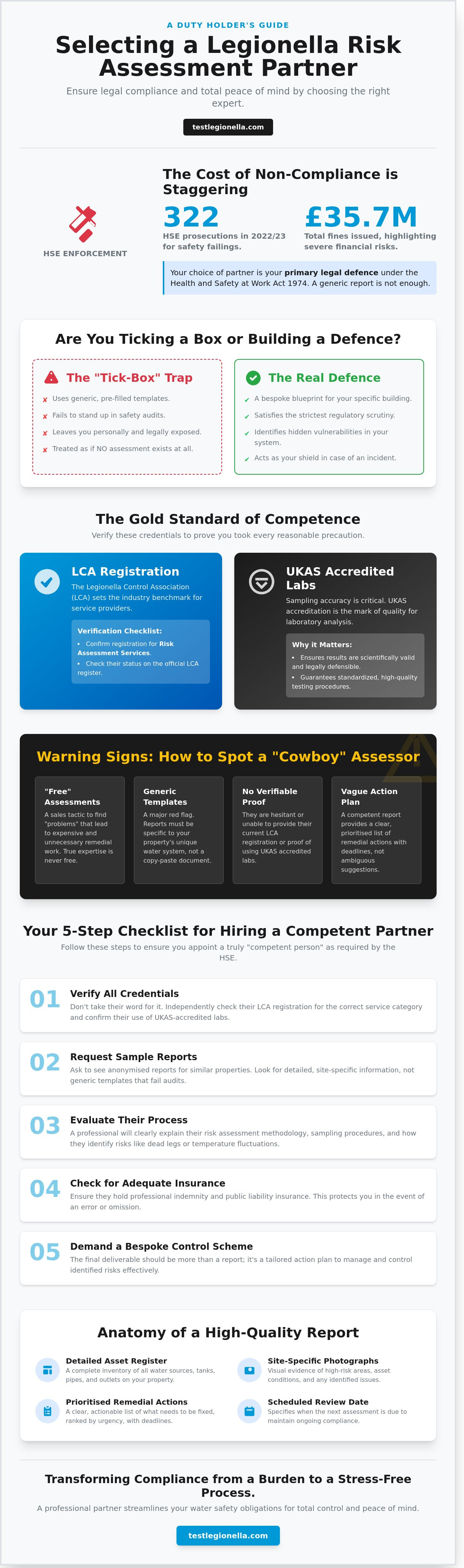
Selecting the right partner from the many legionella risk assessment companies available requires a structured approach. Compliance serves as your legal shield, so you can't leave it to chance. Use this five-point checklist to vet your provider effectively and ensure your property remains safe.
- Step 1: Verify LCA Registration. Confirm the company is a current member of the Legionella Control Association (LCA). You must check their certificate specifically for the "Risk Assessment Services" category. Membership alone doesn't guarantee competence in every service area, so look for that specific accreditation.
- Step 2: Request Sector-Specific Samples. A report for a healthcare facility differs significantly from a small office or a residential flat. Ask for a sample report that mirrors your property type. This ensures their level of detail and technical knowledge meets the specific requirements of your building.
- Step 3: Demand Fixed-Fee Pricing. Avoid "estimate-only" quotes that leave room for hidden extras. Professional providers should offer a transparent, fixed price based on your asset count. This prevents unexpected 30% price hikes for "admin fees" or "travel costs" after the site visit is complete.
- Step 4: Assess Independence. Enquire if the assessor profits from remedial work. Choosing a company that provides independent assessments ensures that any recommended repairs, such as tank cleaning or dead-leg removal, are genuinely necessary for safety rather than driven by sales targets.
- Step 5: Check Support Systems. Compliance is an ongoing cycle, not a one-off event. Choose a partner that offers automated reminders for your next assessment and provides long-term digital storage for your records.
Critical Questions to Ask Your Potential Assessor
Before signing a contract, ask how they keep their team updated with the latest ACOP L8 and HSG274 technical guidance. A competent assessor will explain their regular training programme immediately. You should also confirm if the report includes a bespoke scheme of control for your staff or tenants. Finally, ask for a guaranteed turnaround time. In 2026, receiving a digital report within 3 to 5 working days of a site visit is the standard for efficient, modern providers.
Analysing the Quote: What Should be Included?
When you compare a Legionella risk assessment cost, look beyond the bottom line. A comprehensive quote must list every asset covered, including cold water storage tanks, cylinders, and all outlets. Verify if water sampling is included in the price. While sampling isn't always a legal requirement for every property type, some companies add it as an "optional extra" later, which can double your bill. Ensure the quote covers the full site survey, the technical report, and the final certificate of compliance.
Compliance Care: Streamlining Your Water Safety with Test Legionella
Choosing from the sea of legionella risk assessment companies doesn't need to be a headache. At Test Legionella, we've refined our approach into what we call Compliance Care. We take the complex technical guidance found in HSE documents and boil it down into clear, actionable steps. It's about making safety simple. We don't just hand you a thick folder of jargon; we provide a roadmap to security. Our team transforms legal requirements into a straightforward "Compliance Made Easy" programme that fits your schedule.
We know that time is a critical factor for property managers. Research suggests that 85% of landlords cite time constraints as their biggest barrier to meeting safety standards. That's why our turnaround times are built for speed. You'll receive your digital report within 48 hours of the site visit, ensuring you aren't left waiting while your legal obligations hang in the balance. Our automated reminder service tracks your annual review dates. This proactive system handles the logistics so you never miss a deadline, providing a sense of security that lasts long after the initial assessment.
The Test Legionella Process: Professionalism in Action
From your first enquiry to the delivery of your final compliance certificate, our workflow is built on transparency. We start by identifying the specific needs of your property type. Whether it's a single residential flat or a large industrial site, the process remains rigorous. Our assessors provide advice that saves you money over the long term. For instance, identifying and removing "dead legs" in your pipework can prevent the need for expensive, recurring chemical treatments.
We support landlords and businesses in maintaining a safe environment by providing consistent standards across your entire property portfolio. While we have deep roots in the Midlands, our national coverage ensures that a property in Birmingham meets the same exacting standards as one in London. This consistency is vital for organisations managing multiple sites, as it simplifies the auditing process and ensures every building under your care is equally protected.
Get Your Professional Compliance Score Today
Don't leave your property's safety to chance. Relying on general maintenance staff instead of specialist legionella risk assessment companies often leads to overlooked hazards and potential legal liability. Understanding the nuances of ACOP L8 Explained is the first step toward total protection. We offer a free compliance score tool to help you gauge your current risk level immediately. It's a fast, no-nonsense way to see where you stand before an official inspector arrives.
Choosing a specialist testing company is the safest route for your property and your tenants. We provide the expertise needed to navigate the 2026 regulatory landscape with confidence. Ready to secure your building and achieve total peace of mind? Get My Quote today and experience a professional service that prioritises your safety and your time.
Secure Your Property with Professional Compliance Care
Choosing between various legionella risk assessment companies in 2026 isn't just about ticking a box; it's about protecting lives and ensuring your legal safety under the Health and Safety at Work etc. Act 1974. You now know that verifying LCA registration and demanding jargon-free reporting are the non-negotiable standards for any competent partner. At Test Legionella, we've refined our process to remove the stress of regulatory burdens through our signature Compliance Care. As an LCA Registered Specialist, we provide detailed, clear compliance reports that tell you exactly what you need to know without the technical fluff.
With our national UK coverage, we bring professional expertise to your doorstep, ensuring your water systems remain safe and fully compliant. Our team handles the logistics and tracking so you can focus on running your business with total peace of mind. Don't leave your property's safety to chance when expert help is a click away. We make the complex world of water safety simple and manageable for every landlord. Get your fast, reliable Legionella compliance quote today and take the first step toward a safer, stress-free property management experience.
Frequently Asked Questions
Is a Legionella risk assessment a legal requirement for all landlords?
Yes, it's a mandatory legal requirement for all landlords in the UK to assess and control the risk of Legionella exposure. Under the Health and Safety at Work etc. Act 1974 and the Control of Substances Hazardous to Health Regulations 2002, you're responsible for the safety of your tenants. This applies to all residential and commercial properties with water systems, ensuring you remain compliant with the HSE’s L8 Approved Code of Practice.
Can I carry out my own Legionella risk assessment to save money?
You can perform the assessment yourself if you're "competent," but the legal responsibility for any errors remains with you. Most landlords choose professional legionella risk assessment companies to eliminate the risk of oversight or non-compliance. Hiring a specialist ensures the report meets the strict standards of the Management of Health and Safety at Work Regulations 1999, giving you total peace of mind that your tenants are protected.
How often should a professional Legionella risk assessment be reviewed?
You should review your assessment at least every 24 months or immediately if the water system undergoes a significant change. According to HSE guidelines, a review is also necessary if the building's use changes or if new residents with higher vulnerability move in. Staying proactive with these updates keeps your Compliance Care status current and prevents the legal risks associated with outdated safety records.
What is the average cost of a professional Legionella risk assessment in the UK?
A standard domestic assessment typically costs between £50 and £120 depending on the property size. For commercial premises, industry data shows prices usually start from £300 for small units and can exceed £1,500 for complex industrial sites. These figures cover the site visit and the final compliance report, providing a cost-effective way to manage your legal duties without the stress of hidden fees or complex jargon.
What happens if Legionella bacteria are found during the assessment?
You must take immediate action to disinfect the system and protect building occupants. This usually involves a chemical or thermal shock treatment to kill the bacteria, followed by a re-test to confirm the system is safe. We make this process easy by providing a clear action plan that outlines exactly which remedial steps are needed to restore safety and return your property to full compliance quickly.
Does a Legionella risk assessment company also provide the remedial works?
Many professional legionella risk assessment companies offer a full suite of services, including both the initial audit and any necessary plumbing repairs. Choosing a partner that handles everything from the assessment to the remedial works streamlines your maintenance schedule. It ensures that any issues, like dead legs in pipework or uninsulated tanks, are fixed by specialists who already understand your specific water system layout.
What is the difference between a water test and a full risk assessment?
A water test is a laboratory analysis of a single sample, while a risk assessment is a comprehensive audit of your entire water infrastructure. The assessment identifies potential "dead legs," temperature issues, and stagnant areas where bacteria could grow. While a test tells you what's in the water today, the assessment provides a long-term strategy to prevent growth, making it the central pillar of your safety management.
How long does a typical site visit take for a commercial property?
A typical site visit for a small commercial office takes between 60 and 90 minutes. Larger or more complex sites, such as care homes or factories with multiple cooling towers, can require 4 to 6 hours of detailed inspection. Our experts work efficiently to minimise disruption to your business operations, delivering a thorough inspection that identifies every risk factor while respecting your time and professional schedule.