
Could a single oversight in your water maintenance routine lead to a £20,000 fine or a serious health outbreak? For many UK landlords and business owners, the weight of ACOP L8 and HSG274 regulations feels like an endless technical hurdle. You likely already know that staying on top of legionella testing uk is a non-negotiable responsibility; however, the complex jargon often makes the process feel more difficult than it needs to be. It's frustrating when you're trying to do the right thing but feel buried under confusing paperwork.
We believe that water safety should be straightforward and stress-free. In this guide, you'll discover exactly when and how to conduct professional testing to ensure your property remains 100% compliant and your tenants stay safe. We'll strip away the confusing legal language to provide a clear roadmap for your water safety strategy. We're going to cover everything from the initial risk assessment to the final, easy-to-read safety report. By the end, you'll have a professional plan that turns a regulatory burden into total peace of mind.
Key Takeaways
- Understand how professional microbiological analysis identifies the exact concentration of bacteria to ensure your water systems remain safe and compliant.
- Learn why UKAS-accredited laboratory testing and BS7592 sampling standards are essential for delivering reliable and legally defensible results.
- Identify exactly when professional legionella testing uk becomes a legal requirement, including mandatory quarterly cycles for high-risk systems.
- Discover how to choose a specialist provider that offers clear reporting and actionable remedial advice to simplify your water safety management.
- Explore how the "Compliance Care" approach transforms complex regulatory burdens into a streamlined, stress-free process for total peace of mind.
What is Legionella Testing and Why is it Essential in the UK?
Professional legionella testing uk involves the rigorous microbiological analysis of water samples within a UKAS-accredited laboratory. It isn't a simple visual check or a temperature reading. Instead, it's a scientific process designed to identify the specific presence and concentration of Legionella bacteria within a building's water system. Experts collect samples from "sentinel" outlets, such as the furthest taps or showerheads, to determine if the water chemistry supports bacterial growth.
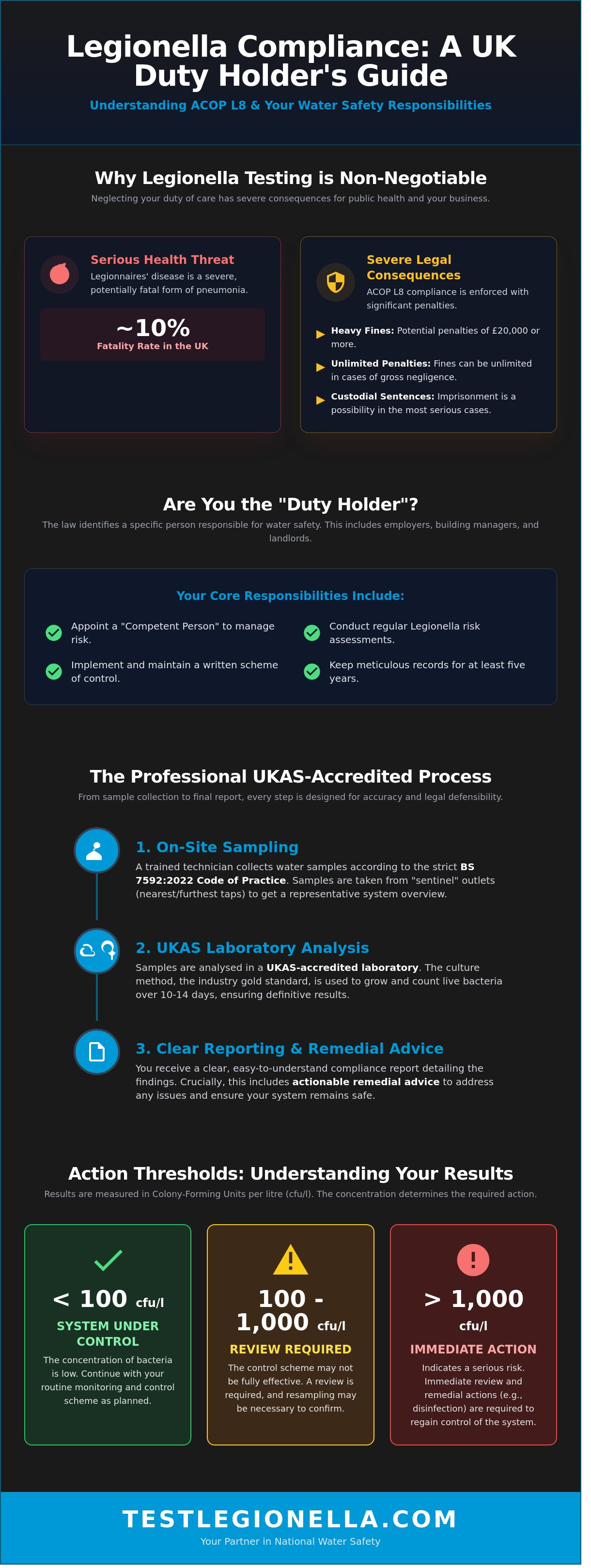
The primary goal is to ensure that colony-forming units remain below dangerous thresholds. When concentrations exceed 1,000 cfu/l (colony-forming units per litre), the risk of infection rises significantly. Property owners have a clear duty of care under the Health and Safety at Work Act 1974 to prevent exposure to these risks. Neglecting this duty can lead to outbreaks of What is Legionnaires' Disease?, a severe and potentially fatal form of pneumonia. UK health data indicates that this disease carries a fatality rate of approximately 10%, making regular monitoring a matter of life and death rather than just paperwork.
The Legal Reality of ACOP L8 Compliance
The Health and Safety Executive (HSE) enforces strict standards through the Approved Code of Practice L8 (ACOP L8). This document provides the framework for managing legionella testing uk and water safety. It's vital to understand that ACOP L8 has a special legal status. If you're prosecuted for a breach of health and safety law and it's proved you didn't follow the provisions of the code, you'll be found at fault by a court unless you can show you complied in some other way. Ignorance of these requirements isn't a valid defence. For a comprehensive breakdown of these rules, view our ACOP L8 Explained guide.
Who is Responsible? Identifying the "Duty Holder"
The law identifies a specific individual known as the "Duty Holder." This is typically the employer or the person in control of the premises, such as a commercial building manager or a residential landlord. Their core responsibilities include:
- Appointing a "Competent Person" to lead the risk management process.
- Conducting regular Legionella risk assessments.
- Implementing and maintaining a written scheme of control.
- Keeping meticulous records of all tests and remedial actions for at least five years.
Residential landlords must ensure their tenants are safe, while commercial managers must protect staff and the public. Failing to organise regular water safety checks doesn't just invite a fine. It can lead to unlimited financial penalties or even custodial sentences if gross negligence is proven. Compliance Care isn't just about following the law; it's about establishing a culture of safety that protects your reputation and your people.
The Professional Process: How UKAS Accredited Testing Works
Achieving water safety doesn't have to be a headache. Professional legionella testing uk relies on United Kingdom Accreditation Service (UKAS) laboratories to provide results you can trust. These facilities undergo rigorous annual audits to ensure every result is accurate and defensible in a court of law. Using a non-accredited lab is a risk you don't need to take; it's the difference between a guess and a scientific certainty. Our goal is to transform this technical necessity into total peace of mind for property managers.
Our technicians follow the BS 7592:2022 Code of Practice. This is the official British Standard that outlines exactly how to collect samples so they reflect the true state of your water system. We use the culture method, which remains the UK industry gold standard. This involves growing the bacteria on agar plates over a period of 10 to 14 days. While some providers offer rapid PCR tests, the culture method is the only way to confirm if the bacteria are alive and capable of causing disease. We manage the entire timeline, from the initial site visit to the delivery of your final compliance report.
Step-by-Step: On-Site Water Sampling
Identifying sentinel points is the first priority. These are the nearest and furthest outlets from your water source, such as cold water storage tanks or calorifiers. Technicians take pre-flush samples to check for contamination at the tap itself, followed by post-flush samples after running the water for 2 minutes to isolate issues within the wider pipework. We maintain a strict, sterile chain of custody for every bottle, ensuring that the sample integrity is never compromised during transit. This precise approach makes identifying the source of any issues much faster.
Laboratory Analysis and Detection Limits
UKAS labs measure results in Colony Forming Units (CFU) per litre. The standard mathematical detection limit is 100 Legionella bacteria per litre. If your report shows "Not Detected," it means levels are below this 100 CFU/L threshold. Laboratories also screen for specific dangerous strains, particularly Legionella pneumophila Serogroup 1, which is responsible for 90% of UK infections. To ensure the bacteria don't multiply or die before reaching the lab, we transport all samples in temperature-controlled containers maintained between 2°C and 18°C.
Professional legionella testing uk provides the data you need to keep your tenants safe and your business compliant. If you are unsure when your system was last checked by a specialist, you can request a professional review to confirm your current status and stay ahead of your legal obligations.
When is Physical Water Testing Legally Required?
Physical sampling isn't just a box-ticking exercise; it's a strategic response to your Legionella Risk Assessment. Under the HSE's ACoP L8 and HSG274 guidelines, most residential and commercial properties manage risk through temperature control. However, physical sampling becomes a legal necessity when specific risk thresholds are met. For high-risk systems like cooling towers and evaporative condensers, the law is clear. You must conduct microbiological testing at least every three months to remain compliant.
Don't fall for the myth that small properties are exempt from legionella testing uk requirements. While a standard domestic rental might primarily require temperature monitoring, the Risk Assessment dictates the actual frequency of physical tests. If your property has complex pipework or caters to vulnerable tenants, your assessor will likely mandate annual or six-monthly sampling to ensure the system remains safe. We've seen cases where small offices with dead-legs in their plumbing required urgent testing to prevent a total system shutdown.
- Cooling towers require quarterly laboratory analysis.
- Hot and cold systems need testing if temperature regimes aren't maintained.
- Healthcare sites often require monthly sampling in high-risk wards.
- Industrial process waters that create aerosols must be monitored regularly.
Trigger Points for Immediate Water Testing
Sudden changes in your water system's environment require immediate action. If a building has been vacant for over 30 days, stagnation allows biofilm to build up. This makes testing essential before re-occupation. You must also sample if your monthly temperature checks show that hot water is consistently failing to reach 50°C, or 55°C in healthcare settings, at the outlets. Any significant plumbing alterations or pipework replacement also triggers a requirement for testing. This validates that the system wasn't contaminated during the works.
High-Risk Environments and Special Considerations
Certain installations carry a much higher aerosol risk. Spa pools and decorative fountains require monthly microbiological monitoring. These systems operate between 20°C and 45°C, which is the prime growth zone for bacteria. In healthcare environments, where 100% of occupants may be at increased risk, more stringent legionella testing uk protocols apply under HTM 04-01. If you've used chemical disinfection to treat a system, you must conduct follow-up testing to prove the treatment worked. This validation provides the documented evidence needed for full HSE compliance and total peace of mind.
Organising Your Compliance: Choosing a Testing Provider
Selecting a partner for your legionella testing uk requirements is about more than just ticking a box. It's about finding a specialist who understands your specific building layout. Whether you manage a single retail unit or a 50-room care home, your provider must have a proven track record with your property type. Experience matters because water systems vary significantly between a Victorian conversion and a modern office hub. A specialist will identify risks that a generalist might overlook, such as redundant pipework hidden behind newer installations.
Look for a provider that offers what we call "Compliance Care." This includes automated reminder services that track your testing cycles for you. Missing a deadline is a common mistake that can lead to fines of up to £20,000 under the Health and Safety at Work Act 1974. A proactive partner ensures you stay ahead of the curve. They should always provide a formal Legionella Certificate upon completion. This document serves as your primary evidence during a Health and Safety Executive (HSE) inspection or a local authority audit.
What to Look for in a Professional Report
A high-quality report transforms complex laboratory data into a clear roadmap for safety. It must feature a prominent "Pass" or "Action Required" status so you can assess your risk level in seconds. Every sample point should be mapped directly to your building’s water schematic. This precision allows your maintenance teams to locate and fix issues without expensive guesswork. Ensure the document includes specific remedial advice, such as exact temperature adjustments for calorifiers or precise flushing schedules for identified dead legs. Clarity is the foundation of effective risk management.
Avoiding the Pitfalls of Cheap DIY Kits
While £30 DIY kits might seem like a bargain, they often fail the legal "competency" test required by ACoP L8 regulations. Untrained users frequently contaminate samples during the collection process. This leads to false negatives that leave your tenants at risk and your business liable. Professional sampling provides a robust audit trail that stands up to legal scrutiny. This is vital for your insurance coverage. Statistics show that 92% of commercial insurers require proof of professional risk management before they will settle a claim related to waterborne pathogens. Professional testing isn't just a service; it's an investment in your peace of mind.
Don't leave your water safety to chance. Get your professional compliance quote today and ensure your property is fully protected.
Test Legionella: Your Partner in National Water Safety
Test Legionella provides nationwide coverage, ensuring that high-quality legionella testing uk services are accessible to every landlord and business owner, regardless of their location. We've built our reputation on a foundation of specialist expertise; we don't just collect samples, we provide a complete safety infrastructure. Our "Compliance Care" approach is designed to remove the stress of regulatory adherence. We take the complex requirements of the HSE’s ACoP L8 and HSG274 and translate them into a clear, actionable strategy for your property.
Speed is a critical component of water safety. A delay in identifying a colonisation can lead to serious health risks and legal liabilities. That's why our laboratory-backed process ensures you receive digital reports within 24 hours of sample analysis. We prioritise clarity in our professional reporting, using colour-coded summaries that tell you exactly what you need to know without the need for a degree in microbiology. You get the facts, the risks, and the solutions delivered straight to your inbox.
Why Property Owners Trust Our Specialist Team
Accuracy is our primary benchmark. Every sample we process undergoes rigorous testing that stands up to the highest levels of regulatory scrutiny. We currently maintain a 100% compliance record for clients who follow our recommended remedial actions. For UK landlords, we offer a transparent, fixed-fee pricing model starting from £85. This means you won't face hidden costs or unexpected "admin fees" after the site visit is complete.
- Reliable Results: Our specialists use UKAS-accredited laboratories for all sample analysis.
- Fixed-Fee Pricing: Clear, upfront costs for single properties or large-scale commercial portfolios.
- Compliance Calendar: We manage your testing schedule, sending automated reminders 30 days before your next assessment is due.
We understand that managing a property portfolio is time-consuming. Our team acts as your organised partner, tracking your compliance dates so you never miss a mandatory inspection. This proactive management helps you avoid the heavy fines associated with non-compliance, which can reach five or six figures in severe cases.
Get Started with a Professional Quote Today
Taking the first step toward total property protection is straightforward. Our enquiry process is designed for efficiency; simply provide your property type and location, and we'll deliver a tailored quote within the same working day. Professional validation isn't just about ticking a box; it's about the peace of mind that comes from knowing your tenants, employees, and visitors are protected from preventable harm.
Don't leave your water safety to chance or amateur assessments. Secure your property with a legionella testing uk programme that prioritises your safety and your schedule. Click below to start your journey toward stress-free compliance with the UK's trusted water safety experts.
Take Control of Your Water Safety Compliance Today
Managing water safety doesn't have to be a complex regulatory burden or a source of constant worry. Under the Health and Safety Executive’s ACoP L8 and HSG274 guidelines, every UK landlord and business owner has a legal duty to prevent the risk of Legionnaires’ disease. By establishing a professional programme for legionella testing uk, you're not just ticking a box; you're protecting lives and securing your professional reputation. Our streamlined service provides UKAS Accredited Laboratory Analysis and fast, reliable reports for landlords & businesses that ensure your property remains 100% compliant with current health and safety laws.
We provide expert compliance advice as standard, helping you navigate the technical requirements of water management with absolute clarity. Whether you manage a single residential unit or a large industrial site, our team delivers the specialist support needed to keep your water systems safe and your documentation audit-ready. It's time to replace uncertainty with professional certainty. You can trust our experts to handle the logistics while you focus on running your business or managing your portfolio safely.
Secure Your Property with Professional Legionella Testing Today
We're ready to help you achieve total peace of mind with a safety strategy that protects your people and your property.
Frequently Asked Questions
Is Legionella testing a legal requirement for UK landlords?
Yes, UK landlords have a specific legal duty to ensure the safety of their tenants under the Health and Safety at Work Act 1974. While the law focuses on the mandatory risk assessment, actual water testing is often the only way to prove your control measures work. Following the HSE’s L8 Approved Code of Practice ensures you stay compliant. Failing to manage these risks can lead to fines exceeding £20,000 or even criminal prosecution.
How often should water testing be carried out in a commercial building?
You should test your water at least quarterly if you manage high-risk systems like cooling towers or evaporative condensers. For standard commercial office spaces, an annual check is the industry benchmark to maintain your legionella testing uk compliance. If your risk assessment identifies specific issues like dead legs or temperatures outside the 20°C to 45°C danger zone, you might need monthly sampling to ensure your staff stay safe.
What happens if Legionella bacteria are found in my water system?
You must take immediate action by isolating the affected outlets and implementing a disinfection programme, typically using thermal or chemical shock treatments. Once the system is cleaned, you need to conduct follow-up samples after 2 to 7 days to confirm the bacteria count has dropped below 100 CFU per litre. We provide a clear recovery plan to restore your compliance status quickly, ensuring your building remains safe for use without the stress.
Can I carry out Legionella testing myself using a kit?
You can use DIY kits, but they often lack the legal weight required for a robust defence in court. Self-testing kits don't provide the UKAS-accredited laboratory analysis that HSE inspectors look for during audits. For total peace of mind, professional sampling ensures your results are accurate and documented correctly. Our experts handle the logistics, so you don't have to worry about sampling errors or invalid results that could leave you vulnerable.
How long does a Legionella test certificate last?
A test certificate acts as a snapshot of your water quality on a specific date, rather than an indefinite guarantee. Most commercial properties refresh their testing annually, while risk assessments must be reviewed every 24 months or whenever the water system changes. If you renovate your plumbing or change the building's use, you've got to update your records immediately to stay within the 1999 Management Regulations and maintain your protection.
What is the difference between a Legionella risk assessment and water testing?
A risk assessment is a mandatory physical survey of your entire water system to identify potential hazards like stagnant water or scale. In contrast, legionella testing uk involves taking physical samples for laboratory analysis to see if bacteria are actually present. You need the risk assessment by law, but testing provides the scientific proof that your prevention methods are working. Both are essential pillars of our specialist Compliance Care service.
How much does professional Legionella testing cost in the UK?
Professional testing for a standard residential property typically starts from £50 to £95 per sample. For larger commercial sites with multiple cooling towers or complex plumbing, costs can range between £250 and £1,500 depending on the number of outlets sampled. We provide fixed-fee quotes to ensure you don't face hidden charges. Investing in professional verification is a small price for avoiding the massive fines associated with health and safety breaches.
What are the symptoms of Legionnaires’ disease I should be aware of?
You should look out for high fevers, a persistent cough, and shortness of breath, which often mirror severe pneumonia. Symptoms typically appear 2 to 10 days after exposure to contaminated water droplets. Around 10% of cases in the UK prove fatal, making early detection and prevention vital. If you or your tenants experience these issues, seek medical advice immediately and check your latest water safety reports to ensure your system is clear.