
Would you bet your property's legal standing on a plastic test strip that provides no courtroom-ready evidence? When comparing DIY legionella testing kits vs professional lab testing, the choice often feels like a trade-off between immediate speed and long-term security. You're likely facing intense pressure to meet ACOP L8 standards while managing tight maintenance budgets and worrying about the safety of your tenants. Following the UKHSA investigations in London during March 2026, the stakes for water safety have never been higher. It's a stressful balance to maintain; however, professional clarity is the first step toward safety.
We understand that you need a solution that transforms complex regulatory burdens into a sense of genuine security. This guide reveals the critical differences between home-based kits and professional laboratory analysis to ensure your property remains fully compliant. You'll learn why UKAS accreditation is the only way to secure total legal protection and how to apply the recent updates to HSG274 technical guidance. We provide a clear, jargon-free path to your compliance certificate, moving you from a state of uncertainty toward a solution that prioritizes both safety and operational excellence.
Key Takeaways
- Identify why rapid kits often miss critical bacterial species and low-level colonization that UKAS-accredited laboratories catch.
- Understand the "Competent Person" requirement under ACOP L8 and why the tester's expertise is vital for your legal standing.
- Evaluate the long-term financial risks of DIY legionella testing kits vs professional lab testing, including the hidden costs of sampling errors.
- Discover how comprehensive laboratory reporting provides the diagnostic depth required to secure total legal protection and tenant safety.
Understanding Your Options: DIY Kits and Professional Legionella Testing
Choosing between DIY legionella testing kits vs professional lab testing is more than a budget decision; it's a critical legal safeguard. As we move through 2026, many property managers feel the pressure of rapid compliance. This has led to a surge in over-the-counter kits that promise instant results. While these tools offer speed, they often lack the diagnostic weight required to protect you during an HSE audit. Testing isn't just about detecting Legionnaires' disease; it's about fulfilling your mandatory duty of care under ACOP L8. You need a result that holds up under scrutiny, not just a quick answer.
The core purpose of any water safety strategy is robust risk management. If you opt for a method that the Health and Safety Executive (HSE) doesn't recognize as definitive, you remain exposed to significant liability. Your choice of testing technology directly dictates your level of protection. A professional approach ensures that if a problem arises, you have a defensible audit trail backed by specialist expertise. This transforms a complex regulatory burden into a manageable process that keeps your tenants safe and your business secure.
What is a DIY Legionella Test Kit?
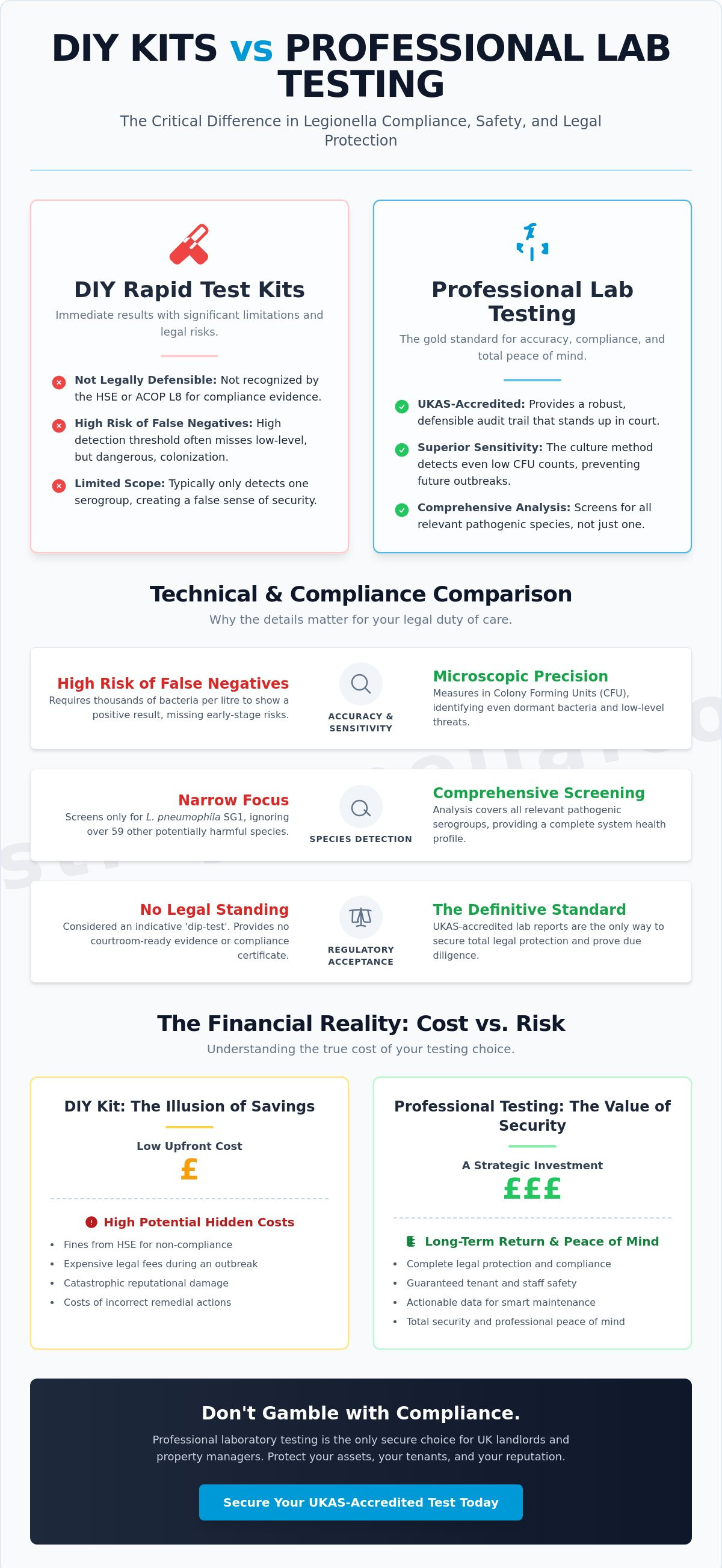
These kits typically utilize Lateral Flow Immunochromatographic Assay (LFICA) technology. If you've used a rapid antigen test for COVID-19, the process will feel familiar. You'll find swabs, collection vials, and reactive strips in the box. The appeal is obvious: you get a "yes" or "no" answer in under 40 minutes. However, this convenience comes at a cost. These kits often only detect specific strains and lack the sensitivity to identify low-level colonization before it becomes a crisis. They provide a snapshot in time but offer no long-term legal immunity.
What is Professional Laboratory Testing?
Professional Legionella Compliance Testing relies on the traditional "Culture Method." This involves incubating water samples in a controlled environment for up to 14 days. It's a meticulous process, but it's the only one validated by the United Kingdom Accreditation Service (UKAS). Unlike a DIY strip, a lab report provides a detailed breakdown of bacterial concentrations and specific species. Most importantly, professional testing provides a secure audit trail. You aren't just getting a result; you're getting a document that stands up in court. This includes expert interpretation of the findings and clear instructions for any necessary remedial actions, ensuring you meet every aspect of your legal obligations.
The Technical Difference: Rapid Antigen Kits vs. UKAS Laboratory Analysis
The debate between DIY legionella testing kits vs professional lab testing often centers on speed, but the real divide is technical precision. Rapid antigen kits rely on visual indicators on a reactive strip. Professional lab analysis uses a controlled culture method. While a kit might give you a result in 25 minutes, it often lacks the resolution to see the full picture of your water system's health. Accuracy requires patience; the 10-day incubation period used in labs is scientifically superior because it allows bacteria to grow to a detectable level. This ensures that the remedial actions you take are proportionate, effective, and legally defensible.
Sensitivity and False Negatives
DIY strips have a high detection threshold. They often require thousands of bacteria per litre to trigger a positive result. In contrast, UKAS-accredited labs measure in Colony Forming Units (CFU), identifying even low-level colonization before it becomes a crisis. This difference is vital because low levels of bacteria today can become a dangerous outbreak tomorrow if left unmanaged. Professional Legionella Compliance Testing eliminates the guesswork by providing a granular view of your system. Lab incubation is the only way to detect "stressed" bacteria that are alive but dormant, which rapid kits consistently overlook.
Targeting the Right Serogroups
Targeting is another major weakness of home-based options. There are over 60 species of Legionella. Most DIY kits only screen for Legionella pneumophila serogroup 1. While SG1 is responsible for many cases of disease, it isn't the only threat. Professional laboratory analysis screens for all relevant pathogenic species. Ignoring non-SG1 strains in complex water systems creates a false sense of security. You might have a negative kit result while a different, equally dangerous strain thrives in your pipework. This gap in detection can lead to severe health risks and legal complications.
A "Yes/No" result is practically useless for professional property management. If a DIY kit turns positive, you don't know the concentration. You won't know if you need a simple temperature adjustment or a full chemical disinfection. Professional results provide specific numbers. These figures allow you to follow the tiered response actions outlined in HSG274 guidance. By using quantified data, you move from reactive panic to planned, efficient maintenance. This structured approach is the hallmark of a responsible property manager who values both safety and operational excellence.
The Compliance Gap: Can DIY Kits Meet Your Legal Obligations?
Relying on a retail-bought kit to satisfy a Health and Safety Executive (HSE) inspector is a risky strategy. While 2026 has seen a rise in "instant" water checks, the legal framework remains firm. The primary regulation, ACOP L8 Fourth Edition, demands a level of rigour that most hand-held tools simply cannot provide. When evaluating DIY legionella testing kits vs professional lab testing, you must consider the legal standing of your evidence. An inspector isn't looking for a quick "pass" on a strip; they're looking for a managed system of control that proves you've taken every reasonable step to prevent Legionnaires' disease.
The law requires the appointment of a "responsible person" who is competent, trained, and experienced. Self-testing with a basic kit often fails this "Competent Person" requirement. If you perform the test yourself without formal training, your results may be dismissed as unreliable during an audit. Professional Legionella Compliance Testing ensures that the individual collecting the sample and the laboratory analysing it both meet the necessary technical standards. This professional oversight transforms a simple water check into a robust legal shield. It's about demonstrating a long-term commitment to safety rather than a one-off transaction.
The Legal Standing of DIY Results
Most rapid kits are classified as screening tools. They're useful for a quick internal check, but they don't constitute compliance evidence. For a result to be legally defensible, it must typically come from a UKAS-accredited laboratory. This accreditation is the gold standard that insurers and regulators demand. Without it, you lack the "proof of due diligence" needed for a strong legal defence. To understand how these requirements fit into your broader strategy, consult our comprehensive ACOP L8 guide. A UKAS-accredited certificate is your only path to total legal protection and emotional security.
The Importance of the Audit Trail
Professional testing provides a watertight chain of custody. This process tracks the sample from the moment it leaves your tap until the final report is issued. It's a verified record that proves the sample wasn't contaminated or mishandled. When you use a DIY kit, you're essentially "self-certifying." In a courtroom or an insurance investigation, self-certified results carry very little weight. A professional report serves as an independent, expert validation of your safety measures. It demonstrates that you've prioritised tenant safety over convenience. This audit trail is the difference between a stressful investigation and a successful compliance review.
A Practical Comparison: Accuracy, Cost, and Regulatory Acceptance
A low purchase price often masks a high regulatory risk. When you weigh up DIY legionella testing kits vs professional lab testing, you must look beyond the initial invoice. A kit might save a few pounds today, but it offers zero support if the result comes back positive. Professional testing includes the specialist interpretation required to act decisively. It's the difference between having a piece of data and having a solution. You're investing in a result that protects your reputation and your tenants.
Evaluating the Real Cost of Testing
The true expense of water safety isn't just the test itself; it's the cost of getting it wrong. You can review our detailed breakdown of legionella risk assessment cost to see how these elements fit into a broader compliance budget. A DIY kit might seem efficient, but if it produces a false negative, the eventual financial impact of an HSE fine far outweighs any minor saving. Professional analysis provides the "what next" advice that kits lack. You receive a clear roadmap for remedial action, ensuring you don't waste money on unnecessary chemical treatments or repeated testing.
The Professional Sampling Advantage
Accuracy starts at the tap. The most sophisticated lab can't fix a sample that was collected incorrectly. Professional technicians are trained to identify "dead legs" and high-risk outlets where bacteria are most likely to thrive. DIY users frequently make mistakes like cross-contaminating samples or failing to record water temperatures at the moment of collection. These errors lead to unreliable data. By choosing professional Legionella Compliance Testing, you ensure that the sampling process itself is an extension of your due diligence.
When is a DIY kit appropriate? For landlords managing simple residential properties with no stored water, a kit analyzed by a UKAS lab might suffice for basic duty of care. However, for any complex system, commercial building, or site with vulnerable tenants, professional intervention is the only secure choice. Don't leave your legal protection to chance. Invest in a process that provides total peace of mind and keeps your property safe. This proactive approach ensures you're always one step ahead of regulatory changes.
Why Professional Lab Testing is the Only Secure Choice for UK Landlords
Security in property management isn't found in a quick result; it's built on a foundation of reliable data and specialist expertise. When you compare DIY legionella testing kits vs professional lab testing, the final decision should always rest on where the liability falls. Professional testing transforms a high-stakes risk into a managed, stress-free process. It provides the emotional security that comes from knowing your tenants are protected and your legal obligations are fully met. You aren't just buying a test; you're securing an expert partner who understands the logistics of maintenance and the gravity of safety standards.
Comprehensive reporting is the cornerstone of this security. Unlike the limited scope of a home kit, professional laboratory analysis identifies specific species and precise concentration levels. This level of detail is vital for determining the exact remedial actions required if bacteria are detected. You move from a state of uncertainty toward a clear, actionable solution. This structured approach ensures that technical requirements feel accessible and manageable, allowing you to focus on your core business while we handle the complexities of regulatory adherence.
The Test Legionella Standard
We're committed to providing authoritative, jargon-free reporting that property owners can actually use. Our reports bridge the gap between complex technical data and practical property management, ensuring you never feel overwhelmed by the requirements of ACOP L8. We maintain a no-nonsense approach to water safety that prioritises clarity over complexity. By delivering results that are both scientifically rigorous and easy to interpret, we help you maintain an atmosphere of calm competence in your property management duties.
Next Steps for Compliance
Transitioning from confusion to total legal protection is a straightforward process. A professional assessment removes the anxiety of potential HSE fines and ensures your audit trail is watertight. Our efficient online portal allows you to schedule a national testing visit with minimal disruption to your daily operations. This streamlined experience is designed for busy professionals who value their time and demand operational excellence. Don't leave your safety record to a "best guess" screening tool. Take the final step toward total peace of mind and secure your property today.
Secure your property with professional Legionella testing today and ensure you meet every legal standard with confidence.
Secure Your Property's Future Today
You've explored the critical technical and legal gaps between DIY legionella testing kits vs professional lab testing. While rapid kits offer a temporary snapshot, they can't provide the UKAS-accredited certainty required to satisfy an HSE inspector or your insurance provider. True compliance requires a combination of precise bacterial quantification and an unbroken chain of custody. By choosing a professional route, you're not just ticking a box; you're establishing a defensible record of due diligence that protects both your residents and your long-term reputation.
Secure your property's safety with a managed service that simplifies the complex world of water regulations. We provide UKAS Accredited Laboratory Analysis, Nationwide Coverage, and ACOP L8 & HSG274 Compliant Reporting to ensure you remain fully protected against the risks of non-compliance. Move from a state of uncertainty to total peace of mind with a specialist partner who understands your operational logistics. Book Your Professional Legionella Compliance Test Now. You've already taken the first step by educating yourself on the 2026 standards; now, let's finalise your path to total water safety and legal tranquility.
Frequently Asked Questions
Are DIY Legionella testing kits accurate enough for landlords?
DIY kits generally lack the sensitivity and species coverage required to provide full legal protection for landlords. These kits often only detect Legionella pneumophila serogroup 1 and miss low-level colonisation that could eventually lead to an outbreak. While they offer a quick snapshot, they don't provide the granular data needed to manage a water system safely or fulfill your duty of care.
Does the HSE accept DIY Legionella test results for compliance?
The HSE typically requires evidence that is scientifically robust and defensible, which usually means results from a UKAS-accredited laboratory. Rapid antigen kits are viewed as screening tools rather than definitive proof of compliance under ACOP L8. When comparing DIY legionella testing kits vs professional lab testing, an inspector will prioritise the lab report because it includes a verified audit trail and expert interpretation.
How long does a professional Legionella lab test take to get results?
Standard laboratory culture analysis takes between 10 and 14 days to complete. This time is essential because it allows any bacteria present in the water sample to grow to a detectable level in a controlled environment. This meticulous process ensures the final result is scientifically valid and provides the specific concentration levels required for professional property management.
What is the difference between a Legionella kit and a UKAS lab test?
The primary difference lies in the methodology and the legal weight of the output. Kits use rapid antigen strips for immediate, often less sensitive results. UKAS lab tests use the culture method, which is the gold standard for accuracy. A UKAS report provides quantified data and a legally defensible certificate that protect you during audits or insurance investigations.
Can I take my own water samples and send them to a lab?
You can collect your own samples, but this introduces significant risks regarding sampling technique and cross-contamination. If the sampling process isn't perfect, the laboratory result may be inaccurate or legally void. Professional collection ensures a secure chain of custody and guarantees that samples are taken from high-risk areas like dead legs and specific temperature points.
What happens if my DIY kit shows a positive result for Legionella?
If a kit shows a positive result, you should immediately isolate the affected outlets and arrange for professional Legionella Compliance Testing to confirm the findings. A simple "yes" result from a kit doesn't provide the concentration levels needed to determine the correct remedial action. You need professional quantification to decide if you require a simple temperature flush or a full chemical disinfection.
Is professional Legionella testing mandatory for small businesses?
A formal risk assessment is mandatory for every business, and this assessment dictates whether testing is required. While small businesses with simple water systems might not need frequent testing, any property with stored water tanks or complex pipework should utilise professional services. Proving adequate control is much easier with a professional lab report than with a self-certified kit.
How much does professional Legionella lab testing cost compared to a kit?
Professional testing involves a higher initial investment but offers far greater long-term value by providing legal immunity and expert guidance. DIY kits may seem cost-effective at first, but they often lead to expensive re-testing or heavy fines if they fail to stand up in court. Investing in a managed service transforms a complex regulatory burden into a predictable, stress-free expense.