
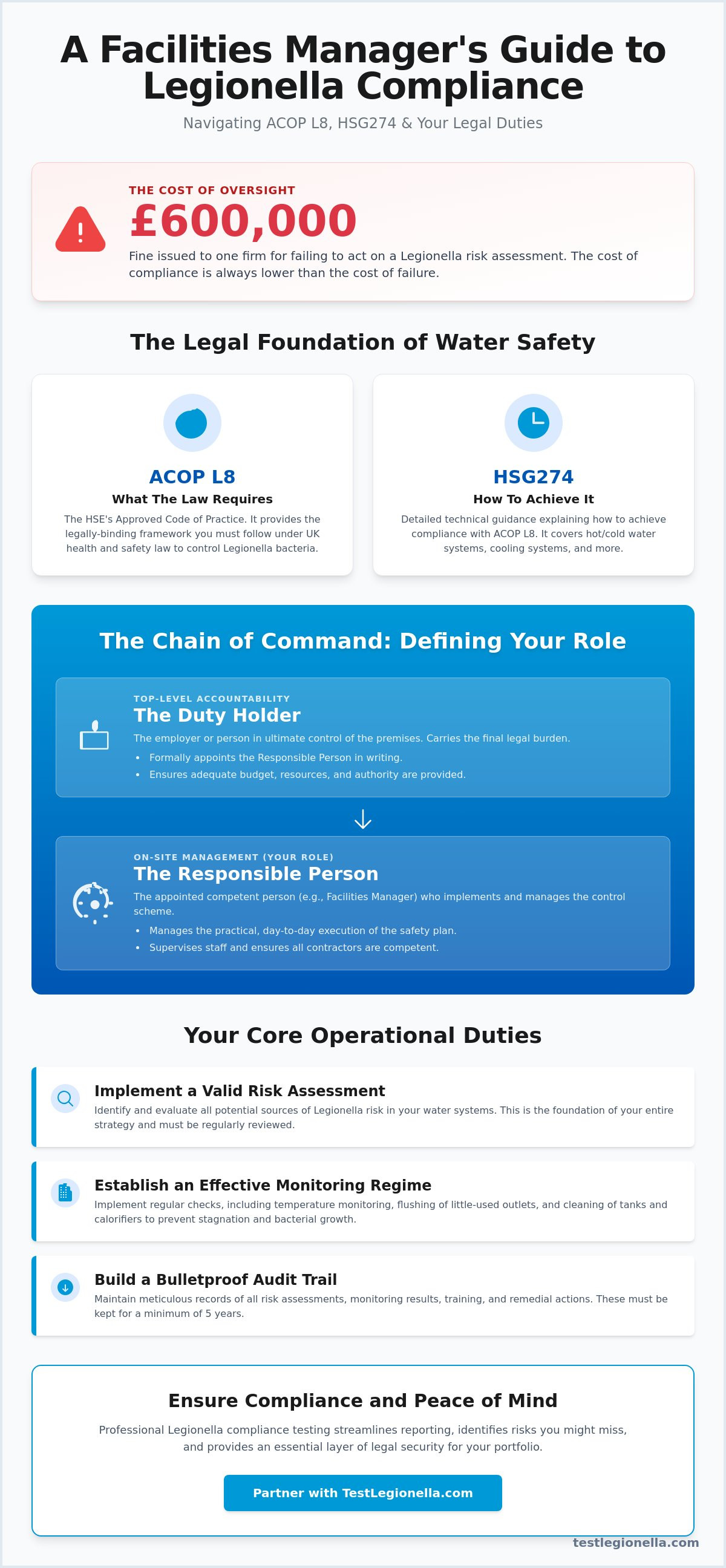
In May 2025, a facilities management firm faced a £600,000 fine for failing to act on a risk assessment, proving that the cost of oversight is far higher than the cost of compliance. As a professional, you understand that facilities manager legionella duties represent more than just administrative tasks. They're the front line of defense against public health risks and the primary shield for your organization against HSE prosecution.
You've probably experienced the frustration of vague contracts where responsibilities between landlords and tenants feel blurred. It's stressful to manage multiple sub-contractors while worrying if your records would survive a surprise audit. This guide eliminates that ambiguity and replaces it with a clear, actionable map for your water safety strategy. You'll learn how to secure your portfolio against the risks highlighted by the London outbreak in March 2026.
We'll break down the specific requirements of ACOP L8 and HSG274, showing you how to manage Legionella compliance testing with total efficiency. From temperature thresholds to five-year record-keeping rules, you're about to gain the expertise needed to transform complex regulations into a seamless, stress-free management process.
Key Takeaways
- Understand the legal weight of ACOP L8 to ensure your water safety standards align with the latest 2026 compliance requirements.
- Clarify the distinction between Duty Holders and Responsible Persons to eliminate contractual ambiguity and establish clear accountability.
- Master the core facilities manager legionella duties, including the implementation of effective monitoring regimes and valid risk assessments.
- Build a bulletproof audit trail by adhering to the five-year record-keeping mandate and transitioning to efficient digital systems.
- Discover how professional Legionella compliance testing streamlines your reporting and provides an essential layer of legal security.
The Legal Framework: ACOP L8 and Facilities Management
Compliance in 2026 is built on a foundation of rigorous standards and clear accountability. The primary regulation governing your site is the Health and Safety Executive (HSE) Approved Code of Practice L8, commonly known as ACOP L8. While the current 4th edition was published in 2013, its legal weight remains absolute. It provides the specific framework you must follow to comply with the Health and Safety at Work etc. Act 1974 and the Control of Substances Hazardous to Health Regulations 2002 (COSHH).
Facilities managers are the primary focus for HSE inspections because they typically hold the operational keys to a building's safety systems. When an inspector walks through your doors, they aren't just looking at pipes; they are looking for evidence that you understand facilities manager legionella duties and have implemented them effectively. The core objective is simple but critical: prevent the growth of bacteria and stop the aerosolisation of contaminated water. To understand the biological risks involved, it's helpful to review What is Legionella? and how it thrives in poorly managed systems. By controlling temperatures and eliminating stagnation, you transform a high-stakes risk into a managed, routine operation.
Why FMs Cannot Delegate Legal Responsibility
You can outsource the physical labor of Legionella Compliance Testing, but you cannot outsource your legal liability. The HSE is clear that the duty to ensure safety remains with the duty holder and the appointed responsible person. You must ensure that anyone performing water safety tasks is a "Competent Person" with the right training and experience. Many professionals fall into the trap of "silent" gaps in their contracts, assuming a sub-contractor is handling a specific task when, in reality, it's falling through the cracks. Secure your reputation by verifying that every line of your safety scheme is actively managed and documented.
Key Regulations: HSG274 and Beyond
ACOP L8 tells you what the law requires, while the HSG274 technical guidance explains how to achieve it. Part 1 of this guidance, which covers evaporative cooling systems, was updated as recently as April 2024 to reflect modern engineering standards. You must also remain mindful of the Management of Health and Safety at Work Regulations 1999, which mandates broad risk assessments across all business activities. ACOP L8 serves as the gold standard for UK water safety compliance. Following this guidance ensures that your facilities manager legionella duties are met with precision, providing you with a sense of security during any regulatory review.
Duty Holder vs. Responsible Person: Defining the Split
Confusion often reigns when defining where a building owner's liability ends and your professional responsibility begins. Under the ACOP L8 guidance, the law identifies two distinct roles: the Duty Holder and the Responsible Person. The Duty Holder is typically the employer or the person in ultimate control of the premises. While they carry the final legal burden, they often lack the technical expertise to manage water systems. This is where you, the Facilities Manager, step in as the appointed Responsible Person.
Your written "Scheme of Control" must explicitly document these roles by name. This prevents the "contractual fog" where everyone assumes someone else is checking the cold water tanks. For FM firms, appointing a Deputy Responsible Person is equally critical. This ensures that if you are off-site, on leave, or managing a different part of your property portfolio, compliance doesn't stall. A site without a designated deputy is a site at risk during an HSE audit, especially if an incident occurs during your absence.
The Duty Holder’s Primary Obligations
The Duty Holder must identify the individual or entity with ultimate control over the premises. Their primary obligation is the formal, written appointment of a "Responsible Person" who has sufficient authority and competence. They must also ensure you have the necessary budget and resources to maintain safety across the site. Without adequate funding for physical repairs or regular monitoring, the Duty Holder remains legally vulnerable. They provide the strategic authority that allows you to execute the safety plan with confidence.
The Responsible Person’s Daily Mandate
As the Responsible Person, your daily mandate involves the practical implementation of the control scheme. This includes supervising staff and ensuring all external contractors are competent for their specific tasks. You are the guardian of the site-specific Legionella logbook, which serves as your primary defense during an inspection. Your facilities manager legionella duties extend to verifying that every tap is flushed, every showerhead is descaled, and every temperature is recorded correctly. To simplify this process and ensure technical accuracy, many FMs rely on professional Legionella Compliance Testing to handle the complex sampling and laboratory analysis required for bulletproof records.
Core Operational Duties for Legionella Control
Your operational success hinges on the transition from legal theory to physical maintenance. While the previous sections defined your role, your daily facilities manager legionella duties are what actually keep the site safe. This starts with a live management plan that responds to the specific risks of your building's architecture, ensuring that no part of the water system is left to chance.
The Legionella Risk Assessment (LRA) is your primary roadmap. It's not enough to have a document gathering dust; it must cover every aspect of your water system, from cooling towers to the smallest breakroom tap. When planning your annual budget, understanding the Legionella risk assessment cost helps you allocate resources effectively without compromising on safety. According to the HSE Approved Code of Practice (ACOP) L8, you must review this assessment at least every two years. However, immediate reviews are mandatory if you introduce new tenants, change the building's use, or modify the plumbing layout.
The Legionella Risk Assessment: The FM’s Roadmap
A valid assessment identifies the unique vulnerabilities of your property portfolio. You must verify that the survey covers all potential aerosol-generating sources, including decorative fountains or spray taps. If the assessment highlights high-priority remedial actions, such as removing dead-end pipework or insulating tanks, you must complete these within the specified timescales to remain compliant. Procrastination on these repairs is a common trigger for HSE intervention.
Routine Monitoring and Maintenance
Routine monitoring remains the most effective way to prevent bacterial growth. Temperature control is your strongest weapon. Hot water must be stored at 60°C or higher and reach outlets at 50°C within one minute. Cold water should always stay below 20°C. If these thresholds slip, you're inviting biofilm to colonize your pipes. Your facilities manager legionella duties include managing these rigid schedules:
- Monthly: Record temperatures at sentinel outlets, which are the nearest and furthest taps from the water source.
- Quarterly: Descale and disinfect all showerheads and hoses to eliminate calcium build-up where bacteria hide.
- Weekly: Flush "little-used" outlets in low-occupancy areas for several minutes to prevent stagnation and biofilm build-up.
Stagnation is a silent killer in commercial properties. Biofilm builds up rapidly in dead legs or unused wings, making regular flushing non-negotiable. By staying proactive and documenting every action, you fulfill your professional obligations while maintaining a constant state of audit-readiness.
Building a Bulletproof Audit Trail
An HSE inspector’s first request is rarely for a tour of the plant room; they want to see your paperwork. If a task isn't recorded, the law assumes it never happened. Under ACOP L8, you must maintain all water safety records for a minimum of five years. This isn't just a suggestion. It's a statutory requirement that forms a core part of your facilities manager legionella duties. Whether you use a physical folder or digital software, your audit trail must be accessible, accurate, and up to date at a moment's notice.
Many professionals are transitioning from paper logbooks to digital compliance platforms to eliminate human error. Digital systems provide timestamped evidence of inspections and automated alerts for missed tasks. This transparency is vital when managing high-occupancy buildings where manual tracking becomes a liability. If a temperature check fails, your system should trigger a "Non-Conformance" report. Documenting the failure, the remedial action taken, and the eventual resolution proves that your safety scheme is proactive rather than reactive. This level of detail is exactly what investigators look for when assessing whether a site is managed with due diligence.
What Must Your Logbook Contain?
Your logbook serves as the single source of truth for your site's safety. It needs to be organized logically so an external auditor can verify compliance in minutes. At a minimum, ensure it includes the names and contact details of the Duty Holder and the Responsible Person. You must also include the written Scheme of Control and the most recent Risk Assessment. Every monitoring result must be logged with the specific date, the exact outlet tested, and the signature of the competent person who performed the work. Gaps in these dates are the first thing an auditor will flag.
Managing and Auditing Third-Party Contractors
Hiring a contractor doesn't absolve you of responsibility. You must verify that your water hygiene partners hold relevant accreditations, such as membership in the Legionella Control Association. Your facilities manager legionella duties include spot-checking their reports for accuracy and consistency. Don't just file their paperwork in a drawer. Review the data to ensure that all legionella testing laboratory results are integrated into your main logbook and that any recommended actions are scheduled immediately. To ensure your records meet the highest UKAS standards, book your professional Legionella Compliance Testing to secure a transparent and defensible audit trail.
Partnering for Compliance: Professional Testing and Reporting
Managing your property portfolio shouldn't feel like a constant battle against red tape. While you now have a clear map of facilities manager legionella duties, the day-to-day execution can still overwhelm even the most organized teams. Professional testing bridges the gap between knowing the law and proving you've followed it. By delegating the technical sampling and analysis to specialists, you shift the administrative burden away from your desk. This allows you to focus on broader operational goals while maintaining a state of constant audit-readiness.
Generic, "off-the-shelf" compliance templates are a common pitfall for busy professionals. They often fail HSE inspections because they lack the site-specific detail required by modern safety standards. An inspector wants to see that your scheme of control reflects the actual plumbing architecture and occupancy patterns of your building, not a generic checklist. Independent, professional reporting provides a transparent layer of protection for your reputation. It demonstrates that you've sought expert validation for your water safety measures, which is a powerful defense if a system failure ever occurs.
The Benefits of Professional Legionella Compliance Testing
Choosing a professional partner means moving beyond guesswork and manual tracking. You gain access to UKAS-accredited laboratory analysis, providing definitive proof that your control measures are working effectively. These clear, actionable reports are designed to satisfy the most stringent acop l8 requirements, leaving no room for interpretation by regulatory bodies. Instead of just identifying potential problems, expert-led testing helps you develop risk mitigation strategies that are both practical and cost-effective. It transforms a complex regulatory burden into a predictable, manageable system that protects both your tenants and your career.
Ready to Secure Your Portfolio?
Total compliance is a journey from uncertainty to a state of calm security. By mastering your facilities manager legionella duties, you've already taken the most important step toward operational excellence. The path forward involves moving away from reactive "crisis management" and toward a proactive, automated water safety regime. Don't wait for a notification from the UKHSA or a heavy fine to audit your internal processes. Take control of your site's safety today and ensure your records are truly bulletproof. Contact Test Legionella for professional Legionella Compliance Testing and let us help you eliminate the stress of regulatory adherence.
Secure Your Property Portfolio with Confident Compliance
Mastering your facilities manager legionella duties doesn't have to be an uphill struggle. By clarifying the split between the Duty Holder and the Responsible Person, you've already eliminated the most common source of legal ambiguity. You now have the tools to maintain a rigorous five-year audit trail and implement a monitoring regime that stands up to the closest HSE scrutiny.
Compliance is about more than avoiding fines; it's about the peace of mind that comes from knowing your water systems are safe. Professional testing removes the guesswork from your daily operations, providing the technical evidence needed to prove your diligence. Our specialists are experts in ACOP L8 and HSG274 adherence, delivering accurate, audit-ready results through UK-wide professional testing and reporting.
Secure your building today with professional Legionella Compliance Testing from Test Legionella.
You've built the foundation for a safer building and a more protected organization. Now, take the final step to transform your regulatory obligations into a streamlined, stress-free management system that works for you.
Frequently Asked Questions
Is the Facilities Manager always the "Responsible Person" for Legionella?
The Facilities Manager is not automatically the Responsible Person, but they are the most common appointee due to their operational control. The Duty Holder must formally appoint a person in writing who has the competence and authority to manage the risk. If you have day-to-day oversight of the water systems, you'll likely hold this title and the legal accountability that comes with it.
How often should a Facilities Manager review a Legionella Risk Assessment?
You must review your Legionella Risk Assessment at least every two years to remain compliant with ACOP L8. However, you should conduct an immediate review if there are significant changes to the water system, building use, or if your monitoring indicates that control measures are failing. Staying proactive with these reviews is a core part of facilities manager legionella duties and prevents legal gaps.
Can a Facilities Manager carry out Legionella testing themselves?
You can perform basic monitoring tasks like temperature checks and flushing if you are trained and competent. However, actual water sampling for laboratory analysis requires specific technical skills and UKAS-accredited equipment. Most professionals outsource Legionella Compliance Testing to specialists to ensure the results are independent, accurate, and legally defensible in court.
What happens if a Facilities Manager fails to meet their Legionella duties?
Failure to meet your obligations can lead to severe HSE intervention, including unlimited fines or criminal prosecution. Recent cases in 2025 have seen fines reaching £600,000 following fatalities. Beyond the financial impact, negligence can lead to corporate manslaughter charges and permanent damage to your professional reputation within the industry.
Do I need to test for Legionella if I only manage small office buildings?
Yes, the law makes no distinction based on building size. If your premises store or distribute water that can create an aerosol, you have a legal duty to assess and manage the risk. Small office buildings often have "dead legs" in plumbing or low-use outlets that actually increase the risk of bacterial growth compared to high-turnover systems.
What are the "hidden" Legionella duties often missed in FM contracts?
Many contracts fail to specify who is responsible for managing stagnation in vacant units or descaling specialized equipment like TMVs. Another common oversight is the verification of sub-contractor training records. You must ensure that every person touching the water system is verified as competent, as "silent" gaps in these facilities manager legionella duties often lead to audit failures.
How long must Legionella compliance records be kept by an FM?
You must keep all Legionella-related records for a minimum of five years. This includes your risk assessments, written schemes of control, and every individual temperature or flushing log. Keeping these records organized and accessible is your primary defense during an HSE inspection or after a reported outbreak.
What should an FM do if Legionella bacteria are detected in the water system?
Immediately follow the emergency procedures outlined in your written scheme of control. This typically involves isolating the affected area, notifying the Duty Holder, and implementing a disinfection program. Once remedial work is complete, you must conduct follow-up testing to verify the system is safe before allowing tenants to resume normal water use.