
A thick ring binder on a dusty shelf isn't a Legionella management plan; it's a liability waiting to be found during an HSE audit. We understand that overseeing water safety across science labs, sports pavilions, and kitchens often feels like deciphering a complex legal code. You want to protect your pupils and staff, but the weight of regulatory jargon and the logistics of constant monitoring can feel overwhelming. It's natural to worry whether your current protocols for legionella testing for schools uk truly meet the latest 2026 standards.
You deserve the peace of mind that comes from a system built on reliability and expert clarity. This guide simplifies your path to compliance, transforming high-stakes risks into a manageable, professional routine. We'll provide a structured framework for your management plan, clarify your legal obligations under ACOP L8 and HSG274, and provide an actionable checklist to ensure your record-keeping is always audit-ready. By the end of this article, you'll have a clear roadmap to transition from technical uncertainty to a state of calm, competent control.
Key Takeaways
- Understand your legal role as a Duty Holder under ACOP L8 and why a "Written Scheme" is the essential operational heart of your school's safety strategy.
- Identify the five pillars of a robust water safety plan, starting with a statutory risk assessment that serves as the foundation for every maintenance decision.
- Learn when to rely on site staff for routine monitoring and when professional legionella testing for schools uk becomes a non-negotiable requirement for UKAS-accredited laboratory analysis.
- Discover specific protocols for managing high-risk periods like summer holidays and how to effectively flush "little-used outlets" in labs and remote areas.
- Bridge the gap between policy and practice with a clear roadmap for simplified record-keeping and proactive monitoring that ensures audit readiness.
The Legal Framework for School Legionella Management in the UK
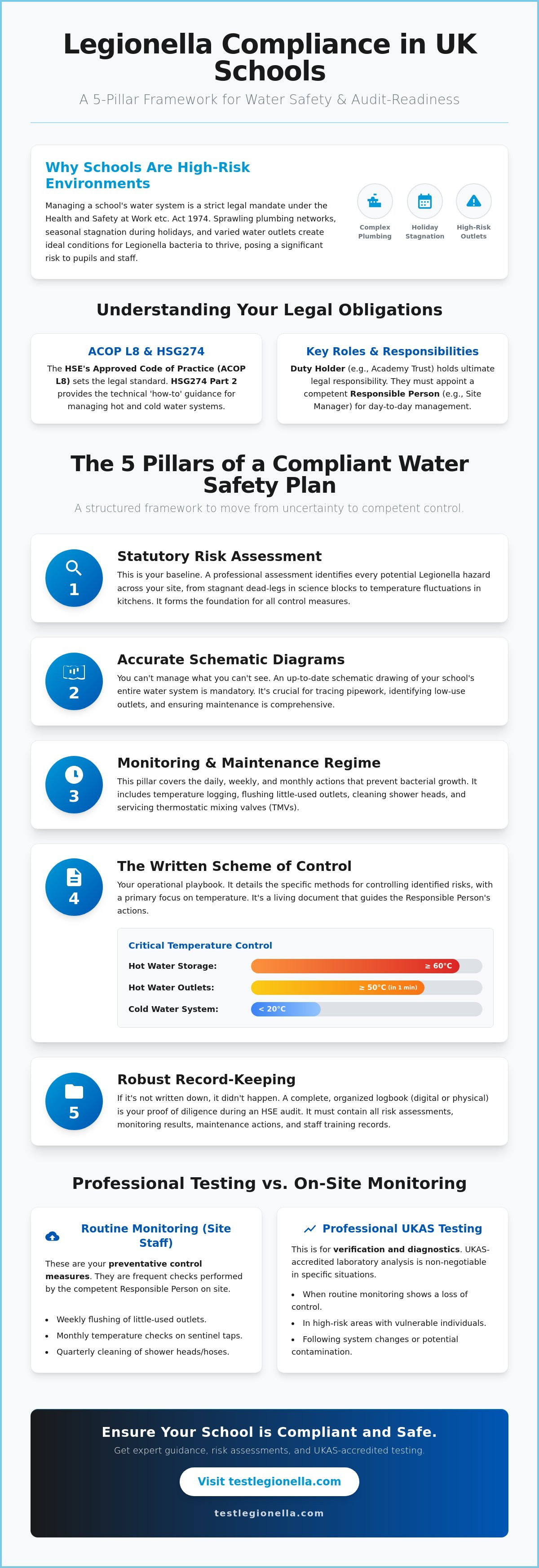
Managing a school's water system isn't just a matter of facility maintenance; it's a strict legal mandate. Under the Health and Safety at Work etc. Act 1974, school leadership has a non-delegable duty to ensure the safety of pupils, staff, and visitors. Schools are uniquely high-risk environments. Their sprawling plumbing networks, seasonal stagnation during holidays, and high-risk outlets like science labs and gym showers create ideal conditions for Legionnaires' disease to develop. Compliance requires more than a one-off check. It demands a living, breathing strategy that protects your community every day of the term.
To stay compliant, you must distinguish between your Risk Assessment and your Management Plan. Many schools fall into the trap of thinking a completed audit is enough. In reality, the Risk Assessment is simply the diagnostic tool that identifies your vulnerabilities. The Management Plan, technically known as the "Written Scheme," is the operational playbook. It details the specific, daily actions your team takes to prevent bacterial growth. Effective legionella testing for schools uk often serves as a vital verification step within this scheme, proving that your control measures are actually working.
Understanding ACOP L8 and HSG274 Part 2
The Health and Safety Executive (HSE) provides the roadmap for compliance through the Approved Code of Practice L8 (ACOP L8). This is the primary legal code you're measured against during an inspection. While ACOP L8 sets the "what," the technical guidance in HSG274 Part 2 explains the "how" for hot and cold water systems. These documents work together to ensure your water safety protocols are scientifically sound. For a deeper dive into these regulations, you can read our guide on ACOP L8 Explained.
Identifying Key Roles: The Duty Holder vs. Responsible Person
Compliance depends on clear accountability. The Duty Holder is typically the employer, such as the Academy Trust or Board of Governors. They hold ultimate legal responsibility for water safety. However, they must appoint a "Responsible Person" to manage the day-to-day logistics. This individual, often a site manager or premises officer, must demonstrate "competence." This means they need sufficient training and authority to take action when risks are identified. Without a competent person overseeing legionella testing for schools uk and routine flushing, the entire management plan remains a paper exercise rather than a safety shield.
5 Essential Pillars of a Compliant School Water Safety Plan
A compliant water safety plan is more than a list of tasks. It's a structured framework designed to eliminate the guesswork from facility management. To meet the standards set out in UK government guidance for schools, your strategy must rest on five specific pillars. These elements work in tandem to transform your legal duties into a repeatable, stress-free routine. When these pillars are solid, you don't just pass audits; you create a genuinely safe environment for every pupil.
- The Statutory Risk Assessment: This is your baseline. It identifies every potential hazard across your site, from stagnant dead-legs in the science block to temperature drops in the kitchen.
- Schematic Diagrams: You can't manage what you can't see. Accurate, up-to-date maps of your school’s entire water infrastructure are mandatory. They help you pinpoint high-risk areas and understand how water flows through the building.
- Monitoring and Maintenance Regimes: This pillar covers the daily, weekly, and monthly actions required to keep bacteria at bay. It includes everything from temperature logs to regular flushing and professional legionella testing for schools uk.
The Written Scheme of Control
The Written Scheme is your operational manual. It outlines the specific methods your school uses to control risks, with a primary focus on temperature control. Hot water must be stored at 60°C and reach outlets at 50°C within one minute, while cold water must stay below 20°C. Your scheme should also provide clear instructions for the safe operation of the water system and define emergency procedures. If a control measure fails, such as a water heater breaking down, your team needs an immediate, pre-approved plan to mitigate the risk. If you are unsure if your current scheme is robust enough, you can verify your compliance status with a specialist review.
Maintaining a Robust Audit Trail
In the eyes of an inspector, if it isn't recorded, it didn't happen. You must maintain a central logbook, either digital or physical, that serves as evidence of every safety action taken. These records must be kept for at least five years. Every entry needs to include the specific date of the check and the name of the person who performed it. This level of detail provides the transparency required to prove you're meeting your Duty Holder obligations. Regular legionella testing for schools uk ensures that your laboratory results back up your physical temperature logs. For staff members who need to understand the underlying risks they are monitoring, our guide on What is Legionella? offers a clear starting point for internal training.
Professional Testing vs. DIY Monitoring: Managing School Risks
Effective facility management requires a strategic balance between internal resources and external expertise. Most schools rely on their site teams for routine tasks like weekly flushing and monthly temperature monitoring. This is a practical and cost-effective way to maintain daily safety. However, internal monitoring has its limits. When plumbing systems become complex or temperature controls fluctuate, the risk of bacterial growth increases. A robust strategy for legionella testing for schools uk provides the empirical proof that your internal efforts are actually working, moving your safety plan from assumptions to verified facts.
Relying solely on internal competence for high-risk systems can create a significant liability gap. While a premises officer is often highly skilled in general maintenance, they may lack the specialized equipment or laboratory training required to detect microscopic threats. If an HSE inspector determines that your "Responsible Person" lacks the technical depth to manage a specific risk, your school could face serious repercussions. Professional testing doesn't replace your site team; it empowers them. It provides the high-level data needed to validate their hard work and ensures your school remains a sanctuary for learning rather than a site of hidden risk.
When is Professional Water Sampling Required?
Routine monitoring is the baseline, but certain scenarios make professional water sampling non-negotiable. If your school operates cooling towers or maintains large stored water tanks, technical sampling is a mandatory requirement. You also need professional intervention if your monthly temperature logs consistently show that your water isn't hitting the required safety thresholds. According to the HSE Approved Code of Practice (ACOP) L8, sampling is essential when control measures are in doubt. In these high-stakes moments, only a UKAS-accredited laboratory analysis can provide the definitive evidence you need to ensure pupil safety.
Cost-Benefit Analysis of Professional Compliance
Budgeting for school safety involves weighing the price of prevention against the catastrophic costs of failure. While professional legionella testing for schools uk is an annual investment, it's a fraction of the potential HSE fines for non-compliance, which can reach hundreds of thousands of pounds. Beyond the financial impact, the reputation of your academy or trust depends on a flawless safety record. You can explore the typical Legionella Risk Assessment Cost to help plan your annual compliance budget. Securing a professional Compliance Certificate offers more than just legal protection; it provides the emotional security and peace of mind that your water systems are managed to the highest professional standards.
Step-by-Step Maintenance for Schools: Holidays and High-Risk Areas
Schools aren't static environments. The plumbing systems that support a bustling community of hundreds can suddenly fall silent during half-terms and summer breaks. This transition from high usage to total stagnation is a primary risk factor for bacterial growth. To maintain safety, your management plan must adapt to the academic calendar. Proactive maintenance ensures that when the school gates reopen, your water systems are as ready for the new term as your teaching staff. Implementing a clear, step-by-step protocol for these quiet periods transforms a potential liability into a controlled, professional routine.
Beyond the calendar, certain areas of your site carry higher inherent risks due to the way water is used. Science labs, Design and Technology (DT) rooms, and sports pavilions often contain "little-used outlets" that site teams might overlook. Every tap, showerhead, and hose is a potential source of aerosolised water droplets. If these outlets sit dormant, they become breeding grounds for bacteria. Identifying these specific points and integrating them into your weekly maintenance schedule is a non-negotiable part of your Duty Holder responsibilities.
The 6-Week Summer Break Strategy
To prevent stagnation, every outlet not in regular use must be flushed weekly for several minutes until the temperature stabilises. This "weekly flushing" rule is your first line of defence during the long summer break. However, before the autumn term begins, you must perform a full system recommissioning to ensure the water is safe for the returning population. Simple flushing might not suffice if temperatures have spiked during a summer heatwave, as warm water accelerates biofilm development. In these cases, legionella testing for schools uk serves as the final verification that your recommissioning has been successful. To ensure your school is ready for the new term, you should book your professional compliance testing well in advance of the September rush.
Specialised School Outlets
High-risk aerosol generators require specific attention to prevent the spread of waterborne pathogens. Gym showers and sports pavilions are particularly sensitive areas because they produce fine mists that can be easily inhaled. Similarly, decorative fountains or pond pumps on school grounds must be managed with the same rigour as your internal plumbing. Use this checklist for your most vulnerable outlets:
- Science Labs: Flush all eye-wash stations and prep room sinks weekly, even if the labs aren't in use.
- DT Rooms: Check and flush any specialised hoses or wash-down areas.
- Sports Facilities: Descale showerheads quarterly to remove the scale that protects bacteria.
- Annual Reviews: Update your management plan and risk assessment every year, or whenever significant changes are made to the plumbing.
Staff training is the final piece of the puzzle. Your site team must understand the "why" behind their tasks, not just the "how." When premises officers are educated on the risks of stagnation and the importance of legionella testing for schools uk, they become proactive guardians of pupil safety. This culture of calm competence ensures that your school remains compliant, protected, and prepared for any inspection.
Implementing Your Plan with Test Legionella’s Specialist Support
Transforming a complex regulatory burden into a streamlined system of safety requires more than just a template; it requires a partner who understands the logistics of school maintenance. We bridge the gap between high-level policy and daily practice, ensuring your site team is supported by technical expertise. This partnership doesn't just manage risk; it removes the stress of compliance, allowing you to focus on education while we handle the technical complexities of water safety. We transform technical requirements into manageable routines that protect your pupils and your reputation.
Boards of Governors and Academy Trusts carry the ultimate weight of legal liability. They need more than just internal logs to feel secure; they require independent expert validation to prove that their Duty Holder obligations are being met. Our professional legionella testing for schools uk provides the objective, laboratory-backed evidence needed to satisfy both internal stakeholders and external inspectors. We help you transition from a confusing paper trail to an authoritative management system that stands up to the closest scrutiny, ensuring every high-risk outlet is accounted for.
Why Schools Choose Professional Testing
Speed and accuracy are the hallmarks of our national legionella testing for schools uk network. We deliver results that don't just tick a box but provide a comprehensive, technical overview of your water health. Our detailed reporting is specifically structured to satisfy the requirements of HSE inspectors and ACOP L8 auditors, ensuring your school is always audit-ready. This provides a vital "Reassurance Factor" for parents, staff, and the wider community, demonstrating that you've chosen the highest standard of protection for the people in your care.
Next Steps for Your School’s Compliance
The first step toward total peace of mind is an immediate audit of your current logbooks and risk assessments. If you haven't reviewed your Written Scheme in the last year, or if your holiday flushing records are incomplete, now is the time to act. Don't wait for an inspection to find the gaps in your safety plan. We invite you to request a professional compliance testing quote to see how our specialists can streamline your safety regime. Our no-nonsense approach ensures that your technical requirements are met with efficiency and professional quality.
Secure your school’s water safety with Test Legionella.
Secure Your School's Future Safety
Maintaining a robust water safety plan is a continuous commitment to pupil wellbeing and legal excellence. You've learned that a compliant strategy requires a clear Written Scheme, meticulous record-keeping, and proactive management of holiday stagnation. By identifying high-risk areas like science labs and gym showers, you transform a complex regulatory burden into a structured, manageable framework that stands up to scrutiny.
While routine monitoring is vital, professional legionella testing for schools uk provides the independent validation your Board of Governors needs to feel truly secure. Our UK-wide professional testing network delivers HSE and ACOP L8 compliant reporting, specifically tailored to the unique needs of educational estates. We help you bridge the gap between policy and practice with specialist expertise that ensures you're always audit-ready and fully protected. Don't leave your school's compliance to chance or outdated templates.
Take the next step toward total operational tranquility today. Request a Professional School Legionella Compliance Quote and ensure your community's safety is backed by expert precision. Your commitment to excellence deserves a water safety system that is just as reliable.
Frequently Asked Questions
Is a Legionella management plan a legal requirement for UK schools?
Implementing a Legionella management plan is a mandatory legal requirement for all UK schools. This document, known as a Written Scheme of Control, is required under the HSE's ACOP L8 to demonstrate how you're preventing exposure to the bacteria. Failing to maintain this plan can lead to significant fines and legal liability for the Duty Holder, such as the Academy Trust or Board of Governors.
How often should a school Legionella risk assessment be reviewed?
You must review your Legionella risk assessment whenever there's a reason to suspect it's no longer valid. This includes changes to the water system, building use, or key personnel like the Responsible Person. While many schools opt for a biennial review, any significant plumbing alterations or a positive test result necessitates an immediate update to ensure your safety protocols remain robust and compliant.
Who can be the "Responsible Person" for water safety in a school?
The Responsible Person is typically a senior staff member with the authority and competence to manage water safety, such as a Site Manager or Estates Director. They must have sufficient training and a clear understanding of the school's plumbing infrastructure. The Duty Holder must ensure this person has the resources and time to implement the management plan effectively across the entire campus.
What happens if we find Legionella bacteria in our school water system?
If a positive result occurs, you must immediately implement the emergency procedures outlined in your Written Scheme of Control. This typically involves isolating affected outlets, performing a chemical or thermal disinfection, and conducting follow-up legionella testing for schools uk to confirm the system is clear. It's essential to document every remedial action in your logbook to maintain a transparent audit trail for inspectors.
Do we need to test for Legionella if we only have a small primary school?
Every school, regardless of size, must conduct a suitable and sufficient risk assessment. While routine laboratory testing isn't a blanket requirement for every small primary school, it's often necessary if your assessment identifies high-risk factors like complex plumbing or inconsistent temperature control. Professional testing provides the definitive proof of safety that temperature logs alone cannot offer, ensuring total peace of mind.
Can school caretakers perform all the required Legionella monitoring?
Trained caretakers and premises officers can manage routine tasks like weekly flushing and monthly temperature monitoring. However, technical tasks such as UKAS-accredited laboratory sampling and complex system disinfections require specialist expertise. Relying on professional legionella testing for schools uk ensures that high-stakes data is handled with the precision and impartiality required by HSE inspectors, providing a layer of protection that internal staff cannot replicate.
What are the most common areas for Legionella growth in a school?
Stagnant water in dead legs or little-used outlets, such as science lab prep rooms and remote sports pavilions, are the most common growth areas. Large cold water storage tanks and gym showerheads also present significant risks if they aren't regularly cleaned and descaled. These areas often experience the temperature fluctuations that allow bacteria to multiply, especially during the long summer holiday periods.
How long must we keep school water safety records?
You must retain all water safety records for a minimum of five years. This includes your current and previous risk assessments, temperature logs, flushing records, and all laboratory test results. Maintaining a robust, five-year archive is crucial for demonstrating a long-term commitment to safety during any retrospective health and safety audit. Proper record-keeping transforms a complex legal burden into a clear history of competent management.