
Could a single overlooked gas hob be the reason your rental property fails a 2026 safety audit? Managing a portfolio is demanding, and the fear of hidden fees or a missed deadline often keeps landlords awake at night. You likely agree that staying legal shouldn't feel like a full-time job or a financial guessing game. Understanding the current gas safety certificate cost is the first step toward reclaiming your professional peace of mind.
It's frustrating when a simple inspection turns into a complex invoice because of additional appliances. You deserve a clear, no-nonsense breakdown of what to expect. Since the Gas Safety (Installation and Use) Regulations 1998 mandate annual checks, staying ahead of the curve is vital for the UK's 2.7 million private landlords. This guide breaks down the latest CP12 pricing trends for 2026 and explains how our "Compliance Care" model makes safety management easy. You'll learn how to bundle your essential checks to protect your tenants and your bottom line simultaneously.
Key Takeaways
- Understand the average gas safety certificate cost in 2026 and how factors like appliance count and property type impact your final quote.
- Learn why the CP12 is a non-negotiable legal requirement for UK landlords and how to secure a valid certificate without overpaying.
- Discover why gas safety is only one half of your legal obligations and how to integrate Legionella risk assessments for total property compliance.
- Identify smart ways to reduce compliance expenses through proactive maintenance while avoiding the risks associated with unverified sources.
- Explore how professional "Compliance Care" simplifies your regulatory duties, transforming complex safety requirements into a streamlined, stress-free process.
Understanding Gas Safety Certificate (CP12) Costs in 2026
Landlords carry a heavy responsibility for tenant safety. The Gas Safety Certificate, commonly known as a CP12, is your proof that gas appliances are safe for use. This document is a statutory requirement under the UK gas safety regulations established in 1998. Every 12 months, you must hire a Gas Safe registered engineer to inspect your property. Failure to comply can lead to heavy fines or even imprisonment. We make this process simple, turning a legal burden into total peace of mind through our dedicated Compliance Care.
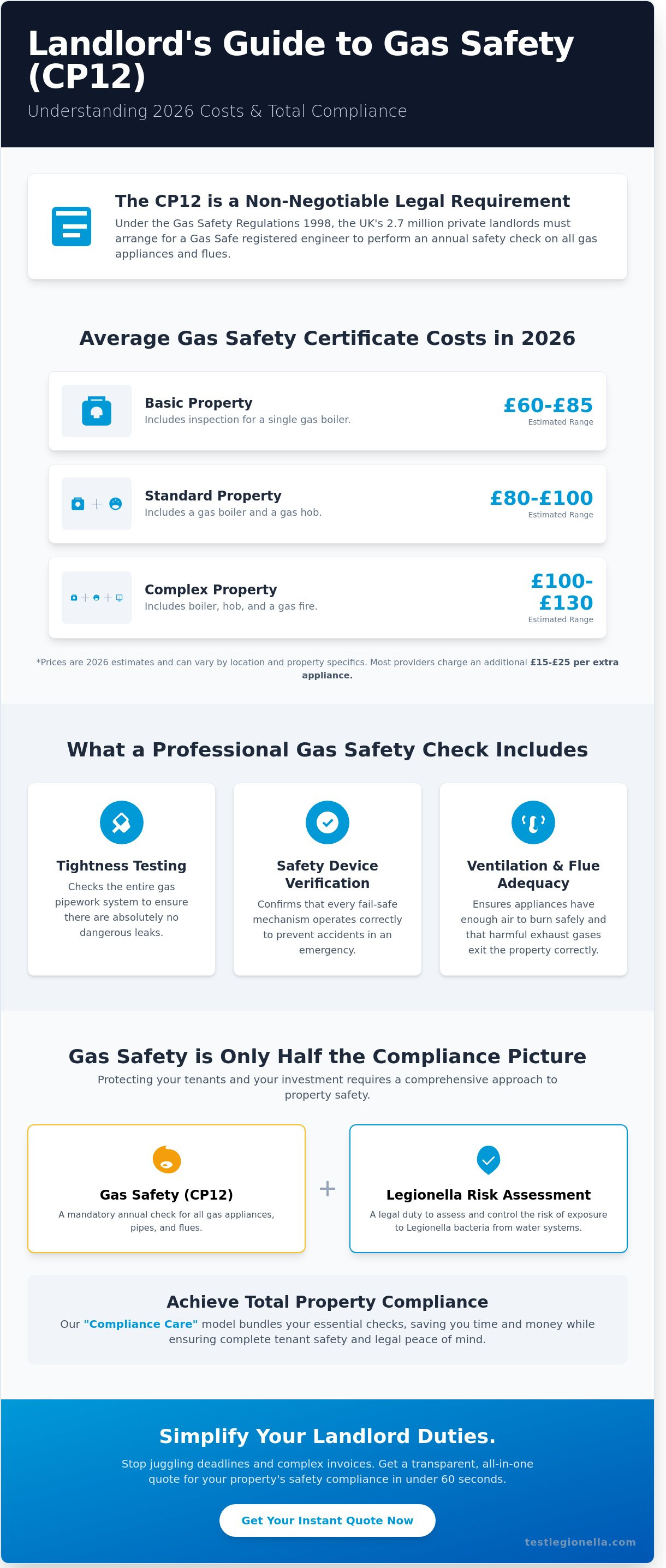
The gas safety certificate cost in 2026 typically ranges from £60 to £120 for a standard residential property. This price reflects the technical expertise required to ensure your property meets every current safety standard. It's vital to distinguish between a safety inspection and a boiler service. While an inspection confirms if the system is safe to operate, a service focuses on mechanical efficiency and internal cleaning. Both are vital for property maintenance, but only the CP12 is a legal mandate for landlords.
What is Included in a Professional Gas Safety Check?
A thorough inspection leaves nothing to chance. Our specialists perform a detailed assessment of all gas appliances, flues, and internal pipework to identify potential risks before they become hazards. This professional process includes:
- Tightness testing: We check the entire gas system to ensure no leaks are present.
- Safety device verification: Every fail-safe mechanism is tested to ensure it operates correctly in an emergency.
- Ventilation adequacy: We confirm that appliances have enough oxygen to burn fuel safely and that exhaust gases exit the property correctly.
Our approach ensures every technical detail is recorded accurately, providing you with a clear and reliable digital report.
Average Price Benchmarks for 2026
Pricing varies based on the number of appliances within your property. For a single-appliance home, such as a modern flat with only a boiler, the gas safety certificate cost often sits between £60 and £85. Properties with multiple gas points require more time on-site for technical scrutiny. Typical 2026 benchmarks include:
- Property with boiler and gas hob: £80 to £100.
- Property with boiler, hob, and gas fire: £100 to £130.
Most industry providers charge a base fee for the first appliance and then apply a standard "per appliance" add-on fee of approximately £15 to £25 for each additional gas point. Managing your compliance correctly from the start saves you from the stress of last-minute renewals. Get my quote today to see how we simplify your annual inspections.
Key Factors That Influence Your Gas Safety Quote
Calculating your gas safety certificate cost isn't as simple as looking at a single price list. Every property has a different footprint, and engineers base their quotes on the time and technical skill required to ensure every pipe and pilot light is safe. Most professionals move away from flat fees because a studio apartment and a five-bedroom detached home present entirely different workloads. Your final quote depends on the physical layout of your gas system and the specific risks involved.
The number of appliances is the most significant variable. A standard inspection usually covers a single boiler, but each additional item, such as a gas hob, a water heater, or a living room fire, adds to the bill. Engineers must perform individual pressure tests and safety checks on every unit to verify they're burning fuel correctly and venting exhaust gases safely. If you have four gas appliances instead of one, expect the inspection time to double. It's a matter of thoroughness; skipping a single hob burner could lead to a carbon monoxide risk later.
Engineer expertise also dictates the price. You're paying for a Gas Safe Register accreditation, which is the only legal way to obtain a valid certificate. Highly experienced engineers often charge a premium because they provide a higher level of "Compliance Care," ensuring your documentation is airtight for insurance purposes. Don't be tempted by cut-price offers from unverified tradespeople. A cheap certificate that doesn't meet legal standards is a waste of money and puts your tenants at risk.
Ease of access is another hidden factor. If your gas meter is tucked away in a cramped crawl space or your flue runs through a ceiling void without visible inspection points, the engineer will spend more time on-site. Difficult access increases the labor cost. It's often more cost-effective to make these areas accessible before the engineer arrives to keep the hourly rate manageable.
Residential vs. Commercial Property Pricing
Commercial certificates involve a much higher level of complexity than domestic ones. Systems in warehouses, offices, or large retail units often use high-capacity meters and complex pipework that require specialist testing equipment. Commercial kitchen equipment is particularly demanding; engineers must check interlock systems and ventilation flow rates to prevent gas buildup in high-heat environments. For landlords managing Houses in Multiple Occupation (HMOs), the regulatory burden is even higher. You can find the specific legal requirements for these properties in the official government guidance provided by the HSE. Because the risks are greater in shared or high-traffic buildings, the time spent on-site increases, which naturally pushes up the price.
Additional Maintenance Costs to Consider
The inspection is a diagnostic process. If an engineer finds an appliance that is "At Risk" (AR) or "Immediately Dangerous" (ID), they're legally required to rectify the issue or disconnect the supply. These repair costs are separate from the certificate fee. You might also face charges for replacement parts like thermocouples or seals. If a property fails the initial check, you'll likely pay for a re-test once the repairs are finished. One common upfront expense for modern properties is the installation of flue inspection hatches. If your flue is hidden behind a wall, the engineer can't certify it without these hatches, so adding them early saves you from a failed inspection. To stay ahead of these requirements, you can get your compliance quote and start planning your maintenance schedule today.
Gas Safety vs. Legionella: The Total Compliance Picture
Most landlords track the gas safety certificate cost with precision, yet many overlook the other silent risk hiding in their properties. While gas leaks present an immediate and explosive danger, water-borne bacteria like Legionella pose a slower but equally lethal threat. Effective property management requires a dual approach to safety. You cannot protect your tenants or your investment by focusing on only one utility. Gas safety is only half of the compliance coin; the other half is water hygiene.
Understanding what is Legionella is the first step toward achieving full compliance. Unlike the annual Gas Safety Record (CP12), water safety assessments follow a periodic schedule. Most industry experts recommend a professional review every two years or whenever the water system undergoes a significant change, such as a boiler replacement or a long period of vacancy. Ignoring this creates a massive legal loophole. If a tenant falls ill from a contaminated showerhead, proving you checked the gas pipes will not save you from a water safety prosecution.
Your Legal Duties Under ACOP L8
The Health and Safety Executive (HSE) provides clear instructions through the ACOP L8 guidelines for UK property owners. These rules state that anyone in control of a premises has a duty to identify and assess sources of risk. Landlords are legally responsible for preventing bacteria growth in domestic water systems just as strictly as they prevent carbon monoxide poisoning. Landlords hold a non-delegable duty of care to ensure that the water systems within their properties are managed and maintained to prevent the growth of harmful bacteria.
The Benefits of Bundling Compliance Services
Managing multiple contractors is a logistical headache that often leads to missed deadlines. Smart landlords are now bundling their safety checks to streamline operations and protect their margins. This integrated approach is what we call Compliance Care, and it makes property management significantly easier.
- Reduce tenant fatigue: Scheduling a gas engineer and a water safety specialist on the same day minimizes disruption for your residents.
- Administrative savings: You deal with one point of contact, one invoice, and one digital portal for all your safety certificates.
- Legal protection: Integrated reporting provides a much stronger defense in legal proceedings, showing a proactive and organized approach to safety.
When you calculate your total gas safety certificate cost for 2026, factor in the administrative time saved by handling water safety simultaneously. It is the most efficient way to move from a state of risk to a state of total peace of mind. Our local experts specialize in making this process fast, reliable, and clear for every type of property owner.
How to Save on Compliance Without Cutting Corners
Managing your gas safety certificate cost effectively requires a shift from reactive spending to proactive protection. While the temptation to choose the lowest quote is high, cutting corners often results in a 200% increase in long-term expenses through fines or emergency repairs. Professional compliance management ensures you aren't just buying a piece of paper; you're securing your property's legal standing and tenant safety.
The Danger of Cheap Certificates
Unverified engineers often provide "ghost" certificates that carry no legal weight. If a gas-related incident occurs, your landlord insurance provider will likely reject your claim if the engineer wasn't on the Gas Safe Register. This leaves you liable for 100% of the damages. High-quality compliance is similar to professional lab analysis in water testing. It's an investment in accuracy that prevents catastrophic legal failures. Using a specialist ensures every check is rigorous, keeping you on the right side of the Gas Safety (Installation and Use) Regulations 1998.
Proactive Maintenance Strategies
Failed inspections drive up the total gas safety certificate cost because they require re-visits and secondary labor charges. You can avoid these setbacks by implementing a few simple habits:
- Tenant Communication: Encourage tenants to report minor issues, like yellow pilot lights or unusual noises, before the annual check.
- Annual Servicing: Combining your safety check with a full boiler service extends appliance lifespan. A 2025 industry survey indicated that serviced appliances have a 40% lower failure rate during compliance checks.
- Pre-Inspection Checklists: Ensure the engineer has clear access to the gas meter, boiler, and all appliances. Removing clutter before they arrive saves billable time.
Digital record-keeping is another vital tool for the modern landlord. Losing a physical certificate can lead to expensive last-minute replacements. By using a partner that offers digital storage, you can retrieve documents in seconds during a local authority audit. Our Compliance Care approach makes this process seamless by tracking your expiry dates for you.
Automated renewal reminders are the final piece of the puzzle. Missing your deadline by even 24 hours puts you in breach of the law. Systems that alert you 30 days in advance allow you to book engineers during off-peak periods, often securing better rates and ensuring you never face the stress of an expired certificate.
Protect your investment and stay compliant with our expert support. Get My Quote today and experience compliance made easy.
Professional Compliance Management with Test Legionella
Managing property safety shouldn't feel like a full-time job. Test Legionella simplifies the regulatory landscape by providing a single point of contact for your essential health and safety requirements. Our Compliance Care model moves beyond basic tick-box exercises. It's a proactive service that tracks your renewal dates and manages the logistics of site visits, so you don't have to worry about missing a deadline. We operate with a national reach, providing professional, authoritative reporting that stands up to the highest levels of scrutiny from local authorities and insurers.
While understanding the gas safety certificate cost is a vital part of your 2026 budget, the true value lies in the quality of the assessment. When you calculate your total gas safety certificate cost, consider the efficiency of a combined service. We bridge the gap between gas and water safety, ensuring your property meets all legal standards seamlessly. By consolidating these services, you reduce the number of contractors entering your property and ensure that all safety documentation is stored in one accessible, professional format. Our team acts as a trusted specialist, transforming a complex legal burden into a sense of total security.
Our Compliance Care Methodology
Time is a critical asset for landlords. Every day a property sits empty because of pending paperwork is a day of lost revenue. We solve this problem with fast turnaround times, often delivering comprehensive digital reports within 24 hours of an inspection. This speed helps you keep your property on the market and occupied without unnecessary delays. Our approach is never one-size-fits-all. We offer tailored solutions for residential landlords with single units and commercial business owners managing large-scale operations across the UK. Working with a specialist means you benefit from deep technical knowledge, ensuring every risk assessment is clear, reliable, and actionable.
Get Your Compliance Score Today
Uncertainty is a risk you can't afford in property management. We've developed free digital tools to help you identify gaps in your current safety strategy before they become legal issues. Use our online diagnostic to find out your compliance score today. It's a simple way to see where your documentation stands and what steps you need to take next to protect your investment. After identifying your needs, you can book a professional assessment with just a few clicks. Our team is ready to provide a bespoke national quote that fits your specific requirements. Reach out to our experts today and experience compliance made easy.
Secure Your Property Compliance for 2026 and Beyond
Navigating property regulations doesn't have to be a source of constant stress for UK landlords. By staying ahead of your 2026 requirements, you protect both your tenants and your long-term investment. Understanding the current gas safety certificate cost allows for precise financial planning while avoiding the heavy penalties associated with non-compliance under the Gas Safety (Installation and Use) Regulations 1998. Our team provides UK-wide professional testing and serves as an expert Legionella and water safety specialist. We handle the technical details so you can focus on managing your portfolio efficiently.
Our detailed compliance reporting is made easy, ensuring you have every document ready for local authority inspections or insurance audits. We've built our reputation on reliability and clear communication, transforming a complex regulatory burden into total peace of mind through our dedicated Compliance Care. Don't leave your property safety to chance when professional support is available across the country. We're ready to help you streamline your safety checks and secure your legal standing today.
Get My Professional Compliance Quote Today
Frequently Asked Questions
Is a Gas Safety Certificate a legal requirement every year?
Yes, you must renew your Gas Safety Certificate every 12 months to remain compliant with the law. Under the Gas Safety (Installation and Use) Regulations 1998, landlords are responsible for ensuring all gas appliances and flues are checked annually by a Gas Safe registered engineer. Failure to provide a valid CP12 record can result in fines up to £6,000 or even imprisonment. We recommend booking your inspection 10 to 12 months after the last check to ensure continuous protection.
How much does a Gas Safety Certificate cost for a landlord in 2026?
The gas safety certificate cost typically ranges from £60 to £100 for a standard residential property with two or three appliances. According to 2024 industry benchmarks from Checkatrade, prices vary based on your location and the number of gas points requiring inspection. You'll likely pay more for properties with additional boilers or gas fires. Bundling this service with other safety checks often reduces the total expense and simplifies your annual maintenance schedule.
Do I need a Legionella risk assessment as well as a Gas Safety Certificate?
Yes, you must conduct a Legionella risk assessment in addition to your gas safety checks because they're governed by different laws. While gas safety falls under 1998 regulations, Legionella control is mandated by the Health and Safety at Work Act 1974 and the ACOP L8. Landlords are legally required to identify and assess sources of risk for Legionella bacteria in their water systems. Our Compliance Care service integrates both assessments, ensuring you meet all health and safety obligations without managing multiple contractors.
Can I do my own gas safety check to save on costs?
No, you cannot perform your own gas safety check unless you're a qualified professional on the Gas Safe Register. The law requires a competent, registered engineer to carry out the inspection to ensure all appliances meet strict safety standards. Attempting a DIY check is illegal and invalidates your insurance policies. Using a certified specialist protects your tenants from carbon monoxide poisoning and ensures your property remains fully compliant with UK law.
What happens if my property fails the gas safety inspection?
If your property fails, the engineer will issue a Warning Notice and may disconnect any appliance deemed Immediately Dangerous or At Risk. You're legally obligated to complete the necessary repairs before a pass certificate can be issued. Most engineers provide a detailed report outlining exactly what's required to achieve compliance. Addressing these faults quickly is essential to maintain tenant safety and avoid potential legal action from local authorities.
How long does a gas safety inspection take to complete?
A standard gas safety inspection usually takes between 30 and 60 minutes to complete. The exact duration depends on the number of appliances, such as boilers, hobs, and gas fires, that require testing. Our engineers work efficiently to minimize disruption for your tenants while conducting thorough pressure tests and flue examinations. You'll receive your digital CP12 record shortly after the inspection, making record-keeping simple and stress-free.
Do I need a certificate for an electric-only property?
No, you don't need a Gas Safety Certificate if your property has no gas supply or appliances. However, landlords must still comply with the Electrical Safety Standards in the Private Rented Sector (England) Regulations 2020. This requires an Electrical Installation Condition Report (EICR) every five years. Even without gas, you must still perform a Legionella risk assessment to ensure the water system is safe for your tenants' use.
Who is responsible for paying for the gas safety certificate?
The landlord is legally responsible for paying all costs associated with the gas safety certificate and any subsequent repairs. This is a non-delegable duty, meaning you cannot pass this cost on to the tenant through separate fees or expect them to arrange the inspection. Investing in regular compliance checks is a standard part of property management. It protects your investment and provides the peace of mind that your rental property meets all current safety standards.