
What if the Legionella certificate you just paid for isn't actually a legal requirement? Business owners frequently ask, is legionella testing mandatory for UK businesses 2026, only to find they've been following expensive, incorrect advice. It's frustrating to manage complex water systems while worrying about HSE fines or the fact that Legionnaires' disease remains fatal in 30% of cases. You deserve a compliance strategy that protects your people without wasting your maintenance budget on unnecessary procedures.
This guide provides a definitive answer on your legal obligations for the year ahead. You'll understand why the 2013 ACOP L8 still dictates your actions and how the 472 confirmed cases reported in 2024 are driving stricter regulatory scrutiny. We'll outline a simple roadmap that separates mandatory risk assessments from tactical laboratory testing. This approach ensures your property stays compliant and your conscience stays clear, making water safety management easy and stress-free for your entire team.
Key Takeaways
- Identify the critical distinction between a statutory Legionella risk assessment and tactical microbiological sampling to avoid unnecessary business costs.
- Learn how the ACOP L8 and COSHH legal frameworks work together to define your safety obligations and protect you from HSE prosecution.
- Get a definitive answer to the question, is legionella testing mandatory for UK businesses 2026, and understand the specific triggers that make lab analysis a legal requirement.
- Follow our simple two-step roadmap to establish a written scheme of control that ensures your water systems remain safe and fully compliant.
- Discover how professional Compliance Care removes the technical burden from property owners through expert reporting and proactive maintenance reminders.
Is Legionella Testing Mandatory for UK Businesses in 2026?
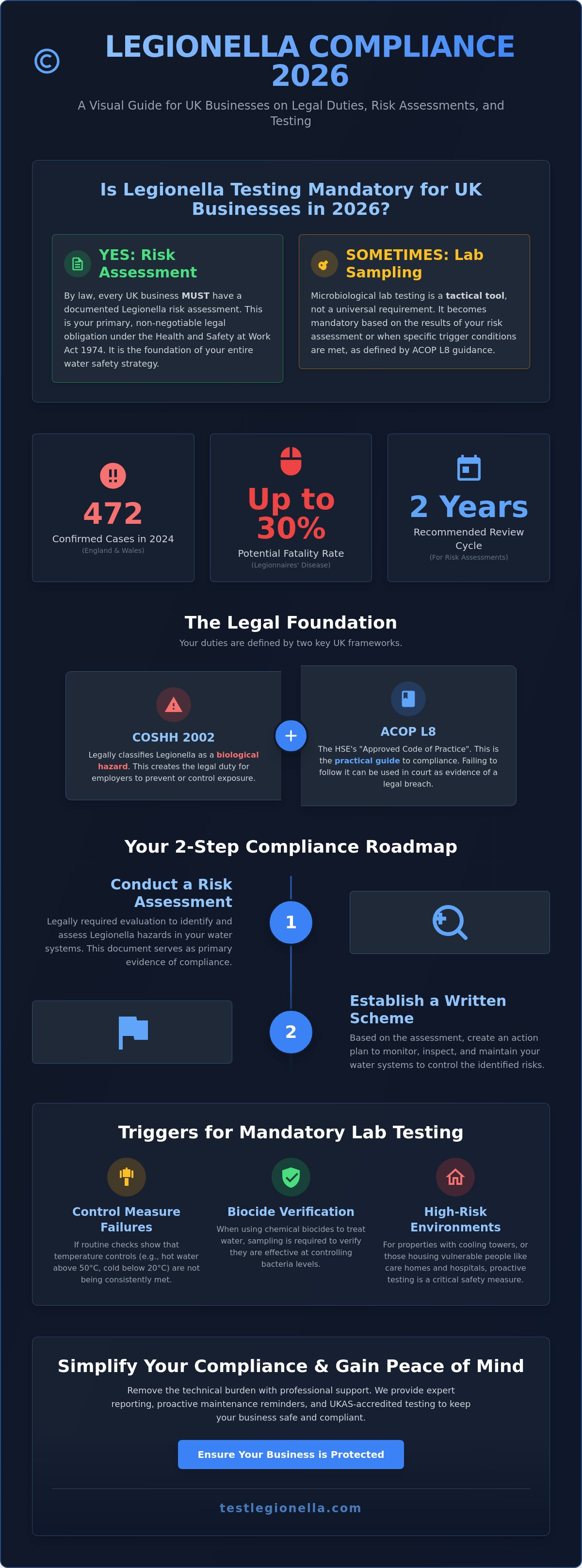
Yes, managing the risk of the Legionella bacterium is a mandatory legal requirement for every business in the United Kingdom. If you operate a commercial premises, you cannot opt out of water safety. The Health and Safety Executive (HSE) remains the primary enforcer in 2026, ensuring that businesses follow the strict guidelines set out in ACOP L8. While the core legislation hasn't changed, the pressure to demonstrate active compliance has increased significantly. You might wonder, is legionella testing mandatory for UK businesses 2026? The answer depends on your definition of "testing." By law, you must conduct a risk assessment. However, sending water samples to a laboratory for microbiological analysis is a tactical decision based on the results of that assessment.
Even if you run a small office with a simple water system, you aren't exempt from these rules. Stagnant water in a single unused tap or a poorly maintained water heater can become a breeding ground for bacteria. In 2024, the UK Health Security Agency reported 472 confirmed cases of Legionnaires' disease across England and Wales. With a fatality rate reaching 30% in some instances, the HSE treats compliance as a non-negotiable public health obligation. They expect every business to have a clear, actionable plan to prevent an outbreak.
The Statutory Requirement for Risk Assessments
Every business premises must have a documented Legionella risk assessment. This isn't just a "best practice" recommendation; it's a legal pillar. This document serves as your primary evidence that you've identified potential hazards and implemented necessary controls. In 2026, you should review your assessment at least every two years to ensure it reflects your current water usage. If you've modified your plumbing or changed how you use your building, you must update it immediately to stay protected. Under the Health and Safety at Work Act 1974, the Duty Holder is legally responsible for identifying and managing risks to health and safety, including the control of Legionella in water systems.
Microbiological Testing: Mandatory or Recommended?
Laboratory testing, often called microbiological sampling, isn't mandatory for every single water outlet in your building. It's a specific tool used when certain triggers occur. According to ACOP L8, you must test your water if your control measures, like temperature monitoring, are consistently failing. You'll also need it if you're using biocides and need to verify their effectiveness. For high-risk environments like care homes or hospitals, proactive sampling is considered the gold standard for safety. When asking is legionella testing mandatory for UK businesses 2026, remember that the law prioritizes the risk assessment as your primary defense. However, sampling provides the ultimate peace of mind that your water is safe for everyone.
Understanding the Legal Framework: ACOP L8 and COSHH
UK health and safety law doesn't treat water safety as a suggestion. Under the Control of Substances Hazardous to Health (COSHH) Regulations 2002, Legionella is classified as a biological hazard. This classification means you have a specific legal duty to prevent or control exposure to the bacteria. The ACOP L8 guidance acts as the bridge between these high-level regulations and your daily operations. While the code of practice itself isn't a law, it has special legal status. If you're prosecuted for a health and safety breach, proving you failed to follow the ACOP is often enough for a court to find you guilty.
Many owners still ask, is legionella testing mandatory for UK businesses 2026, but they often overlook that compliance is about the process, not just a single test result. Claiming you didn't know the rules won't protect you during an HSE inspection. The inspectors look for a continuous chain of responsibility and documented evidence. If you're feeling overwhelmed by the technical requirements, seeking professional compliance support can help you navigate these complex legal waters safely.
The Role of the Duty Holder and Responsible Person
The law requires clear accountability. The "Duty Holder" is typically the employer or the person in control of the premises. They carry the ultimate legal weight. However, they must appoint a "Responsible Person" to manage the day-to-day control measures. This individual must be competent, meaning they have sufficient knowledge and training to perform the role. Because internal staff often lack the specialized equipment or technical depth required, many businesses appoint external specialists to ensure their ACOP L8 compliance is objective and thorough.
Health and Safety at Work Act 1974 Obligations
Your duties extend beyond your own staff. Sections 2 and 3 of the 1974 Act mandate that you protect both your employees and any members of the public who might be affected by your business activities. This includes visitors, contractors, or even passers-by if your systems create aerosols. Water safety is a core component of providing a "safe environment" as defined by this act. In 2026, company directors can face unlimited fines and criminal prosecution, including imprisonment, if a failure to manage Legionella risks leads to a preventable death.
Risk Assessment vs. Microbiological Sampling: What Do You Need?
Monitoring temperatures isn't the same thing as testing for bacteria. Many stakeholders ask is legionella testing mandatory for UK businesses 2026 while confusing these two distinct processes. Think of your risk assessment as the "brain" of your water safety plan. It dictates every action you take. While regular temperature checks are a standard part of monitoring, microbiological sampling is a deeper diagnostic tool. You don't always need to sample every tap, but you must have a logic-driven plan that explains why you chose a specific monitoring strategy.
For certain high-risk systems, lab testing is non-negotiable. If your business operates cooling towers or evaporative condensers, the law requires regular sampling because these systems create fine aerosols that can spread bacteria over several miles. Similarly, healthcare settings and care homes must prioritize sampling due to the vulnerability of their occupants. According to UK government guidance on Legionnaires' disease, older adults over 60 accounted for 64% of cases in 2024. This data highlights why your risk assessment must be used to determine a sampling frequency that actually reflects the danger level of your specific property.
When Lab Sampling Becomes a Legal Requirement
There are specific triggers where lab analysis moves from "recommended" to "mandatory" under ACOP L8. If your temperature control measures are consistently failing, or if your water system has been "out of control" for a period, you must test. Sampling is also required immediately following a suspected outbreak or when you're verifying the effectiveness of a new water treatment regime. Always ensure you use a UKAS-accredited laboratory for these tests. While some companies offer "DIY" dipslides, these are often insufficient for commercial compliance because they lack the sensitivity and legal validity required to satisfy an HSE auditor during an inspection.
The Myth of the "Legionella Certificate"
It's a common misconception that the government issues an official "Legionella certificate" for businesses. In reality, no such document exists. What you actually need is a professional compliance report. This document must include a detailed asset register, a list of identified risks, and a clear written scheme of control. To help you budget for these requirements, we've compiled a guide on Legionella risk assessment costs which shows that small commercial properties typically pay between £200 and £600 for a thorough report. Investing in a professional document ensures you have the evidence needed to prove your business is protected legally and operationally.
The 2026 Compliance Roadmap: Steps to Ensure Business Safety
Achieving total water safety doesn't have to be a logistical nightmare. While you've likely asked is legionella testing mandatory for UK businesses 2026, the real question is how you manage the identified risks daily. You need a structured approach that moves from initial assessment to ongoing maintenance. This roadmap provides that clarity, transforming a complex regulatory burden into a manageable routine. Following these five steps ensures you remain protected from both biological hazards and legal repercussions.
- Step 1: Risk Assessment. Commission a professional to identify dead legs, stagnant outlets, and temperature issues. This document is the foundation of your safety strategy.
- Step 2: Written Scheme of Control. Implement a plan based on your assessment findings. This document acts as your operational manual, detailing exactly what needs to be done.
- Step 3: Monitoring and Flushing. Establish a rigorous regime. If a tap or shower isn't used at least once a week, it must be flushed for several minutes to prevent stagnation.
- Step 4: Compliance Logbook. Maintain a rigorous record of every check. Whether digital or physical, this is your primary evidence during an audit.
- Step 5: Regular Review. Building usage changes constantly. With hybrid working models remaining popular in 2026, you must re-assess your system if occupancy levels shift significantly.
You can streamline this entire process by choosing a specialist partner. Get your water safety sorted today by booking a professional Legionella risk assessment to secure your business's future.
Monthly Monitoring and Sentinel Points
Sentinel points are your diagnostic anchors. You must identify and check the temperature of the water at the outlet nearest to the water heater and the one furthest away. For hot water systems, the water must reach 50°C (or 55°C in healthcare settings) within one minute of running. Cold water should remain below 20°C after two minutes of flow. If you store hot water in a calorifier, it must be kept at 60°C to kill bacteria. Logging these results monthly is a non-negotiable legal requirement under ACOP L8.
Record Keeping and Digital Audit Readiness
Your compliance data is only useful if it's accessible and accurate. UK law requires you to keep Legionella records for a minimum of five years. In 2026, there is a clear shift toward digital compliance tracking. Moving away from paper binders to automated cloud-based systems reduces human error and ensures your data is always audit-ready. If an HSE or Local Authority inspector arrives for an unannounced visit, you should be able to produce your current risk assessment and the last twelve months of temperature logs instantly. Being organized isn't just about safety; it's about demonstrating professional competence.
Simplifying Compliance: How Professional Testing Provides Peace of Mind
Managing water safety alone is a heavy burden for any property owner. By now, you understand that is legionella testing mandatory for UK businesses 2026 is a question of process rather than just a single lab sample. Professional support transforms this from a stressful chore into a seamless part of your operations. Our Compliance Care service handles the technical complexity so you can focus on running your business. We provide proactive reminders and expert analysis that ensure you never miss a deadline or a critical temperature check. This level of organization moves your business from a state of constant risk to one of total reliability.
A specialist report is your strongest defense in any legal dispute. If an inspector or a legal claimant challenges your safety standards, a professional audit trail proves you've taken every reasonable precaution. It demonstrates that you've followed the ACOP L8 guidelines to the letter. This isn't just about avoiding fines; it's about building a culture of safety. Given that Legionnaires' disease can be fatal in as many as 30% of cases, having an expert verify your system is a critical safety measure that protects your reputation and your people.
The Value of Specialist Expertise
Professional assessors identify hazards that are invisible to the untrained eye. For example, a "dead leg" in your pipework or a redundant water heater can harbor bacteria even if your main taps are flushing correctly. Our experts look at the entire system architecture to spot these hidden dangers before they become a problem. Having a third-party audit trail is also vital for your insurance policy. Most commercial insurers require evidence of proactive risk management to validate coverage. Test Legionella simplifies the entire process from your initial quote to the final digital report, ensuring every asset is tracked and every risk is mitigated.
Your Next Steps for 2026 Compliance
Don't wait for an unannounced inspection to find out your records are incomplete. Getting a fast, reliable quote for your business premises is the first step toward total security. Whether you manage a small dental practice or a large hotel, a tailored plan ensures you meet your legal obligations without overspending on unnecessary tests. Compliance is Made Easy when you have a partner who understands the ACOP L8 requirements inside out. Take action today to secure your peace of mind and protect everyone who enters your building.
Secure Your Business Compliance for 2026
Compliance doesn't have to be a source of constant stress. You now understand that while the answer to is legionella testing mandatory for UK businesses 2026 depends on your specific risk profile, the requirement for a professional risk assessment is an absolute legal pillar. By following the roadmap we've outlined, you move from reactive worry to proactive security. Maintaining your five-year audit trail and sentinel point logs ensures you're always ready for an unannounced inspection or a rigorous insurance review.
Our authoritative UK water safety experts are here to simplify the entire process. We provide UKAS-accredited laboratory analysis and comprehensive Compliance Care reports that satisfy both legal auditors and building owners. Let us handle the technical complexities of ACOP L8 so you can focus on your core operations with total confidence. Your safety is our priority, and we're committed to making your regulatory journey as efficient as possible.
Get Your Professional Legionella Compliance Quote Today and discover how easy water safety management can be with the right specialist partner by your side. Take this simple step toward a safer, more reliable future for your business.
Frequently Asked Questions
Is a Legionella risk assessment a legal requirement for small businesses?
Yes, a Legionella risk assessment is a legal requirement for every business premises, regardless of size or employee count. The Health and Safety Executive specifies that even small retail units or offices with simple water systems must have a documented assessment. While the process is simpler for low-risk sites, you must still identify potential hazards to ensure your staff and visitors remain protected. Neglecting this duty can lead to immediate enforcement action during a routine inspection.
How often must a business carry out Legionella testing in 2026?
There isn't a single interval for every property, as the frequency is determined by your specific risk assessment and system type. When asking is legionella testing mandatory for UK businesses 2026, it's important to note that high-risk systems like cooling towers require sampling at least every three months. Most standard commercial systems focus on monthly temperature monitoring rather than constant lab testing unless your control measures fail or you are managing a highly vulnerable population.
Can I carry out my own Legionella risk assessment for my business?
You are legally allowed to conduct your own assessment if you are competent to do so, but this requires specific technical knowledge. Competency means having the ability to identify complex pipework dead legs, understand aerosol risks, and interpret ACOP L8 guidelines correctly. Most business owners appoint a specialist to avoid the risk of missing hidden hazards that could lead to an HSE improvement notice or a failure to comply with insurance requirements.
What are the penalties for non-compliance with Legionella regulations?
Non-compliance can lead to unlimited fines and criminal prosecution for company directors under the Health and Safety at Work etc. Act 1974. The courts have the power to impose custodial sentences if negligence leads to a public health risk or a preventable outbreak. Beyond the legal costs, a single safety breach can cause irreparable damage to your brand's reputation and operational viability, making proactive compliance a critical business investment.
Do I need to test for Legionella if my building is currently empty?
Yes, empty buildings require more frequent management because water stagnation significantly increases bacterial growth. If your premises is vacant, you must implement a weekly flushing regime for all outlets to move water through the entire system. Neglecting an empty building often leads to high bacterial counts that require expensive chemical disinfection before the property can be safely reoccupied. Stagnation is often the primary cause of system-wide contamination.
What is the difference between a Legionella risk assessment and a water sample test?
A risk assessment is a physical inspection of your water system to identify potential hazards, whereas a water sample test is a laboratory analysis for the presence of bacteria. The assessment acts as the master plan for your site safety and is the primary legal requirement. Sampling is a diagnostic tool used to verify that your master plan is working or to investigate a specific problem identified during your monthly temperature monitoring.
Who is legally responsible for Legionella in a rented commercial property?
The Duty Holder is legally responsible, which is typically the employer or the person in control of the premises. In a rented commercial property, the responsibility is often shared between the landlord and the tenant. Usually, the landlord manages the central plant equipment, while the tenant handles the internal outlets and local water heaters. You should check your lease agreement to clarify exactly where your maintenance duties begin and end to avoid compliance gaps.
What should I do if Legionella bacteria are found in my water system?
You must immediately isolate the affected area and implement a disinfection program, typically using high-level chlorination or thermal shock. Once the system is treated, you are required to conduct follow-up sampling to confirm the bacteria has been successfully eradicated. Documenting every step of this remedial action is essential to prove to auditors that you've regained control of the risk. Professional guidance is highly recommended during any positive count scenario.