
In 2024, England and Wales saw 472 reported cases of legionellosis with a case fatality rate of 2.8%. These figures highlight why the Health and Safety Executive (HSE) takes water safety so seriously. If you're searching for a legionella responsible person duties checklist 2026, you're likely feeling the pressure of managing complex systems while trying to avoid the threat of prosecution. It's common to feel buried under ACOP L8 technical jargon or worried that a missed monthly temperature check could result in a massive fine.
We understand that you need clarity, not more confusion. This guide provides the definitive checklist you need to master your legal obligations and achieve total Compliance Care. You'll gain the peace of mind that comes from knowing exactly what to monitor, what to delegate, and how to prove you've met every HSE standard. We'll walk you through the essential 2026 requirements, from ensuring hot water is stored at 60°C to the specific rotation of sentinel outlet checks that keep your building safe.
Key Takeaways
- Understand the legal hierarchy between the Duty Holder and the Responsible Person to ensure clear accountability for your property's safety.
- Master the legionella responsible person duties checklist 2026 to maintain a valid Written Scheme of Control and stay ahead of ACOP L8 requirements.
- Learn how to effectively oversee external contractors while recognizing that legal liability for water safety always remains with the designated Responsible Person.
- Establish a reliable monitoring calendar for weekly flushing and monthly temperature checks to guarantee continuous compliance and resident safety.
- Discover how professional support and independent audits make compliance easy by identifying hidden risks your contractors might miss.
Defining the Legionella Responsible Person Role in 2026
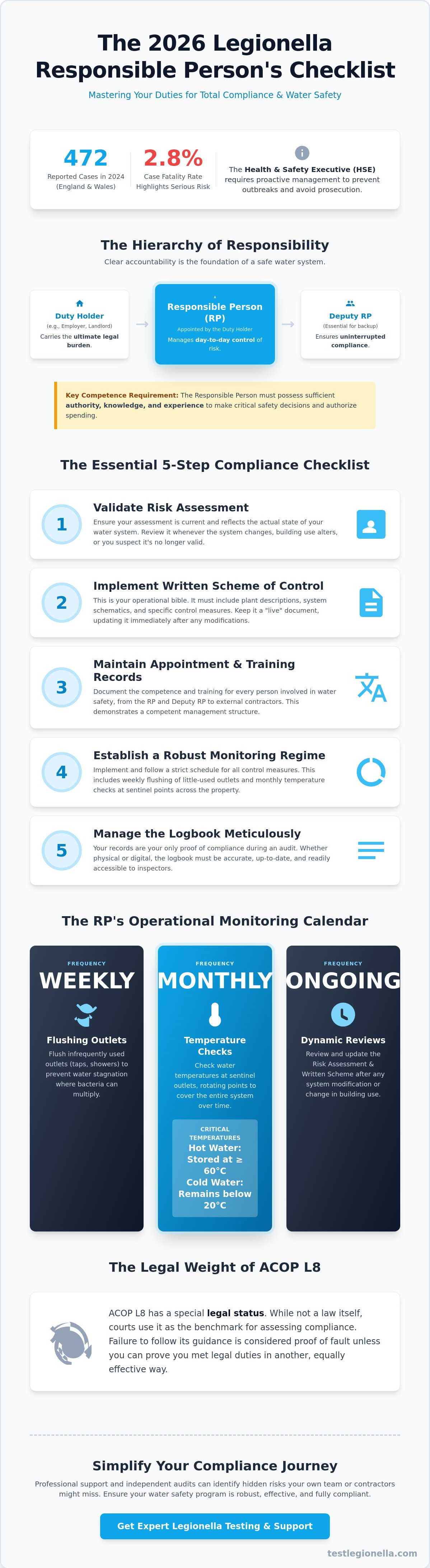
Understanding the hierarchy of safety is the first step in mastering the legionella responsible person duties checklist 2026. Many property owners confuse the roles of the Duty Holder and the Responsible Person, but the law makes a clear distinction. The Duty Holder is typically the employer, landlord, or person in control of the premises. While they carry the ultimate legal burden, they appoint the RP to manage the technical details. The RP is the individual appointed by the Duty Holder to take day-to-day responsibility for controlling Legionella risk. This role is central to preventing What is Legionnaires' disease? from developing in your water systems.
The Health and Safety Executive (HSE) requires that the RP possesses sufficient authority and knowledge. You can't simply pick a name from a staff list; the person must understand the risks and have the power to spend money or halt operations if a system becomes dangerous. In 2026, the focus has shifted from simple box-ticking to demonstrable competence. If an inspector visits, they'll look for evidence that the RP understands the specific layout and risks of your building water system. It's about being proactive rather than just waiting for a test result to come back positive.
Who Can Be Appointed as a Responsible Person?
An effective RP must have an organizational position that allows them to make decisions quickly. They should be competent, which the HSE defines as having the right training, skills, and experience. It is a common mistake to appoint a junior staff member who lacks the authority to act. You must also appoint a Deputy Responsible Person. This ensures that compliance doesn't lapse during holidays or sickness. Without a deputy, a single week of missed flushing could allow bacteria levels to spike, putting your residents or staff at risk.
The Legal Weight of Your Appointment
Your appointment isn't just a corporate title; it carries significant legal weight under the Health and Safety at Work etc. Act 1974. While ACOP L8 isn't a law itself, it has a special legal status. If a case of Legionnaires' disease occurs and you're prosecuted, a court will use ACOP L8 as the benchmark. If you haven't followed its guidance, you'll be found at fault unless you can prove you complied with the law in some other way. By 2026, regulatory bodies have become more focused on proactive management. They prioritize your ability to show a continuous history of safe monitoring over reactive testing after a problem has already been found. Using a professional legionella responsible person duties checklist 2026 ensures you stay on the right side of this benchmark every single day.
The Essential 2026 Legionella Compliance Checklist
To achieve full compliance, you need a structured approach that leaves nothing to chance. Your legionella responsible person duties checklist 2026 begins with five non-negotiable steps designed to align with the HSE Approved Code of Practice (ACOP L8). These steps ensure that your building remains safe and your legal position stays protected. It starts with verification. You must confirm you have a valid, up-to-date Legionella Risk Assessment. While there's no fixed expiry date, the HSE requires a review whenever you suspect the old one is no longer valid. This includes changes to the water system or building use that have occurred since your last inspection.
Once the risks are identified, you must implement a Written Scheme of Control and maintain meticulous appointment records. Every person involved in water safety, from the maintenance team to the Deputy RP, must have their training and competence documented. You then establish a robust monitoring regime. This includes monthly temperature checks at sentinel points and weekly flushing of infrequently used outlets. Finally, management of the logbook is critical. Whether you use a physical folder or a digital system, your records are your only proof of compliance during an audit. If you're concerned about the state of your current records, our team offers legionella compliance testing to help you identify and fix gaps quickly.
The Written Scheme of Control: Your Operational Bible
The Written Scheme of Control is the central document for all RP activities and risk mitigation. It must include detailed plant descriptions, accurate schematics of your water systems, and the specific control measures you've put in place to manage risks. To ensure your scheme remains a "live" document rather than a shelf-filler, update it immediately following any system modifications. In 2026, inspectors expect to see a scheme that reflects the actual, current state of the building plumbing, not a generic template from five years ago.
Documentation and Evidence Trails
HSE inspectors follow a strict rule: if it isn't written down, it didn't happen. You must maintain a clear evidence trail to defend your actions in court. Under current regulations, you are required to keep records of all monitoring, inspections, and treatments for at least 5 years. Records relating to the risk assessment and the written scheme itself must be kept for the entire period they are current, and for at least 2 years after they are replaced. Many businesses are now transitioning to digital logbooks. This shift provides better 2026 compliance visibility, as digital systems can send automatic reminders and provide instant access to reports during an unannounced inspection.
Managing Competence: Delegation and Contractor Oversight
As a Responsible Person, you aren't expected to be a water treatment scientist. However, you are expected to be an effective manager of those who are. While tasks can be delegated, the legal liability remains with the Duty Holder and RP. This means if a contractor fails to perform a monthly temperature check correctly, the HSE will hold you accountable for that failure. Your legionella responsible person duties checklist 2026 must include a process for verifying that your external partners are actually doing what they say they're doing.
The core of compliance lies in the distinction between "doing" the work and "managing" the risk. You might hire a specialist for legionella compliance testing, but you must still review their findings and act on their recommendations. Before hiring any provider, ask them how they ensure site-specific accuracy and how they handle emergency notifications if a sample exceeds 1,000 cfu/litre. A provider who can't explain their escalation process clearly is a risk to your business. You need a partner who understands that their reports are your primary defense in a safety audit.
Auditing Your Service Providers
Don't take a contractor's word for their expertise. Check for UKAS accreditation and membership in the Legionella Control Association (LCA). These certifications provide a baseline of quality, but they don't replace your duty to audit their work. Review their method statements and risk assessments to ensure they've actually looked at your specific pipework. Generic service reports that look the same for every property are a major red flag. These "copy-paste" documents often miss unique "dead legs" or stagnant areas where bacteria thrive, leaving you exposed to both health risks and legal trouble.
Internal Training for On-Site Staff
Not every task requires an external expert. You can train on-site staff for "task competence" in simple areas like weekly flushing or basic temperature monitoring. However, this training must be documented and refreshed regularly. Both the RP and the Deputy RP need a deeper understanding of the entire system to maintain control. For a deeper dive into these requirements, read our guide on ACOP L8 Explained to see how these training standards fit into the broader legal framework. Keeping your team's skills sharp is the best way to ensure your 2026 compliance remains ironclad and your building stays safe.
The RP’s Operational Calendar: Monitoring Frequencies
Consistency is the foundation of water safety. Your legionella responsible person duties checklist 2026 is built around a specific rhythm of tasks that prevents bacteria from colonizing your system. By following a strict operational calendar, you transform a complex legal requirement into a manageable routine. This proactive approach ensures you never miss a critical deadline, keeping your building residents safe and your compliance records spotless. A well-maintained calendar is your best defense against the "drift" that often leads to safety failures.
Your weekly tasks focus on preventing stagnation. You must flush all infrequently used outlets, defined as any tap or shower not used within the last seven days, for at least two minutes. You should also perform a visual check of expansion vessels to ensure they aren't showing signs of leaks or corrosion. Every month, the focus shifts to temperature monitoring at sentinel points. These are the outlets nearest and furthest from your water heater or storage tank. Quarterly, you must descale and disinfect all showerheads and hoses. Finally, your annual duties include a full inspection of cold water storage tanks and a blowdown of the calorifier to remove accumulated sludge and debris.
Temperature Control: The Primary Defence
Temperature is your most effective tool for killing Legionella bacteria. According to HSG274 Part 2, cold water must remain below 20°C after running for two minutes. Hot water must reach at least 50°C within one minute at the outlet, though this requirement increases to 55°C in healthcare premises. If a reading fails, you must take immediate action. This usually involves checking the thermostat on your water heater or investigating "cross-flow" issues where cold water leaks into the hot system. Record every failure and the specific steps you took to fix it; this shows inspectors that you're actively managing the system rather than just recording problems.
Managing Stagnation and Dead Legs
Stagnation is the biggest enemy of any Responsible Person, especially in large, complex buildings. When water stops moving, it loses its residual heat or chemical treatment, creating the perfect environment for biofilm to grow. Dead legs, which are lengths of pipework leading to nowhere, are particularly dangerous. If you've recently modified your plumbing or closed off a section of your building, you need to be certain the water isn't sitting still. In these cases, it's vital to seek professional Legionella testing to verify that your system remains under control. If you're unsure about your current monitoring schedule, book a professional compliance review today to secure your property's safety.
Simplifying Compliance with Professional Support
Managing water safety is a heavy burden that carries life-altering stakes. Using a professional legionella responsible person duties checklist 2026 helps organize your tasks, but expert support removes the final layer of guesswork. An independent audit is invaluable because it identifies gaps your maintenance contractors might miss during their routine visits. While contractors "do" the work, an independent specialist verifies it with a fresh set of eyes. This shift moves you from "Panic Compliance"—the stressful state of reacting to failed tests—to "Compliance Care." Our Midlands-based specialists transform complex regulatory burdens into a sense of security, ensuring you feel protected by experts who understand both the law and the logistics of property maintenance.
When to Review Your Risk Assessment
Many RPs still believe the outdated myth of the "two-year rule" for risk assessments. In reality, the HSE requires a review "regularly" and whenever there's a reason to believe the current assessment is no longer valid. Trigger events include physical changes to the water system, modifications to the building's use, or a change in key personnel like the RP or Duty Holder. For instance, if 25% of your building becomes vacant, the resulting stagnation creates a new risk profile that your old assessment won't cover. If you've recently updated your boiler system or added new outlets, your old assessment is technically obsolete. When planning your annual budget, ensure your 2026 strategy accounts for Legionella risk assessment costs to ensure you're never caught without valid documentation during an inspection.
Peace of Mind Through Expert Testing
Professional sampling provides the ultimate evidence that your control measures are actually working. While temperature monitoring is your primary defense, laboratory analysis confirms that bacteria levels remain below the 100 cfu/litre threshold where systems are considered under control. The Test Legionella approach is designed to be fast, reliable, and tailored to your specific property type. We don't just hand you a stack of data; we provide clear reports and actionable remedial lists that tell you exactly what needs to be fixed. This no-nonsense approach saves you time and ensures your building remains a safe environment for everyone. Don't leave your legal safety or your peace of mind to chance. Get your professional Legionella compliance quote today and let us help you make water safety easy.
Secure Your Compliance Strategy for 2026
Mastering your role as a Responsible Person means moving beyond basic awareness toward a structured, proactive management system. You now understand the critical hierarchy of safety and the importance of maintaining an operational calendar that tracks everything from weekly flushing to annual tank inspections. Using a comprehensive legionella responsible person duties checklist 2026 ensures that no monitoring task slips through the cracks, protecting both your residents and your legal standing. Compliance isn't a one-off event; it's a continuous cycle of care that requires precision and reliable data.
We provide the expert guidance you need to simplify ACOP L8 duties and transform complex regulations into manageable steps. Our team offers UKAS-accredited laboratory testing and delivers comprehensive compliance reports fast, so you always have the evidence required for an HSE audit. Don't let the weight of technical jargon or the fear of a missed inspection slow you down. Ensure your 2026 compliance with a professional Legionella Risk Assessment today. You've now got the knowledge to manage your water systems with confidence and total peace of mind.
Frequently Asked Questions
Is the Responsible Person legally liable for a Legionella outbreak?
Yes, the Responsible Person can be held legally liable under the Health and Safety at Work etc. Act 1974 if they fail to perform their duties. While the Duty Holder often carries the ultimate burden, the RP is responsible for the day to day management of the system. Failure to follow the guidance in ACOP L8 can be used as evidence in court to prove a breach of safety laws.
Can a landlord be their own Legionella Responsible Person?
A landlord can act as their own Responsible Person if they have the knowledge to identify and manage risks. This is common for owners of single residential properties where the water system is simple. However, they must still follow a legionella responsible person duties checklist 2026 to ensure they don't miss statutory tasks like temperature monitoring or risk reviews. It's about being competent, not just being the owner.
How much training does a Responsible Person need to be considered "competent"?
Competence is defined by the HSE as having sufficient training, skills, and experience rather than a specific number of training hours. You must understand the technical requirements of HSG274 and be able to identify potential hazards in your specific system. Regular refresher training, typically every 2 years, is a standard industry benchmark to maintain this competence and stay updated on current safety standards.
What happens if a Responsible Person leaves the business without a replacement?
If an RP leaves without a replacement, the legal responsibility reverts immediately to the Duty Holder. This creates a high risk gap in your safety management that could lead to non-compliance. This is why the HSE recommends appointing a Deputy Responsible Person to ensure continuous cover. Having a deputy prevents missed monitoring tasks during personnel transitions and keeps your building safe.
Do I need a "Legionella Certificate" to prove I am a competent RP?
There is no single legal "Legionella Certificate" required by law to prove competence. Instead, your competence is proven through documented training records, a thorough Written Scheme of Control, and a history of consistent monitoring. An inspector will look at your actions and records rather than a piece of paper on the wall. Compliance is demonstrated through your daily management and attention to detail.
Can I delegate all my Legionella duties to a water treatment company?
You can delegate physical tasks like sampling and descaling to a water treatment company, but you cannot delegate your legal liability. The RP must still oversee the contractor's work and review all reports to ensure they are accurate. Using a legionella responsible person duties checklist 2026 helps you manage these external partners effectively while keeping your business protected from regulatory failures.
What is the most common mistake the HSE finds in RP logbooks?
The most frequent mistake found in logbooks is the failure to document remedial actions after a failed temperature reading. It's not enough to record a low temperature; you must also record exactly what you did to fix it. Gaps in weekly flushing records for vacant areas are another common reason for HSE intervention. Clear, consistent documentation is the only way to prove your system is under control.
How often should the Responsible Person audit the Written Scheme of Control?
You should audit your Written Scheme of Control at least once every 12 months to ensure it still reflects the building's layout. You also need an immediate review if there are significant changes, such as a 15% increase in pipework or a change in building use. This ensures your safety plan remains a live document that actually protects people rather than just being an outdated file in a cabinet.