Could a single overlooked tap lead to a £20,000 fine and a legal nightmare? Since the start of 2024, local authorities across the East Midlands have ramped up inspections, reinforcing that a professional legionella risk assessment for landlords Nottingham is a non-negotiable legal requirement. We understand that managing a portfolio in the city is demanding, and the fear of missing a critical safety check often keeps property owners awake at night. It's a heavy responsibility to carry when you're already balancing maintenance and tenant needs.
You deserve a process that's straightforward and reliable, not a mountain of confusing paperwork. This guide explains how our Compliance Care approach ensures you meet every legal requirement without the usual stress. We'll show you exactly how to secure total legal protection for 2026 through clear reports and a fast, hassle-free assessment process. From technical details to actionable advice, we make property safety easy so you can get back to what you do best.
Key Takeaways
- Master your legal obligations under ACOP L8 and the Health and Safety at Work Act 1974 to ensure your property remains fully compliant.
- See how a professional legionella risk assessment for landlords Nottingham identifies hidden water system hazards that generic DIY templates often miss.
- Learn how to calculate compliance costs for 2026 and why investing in expert surveys is far more cost-effective than facing potential HSE fines.
- Uncover the technical steps of a professional inspection, including precise temperature monitoring and outlet mapping for complete tenant protection.
- Discover the "Compliance Care" philosophy that delivers fast, easy-to-read reports and long-term peace of mind through proactive safety management.
Legal Obligations for Landlords: Navigating ACOP L8 and Health Safety
Keeping tenants safe isn't just a moral choice; it's a strict legal mandate. Under the Health and Safety at Work Act 1974, landlords in Nottingham must ensure the health and safety of their tenants by identifying and controlling risks. This includes managing the threat of Legionnaires' disease. The Health and Safety Executive (HSE) provides the L8 Approved Code of Practice (ACOP) to guide this process. ACOP L8 isn't a mere suggestion. If you're prosecuted for a breach of health and safety law, failing to follow this code will be used as evidence against you in court. It provides the framework for a robust legionella risk assessment for landlords Nottingham, ensuring your property remains compliant and your tenants stay protected.
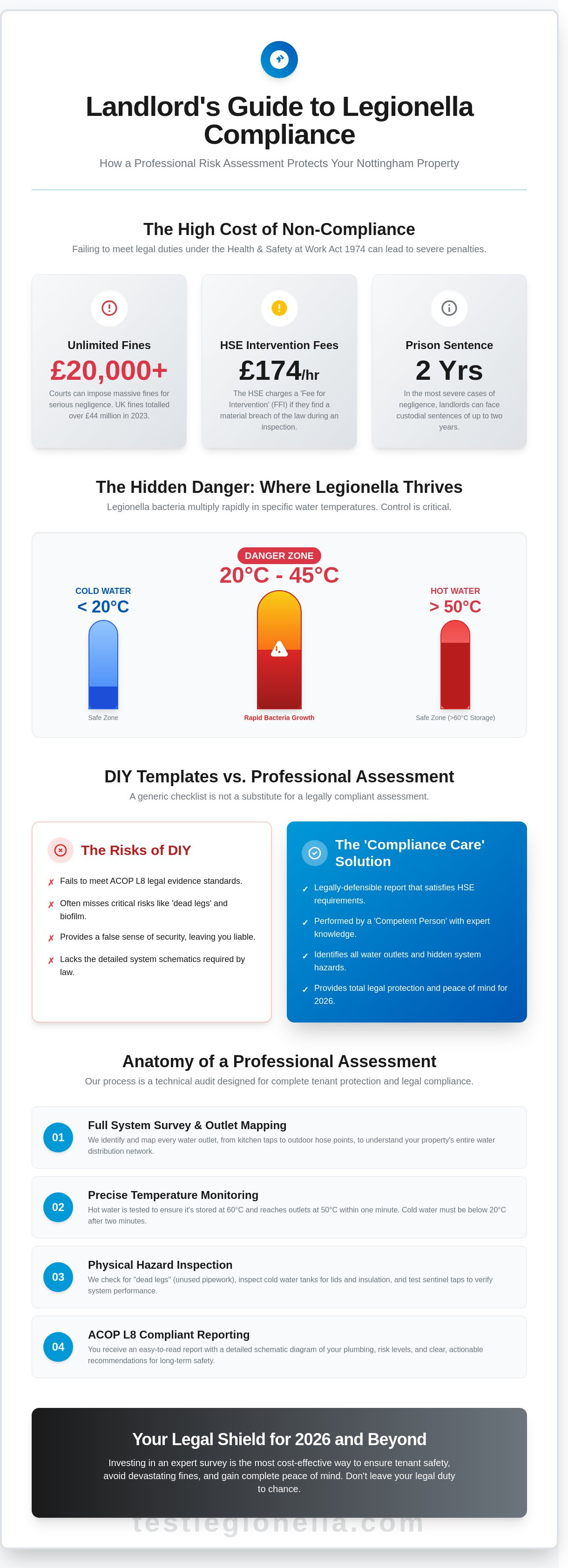
As the property owner, you are legally defined as the 'duty holder'. This means the responsibility for water safety cannot be ignored or shifted. The consequences of non-compliance are severe and immediate. Under the Health and Safety (Fees) Regulations 2012, the HSE can charge a 'Fee for Intervention' (FFI) of £174 per hour if they find a material breach of the law. For serious negligence, courts can impose unlimited fines or even prison sentences of up to two years. In 2023 alone, UK health and safety fines totalled over £44 million, proving that regulators are increasingly active in enforcing these standards.
Who is Responsible for Legionella Safety?
You cannot delegate your legal liability to a tenant through a standard tenancy agreement. While you can hire a 'Competent Person' to perform the physical inspections, the legal accountability stays with you. A competent person must have the specific skills, knowledge, and experience to spot hazards that an untrained eye would miss. This role is vital for maintaining a safe water system. For a deeper look at these requirements, visit our ACOP L8 guide to see how compliance has evolved for 2026.
The Duty of Care for Residential Properties
Small domestic properties are just as susceptible to bacteria growth as large commercial buildings. Any system that creates water droplets, such as a showerhead or a kitchen tap, poses a risk. You must ensure hot water is stored at 60°C and reaches outlets at 50°C within one minute. Understanding what Legionella is helps you recognise why stagnant water in a vacant flat is a major hazard. Booking a professional legionella risk assessment for landlords Nottingham is the most efficient way to prove you've met your duty of care and secured your property against these risks.
What to Expect During a Professional Legionella Risk Assessment
A professional legionella risk assessment for landlords Nottingham properties require is a technical audit, not a simple walk-through. The process begins with a comprehensive site survey where an assessor identifies every water outlet, from kitchen taps to outdoor hose points. We don't just look at what's visible; we map the entire distribution network to understand how water flows through your building and where it might stagnate.
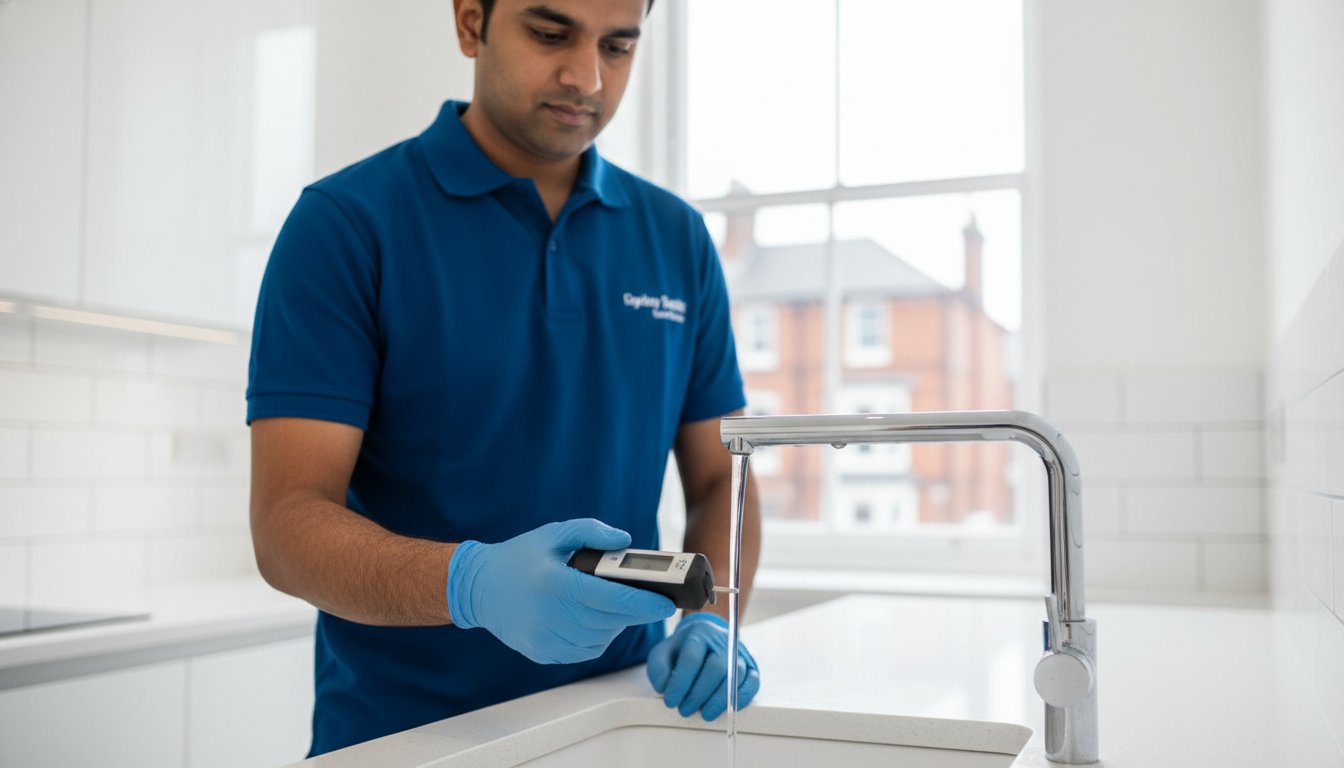
During the visit, our specialists conduct precise temperature testing at the calorifier and various distribution points. We check that hot water is stored at 60°C and reaches outlets at a minimum of 50°C within 60 seconds. Cold water must remain below 20°C after two minutes of running. These specific benchmarks are vital because Legionella bacteria thrive between 20°C and 45°C. By confirming your system operates outside this range, we provide the first layer of your Compliance Care protection.
The Site Inspection Process
Assessors pay close attention to "dead legs," which are lengths of pipework leading to closed outlets or removed appliances. These areas allow water to sit still, creating a primary breeding ground for biofilm. We also perform a rigorous visual inspection of cold water storage tanks. We ensure they have tight-fitting lids, insect screens, and adequate insulation to prevent thermal gain. Testing "sentinel" taps, the outlets closest and furthest from the water source, allows us to verify the system's overall thermal performance quickly and accurately.
Understanding Your Compliance Report
A professional report is your primary shield against legal liability. Unlike a basic checklist, a Test Legionella report includes a detailed schematic diagram of your plumbing system, as required by the ACoP L8 guidelines. It provides a clear executive summary that highlights any "High" or "Medium" risks that need immediate attention. When booking the legionella risk assessment for landlords Nottingham specialists provide, you receive a document that stands up to scrutiny from local authorities or insurance providers. This document acts as your formal evidence of compliance, proving you've met your duty of care under the Health and Safety at Work Act 1974.
If you're unsure whether your current documentation meets these 2026 standards, you can check your compliance score online to identify any gaps in your records. Our goal is to transform this regulatory requirement into a straightforward, manageable asset for your property portfolio.
Calculating the Cost of Legionella Compliance in 2026
Budgeting for safety is a priority for every property owner. While some view it as a simple box-ticking exercise, a professional legionella risk assessment for landlords Nottingham is a strategic investment in your asset's health. In 2026, the average cost for a domestic assessment in the Midlands ranges from £85 to £200. This variability depends on the scale of the water system and the specific property type. Choosing a cheap, £30 "downloadable template" might seem tempting, but these often fail to meet the rigorous standards set by ACoP L8 and HSG274. Inadequate assessments leave you legally exposed to HSE fines that can exceed £20,000 for serious breaches of the Health and Safety at Work Act 1974.
Factors Influencing Your Quote
Domestic properties with simple combi-boiler systems are the most straightforward to assess. Prices increase when complexity enters the frame. For example, a 6-bedroom HMO in Lenton with multiple bathrooms and a cold water storage tank requires significantly more time on-site than a modern studio flat in Nottingham City Centre. We look at three main variables:
- System Complexity: Properties with water storage tanks, calorifiers, or secondary return circuits require detailed schematic mapping.
- Number of Outlets: Every tap, shower, and toilet is a potential risk point that must be inspected.
- Portfolio Size: We offer fixed-fee services for portfolio landlords. Managing 10 or more properties under a single "Compliance Care" agreement can reduce your per-property cost by 15% through streamlined logistics.
Long-term Savings Through Compliance
Proactive management prevents the need for expensive emergency interventions. A professional assessment often identifies "dead legs" or redundant pipework early. Removing a dead leg for £75 is far more economical than a full system disinfection, which frequently costs over £1,200 if bacteria levels spike. Clear documentation also protects your financial interests in other ways.
Insurance providers are becoming stricter. By January 2026, 85% of leading UK insurers required evidence of a valid legionella risk assessment for landlords Nottingham before renewing public liability policies. Without this paper trail, you risk a voided policy during a claim. Our managed schedule takes the pressure off your shoulders. We track your renewal dates and provide automated reminders 60 days in advance, ensuring you never lapse into non-compliance. It's a professional partnership that transforms a complex legal burden into a simple, manageable routine.
DIY vs Professional Assessments: Why Templates Pose a Significant Risk
Many property owners assume that a simple checklist satisfies their legal obligations. While the Health and Safety Executive (HSE) permits landlords to conduct their own assessments if they are "competent," this definition is a high bar to meet in a courtroom or during a council audit. A professional legionella risk assessment for landlords Nottingham provides more than just a tick-box exercise. It offers technical certainty that a generic £10 online template simply cannot replicate.
Templates lack the site-specific nuance required to identify biological hazards unique to your plumbing. A standard form won't tell you if a hidden "dead leg" in an 1890s Victorian conversion in Lenton is harbouring dangerous biofilm. Professional assessors carry Professional Indemnity insurance, typically valued between £2 million and £5 million. This insurance transfers the professional liability from the landlord to the specialist. Without it, you are personally responsible for every health outcome and legal failing associated with the property's water system.
The Limitations of Self-Assessment
Landlords frequently overlook critical risk factors that aren't immediately visible to the untrained eye. Stagnant water in a guest en-suite or a rarely used cloakroom provides the perfect breeding ground for bacteria if temperatures sit between 20°C and 45°C. Professional assessments involve technical steps that DIY attempts usually miss:
- Digital Temperature Calibration: We use industrial-grade probes to ensure hot water reaches at least 50°C within one minute at every outlet to kill bacteria.
- Mandatory Schematic Mapping: We create a formal diagram of the water system, which is a legal requirement under ACOP L8 that most DIY landlords fail to produce.
- Aerosol Risk Identification: Our experts evaluate showerheads, spray taps, and even outdoor hoses that create breathable droplets, which is the primary route of infection.
Why HSE Prefers Professional Documentation
If a tenant falls ill, the HSE or local authorities will scrutinise your records with extreme detail. An independent, third-party report carries significantly more weight in a legal dispute than a self-signed document. Professional reports are structured to align exactly with HSG274 guidelines, making the audit process for Nottingham City Council licensing schemes efficient and stress-free.
Experts use calibrated equipment to provide precise data points, whereas DIY attempts often rely on unreliable domestic thermometers that can be off by several degrees. Using a specialist ensures your legionella risk assessment for landlords Nottingham is robust enough to withstand legal challenges. It proves you've taken "all reasonable steps" to ensure safety. This proactive approach transforms a complex regulatory burden into long-term peace of mind.
Don't risk your business and tenant safety with a generic template. Get your professional compliance report today and ensure your property meets the 2026 standards.
Professional Legionella Risk Assessment for Landlords in Nottingham
Test Legionella provides a streamlined solution through our signature Compliance Care philosophy. We understand that managing a property portfolio in the East Midlands requires more than just a tick-box exercise. Our team delivers a legionella risk assessment for landlords Nottingham that combines technical accuracy with absolute simplicity. We provide fast turnaround times, typically delivering professional, easy-to-read reports within 48 hours of the site visit. This speed ensures your tenancies proceed without delays while meeting the latest 2026 safety standards.
Our reports are designed for clarity, moving away from dense legal jargon to focus on actionable outcomes. We use a high-contrast format that highlights necessary remedial works immediately, so you don't have to hunt for the information that matters. Whether you're dealing with a single terrace house in Sneinton or a sprawling student complex in Lenton, our assessors treat every property with the same rigorous attention to detail. We've built our reputation on being a trusted specialist and an efficient partner for the Nottingham rental market.
To ensure you stay ahead of the law, we've integrated automated reminders into our service. We'll notify you 30 days before your next assessment is due, preventing any gaps in your compliance history. This proactive tracking is essential for landlords who want to avoid the stress of last-minute bookings. Our national coverage means we bring a wealth of cross-industry knowledge to your doorstep, applying best practices from across the UK to your local Nottingham properties.
The Benefits of Compliance Care
Compliance Care is our proactive approach to property safety. We've designed every stage to be "Made Easy" for busy landlords. You won't have to chase engineers or decipher complex jargon; our specialists handle the logistics. This provides the reassurance of having a dedicated expert on your side, transforming a regulatory burden into a predictable, stress-free management routine that protects your tenants and your investment.
How to Organise Your Assessment Today
Booking your legionella risk assessment for landlords Nottingham is straightforward. Whether you manage a single studio or a portfolio of 50 HMOs, our simple booking process scales to your needs. We believe in clear, transparent pricing with no hidden extras. Our team is ready to help you secure your properties for the 2026 season. Get your fast, professional quote from Test Legionella today and enjoy immediate peace of mind.
Protect Your Tenants and Your Reputation in 2026
Navigating the evolving landscape of ACOP L8 regulations doesn't have to be a source of stress for property owners. By 2026, the emphasis on documented safety is stricter than ever, making a professional legionella risk assessment for landlords Nottingham a vital asset for your business. Relying on generic templates often leaves gaps that could lead to significant HSE penalties or, worse, preventable illness. A specialist assessment provides a precise blueprint of your property's water system, identifying specific risks like dead legs or incorrect tank temperatures before they become liabilities.
Our team delivers expert HSE-compliant assessors directly to your door, offering fast turnaround reports that keep your lets moving. Through our Comprehensive Compliance Care management, we handle the logistics of tracking inspection dates and maintaining records, truly making safety made easy. This professional oversight ensures you meet every legal benchmark while protecting your investment from the ground up. Secure your property and get your Legionella compliance report today. It's the simplest way to ensure your portfolio remains profitable, protected, and fully compliant for years to come.
Frequently Asked Questions
Do landlords legally need a Legionella risk assessment in 2026?
Yes, you have a legal duty to assess and control Legionella risks under the Health and Safety at Work etc. Act 1974. These regulations require all landlords to ensure the health and safety of tenants by keeping water systems safe. Failure to comply can lead to fines up to £20,000 or even criminal prosecution. Our legionella risk assessment for landlords Nottingham service ensures you meet these 2026 standards efficiently and stay fully compliant.
How often should a Legionella risk assessment be carried out for a rental property?
You should review your assessment every 2 years or whenever there's a significant change to the water system. This includes changes to the building's pipework, a change in tenant vulnerability, or if the property has been vacant for over 30 days. Regular reviews prevent bacterial growth in stagnant water. We track these dates for you through our Compliance Care service, sending reminders 30 days before your next review is due.
Can I carry out my own Legionella risk assessment as a landlord?
Yes, the law allows you to perform your own assessment if you're competent to do so. However, you must identify all potential risks, including dead legs in pipework and water temperature fluctuations outside the 20°C to 45°C danger zone. Most landlords prefer a professional report to ensure total accuracy. A specialist assessment provides a robust legal defence that a DIY check often lacks, giving you complete peace of mind.
What happens if a tenant contracts Legionnaires’ disease?
If a tenant contracts the disease, the Health and Safety Executive (HSE) will investigate your compliance records immediately. You could face unlimited fines or even a prison sentence if you haven't conducted a proper legionella risk assessment for landlords Nottingham. Legal claims for damages often exceed £50,000 in these cases. Having a professional, dated report proves you took reasonable steps to prevent the outbreak and protects your reputation and personal assets.
How much does a professional Legionella risk assessment cost in the UK?
A professional assessment for a standard domestic property in Nottingham typically costs between £70 and £120. Prices vary based on the size of the property and the complexity of the water system. For a three-bedroom house, you can expect a flat fee that includes a full digital report. This small investment eliminates the risk of a £20,000 fine and ensures your rental business remains profitable, safe, and legally sound.
Do I need a Legionella certificate for a property with no water tank?
Yes, every rental property requires an assessment regardless of whether it has a cold water storage tank. Even combi-boiler systems with direct mains feeds have risks in showerheads, taps, and external hose pipes. Legionella bacteria can thrive in any part of the system where water might stagnate or temperatures reach 20°C. We provide a clear compliance report for all property types, ensuring no hidden risks are missed during the site inspection.
What are the most common remedial actions found in assessments?
The three most frequent recommendations involve descaling showerheads, removing redundant pipework, and adjusting water heater temperatures. Statistics show that 65% of domestic properties require showerhead disinfection every quarter to prevent biofilm buildup. Another common action is insulating pipes to keep cold water below 20°C. These simple, low-cost steps significantly reduce the risk of bacterial growth and keep your tenants safe without requiring expensive or complex plumbing overhauls.
Is a Legionella risk assessment different from a water sample test?
Yes, a risk assessment is a physical survey of the entire water system to identify potential hazards. A water sample test is a laboratory analysis used to detect the actual presence of bacteria. The HSE's ACoP L8 guidelines state that sampling isn't usually required for domestic properties unless a specific risk is identified. Our assessments focus on prevention, identifying structural issues before they become a health crisis or a major legal liability.