
Could an empty building be more dangerous to your reputation than a busy one? While a property sits vacant, the water inside doesn't just stay still; it becomes a potential breeding ground. Stagnation is a silent catalyst for bacterial growth, and managing the legionella risk in vacant or mothballed properties requires more than just locking the front door. You're likely feeling anxious about ACOP L8 compliance or confused about whether to drain or flush your systems to avoid "dead legs." It's a common concern for duty holders who need to balance safety with the logistics of a dormant site.
This guide provides a clear path to security by showing you how to identify, manage, and eliminate these risks effectively. You'll learn how to establish a robust maintenance regime that keeps your site safe and protects you from Magistrates' Court fines of up to £20,000 or unlimited penalties in Crown Court. We'll preview the essential steps for monitoring water temperatures and keeping the five years of records required by law. Secure your building today so you can re-open with total confidence in the future.
Key Takeaways
- Understand how water stagnation and temperature fluctuations create the ideal environment for bacterial proliferation in dormant systems.
- Clarify your ongoing legal obligations under ACOP L8 to ensure you remain compliant and protected even when tenants have vacated.
- Determine the most cost-effective strategy to manage legionella risk in vacant or mothballed properties by comparing active flushing against full decommissioning.
- Implement a structured maintenance checklist, including weekly flushing regimes and monthly temperature monitoring, to build a robust audit trail.
- Identify why professional Legionella Compliance Testing is a non-negotiable requirement before safely re-commissioning any building for use.
The Science of Stagnation: Why Vacant Buildings Are High-Risk
Stagnation is the primary catalyst for bacterial proliferation in any water system. In an active building, the constant movement of water prevents sediment from settling and ensures that disinfectants reach every outlet. When a property becomes empty, this natural defense disappears. This lack of flow is why the legionella risk in vacant or mothballed properties is significantly higher than in occupied spaces. Without movement, water becomes a stagnant pond inside your walls, allowing microscopic organisms to thrive undisturbed.
You must be particularly aware of "dead legs" and "dead ends." These are sections of pipework leading to capped-off outlets or rarely used fixtures. In a vacant building, almost the entire system can effectively become a series of dead legs. Water trapped in these zones doesn't just sit there; it degrades. It loses its chlorine or silver-hydrogen peroxide residual and begins to interact with the pipe material itself. This leads to corrosion and nutrient release, creating an ideal environment for pathogens to multiply.
Biofilm Formation in Unused Pipework
The colonization of your pipework happens faster than most stakeholders realize. Within a 24-hour cycle, free-floating bacteria begin to adhere to internal surfaces. They secrete a sticky substance that forms a biofilm. Understanding The Science of Legionella shows that these biofilms are complex communities. They act as both a nutrient source and a physical shield. Standard chemical treatments often struggle to penetrate established biofilms, which protect the bacteria from heat and disinfectants. Low flow also encourages the buildup of scale and sediment. These deposits provide even more "housing" for bacteria to hide and multiply, making your eventual re-opening more complex and potentially hazardous.
The Temperature Danger Zone (20°C to 45°C)
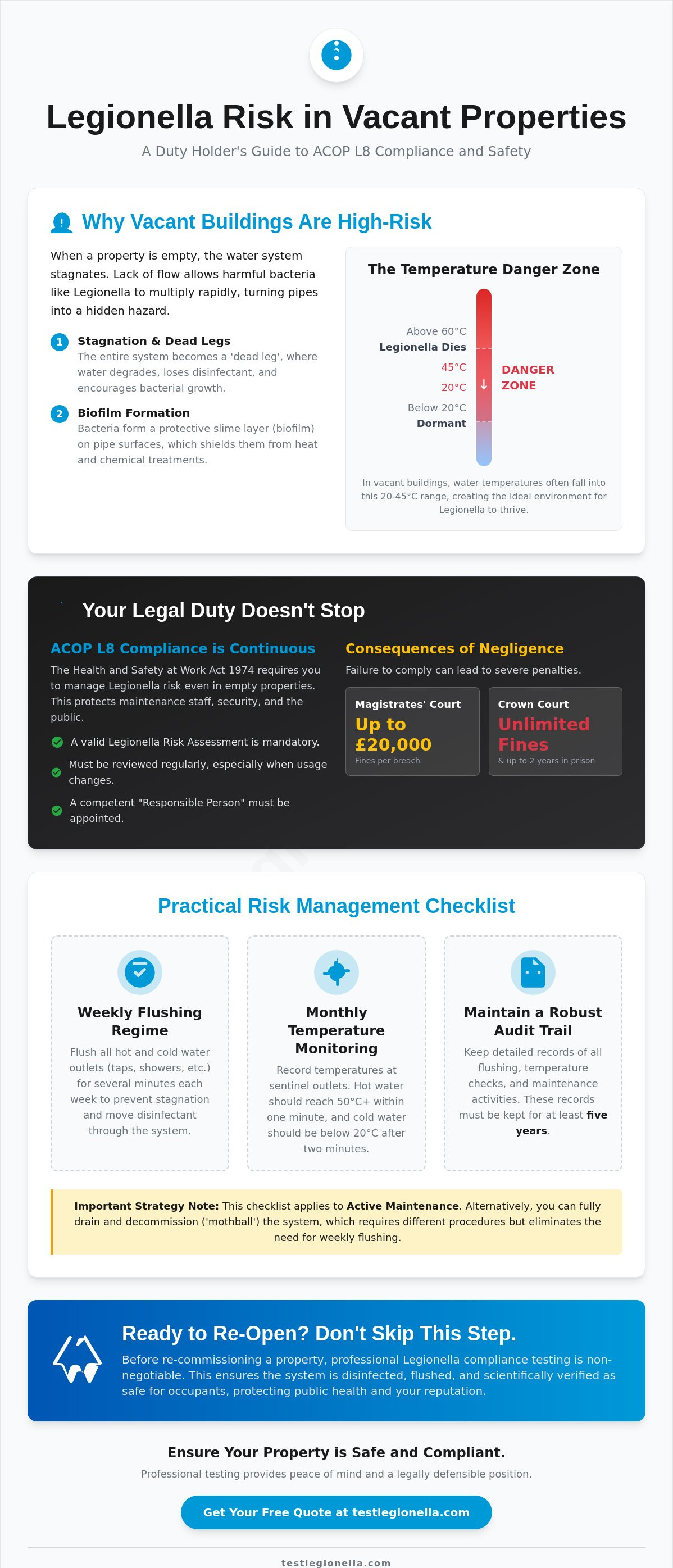
Legionella bacteria thrive when water temperatures sit between 20°C and 45°C. In a functioning building, hot and cold water systems are designed to stay outside this window. However, vacancy allows water to reach "ambient" temperatures. Cold water pipes in an empty office can quickly warm up to 22°C or 25°C, especially if they're near heating ducts or affected by solar gain in mothballed units. Conversely, hot water that isn't being circulated will cool down into this danger zone. Lukewarm water isn't just a maintenance issue; it's the single greatest risk factor for a Legionnaires' disease outbreak. Keeping water moving or completely decommissioning the system are the only ways to ensure these temperature thresholds don't become a liability. Managing the legionella risk in vacant or mothballed properties effectively starts with controlling these thermal environments.
Legal Duties and ACOP L8 Compliance for Empty Properties
Legal responsibility for water safety doesn't vanish just because a building is empty. Many property managers mistakenly believe that a lack of occupants pauses their regulatory obligations. In reality, the Health and Safety at Work Act 1974 and the Management of Health and Safety at Work Regulations 1999 require you to protect anyone who might be exposed to your water systems, including maintenance staff, security, or neighbors. Managing the legionella risk in vacant or mothballed properties is a continuous legal requirement that demands an active strategy rather than a passive wait-and-see approach.
The Health and Safety Executive (HSE) identifies the "Duty Holder" as the person in control of the premises. This individual must appoint a "Responsible Person" with the competence to manage the risks. Even for vacant assets, a valid Legionella risk assessment is non-negotiable. This document must be reviewed regularly and updated whenever there is a significant change to the building's use. If your property is currently dormant, your risk assessment must specifically address the dangers of stagnation and the lack of regular throughput.
Regulatory Framework: COSHH and HSWA
The Control of Substances Hazardous to Health (COSHH) regulations classify Legionella as a biological hazard. This means you have a statutory duty to prevent or adequately control exposure. Negligence in mothballed buildings can lead to severe penalties. Magistrates' Courts can issue fines of up to £20,000, while Crown Courts can impose unlimited fines and prison sentences of up to two years for serious breaches. To understand the full scope of your obligations, read our ACOP L8 explained guide. Citing Landlords' Legal Responsibilities from the HSE confirms that these duties apply regardless of whether the property is residential or a large-scale commercial unit.
Record Keeping for Vacant Sites
A robust audit trail is your primary defense against prosecution. You must maintain a log book that documents every flushing event, temperature check, and inspection. Under current regulations, you must keep these records for a minimum of five years. For multi-site commercial portfolios, digital audit trails are far more effective than paper logs. They provide real-time visibility and ensure that nothing is missed during the vacancy period. This level of due diligence is exactly what an HSE inspector looks for during a spot check. If you're concerned about the current safety of your system, professional Legionella Compliance Testing provides the documented proof you need to show that your building remains under control. This proactive approach transforms a complex regulatory burden into a manageable, stress-free process.
Mothballing vs. Active Maintenance: Choosing Your Strategy
You face a strategic choice when a building becomes dormant. You can either keep the system live through active maintenance or shut it down entirely via mothballing. Both paths have distinct impacts on the legionella risk in vacant or mothballed properties. Active maintenance involves keeping water moving to simulate normal use, while mothballing is the physical isolation and removal of water from the system. Choosing the wrong path can lead to permanent pipework damage or a dangerous bacterial outbreak upon re-entry.
The "tipping point" for these strategies usually depends on the expected duration of the vacancy and the complexity of your plumbing. For short periods, active maintenance is often more cost-effective. However, if a property will be empty for more than six months, the labor costs of weekly flushing typically exceed the expense of a professional decommissioning. Be wary of partial draining. Leaving water trapped in low points or dead legs creates an environment far more dangerous than a full system, as it combines stagnation with high oxygen levels. Refer to the HSE guidance on vacant properties to ensure your chosen strategy aligns with current safety expectations.
The Active Flushing Regime
If you choose to keep the system live, you must implement a rigorous flushing schedule. This isn't just about turning on a tap for a few seconds. You must flush every outlet, including toilets, showers, and cleaners' sinks, for at least two minutes every week. This process must start from the water source and work outward to the furthest sentinel points. Don't forget your Thermostatic Mixing Valves (TMVs). These devices must be exercised during the flushing process to prevent water from sitting stagnant within the valve body itself. This regime keeps the water chemistry stable and ensures that any residual disinfectant remains active throughout the pipework.
Safe Decommissioning (Full Mothballing)
Full mothballing is a technical process that requires more than just turning off the stopcock. You must isolate the incoming supply and drain the entire system, including tanks, calorifiers, and all distribution pipework. The primary challenge here is moisture. A "dry" system that isn't truly dry will suffer from rapid internal corrosion and localized bacterial growth. For long-term storage, some specialists use nitrogen purging to displace oxygen and moisture or apply specific chemical inhibitors to protect the metal surfaces. This approach is complex but provides the highest level of security for buildings facing multi-year vacancies. Regardless of the strategy you pick, regular Legionella Compliance Testing remains the only way to verify that your chosen methods are actually working.
Practical Risk Management: A Checklist for Empty Buildings
Establishing a rigorous routine is the only way to mitigate the legionella risk in vacant or mothballed properties. Once you've chosen an active maintenance strategy, you must move from theory into a documented schedule of physical checks. This proactive approach ensures that your water system remains under control and ready for a safe re-opening. Use the following checklist to maintain your building's health during periods of low occupancy:
- Weekly Flushing: Run every tap, showerhead, and toilet for at least two minutes. This prevents water from sitting stagnant and ensures fresh, treated water reaches every part of the system.
- Monthly Temperature Checks: Record the temperature at your sentinel points to verify that your water remains outside the 20°C to 45°C danger zone.
- Quarterly Showerhead Maintenance: Clean and descale all showerheads and spray taps every three months. Scale and biofilm buildup on these fixtures provide a perfect nesting ground for bacteria.
- Tank Inspections: Check cold water storage tanks for debris, sediment, or signs of animal ingress. Ensure lids are tight-fitting and vents are screened.
- Dead Leg Removal: Identify redundant pipework leading to removed fixtures. If a tap is no longer needed, have the pipework cut back as close to the main branch as possible to eliminate "blind ends."
Sentinel Point Monitoring
To verify your system's safety, you must identify your sentinel points. These are the outlets closest to and furthest from your water source or storage tanks. When taking readings, record a "first draw" temperature immediately upon opening the tap to see what the water has reached while sitting. Then, take a "flushed" reading after two minutes of flow. Your target for cold water is below 20°C within two minutes. For hot water, it must reach at least 50°C within one minute. In healthcare environments, this hot water threshold increases to 55°C to protect more vulnerable occupants.
Managing External Risks
Don't limit your focus to internal taps. External systems like cooling towers, decorative fountains, and humidifiers often present the highest aerosol risks and must be managed according to HSG274 guidelines. Sprinkler systems and fire hoses are frequently overlooked in vacant commercial units. These systems contain large volumes of stagnant water that can become highly contaminated. Finally, coordinate with your site security team. Ensure they don't accidentally isolate power to water heaters or circulation pumps that are essential for your thermal control regime. If you need absolute certainty that your management plan is working, book our professional Legionella Compliance Testing to validate your results with UKAS-accredited laboratory analysis.
Safe Re-commissioning: Bringing the Property Back to Life
Re-opening a commercial asset after a period of dormancy is a significant operational milestone. However, simply "turning the taps on" is a dangerous mistake that can lead to immediate health risks. During the vacancy, the legionella risk in vacant or mothballed properties has likely escalated within stagnant pipework. A sudden return to use can release high concentrations of bacteria through aerosol-generating outlets like showers and spray taps. To ensure safety and legal compliance, you must follow a structured re-commissioning protocol that includes thorough system cleansing and validation through laboratory analysis.
Every re-opening strategy must be integrated into an updated Legionella risk assessment. This ensures your documentation reflects the current state of the building and the specific steps taken to mitigate the legionella risk in vacant or mothballed properties before anyone enters the site. This isn't just a best practice; it's a fundamental requirement to prove due diligence to the HSE and protect your business from liability.
Water Sampling and Lab Analysis
Professional water sampling is the only way to confirm your building is safe for occupants. Timing is critical. You should take samples 48 to 72 hours after the system has been thoroughly flushed. This delay allows you to capture a representative picture of the water quality under normal operating conditions rather than just testing the fresh water you've just introduced. When you receive your results, the lab will report findings in Colony Forming Units per Litre (CFU/L). Understanding these action levels is essential:
- Under 100 CFU/L: The system is generally considered under control, though monitoring must continue.
- 100 to 1000 CFU/L: This requires an immediate review of your control regime and potentially a re-sample to check for trends.
- Over 1000 CFU/L: This indicates a serious loss of control. You must take urgent remedial action, which usually involves full system disinfection.
Professional Disinfection Procedures
If your system has been mothballed for an extended period or returns a high bacterial count, "Shock Chlorination" is the industry standard for disinfection. This process involves introducing high levels of chlorine into the system to penetrate the stubborn biofilms we discussed in earlier sections. While some managers attempt thermal disinfection by raising water temperatures to 60°C or above, this pasteurisation is often insufficient on its own. Heat rarely reaches every extremity of a complex commercial system, and it doesn't remove the physical scale that protects bacteria from the temperature rise. For total peace of mind and a clear audit trail, book a professional Legionella compliance test. This final verification transforms a high-risk transition into a safe, successful re-entry for your staff and tenants.
Protect Your Property and Ensure a Safe Re-opening
Managing a vacant property shouldn't be a source of constant worry. By understanding the science of stagnation and implementing a structured maintenance regime, you transform a complex regulatory burden into a manageable process. Whether you choose active flushing or full decommissioning, the goal remains the same: ensuring your water system doesn't become a liability. Effectively controlling the legionella risk in vacant or mothballed properties protects your reputation and prevents the severe legal consequences of non-compliance.
Remember that your legal duties under ACOP L8 continue regardless of occupancy. A clear audit trail of temperature checks and flushing events is your best defense. Most importantly, never re-open a building without the validation of professional laboratory analysis to confirm your water is safe. We provide the expertise you need to navigate these requirements with ease. Our specialists provide expert UKAS-standard lab analysis and comprehensive digital compliance reports with national coverage for commercial and residential assets. Secure your vacant property with a professional Legionella compliance test today. Take the first step toward a stress-free re-opening and enjoy the tranquility that comes with total compliance.
Frequently Asked Questions
How long can a property be vacant before Legionella becomes a risk?
Legionella risk begins to escalate within just 24 hours of water stagnation. While short periods of vacancy are manageable, any property left unused for more than seven days requires a formal flushing regime. This prevents the formation of biofilms that protect bacteria from standard temperature controls and disinfectants.
Do I have to flush the toilets every week in an empty building?
Yes, you must flush every toilet, tap, and showerhead at least once a week to simulate normal water demand. This movement is essential for preventing the stagnation that drives legionella risk in vacant or mothballed properties. Each outlet should be run for at least two minutes to ensure fresh, treated water from the main reaches the fixture.
Is it better to drain the water system or keep it running if the property is for sale?
Keeping the system running with a regular flushing regime is usually the best choice for properties on the market. It ensures the building is ready for immediate viewing and avoids the risk of internal pipework corrosion. Draining a system is a complex technical task; if any moisture remains in low points, it can create a localized bacterial hazard that is difficult to resolve later.
What is the difference between a vacant property and a 'mothballed' one?
A vacant property is an empty building where the water system remains live and requires weekly maintenance. A mothballed property has undergone a professional decommissioning process where the system is isolated and fully drained. While mothballing reduces weekly labor costs, it requires a much more intensive re-commissioning process before the building can be safely used again.
Can I do the Legionella risk assessment myself for an empty house?
You can perform the assessment yourself if you are competent and understand the specific plumbing layout of the property. However, you must be able to identify complex risks like "dead legs" or temperature gain in cold water pipes. Most duty holders prefer to use a specialist to ensure their documentation meets ACOP L8 standards and provides a robust legal defense.
What happens if I re-open a building without testing the water first?
Re-opening a building without prior water testing is a breach of health and safety law and puts occupants at risk of Legionnaires' disease. Legally, this negligence can result in Magistrates' Court fines of up to £20,000 or unlimited fines in Crown Court. In the event of a fatality, you could face charges under the Corporate Manslaughter and Corporate Homicide Act 2007.
Are there specific rules for empty commercial offices vs. residential flats?
The fundamental legal duty to manage legionella risk in vacant or mothballed properties applies to both, but the technical guidance varies. Commercial offices often house complex systems like cooling towers or large calorifiers that require adherence to HSG274 technical standards. Residential flats typically have simpler hot and cold water systems but still require a valid risk assessment and proof of regular maintenance.
How much does professional re-commissioning testing cost in 2026?
The cost of re-commissioning testing depends on the size of the building and the number of water samples required for laboratory analysis. Factors such as the presence of complex plant equipment or the need for a full system disinfection will also impact the price. You should check with a specialist provider for a customized quote that covers your specific compliance needs.