
Your Legionella risk assessment doesn't actually have a legal expiry date. While many property owners still scramble to meet a defunct two-year deadline, the truth is that your legionella testing frequency for landlords uk depends entirely on the stability of your water system rather than a fixed calendar date. We understand that navigating HSE expectations can feel like a constant battle between maintenance budgets and the fear of heavy fines. You want to protect your tenants from a disease that can be fatal in up to 30% of cases, but you need a strategy that's both practical and compliant.
This guide will help you master the legal requirements for risk assessment validity and identify the specific triggers that necessitate a professional review of your records. We'll move past common myths to give you a clear understanding of when action is truly required. You'll gain a definitive checklist of system changes that demand an update, providing the peace of mind that your water safety programme is fully audit-ready and your legal duty of care is met with calm competence.
Key Takeaways
- Understand why the "2-year rule" is an industry myth and how the HSE defines the actual validity of your safety records.
- Learn how to navigate your statutory duties under ACOP L8 and the Health and Safety at Work Act 1974 with confidence.
- Identify the five critical triggers that dictate the legionella testing frequency for landlords uk to ensure your property remains compliant.
- Discover the difference between a desktop review and a full physical survey to avoid overspending on unnecessary assessments.
- Master the documentation process required to prove your water system is managed by a competent person and audit-ready.
The 2-Year Myth: How Long is a Legionella Risk Assessment Actually Valid For?
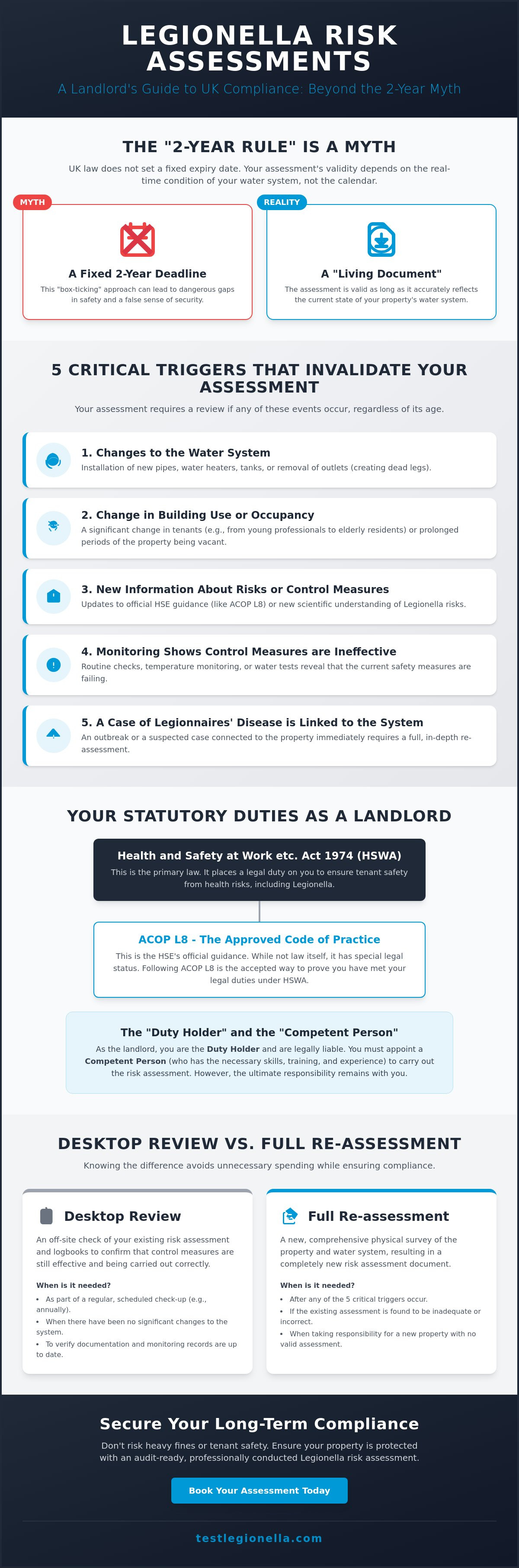
Many UK landlords believe their Legionella risk assessment expires exactly 24 months after the signature date. This is a persistent myth that can lead to both unnecessary costs and dangerous gaps in safety. UK law does not set a hard, chronological deadline for renewal. Instead, the Health and Safety Executive (HSE) requires that your assessment remains "valid." This means the document must accurately reflect the current state of your water system at all times. If your property changes, your assessment must change with it.
Determining the correct legionella testing frequency for landlords uk isn't about watching the clock; it's about active management. Think of your risk assessment as a living document. It's a proactive record of safety that requires regular oversight rather than a "set and forget" certificate. Before diving into the technical paperwork, it's vital to understand the biological risk. What is Legionella? Knowing how this bacterium colonizes man-made water systems helps you see why a static, two-year-old report might be dangerously outdated if the building's usage has shifted.
Why the 2-Year Recommendation Changed
The HSE shifted away from the mandatory two-year review to prevent a culture of complacency. In the past, fixed dates encouraged a "box-ticking" exercise where landlords ignored their water systems until the two-year mark approached. This created significant windows of risk, especially in high-risk buildings or properties with complex plumbing. By moving to a risk-based model, the focus is now on continuous observation. "Regularly" now implies that you are constantly looking for changes in your system that could increase the threat of bacterial growth. This shift ensures that safety is managed based on actual conditions rather than an arbitrary calendar date.
The Definition of a Valid Assessment in 2026
A valid assessment in 2026 must be a precise mirror of your property's plumbing infrastructure. It's no longer enough to have a generic report. Your documentation must detail every specific asset, including cold water storage tanks, water heaters, and all outlets. A professional schematic diagram is also essential; it should clearly map the water flow and identify potential dead legs where stagnation might occur. Without these details, the assessment cannot provide a reliable safety framework. A valid assessment is one conducted and signed off by a Competent Person who possesses the necessary skills, training, and experience to identify and evaluate Legionella risks effectively.
Statutory Requirements: ACOP L8 and HSWA Guidance for Landlords
Compliance isn't just about safety; it's a statutory obligation that protects both your tenants and your reputation. The Health and Safety at Work etc. Act 1974 (HSWA) forms the backbone of UK safety legislation. For landlords, this means you have a legal duty to ensure that your tenants and visitors aren't exposed to health risks. While the act itself is broad, the specific roadmap for compliance is found in the ACOP L8 and HSWA Guidance. This Approved Code of Practice provides the technical standards you must meet to satisfy the law. While ACOP L8 isn't "the law" in the same way an Act of Parliament is, it has special legal status. If you're prosecuted for a breach and haven't followed the code, a court will likely find you at fault unless you can prove you complied in another, equally effective way.
Using an outdated assessment is a gamble that rarely pays off. If a Legionella incident occurs, the HSE will examine your records to see if you managed the risk appropriately. An assessment that doesn't account for recent plumbing changes or reflects a property state from years ago won't stand up in court. This is why understanding the legionella testing frequency for landlords uk is so critical; it’s about maintaining a continuous chain of evidence that you've prioritised tenant safety through every stage of the tenancy.
The Duty Holder’s Legal Responsibility
In a rental context, the landlord is typically the "Duty Holder." This role carries the weight of legal liability. You're required to appoint a "Competent Person" to help you identify and assess the risks within your water system. This person must have the right skills and knowledge, but remember that appointing them doesn't absolve you of responsibility. Even if you outsource your Legionella compliance testing, you remain legally liable for the safety of the water system. It's your job to ensure the person you hire is truly competent and that their findings are acted upon immediately.
COSHH and Water Safety Compliance
The Control of Substances Hazardous to Health (COSHH) Regulations 2002 also play a vital role in your safety strategy. These regulations classify legionella as a biological agent that must be controlled. Under COSHH, you're required to prevent exposure or, where that's not possible, adequately control it. This leads to the creation of a "written scheme of control." This document is your tactical plan, based on the risk assessment, detailing how you'll monitor temperatures and flush outlets. Without a valid risk assessment as your foundation, your entire safety programme is built on guesswork, leaving you exposed to both health risks and legal prosecution.
Review Triggers: 5 Signs Your Current Assessment is No Longer Valid
Many property owners assume that if they haven't touched the plumbing, their risk profile remains static. This is a dangerous misconception. Stagnation is the silent enemy of water safety, and even a quiet system undergoes internal changes. Your legionella testing frequency for landlords uk isn't just about the hardware; it's about the environment within the pipes. If the water isn't moving or the temperatures aren't hitting their targets, the risk level is shifting beneath the surface. You must treat your risk assessment as a reactive tool that responds to the reality of your building's daily life.
A "Significant Change" isn't always a major construction project. It can be as simple as a shift in how a room is used or a failure in your monthly monitoring. According to the Statutory Requirements for Landlords, you're obligated to review your assessment the moment you suspect it no longer accurately represents the risk. Complacency is often the precursor to a compliance breach. Staying proactive ensures you remain protected from the legal and health implications of an outdated safety record.
Physical and Structural System Changes
Renovations are a primary trigger for a new assessment. If you remove an outlet, such as a redundant sink or shower, you might create a "dead leg." This is a length of pipe where water sits stagnant, away from the main flow. These sections become breeding grounds for bacteria and can contaminate the entire system. Similarly, modifications to your water storage, like bypassing a cold water tank or installing a new unvented cylinder, completely alter the system's hydraulics. Your existing schematic diagram and risk profile become obsolete the moment these tools are adjusted. Even a change in the primary heating mechanism can shift your temperature control boundaries, requiring a professional review to ensure your "written scheme of control" is still effective.
Operational and Personnel Shifts
Operational changes are often overlooked but carry significant weight. If a property changes its primary use, perhaps moving from a residential let to a commercial office space, the water usage patterns will change. Lower usage in certain areas increases the risk of biofilm development. Personnel shifts also matter. If the "Responsible Person" or the maintenance staff carrying out the monthly checks changes, you must ensure the new team is competent and fully briefed. If there's a gap in this transition, your safety chain is broken. Finally, updates to national legislation or new health data regarding Legionnaires’ disease serve as external triggers. When the standard for "safe" evolves, your assessment must evolve with it to maintain your audit-ready status.
Reviewing vs. Re-assessing: Which Path Do You Need?
Understanding the difference between a record review and a full physical re-assessment is vital for cost-effective management. A review is essentially a high-level audit of your existing paperwork to ensure nothing has changed. In contrast, a re-assessment is a comprehensive physical survey of the water system, resulting in a brand-new report. While the legionella testing frequency for landlords uk isn't dictated by a calendar, your strategy for choosing between these two paths determines your level of protection. If you manage multiple properties, you need a logical framework to decide which action to take for each site.
For facility managers, this decision-making process should be systematic. If your monthly temperature logs are consistent and no physical modifications have occurred, a documented desktop review is often sufficient. However, if your records show "drift" in temperatures or if a tenant has reported plumbing issues, a physical survey becomes the safer, more responsible choice. Always prioritise the accuracy of the data over the ease of the process. If you're unsure about the current state of your property, it's time to book professional Legionella compliance testing to reset your safety baseline.
The Annual Compliance Review
Conducting an annual check of your acop l8 assessment is considered best practice across the UK. During this review, you should scrutinise your maintenance logbooks and temperature records for the past twelve months. Look for any patterns of non-compliance, such as hot water falling below 50°C or cold water rising above 20°C. To prove "due diligence" to health and safety inspectors, you must document this review even if no changes are identified. A simple signed and dated statement attached to the original assessment, confirming that a review took place and the system remains unchanged, provides a clear audit trail for any visiting authority.
When to Call a Professional Specialist
There are specific scenarios where a simple review isn't enough and a professional re-assessment becomes a mandatory legal requirement. If you receive a positive Legionella test result from a laboratory, your current risk assessment is immediately void. You must commission a new survey to identify the source of the contamination. Similarly, if your original assessment is over two years old and lacks technical detail, such as a schematic diagram or a clear written scheme of control, it no longer meets modern standards. Finally, if the current Duty Holder feels they lack the technical competence to accurately judge the risks, they must appoint a specialist. Recognising the limits of your own expertise is a hallmark of a professional approach to safety management.
Securing Long-Term Compliance with Test Legionella
Achieving total peace of mind in property management requires more than just knowing the rules. It requires proof of action. While we've established that the legionella testing frequency for landlords uk is determined by risk rather than a static date, the burden of proof always rests with the Duty Holder. Professional testing serves as the ultimate verification that your control measures are actually working. It transforms a complex regulatory burden into a structured, manageable asset that protects your tenants and your business. By partnering with specialists, you ensure that your safety records aren't just compliant, but bulletproof in the event of an inspection or insurance claim.
An independent, expert report provides a layer of protection that internal checks simply cannot match. If you are faced with a health and safety audit, an expert report demonstrates that you have engaged a competent person to manage high-stakes risks. This is particularly crucial for insurance purposes. Most insurers expect landlords to follow ACOP L8 guidance to the letter. Having a professional record of your legionella testing frequency for landlords uk and your control results ensures that you are never left vulnerable to claims of negligence. It turns a potential legal nightmare into a stress-free management process where every risk is accounted for and mitigated.
Expert Legionella Compliance Testing
Professional testing goes beyond simple temperature checks. It involves detailed laboratory analysis that identifies the specific presence and concentration of bacteria within your system. We ensure your systems meet the latest 2026 safety standards through clear, actionable reporting. You won't receive a document filled with confusing jargon. Instead, you get a precise roadmap for maintenance. This accurate, professional reporting stands up to the highest levels of scrutiny, providing the calm competence you need to manage your portfolio effectively. It is about transforming a technical requirement into a sense of security for you and your tenants alike.
Start Your Compliance Journey Today
If your risk assessment is aging or your system has undergone recent changes, the time to act is now. You can book a professional assessment or water sampling test nationally with ease. Integrating these professional checks into your ongoing maintenance schedule removes the guesswork from compliance. It allows you to move from a state of uncertainty toward a solution that prioritises operational excellence. Don't let an outdated record become a legal liability. Take the proactive step to secure your property today and ensure your water safety programme is fully audit-ready.
Book Your Professional Legionella Compliance Test Today
Take Control of Your Water Safety Strategy
Maintaining a safe rental property doesn't have to be a source of constant stress. By moving beyond the 2-year myth and focusing on specific system triggers, you can manage your legal obligations with efficiency and precision. Remember that your legionella testing frequency for landlords uk should always be dictated by the physical reality of your plumbing and the stability of your water temperatures. Whether you're dealing with a single domestic flat or a complex commercial portfolio, the goal is a robust audit trail that satisfies HSE inspectors and protects your tenants from harm.
Professional verification is the most reliable way to confirm your control measures are effective. Our specialist UK-wide water safety experts provide accurate laboratory analysis and reporting that ensures you stay on the right side of the law. You'll receive detailed compliance reports for legal protection, transforming complex regulations into clear, manageable records that stand up to scrutiny. Don't leave your compliance to chance or outdated paperwork. Book Your Professional Legionella Compliance Test Today and secure the long-term safety of your property. We're here to help you navigate the path to total tranquility and professional excellence.
Frequently Asked Questions
Is a Legionella risk assessment a legal requirement for all UK landlords?
Yes, carrying out a Legionella risk assessment is a mandatory legal requirement for all residential and commercial landlords in the UK. This duty is established under the Health and Safety at Work etc. Act 1974 and the COSHH Regulations. You must identify potential hazards and implement control measures to protect your tenants from exposure to the bacteria. Failure to maintain these records can lead to severe legal penalties.
Can I carry out my own Legionella risk assessment review?
You can perform the review yourself if you are a "competent person" with the necessary technical knowledge to identify risks. For simple domestic properties with standard combi-boilers, some landlords feel comfortable managing this. However, for properties with cold water storage tanks or complex plumbing, appointing a specialist ensures your legionella testing frequency for landlords uk and monitoring protocols meet the high standards required for legal protection.
What happens if I do not have a valid Legionella risk assessment?
Operating without a valid risk assessment leaves you vulnerable to HSE prosecution, unlimited fines, and potential imprisonment in cases of gross negligence. Beyond criminal charges, you face significant civil litigation risks if a tenant contracts Legionnaires' disease. Most insurance providers also require proof of a valid water safety programme to maintain your cover, meaning a lack of documentation could leave you personally liable for all costs.
Does a new assessment need to be done if the tenant changes?
A change in tenancy doesn't automatically require a brand-new assessment, but it is a critical time to review your existing records. You should use the void period to flush the entire water system and descale showerheads. If the property has been vacant for an extended time, the risk of stagnation increases significantly. Documenting these actions during the tenant handover proves you are actively managing the system's safety.
How much does a professional Legionella risk assessment cost in 2026?
Costs for a professional Legionella risk assessment in 2026 vary depending on the size and complexity of the water system. For a standard domestic property, prices are generally lower than for large commercial sites with multiple storage tanks. You should check with a specialist provider to get a quote tailored to your specific property type. This ensures you receive a comprehensive report that includes a schematic diagram and a written scheme of control.
How often should I test my water for Legionella bacteria?
There is no fixed legal legionella testing frequency for landlords uk regarding water sampling. Testing is typically only required if your risk assessment identifies a specific concern or if your temperature control measures are failing. For most domestic properties, regular temperature monitoring and flushing are sufficient. However, commercial sites or high-risk environments often require annual or quarterly sampling to verify that the control scheme is effective.
What is the difference between a risk assessment and a water sample test?
A risk assessment is a physical survey of the plumbing to identify hazards like dead legs or incorrect temperatures. A water sample test is a laboratory analysis used to detect the actual presence of Legionella bacteria. While the risk assessment is a universal legal requirement, the sample test is a supplementary tool used for verification. Both play a role in a comprehensive safety programme but serve different compliance functions.
Do I need a Legionella certificate for a vacant property?
Landlords don't need a "testing certificate," but you must have a documented risk assessment that covers periods of vacancy. Stagnant water in empty properties is a major risk factor for bacterial growth. You should have a plan to flush the outlets at least weekly while the building is unoccupied. Keeping a log of these maintenance tasks ensures you remain compliant and ready for the next tenant to move in safely.