
Did you know that the Health and Safety Executive (HSE) has issued individual fines exceeding £100,000 for failures in water safety management? It's a sobering figure that highlights why documented legionella training and proven competence are no longer optional for UK property owners in 2026. You likely feel the pressure to stay compliant, yet the technical jargon found in ACOP L8 often makes the process feel overwhelming. It's frustrating when you're trying to protect your building but can't clearly distinguish between simple awareness and the deeper management skills your staff need.
We're here to turn that confusion into confidence. This guide provides a straightforward breakdown of the training required to safeguard your property and satisfy legal inspectors. You'll learn how to identify the specific levels your team needs, how to avoid common compliance pitfalls, and how to implement a cost-effective safety strategy. We'll walk you through the essential steps to ensure your records are audit-ready, giving you the peace of mind that comes from professional, verified water safety management.
Key Takeaways
- Master the legal requirements of the Health and Safety at Work Act to protect your tenants and keep your UK property fully compliant.
- Identify whether your team needs awareness, management, or technical-level legionella training to meet the specific safety demands of your role.
- Evaluate the benefits of modern hybrid learning models to ensure maximum information retention and practical safety application for your staff.
- Follow a clear, step-by-step process to appoint a Responsible Person and implement a professional written scheme of control.
- Learn how to integrate independent water testing with your internal protocols to achieve total peace of mind and stress-free management.
Understanding Legionella Training and Legal Requirements in 2026
Legionella training is the practical process of gaining the specific knowledge required to identify, assess, and manage water-borne pathogens within a building's infrastructure. It isn't just about attending a lecture; it's about developing the skill set to spot stagnant water or temperature fluctuations before they become hazards. Under the Health and Safety at Work Act 1974, every UK employer has a legal duty to ensure the safety of their staff and visitors. This includes providing adequate information and instruction to those managing water systems. In 2026, the Health and Safety Executive (HSE) continues to prioritize "competence" over the mere possession of a certificate. You must prove that the person in charge can actually perform the tasks required by the acop l8 guidelines, rather than just holding a piece of paper from a decade ago.
Effective legionella training bridges the gap between theory and safety. By Understanding Legionnaires' Disease, its causes, and how it spreads through aerosolized droplets, staff can make informed decisions during daily operations. This specialized education ensures that your team isn't just guessing. They'll know exactly why they're flushing outlets or checking calorifier temperatures. We call this Compliance Care, where professional expertise meets practical property management.
The Legal Framework: ACOP L8 and HSG274
The Approved Code of Practice (ACOP L8) is the gold standard for UK compliance, carrying a unique legal status where failure to follow it can be used as evidence in court. While ACOP L8 sets the legal expectations, the HSG274 technical guidance acts as the roadmap for trained individuals, detailing how to manage cooling towers, hot and cold water systems, and other risk areas. The Duty Holder is legally required to appoint a "competent person" with the necessary skills and knowledge to take managerial responsibility for legionella control.
Why Training is Essential for Duty Holders
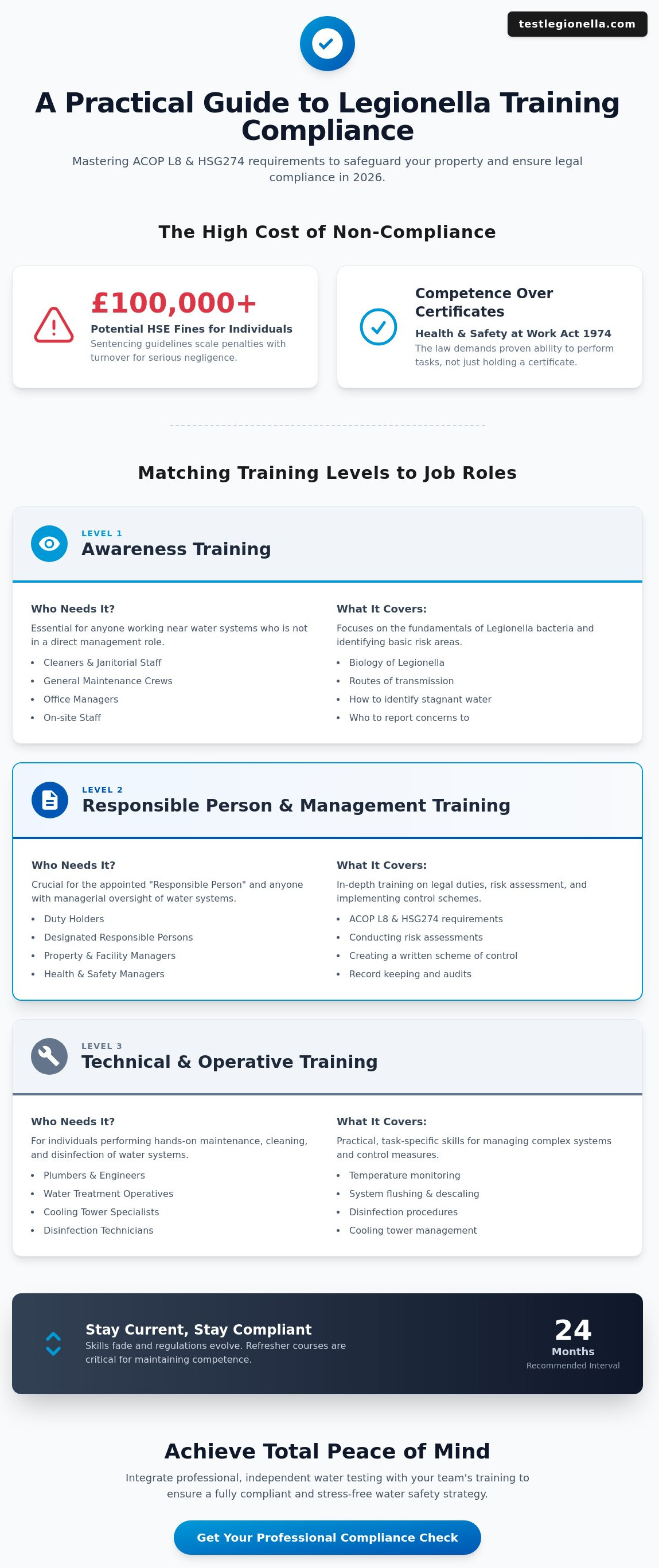
Informed oversight is your first line of defense. When your team understands the risks, they can prevent the conditions that lead to Legionnaires’ disease, protecting both lives and your reputation. The financial stakes are high; since the 2016 sentencing guidelines update, fines for health and safety breaches have scaled with company turnover, often reaching six or seven figures for serious negligence. Beyond avoiding penalties, legionella training builds a culture of safety. It protects tenants and employees alike, turning a complex regulatory requirement into a straightforward, stress-free routine. We make compliance easy so you can focus on running your business with total peace of mind.
Identifying the Right Level of Training for Your Role
Effective legionella training isn't just a box-ticking exercise. It's the foundation of a safe property and the primary defense against the legal and health risks associated with contaminated water systems. To stay compliant with the Health and Safety Executive (HSE) ACoP L8 guidelines, you must ensure that every person involved in water management possesses the correct level of competence for their specific duties.
Determining the right instruction level depends on the complexity of your building's plumbing. A small retail unit with a single combi-boiler requires a different approach than a large industrial site with cooling towers and complex distribution networks. You should categorize your staff into three distinct levels: Awareness, Management, and Technical. This targeted approach ensures resources are used efficiently while maintaining high safety standards across the board.
Frequency matters as much as the initial course content. Skills fade over time, and UK regulations evolve. Industry standards suggest a 24-month interval for refresher courses to keep staff updated on the latest biological insights and reporting tech. If you've recently upgraded your water system or changed the "Responsible Person" in your organization, you should trigger an immediate training review to close any knowledge gaps. If you're unsure where your team stands, you can quickly assess your current status with a professional compliance check.
Legionella Awareness for General Staff
This level is essential for anyone working near water systems, including cleaners, maintenance crews, and office managers. The curriculum focuses on the biology of the bacteria, specifically how it thrives in temperatures between 20°C and 45°C. Employees learn to identify "dead legs" where water stagnates and how to spot failing thermostatic mixing valves. The goal is to create an internal reporting culture where a simple observation can prevent a major outbreak. Every employee becomes a pair of eyes on the ground, capable of identifying basic hazards before they escalate into legal liabilities.
Management Training for the Responsible Person
For those in leadership roles, the focus shifts from spotting leaks to strategic oversight and legal accountability. This training provides the skills needed to use a legionella risk assessment template effectively. Managers must learn how to audit external contractors, verify the accuracy of water testing reports, and maintain a robust compliance file that would stand up to a local authority inspection. It's about understanding the "why" behind the data and ensuring that every preventive action is documented, dated, and signed off to provide total peace of mind.
Online vs. Classroom: Choosing the Best Training Format
Selecting the right legionella training is a vital step in your compliance journey. The best format depends on your specific role and the complexity of the water systems you manage. In 2026, industry data shows a 22% increase in businesses adopting hybrid learning models. These programs blend the speed of digital theory with the depth of practical workshops. This approach ensures that technical details aren't just seen; they're understood and applied correctly in the field.
Credibility is your first filter. Always verify that a training provider carries accreditation from respected bodies like IOSH, RoSPA, or the CPD Certification Service. These endorsements prove the course material aligns with the latest HSE ACOP L8 guidelines. Choosing unaccredited courses might save a few pounds initially, but it leaves your business vulnerable during a health and safety inspection. High-quality training transforms a regulatory burden into a streamlined part of your property management strategy.
The Benefits of Online Legionella Courses
Digital learning is often the most efficient path for general staff awareness. It's a scalable solution that keeps costs low while ensuring everyone understands basic risk factors. Online modules are designed for speed and clarity, making them ideal for modern teams. Benefits include:
- Cost-effectiveness: You can train high volumes of staff without the travel expenses or venue fees associated with off-site sessions.
- Flexibility: Busy landlords can complete modules at their own pace. This makes it easy to fit education into a packed schedule without disrupting daily operations.
- Digital Record-keeping: Online platforms provide instant certification. You can download and store these records immediately, ensuring your compliance audit trail is always ready for review.
When Practical Classroom Training is Essential
Online modules have limits, especially for those designated as the "Responsible Person" under UK law. If your site features complex industrial cooling towers or high-risk aerosol-generating systems, face-to-face instruction is vital. You need the tactical experience that only a physical environment provides. Practical sessions allow for:
- Expert Interaction: You can ask specific questions about your unique pipework or plant room setup. This gives you immediate, specialist advice tailored to your building.
- Peer-to-Peer Learning: Sharing experiences with other professionals often reveals practical solutions to common maintenance hurdles that you won't find in a textbook.
- Real-World Simulations: Hands-on legionella training replicates the physical tasks of temperature monitoring and water sampling. These are technical skills that require physical practice to master accurately.
Don't leave your safety to chance. Choose a format that provides genuine peace of mind and keeps your property protected. Specialist training makes compliance easy and keeps your operations running smoothly. Find out today which path fits your team best.
From Theory to Practice: Implementing Water Safety Protocols
Moving from understanding the law to active site management is where many property owners feel overwhelmed. It doesn't have to be complicated. By following a structured four-step process, you turn a legal obligation into a streamlined routine that protects your tenants and your business reputation. Compliance Care starts with a clear roadmap to safety.
- Step 1: Conduct a comprehensive legionella risk assessment to identify specific hazards within your unique water system.
- Step 2: Appoint a trained Responsible Person. This individual must have the authority and knowledge to oversee the written scheme of control.
- Step 3: Establish a regular monitoring regime. This includes monthly temperature checks, weekly flushing of infrequent outlets, and quarterly cleaning.
- Step 4: Maintain a detailed logbook. Every action, from a simple tap flush to a full tank disinfection, must be recorded to prove ongoing compliance to local authorities.
Conducting and Reviewing Risk Assessments
A professional risk assessment is only useful if you can act on its findings. Specialized legionella training empowers property managers to interpret these reports correctly, ensuring you don't miss critical red flags. You'll learn to spot "dead legs," which are lengths of pipework where water stagnates, and identify temperature fluctuations that allow bacteria to thrive in the 20°C to 45°C danger zone. A risk assessment is a living document that requires regular review to reflect any physical changes to the building or its usage.
Setting Up a Monitoring and Maintenance Regime
Consistency is your best defense against bacterial growth. Practical steps include monthly temperature checks where cold water should stay below 20°C and hot water should reach at least 50°C within one minute of running. You must also prioritize descaling showerheads and disinfecting water tanks every six months to remove the scale and biofilm that feed bacteria. Documenting these results creates a robust paper trail for HSE inspectors. If an inspector visits, having an organized logbook demonstrates that you've taken every reasonable precaution. It transforms your safety duties from a source of stress into a manageable, professional standard.
Ready to secure your property and achieve total peace of mind? Book your professional risk assessment today.
Achieving Total Compliance with Test Legionella
While legionella training provides your staff with the essential knowledge to spot risks, it's only the first step toward full regulatory adherence. Internal monitoring is vital, yet it lacks the independent verification required to satisfy the Health and Safety Executive (HSE) during a spot check. Professional testing acts as the ultimate safeguard. It transforms your internal "awareness" into a state of "certified safety." By bringing in a specialist, you gain an objective second opinion that validates your control measures are actually working.
Relying solely on internal checks can lead to oversight. Even the most diligent team can miss stagnant "dead legs" in a complex plumbing system or fail to notice a slight drop in water heater efficiency. Test Legionella bridges this gap. We provide the technical expertise and laboratory analysis needed to confirm your site is free from harmful bacteria. This professional oversight doesn't just protect your tenants; it protects your reputation and your bottom line from the heavy costs of non-compliance.
Professional Testing and Compliance Support
Internal temperature logs are a great start, but they don't provide the microscopic data found in a UKAS-accredited laboratory report. We use professional analysis to verify that your chemical treatments and thermal controls are effective. Test Legionella delivers the accurate, high-fidelity data you need for a robust compliance file. Unlike basic internal checks, our UKAS-accredited sampling provides a legally defensible record that stands up to scrutiny from local authorities. We handle the technical heavy lifting so you don't have to worry about the details of lab protocols.
Maintaining Your Compliance Record Over Time
Compliance isn't a one-time event; it's a continuous commitment. Professional reports are essential for satisfying insurers who often require proof of expert risk management before renewing a policy. Without this evidence, you risk facing significant liabilities if an outbreak occurs. According to the HSE, many businesses fail compliance not because they don't care, but because they lose track of their testing schedules.
We make long-term safety simple. Our service includes setting up automated reminders for your re-testing dates and future assessment reviews. This ensures you never miss a deadline. By moving your records into our structured reporting system, you create a clear audit trail that demonstrates your proactive approach to safety. Don't leave your property's safety to chance or memory.
Ensure your property is fully protected. Get your professional Legionella compliance quote today.
Master Your Water Safety Strategy for 2026
Professional legionella training ensures you meet the latest UK Health and Safety Executive (HSE) standards, specifically the ACoP L8 and HSG274 guidelines. By 2026, the shift toward digital-first compliance and real-time monitoring means your team must understand how to bridge the gap between classroom theory and daily site management. Whether you opt for flexible online modules or intensive classroom sessions, the goal remains the same: total safety and zero legal risk. Managing these complex requirements shouldn't be a source of stress for busy property owners.
Test Legionella makes compliance care simple by handling the technical heavy lifting for you. We provide expert UKAS-accredited laboratory analysis and fast, reliable results that give you total peace of mind. Our detailed compliance reports give landlords and business owners the clarity needed to protect tenants and stay on the right side of the law. You'll receive clear, actionable data that transforms a regulatory burden into a streamlined management process.
Book Your Professional Legionella Compliance Testing Now
Taking these steps today protects your occupants and secures your professional reputation for the long term.
Frequently Asked Questions
Is Legionella training a legal requirement for UK landlords?
Yes, Legionella training is a legal requirement for UK landlords and duty holders to ensure they're competent. The Health and Safety at Work etc. Act 1974 and the Management of Health and Safety at Work Regulations 1999 mandate that those in charge of premises must understand the risks involved. Proper legionella training provides the specific knowledge you need to identify hazards and implement control measures effectively. It's about protecting your tenants and your reputation.
How long does a Legionella training certificate last in 2026?
Most Legionella training certificates are valid for 3 years, so a certificate issued in 2023 will expire during 2026. While the law doesn't set a rigid expiry date, the HSE’s ACoP L8 requires regular evidence of competence. We recommend refreshing your skills every 24 to 36 months to stay aligned with the latest safety protocols. This ensures your Compliance Care remains current and your property stays safe from evolving risks.
Can I carry out my own Legionella risk assessment if I am trained?
You can carry out your own Legionella risk assessment if you've completed legionella training and feel competent to handle the specific water system. For small residential properties with simple plumbing, a trained landlord often manages this task to keep costs low. However, for complex commercial buildings, 90 percent of duty holders hire specialists. This ensures total accuracy and helps you avoid the heavy fines associated with overlooked risks or poor documentation.
What is the difference between a Duty Holder and a Responsible Person?
The Duty Holder is the person with ultimate legal accountability, usually the employer or the landlord. In contrast, the Responsible Person is someone appointed by the Duty Holder to manage the daily control of Legionella risks. This distinction is clearly defined in ACoP L8 paragraph 48. Both roles require specific levels of training to ensure the water safety plan is executed without any dangerous errors or gaps in oversight.
How much does professional Legionella training typically cost?
Professional training costs vary depending on the depth of the course and the delivery method. Basic online awareness courses typically start from £35 per person, while comprehensive classroom-based sessions for Responsible Persons range from £200 to £500. These figures are based on 2024 industry averages in the UK. Investing in this education is a cost-effective way to protect your business from the severe financial penalties of a HSE intervention.
Does online training count as "competent" in the eyes of the HSE?
Online training counts toward competence if the course is accredited and covers the specific technical requirements of your water system. The HSE states that competence is a mix of training, experience, and knowledge. For simple hot and cold water systems, a high-quality digital course provides a solid foundation. If you manage cooling towers or complex healthcare sites, you'll likely need practical instruction to meet the highest legal standards.
What happens if I don’t have trained staff managing my water systems?
Failing to have trained staff leads to significant legal and financial risks for your business. Under the Health and Safety at Work etc. Act 1974, you could face unlimited fines or even prosecution if a Legionella outbreak occurs due to negligence. In 2022, several UK firms faced fines exceeding £100,000 for failing to manage water safety properly. Beyond the money, it's about preventing Legionnaires' disease, which has a 10 percent fatality rate.
How often should I refresh my Legionella awareness training?
You should refresh your Legionella awareness training every 2 years to maintain high safety standards and peace of mind. This ensures your team stays updated on the latest ACoP L8 and HSG274 guidance. If your water system undergoes major changes or if a new risk assessment identifies fresh hazards, you must update your training immediately. Regular refreshers turn a complex regulatory burden into a manageable routine for your property management.