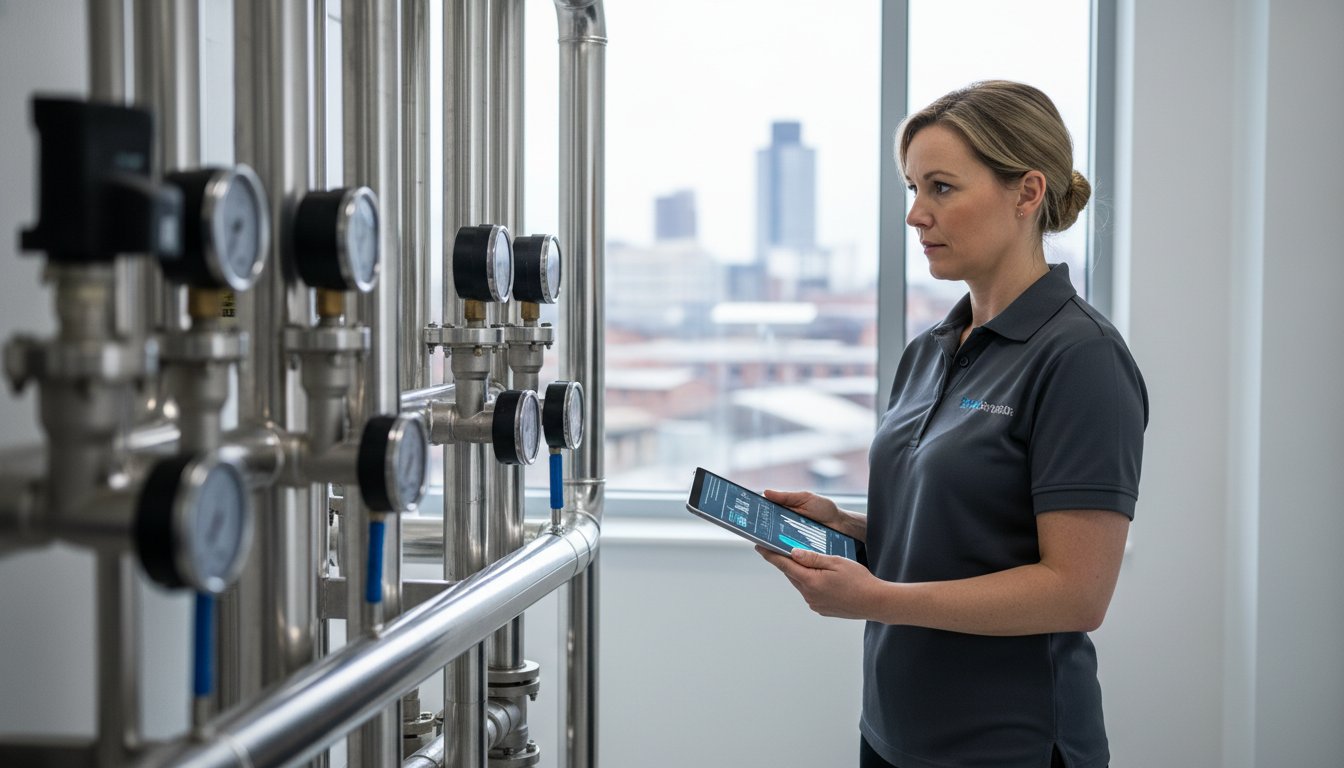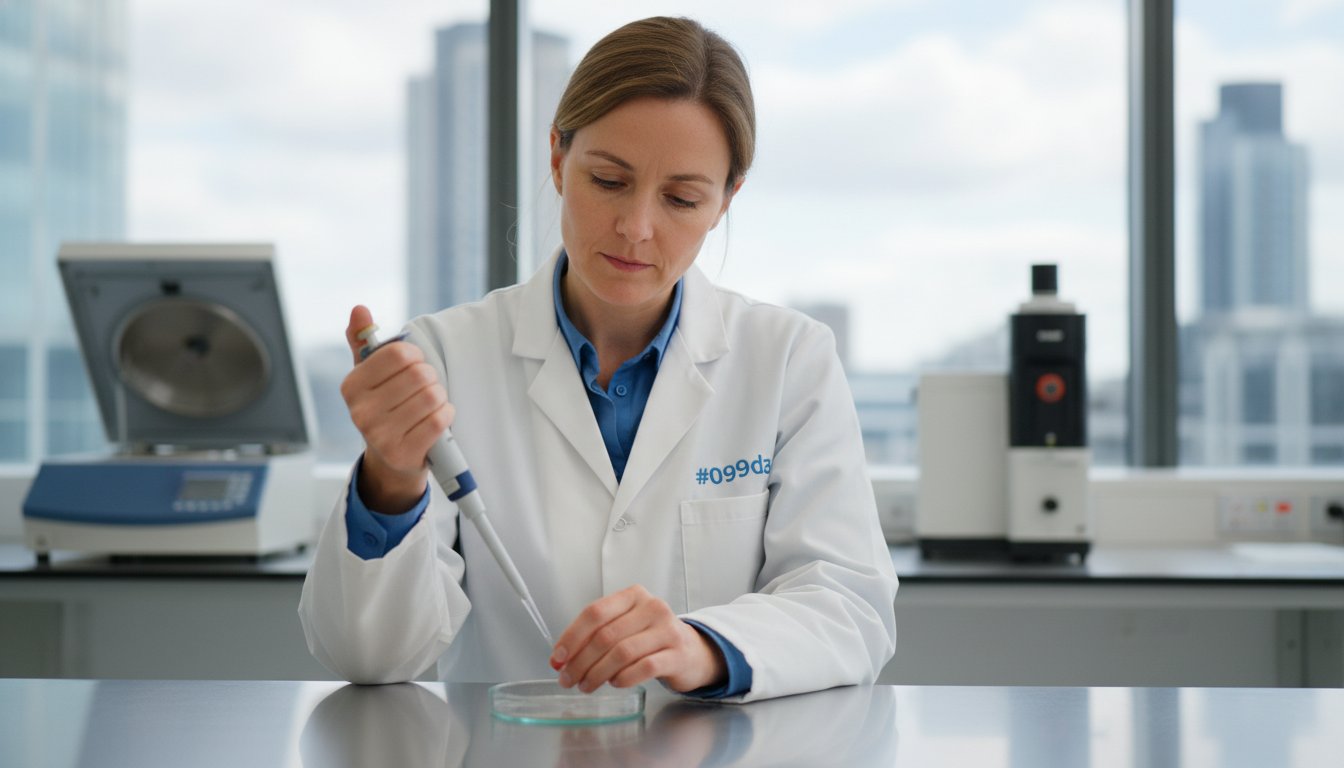

Did you know that failing to maintain a clear audit trail for Legionella can lead to fines exceeding £20,000 for a single health and safety breach under UK law? You likely already feel that protecting your tenants and employees is your most important responsibility. However, the technical burden of legionella water testing often feels like a maze of complex lab reports and shifting regulations. It's frustrating to stare at a spreadsheet of results and wonder if you're actually protected from a legal standpoint, and you don't want to guess when public health is on the line.
This guide is designed to transform that regulatory burden into total peace of mind through our "Compliance Care" approach. We'll help you master the complexities of water safety through expert insights on lab analysis and maintaining legal compliance. You'll gain a clear understanding of why professional sampling is the only reliable way to meet your 2026 obligations. We'll walk you through the entire process, making safety "Made Easy" while ensuring your property management stays hassle-free and your occupants remain safe.
Key Takeaways
- Understand how ACOP L8 and HSG274 guidelines dictate your legal obligations for water safety and property compliance in 2026.
- Learn why UKAS-accredited lab analysis is the only compliant method for legionella water testing, offering far more legal protection than rapid field kits.
- Identify the specific "triggers" and property conditions that make professional water sampling a mandatory legal requirement rather than an optional check.
- Gain the confidence to decode technical microbiology reports, allowing you to interpret "cfu/l" results and take immediate, effective action.
- Discover how professional Compliance Care simplifies complex regulations, turning a high-stakes burden into a streamlined, stress-free management process.
The Role of Legionella Water Testing in UK Compliance
Legionella water testing is a precise microbiological analysis designed to identify the presence of Legionella pneumophila bacteria within a building's water system. It isn't a visual inspection or a simple temperature check. Instead, it involves taking physical samples and sending them to a UKAS-accredited laboratory to determine the exact colony-forming units per litre (cfu/l). In 2026, this process remains the gold standard for verifying that your water is safe for tenants, employees, and the public.
It's vital to understand that legionella water testing is a supplement to your safety regime, not a replacement for a mandatory risk assessment. While a risk assessment identifies potential hazards, the testing provides the hard evidence that your control measures are actually working. Think of it as the final check in your safety chain. If your heaters are set to the correct temperatures but the bacteria still thrive, only a lab test will reveal the truth before a health crisis occurs.
The primary goal is validation. By testing your water, you confirm that your thermal disinfection or chemical treatments are effective. This proactive approach transforms a complex regulatory burden into a manageable routine, providing the "Compliance Care" your property deserves.
Why Water Testing Matters in 2026
The Health and Safety Executive (HSE) has significantly increased its focus on property safety standards since the 2024 updates to enforcement protocols. Landlords and facility managers now face stricter scrutiny regarding their audit trails. A missing test result during an inspection can lead to heavy fines or legal action. Beyond the paperwork, the human cost is the highest priority. Detecting the bacteria early is the only way to prevent Legionnaires' disease, a severe and potentially fatal form of pneumonia caused by inhaling contaminated water droplets.
- Early Detection: Identify colonisation before it reaches dangerous levels.
- Audit Readiness: Maintain a clear, dated history of water quality for HSE inspectors.
- Peace of Mind: Know for certain that your "Made Easy" compliance strategy is working.
The Legal Framework: ACOP L8 and Beyond
The legal weight of water testing is anchored in the ACOP L8 guidelines and the technical specifications found in HSG274. These documents outline the duty holder's responsibility to appoint a "competent person" to monitor and manage risk. You are legally responsible for the safety of anyone using your water systems. While the law doesn't demand monthly testing for every small domestic property, it becomes a strict legal necessity when your primary control regimes, such as temperature monitoring, fail to stay within safe limits. Following these rules ensures your business stays protected, professional, and fully compliant with UK law.
Methods of Testing: Lab Analysis vs. Rapid Field Kits
Choosing the right method for legionella water testing isn't just a technical decision; it's a legal one. While DIY kits promise instant results, they often fail to meet the rigorous standards required for a robust safety record. You need to understand the difference between a "quick look" and a definitive analysis to keep your tenants and employees safe. Reliability starts with the right equipment and the right expertise.
UKAS-Accredited Laboratory Testing
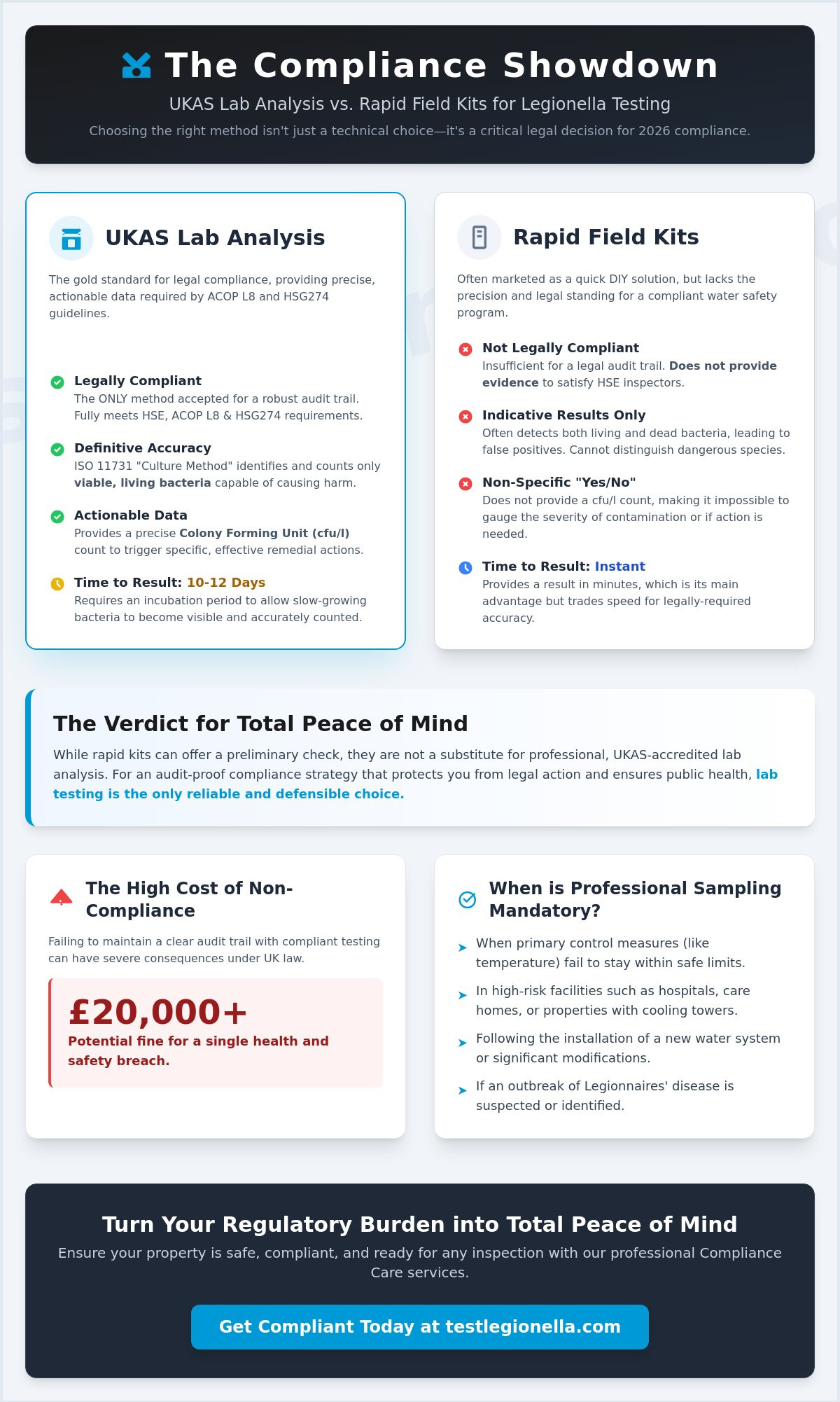
UKAS accreditation is the industry benchmark for technical competence and reliability. It ensures that the laboratory follows strict ISO 11731 standards for isolating Legionella bacteria. This "Culture Method" involves a 10-12 day incubation period. During this time, specialists monitor samples in a controlled environment to allow slow-growing bacteria to become visible. This is the only method that provides a definitive count of viable bacteria. The mathematical detection limit required by the HSE is 100 colony forming units per litre (cfu/l). This level of precision is vital. It provides the specific data needed to trigger remedial actions like system disinfections. Following HSE guidance on Legionella testing ensures your property stays within the law and your records remain bulletproof. Professional sampling must also follow BS 7592 protocols. These rules dictate exactly how and where to take a sample so the results accurately reflect the entire water system, not just one tap.
The Truth About Rapid Legionella Kits
Rapid field kits, often called Lateral Flow Tests, work by detecting specific antigens in the water. They offer a 25-minute turnaround, which is attractive for immediate feedback. However, these kits have significant gaps that landlords must recognize. Most only detect Legionella pneumophila serogroup 1. They frequently miss other dangerous strains or low concentrations that still pose a significant health risk. In a commercial or legal setting, a "negative" result from a DIY kit doesn't provide a legal defense if an outbreak occurs. These tools are best used for informal spot checks between scheduled professional visits. They're a supplement, not a substitute for official certification. If you're unsure which method your site requires for 2026, you can check your compliance score to see where you stand. Relying on lab analysis ensures you aren't just ticking a box, but actually managing the risk.
- Lab Analysis: 10-12 days, detects all strains, legally compliant.
- Rapid Kits: 25 minutes, detects limited strains, for internal use only.
- BS 7592: The mandatory standard for how samples are collected.
Compliance care is about more than just a pass or fail result. It's about having a clear, audit-ready paper trail that proves you've taken every reasonable step to prevent harm. Lab results provide the professional weight required to satisfy insurance providers and health inspectors alike.
When is Professional Water Sampling Actually Mandatory?
A common misconception among UK property owners is that legionella water testing must occur every single month. This isn't the case for most standard buildings. Mandatory sampling is usually driven by specific risk factors rather than a fixed calendar date. The "Responsible Person" appointed for the premises holds the legal duty to decide when sampling is necessary, guided by the initial risk assessment and ongoing monitoring results.
For many, the goal is achieving Compliance Care without unnecessary costs. While routine monitoring of water temperatures is a monthly requirement, actual laboratory analysis of water samples is only compulsory under certain "trigger" conditions. These triggers ensure that resources are focused where the risk of bacterial growth is highest. Professional sampling transforms a complex regulatory burden into a clear, manageable process.
Triggers for Mandatory Testing
- Temperature failures: If your hot water drops below 50°C or cold water rises above 20°C consistently, the risk of Legionella proliferation increases. Sampling becomes a priority to verify if the bacteria have taken hold.
- High-risk systems: Cooling towers, evaporative condensers, and spa pools require mandatory quarterly testing. These systems create aerosols, which are the primary vehicle for infection.
- Suspected outbreaks: If a case of Legionnaires' disease is linked to a property, professional sampling is a legal requirement to identify the source and validate disinfection.
- System complexity: Large, intricate buildings with "dead legs" or low-use outlets often require more frequent legionella water testing to ensure the control measures are effective.
Understanding these triggers helps you stay ahead of regulatory changes. While UK laws are strict, they align with broader U.S. and International Legionella Regulations regarding the management of high-risk aerosol-generating systems. This global standard emphasizes that sampling is a diagnostic tool, not just a box-ticking exercise.
Testing Requirements for Landlords and Small Businesses
For landlords managing simple domestic properties, routine laboratory testing isn't usually a legal requirement if the water system is well-maintained. However, a professional Legionella risk assessment might flag specific concerns that necessitate a one-off sample. This often happens in older buildings with galvanized pipework or large storage tanks where debris can accumulate.
Vacant properties present another critical trigger. If a building or a specific wing has been empty for more than three weeks, you should consider sampling as part of the re-commissioning process. Stagnant water is a primary breeding ground for bacteria. Getting a clear laboratory report before tenants return provides the peace of mind that your safety strategy is working and your occupants are protected. It makes the transition back to occupancy smooth and stress-free.
How to Read and Act on Your Lab Results
Receiving a microbiology report can feel overwhelming if you aren't familiar with laboratory jargon. The primary metric you will see is "cfu/l," which stands for colony forming units per litre. This number represents the concentration of live Legionella bacteria detected in a one-litre water sample. Understanding these figures is the first step toward achieving total peace of mind for your property.
The Health and Safety Executive (HSE) provides specific thresholds in the HSG274 technical guidance to help duty holders manage risk. These levels dictate whether your current control regime is working or if you need to intervene. We simplify this process through our Compliance Care approach, ensuring you never have to guess about your next steps.
Interpreting the Numbers: What is Safe?
A "Not Detected" result is the gold standard for any water system. It means the bacteria levels are below the laboratory's limit of detection, typically 10 or 20 cfu/l. If your legionella water testing returns a result between 100 and 1,000 cfu/l, the system is colonized. While this isn't an emergency, it is a warning. You must review your risk assessment, check water temperatures, and ensure flushing regimes are being followed correctly.
When a result exceeds 1,000 cfu/l, the HSE classifies this as "Action Required." This concentration indicates a significant failure in your control measures. At this level, the risk of Legionnaires' disease increases, making immediate intervention mandatory to protect tenants or employees. High counts often stem from stagnant "dead legs" in pipework or failing water heaters that aren't reaching the required 60°C.
Immediate Actions Following a Positive Test
If you receive a high-level positive result, follow this three-step response plan to regain control of your system quickly and efficiently.
- Step 1: Isolate the source. Immediately prevent the use of affected outlets, such as showers or spray taps. This stops the creation of contaminated aerosols, which is how the bacteria enter the lungs.
- Step 2: Conduct a shock disinfection. Perform a chemical "shock" using high-level chlorine or a thermal disinfection by circulating water at 70°C through the entire system for at least one hour.
- Step 3: Resample the water. You can't assume the fix worked. Take a new sample between 2 and 7 days after the disinfection to verify the system is clear.
Managing these technical requirements shouldn't be a source of stress. Our team provides the clarity you need to stay compliant without the headache of complex paperwork.
Don't leave your safety to chance. Get My Quote for professional testing and clear, actionable reports today.
Streamlining Your Water Safety with Professional Compliance Care
Managing water safety shouldn't be a source of stress for property owners. Test Legionella makes regulatory adherence Made Easy by acting as your dedicated safety partner. We handle the technical complexities of the HSE’s ACoP L8 and HSG274 guidelines, allowing you to focus on your core business operations. Our approach moves you away from reactive fixes toward a proactive strategy of total property protection.
Why Professional Sampling Beats DIY
Attempting to save costs with unverified DIY kits often leads to significant legal and health risks. Professional legionella water testing is about more than just filling a bottle; it's about precision and scientific validity. A common issue with self-sampling is the failure to properly neutralise biocides like chlorine at the point of collection. If the biocide isn't neutralised, it continues to kill bacteria inside the sample bottle during transit. This results in a "false negative," leaving you with a clean report while a colony potentially grows in your pipes.
- Expert Technique: Our technicians follow strict ISO 17025 sampling protocols to prevent cross-contamination.
- Accurate Interpretation: We don't just hand you a raw data sheet. We provide clear, actionable insights into what the numbers mean for your specific building.
- Legal Weight: Professional reports carry the necessary authority for insurance providers and health and safety inspectors.
Get Your Professional Compliance Score Today
Uncertainty is a liability in property management. Our Compliance Care service transforms that uncertainty into a state of protected expertise. We provide a comprehensive Compliance Score that benchmarks your current safety levels against the 2026 standards. This isn't a one-off transaction; it's an ongoing safety net. Through Compliance Care, we track your mandatory monitoring dates and send automated reminders well in advance of deadlines. This ensures you never fall out of compliance due to a busy schedule.
In the event of a legal dispute or an insurance claim, a professional report is your primary line of defence. It proves that you've exercised due diligence and followed expert advice. For landlords and business owners in the Midlands and across the UK, this level of detail provides genuine peace of mind. You can rest easy knowing that your tenants, staff, and reputation are protected by specialists who understand both the law and the logistics of maintenance.
Don't leave your property's safety to chance. Move toward a streamlined, stress-free management style with a partner you can trust. Get a fast, reliable quote for professional Legionella water testing and secure your compliance today.
Secure Your Water Safety and Compliance for 2026
Meeting the rigorous standards set by HSE HSG274 and ACoP L8 guidelines is essential for every UK property manager. By prioritizing professional legionella water testing, you replace uncertainty with verified data from UKAS-accredited laboratories. This process ensures your records are audit-ready and provide a robust legal defense. Professional interpretation transforms complex lab results into a simple, actionable safety plan that eliminates guesswork. Our Compliance Care approach makes meeting your legal obligations fast and straightforward. We provide detailed reports and rapid turnaround times, ensuring your property remains safe without disrupting your daily operations. You're not just checking a box; you're protecting lives and securing your business's future.
Ensure your property is safe—book your professional Legionella water testing today
Take the stress out of your 2026 safety requirements and enjoy the peace of mind that comes with expert support.
Frequently Asked Questions
How often should Legionella water testing be carried out in the UK?
The frequency of testing depends on your specific risk assessment and the type of water system you manage. For high-risk systems like cooling towers, the HSE mandates testing at least quarterly. In standard residential or office environments, annual testing or checks during tenancy changes ensure your compliance remains up to date. Health and safety managers often increase this frequency if water temperatures consistently fall between 20°C and 45°C.
Can I take my own water samples for Legionella testing?
You can physically take samples, but it's rarely advisable for legal compliance. Professional technicians use sterile equipment and specific "first flush" techniques to ensure accuracy. If a sample is contaminated during collection, you'll receive a false positive, leading to expensive and unnecessary disinfection. Most UKAS-accredited laboratories require samples to be transported in temperature-controlled conditions within 24 hours to provide a valid result.
What is the difference between water sampling and water testing?
Water sampling is the physical process of collecting water from your taps, showers, or tanks. Water testing is the scientific analysis conducted in a laboratory to count the bacteria present. Sampling happens at your property, while testing occurs in a controlled environment. Both steps are essential parts of legionella water testing to ensure your building meets the safety standards set out in the ACoP L8 guidelines.
How long does it take to get Legionella test results back from the lab?
Standard laboratory culture tests take 10 to 12 days to produce a final result. This duration is necessary because the bacteria must be incubated to see if colonies grow. While rapid PCR tests can provide data within 48 hours, they often detect dead DNA, which can lead to confusing results. The 10-day culture method remains the industry benchmark for accuracy and regulatory peace of mind.
Is a Legionella test the same as a Legionella risk assessment?
No, these are two different but complementary requirements for property safety. A risk assessment is a visual and technical survey that identifies potential hazards like stagnant water or pipework "dead legs." Testing is the physical proof that your control measures are working. You're legally required to have a risk assessment under the Health and Safety at Work Act 1974, while testing provides the data to back it up.
What happens if Legionella is found in my water system?
You must take immediate action if levels exceed 100 CFU/litre as per HSG274 guidelines. This usually involves restricted access to outlets and a system-wide disinfection using thermal or chemical treatments. Once the system is cleaned, you'll need to conduct a follow-up legionella water testing procedure within 7 to 14 days. This confirms the bacteria has been successfully eradicated and your property is safe for occupants again.
Are DIY Legionella testing kits legally valid for landlords?
DIY kits don't provide the same legal protection as a professional certificate from a UKAS-accredited partner. While they might give you a quick indication of water quality, they lack a documented chain of custody. If a tenant becomes ill, you'll need a professional compliance report to prove you've met your Duty of Care. Professional services make compliance easy by providing defensible evidence that stands up in court.
Do I need to test the water in a vacant property?
Vacant properties are high-risk zones because water stagnation allows biofilm to build up in the pipes. If a property has been empty for more than 30 days, the HSE recommends a thorough flush and a professional water test before re-occupation. Implementing a weekly flushing regime for all taps and showers helps, but a final test provides the certainty you need to hand over the keys safely.