
Did you know that reported cases of legionnaires disease in the UK have risen by nearly 40% over the last decade, with the UK Health Security Agency often tracing outbreaks back to poorly managed water systems in commercial properties? It's a sobering statistic that highlights why water safety is a critical legal requirement rather than an optional extra. You likely feel the weight of responsibility for your tenants' health, yet the gap between medical symptoms and technical plumbing standards often feels frustratingly wide.
We're here to transform that regulatory burden into a sense of security. This 2026 guide gives you a clear understanding of the health risks and a practical roadmap for meeting your legal duties. You will learn to identify high-risk zones in your property and understand the exact steps needed for a valid risk assessment. We believe in Compliance Care that protects your people and your reputation. Find out how to secure your building today with our straightforward approach to water safety.
Key Takeaways
- Identify early warning signs and understand the science behind bacterial transmission to protect your tenants and staff effectively.
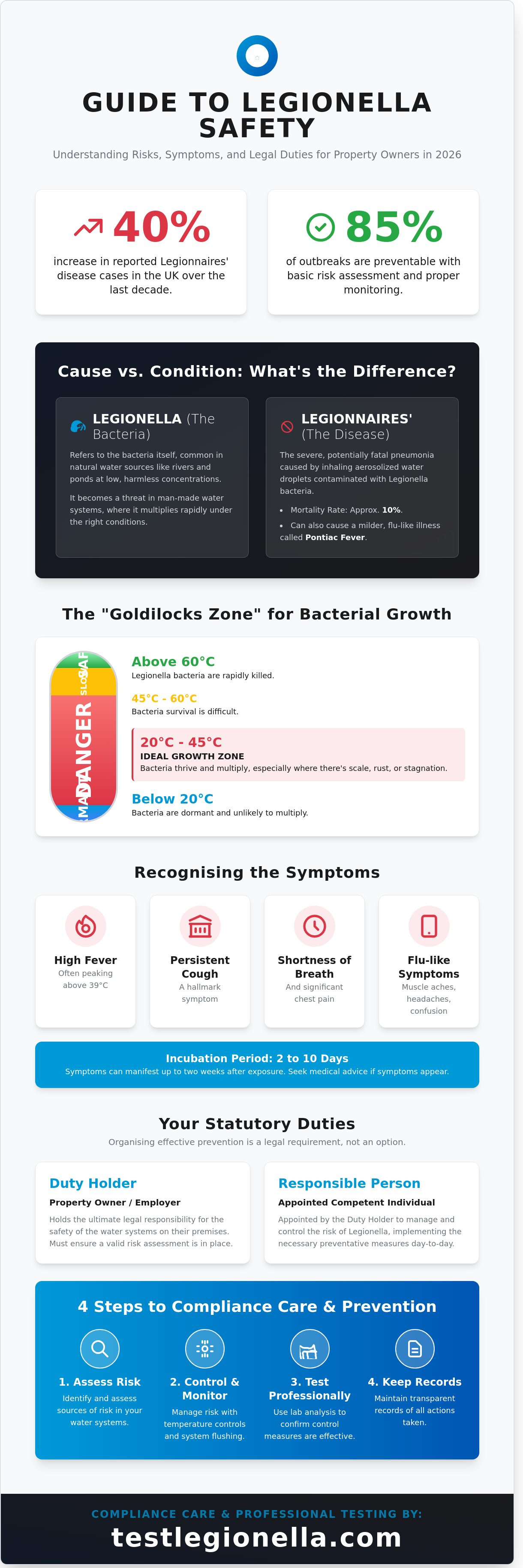
- Pinpoint high-risk areas in your water systems by understanding the "Goldilocks zone" temperatures where bacteria flourish.
- Master your statutory duties by defining the legal roles of the Duty Holder and Responsible Person within current UK regulations.
- Discover how professional testing and lab analysis can transform complex compliance into a manageable, stress-free process for preventing legionnaires.
- Learn the vital difference between mandatory sampling and best-practice recommendations to ensure your property meets 2026 safety standards.
What is Legionnaires’ Disease? Understanding the Risks in 2026
Legionnaires’ disease is a severe, potentially fatal form of pneumonia that remains a significant public health priority across the United Kingdom. It's caused by the inhalation of small droplets of water suspended in the air which contain the Legionella bacteria. While most healthy individuals recover with intensive antibiotic treatment, the infection carries a mortality rate of approximately 10% in the general population. For those with underlying health conditions or weakened immune systems, this risk increases significantly. Understanding What is Legionnaires' Disease? is the first step toward managing the safety of any built environment in 2026.
The Health and Safety Executive (HSE) continues to enforce strict regulations because legionnaires outbreaks are almost entirely preventable. In the UK, the legal responsibility for water safety falls squarely on the shoulders of the "Duty Holder," typically the property owner or employer. Failure to manage these risks doesn't just lead to hefty fines; it puts lives at risk. That’s why we focus on Compliance Care. It's our proactive approach to water safety that shifts the focus from reactive repairs to consistent, expert-led prevention. This framework ensures your property meets every legal standard while providing total peace of mind for you and your tenants.
The Difference Between Legionella and Legionnaires’
It's vital to distinguish between the biological cause and the resulting medical condition. Legionella refers to the bacteria itself, which is actually quite common in natural water sources like rivers and ponds. In these environments, they rarely cause harm because the concentrations are low. However, when these bacteria enter man-made systems, they find the perfect conditions to multiply. They thrive in temperatures between 20°C and 45°C, especially where there's scale, rust, or stagnation.
Legionnaires is the clinical illness that occurs when a person breathes in these concentrated bacteria. It's a serious lung infection. In some cases, exposure might result in Pontiac fever instead. This is a milder, flu-like illness that doesn't cause pneumonia. While Pontiac fever is less dangerous, its presence in a building is a major red flag. It proves that the water system is contaminated and that a more serious outbreak could be imminent if you don't take immediate action.
Why Public Health Safety is a Property Owner’s Priority
In 2026, the landscape of property management has shifted toward much stricter accountability. New digital tracking standards mean that "I didn't know" is no longer a valid legal defence. Recent data shows that 85% of recorded outbreaks could have been avoided with a basic risk assessment and temperature monitoring. Landlords are now expected to provide transparent safety records to tenants as part of standard rental agreements.
Prioritising water safety protects your investment as much as your people. A single confirmed case can lead to a building being closed for weeks, resulting in massive financial loss and irreparable brand damage. Professional testing and regular risk assessments are now the non-negotiable safety standards for any responsible owner. By implementing a structured Compliance Care plan, you transform a complex regulatory burden into a simple, automated process. It’s the most efficient way to stay protected, stay legal, and stay focused on your business.
Recognising Symptoms and the Science of Transmission
Identifying the early signs of legionnaires disease is the first step in managing health risks effectively. This condition is a severe form of pneumonia that requires prompt medical intervention. Most patients experience a high fever, often peaking above 39°C, alongside a persistent cough and significant chest pain. Shortness of breath is another hallmark symptom that shouldn't be ignored. The incubation period typically spans 2 to 10 days, although some cases manifest up to two weeks after the initial exposure. If you develop these symptoms, particularly after staying in a hotel or working in a large office building, consult a GP immediately.Common Symptoms and Health Complications
Early indicators often mirror the flu, which can lead to dangerous delays in diagnosis. You might suffer from intense muscle aches, headaches, and a general sense of confusion. If the infection progresses without treatment, it can lead to life-threatening complications. Data from UK health surveillance suggests that roughly 10% of cases result in respiratory failure or acute kidney issues. Understanding the Risks in 2026 provides a clear framework for identifying how these symptoms escalate. Always inform medical professionals about your recent travel history or any exposure to complex water systems. This information helps doctors distinguish between standard pneumonia and a legionella-related infection.How Bacteria Travel: From Water Systems to the Lungs
The disease doesn't spread through person-to-person contact. Instead, it relies on a process called aerosolisation. This occurs when water is agitated into a fine mist or tiny droplets that are small enough to be inhaled deep into the lungs. Common sources of these aerosols include:- Showers and spray taps that haven't been used recently.
- Cooling towers in large-scale air conditioning units.
- Whirlpool spas and hydrotherapy pools.
- Ornamental fountains and misting systems.
High-Risk Environments: Where Does the Danger Hide?
Legionella bacteria don't just appear; they thrive in man-made water systems that provide the perfect conditions for colonisation. While these systems are essential for modern living, they often create a "Goldilocks zone" where temperatures sit between 20°C and 45°C. In this range, the bacteria multiply rapidly. Below 20°C, the bacteria survive but remain dormant; above 60°C, they cannot survive. Understanding these thresholds is the first step toward effective risk management.
The bacteria need more than just warmth to flourish. They require a food source, which they find in the form of scale, rust, and bio-film. These materials accumulate in pipes and tanks, providing the nutrients and protection the colonies need to grow. Any building with a complex water system carries an inherent degree of risk. This makes professional oversight a necessity rather than an option for property owners. Recognising Symptoms and the Science of Transmission is vital for anyone managing these environments, as early detection saves lives.
Commercial vs. Residential Risk Profiles
High-occupancy buildings like hotels and hospitals present a higher risk profile than standard domestic rentals. These sites often feature extensive pipework where water can sit for long periods. Spa pools and hot tubs are particularly hazardous because they combine warm temperatures with vigorous aeration, creating the fine mists that carry legionnaires bacteria into the lungs. In industrial settings, cooling towers can spread contaminated droplets over a wide area, potentially affecting hundreds of people in a single event.
Stagnation and Temperature: The Perfect Breeding Grounds
Water stagnation is a silent contributor to bacterial growth. Unused taps in guest rooms or "dead legs" in plumbing systems allow water to sit at ambient temperatures, stripping away the protection of residual chlorine. You should consult the Legionella temperature guide to ensure your system remains within safe thresholds. To stay compliant, regularly inspect these high-risk components:
- Calorifiers: Ensure water is stored at 60°C or higher to kill bacteria.
- Cisterns and Cold Water Tanks: These must be kept clean, covered, and maintained below 20°C.
- Thermostatic Mixing Valves (TMVs): These require regular servicing to prevent internal fouling and debris buildup.
Managing these risks doesn't have to be a burden. By identifying these danger zones, you can implement a targeted maintenance programme that ensures safety and total compliance. Our approach makes this process simple, turning a complex health requirement into a manageable part of your property care routine.
Statutory Duties: How to Organise Effective Prevention
Managing water safety isn't just a recommendation; it's a strict legal requirement under the Health and Safety at Work etc. Act 1974 and the Management of Health and Safety at Work Regulations 1999. In the UK, the law identifies two vital roles that must be filled to ensure safety. The Duty Holder is typically the employer, landlord, or building owner who carries the ultimate legal responsibility. They must appoint a "Responsible Person" who possesses the technical competence and authority to oversee day-to-day control measures. Neglecting these roles leads to severe penalties. The Health and Safety Executive (HSE) can issue unlimited fines for non-compliance, and in cases of fatal legionnaires infections, prosecution for corporate manslaughter is a real threat. Viewing these duties as a path to peace of mind ensures you protect your tenants while securing your business against litigation.
ACOP L8 and Your Legal Obligations
The ACOP L8 guidelines serve as the primary roadmap for compliance in the UK. These rules apply to every landlord, whether you manage a single residential flat or a sprawling industrial complex. You're legally required to implement a written scheme of control. This document is a bespoke plan that details exactly how you'll manage risks, from monthly temperature monitoring to quarterly showerhead descaling. It transforms a complex regulatory burden into a structured, manageable programme. Following this code of practice gives you a legal "safe harbour," as it demonstrates you've followed the approved methods for preventing legionnaires disease.
The Role of Regular Risk Assessments
A professional risk assessment is the foundation of your safety strategy. While some attempt a DIY approach, generic templates often miss hidden "dead legs" in pipework or failing insulation, which creates unnecessary liability. A specialist assessment identifies specific points of failure that a layman might overlook. You should review your assessment every two years or immediately if your water system undergoes material changes, such as a boiler replacement or a change in building use. Compliance requires you to keep all records, including test results and inspection logs, for at least five years. This robust paper trail is your best defence if an inspector visits your property, proving your commitment to "Compliance Care."
Don't leave your property's safety to chance. Get your free compliance score today and see how we make water safety simple and stress-free.
Professional Legionella Testing: Ensuring Compliance and Safety
Managing water systems isn't just about ticking boxes. It's about protecting lives. While a Legionella Risk Assessment is a legal necessity for all UK landlords, actual water sampling sits in a unique category. For many residential landlords, it remains a best-practice recommendation. However, for those managing high-risk systems like cooling towers or healthcare facilities, regular sampling is a statutory requirement under ACOP L8 guidelines. Professional testing provides the scientific proof that your temperature controls and cleaning regimes actually work.
A professional technician collects samples from specific "sentinel" taps, which are the outlets furthest from the water source. These samples are transported under temperature-controlled conditions to a UKAS-accredited laboratory for analysis. Within 10 to 14 days, you receive a detailed report showing colony-forming units (CFU) per litre. This data forms the backbone of your compliance report, acting as a vital legal shield if your safety measures are ever scrutinised.
When to Seek Professional Water Sampling
Proactive testing is the most effective way to manage risk. You should trigger a professional sampling session in the following scenarios:
- After system changes: If you've modified the plumbing or replaced a water heater, testing ensures no new risks were introduced.
- Following stagnation: If a property has been vacant for more than 7 days, bacteria levels can spike.
- High-risk settings: Care homes and hospitals often require 6-monthly testing due to resident vulnerability.
- Outbreak investigations: Immediate sampling is required if symptoms of legionnaires disease are linked to your site.
Visual inspections are helpful for spotting scale or rust, but they can't see bacteria. Laboratory-verified sampling is the only way to confirm your water is truly safe and that your control measures are performing as intended.
How Test Legionella Simplifies Your Compliance Journey
Test Legionella provides national testing services that deliver speed and reliability. Our "Compliance Care" approach is designed to take the weight off your shoulders. We don't just send a technician; we provide a full support system that includes clear, jargon-free reports and automated reminders for your next inspection. This ensures you never miss a deadline or fall out of compliance.
We believe water safety should be a source of peace of mind, not a source of stress. Our experts handle the technical logistics so you can focus on running your business or managing your property. Transform your regulatory burden into a sense of security today. Contact us to find out how we can protect your reputation and your tenants with our tailored safety solutions. Don't leave your health and safety to chance; choose a partner that makes legionnaires prevention simple and effective.
Secure Your Property for 2026 and Beyond
Managing the risks of legionnaires disease in 2026 requires more than a basic understanding of water safety. It demands a proactive approach to statutory duties defined by the Health and Safety Executive (HSE). Landlords must identify high-risk zones, such as stagnant pipework or cooling towers, to prevent bacterial growth. Failure to act doesn't just risk public health; it carries legal consequences under the Health and Safety at Work etc. Act 1974. We make compliance easy by handling the technical details for you.
Our team provides UK-wide professional testing coverage, delivering expert compliance reports fast. We offer dedicated support for landlords and business owners, ensuring every property meets the latest safety standards without the stress. Our Compliance Care approach transforms complex regulatory burdens into total peace of mind. You'll receive clear, actionable data that keeps your tenants safe and your business protected from liability.
Ensure your property is compliant. Book your professional Legionella test today
Protecting your property is a vital responsibility, and we're ready to help you manage it with confidence.
Frequently Asked Questions
Is Legionnaires’ disease contagious from person to person?
No, you cannot catch Legionnaires’ disease through person-to-person contact. The infection spreads when you breathe in tiny droplets of water contaminated with the bacteria. This usually happens via showers, taps, or air conditioning systems. It's a localised environmental risk rather than a communicable virus, so there's no need to isolate if you're diagnosed.
Can you catch Legionnaires’ disease from drinking tap water?
You cannot usually catch the disease from drinking tap water. The bacteria must reach the lungs to cause infection, which happens if you accidentally inhale water droplets while drinking. This process, known as aspiration, is rare but more common in people with swallowing difficulties. For most, the main risk remains breathing in aerosolised mist from contaminated outlets.
How long is the incubation period for Legionnaires’ symptoms?
Symptoms of legionnaires typically appear within 2 to 10 days after exposure. In rare cases, the incubation period can extend to 19 days according to UK Health Security Agency data. Early signs often include a high fever, chills, and a cough. Monitoring your health for three weeks after visiting a site with a known outbreak is the safest approach.
What is the mortality rate for Legionnaires’ disease in the UK?
The mortality rate for Legionnaires’ disease in the UK is approximately 10% for the general population. This figure increases to 25% for patients who acquire the infection in a hospital setting. Data from the UK Health Security Agency shows that prompt antibiotic treatment is vital for survival. Managing your property's water safety isn't just about paperwork; it's about preventing these life-threatening outcomes.
Who is most at risk of becoming seriously ill from the bacteria?
Individuals over the age of 45 and those with respiratory issues face the highest risk. Men are three times more likely to contract the disease than women, based on historical UK infection data. Smokers and people with suppressed immune systems also have a significantly higher chance of developing severe pneumonia. Protecting these vulnerable groups starts with a professional risk assessment to identify potential breeding grounds.
How is Legionnaires’ disease diagnosed by medical professionals?
Doctors diagnose the infection using a urinary antigen test or by testing a sample of phlegm. The urine test is the most common method as it provides rapid results by detecting specific proteins produced by the bacteria. If you're hospitalised, medical staff might also perform a chest X-ray to confirm the presence of pneumonia. Early diagnosis ensures you receive the correct antibiotics quickly to manage the illness.
What water temperature is required to kill Legionella bacteria?
Water must reach a temperature of 60°C to kill Legionella bacteria almost instantly. At 50°C, it takes approximately two hours for 90% of the bacteria to die. Keeping your hot water cylinder at 60°C and ensuring cold water stays below 20°C is the most effective way to maintain compliance. This simple temperature control strategy forms the backbone of your water safety plan and provides essential peace of mind.
Do I need a Legionella test if I only have one rental property?
Yes, you are legally required to carry out a risk assessment even if you only have one rental property. The Health and Safety at Work etc. Act 1974 and the Management of Health and Safety at Work Regulations 1999 mandate that all landlords assess the risk of legionnaires to their tenants. We make this process simple through our Compliance Care service, ensuring your property meets all current UK standards without any unnecessary stress.