
Would your current water safety records stand up to a 2026 HSE audit, or are you betting your business on a £20 DIY kit? Relying on guesswork for professional legionella testing isn't just a risk to public health; it's a direct threat to your professional liability. We know that the distinction between ACOP L8 requirements and general health and safety law often feels like a legal maze. You want to protect your tenants and your reputation without drowning in technical jargon or the fear of fines that can exceed £20,000 for serious breaches.
You likely believe that compliance should be a path to security rather than a constant source of stress. This guide ensures you master the complexities of UK water safety requirements for total property compliance and occupant safety. We'll break down the 2026 standards, explain why professional reports beat home kits every time, and show you how to secure a clear, actionable water safety report that provides lasting peace of mind. We're going to transform your regulatory burden into a streamlined process that protects your property and your people.
Key Takeaways
- Understand your legal obligations under HASWA 1974 and COSHH to ensure your UK property meets the latest 2026 safety standards.
- Learn why a risk assessment is only the first step and how professional legionella testing provides the definitive proof required for total compliance.
- Discover why UKAS-accredited laboratory analysis is essential for legal validity and protecting your business from potential health crises.
- Identify the hidden risks of DIY testing kits and how partnering with an independent specialist makes compliance care fast and reliable.
- Master the complexities of water safety to transform regulatory burdens into long-term peace of mind for you and your occupants.
What is Legionella Testing and Why is it Essential?
Legionella testing is the professional microbiological analysis of water samples to identify the presence of specific bacteria within a building's water system. It's the only definitive way to confirm that your existing control measures, such as temperature monitoring or chemical dosing, are actually working. While many UK landlords rely solely on monthly temperature checks, laboratory analysis remains the gold standard for verifying water safety. The primary objective is identifying What is Legionella? and specifically the Legionella pneumophila strain, before it reaches concentrations that could lead to a public health crisis.
There's a clear distinction between routine monitoring and reactive sampling. Routine legionella testing involves scheduled samples taken at specific intervals to maintain a baseline of safety and compliance. Reactive sampling occurs after a system failure, a positive result, or a significant change in water usage. For UK business owners, understanding this difference is vital. One keeps you compliant on a day-to-day basis; the other protects your reputation and legal standing during an emergency. Our approach makes this process simple, ensuring your water systems remain under control without the stress of complex paperwork.
The Health Risks: Why We Test
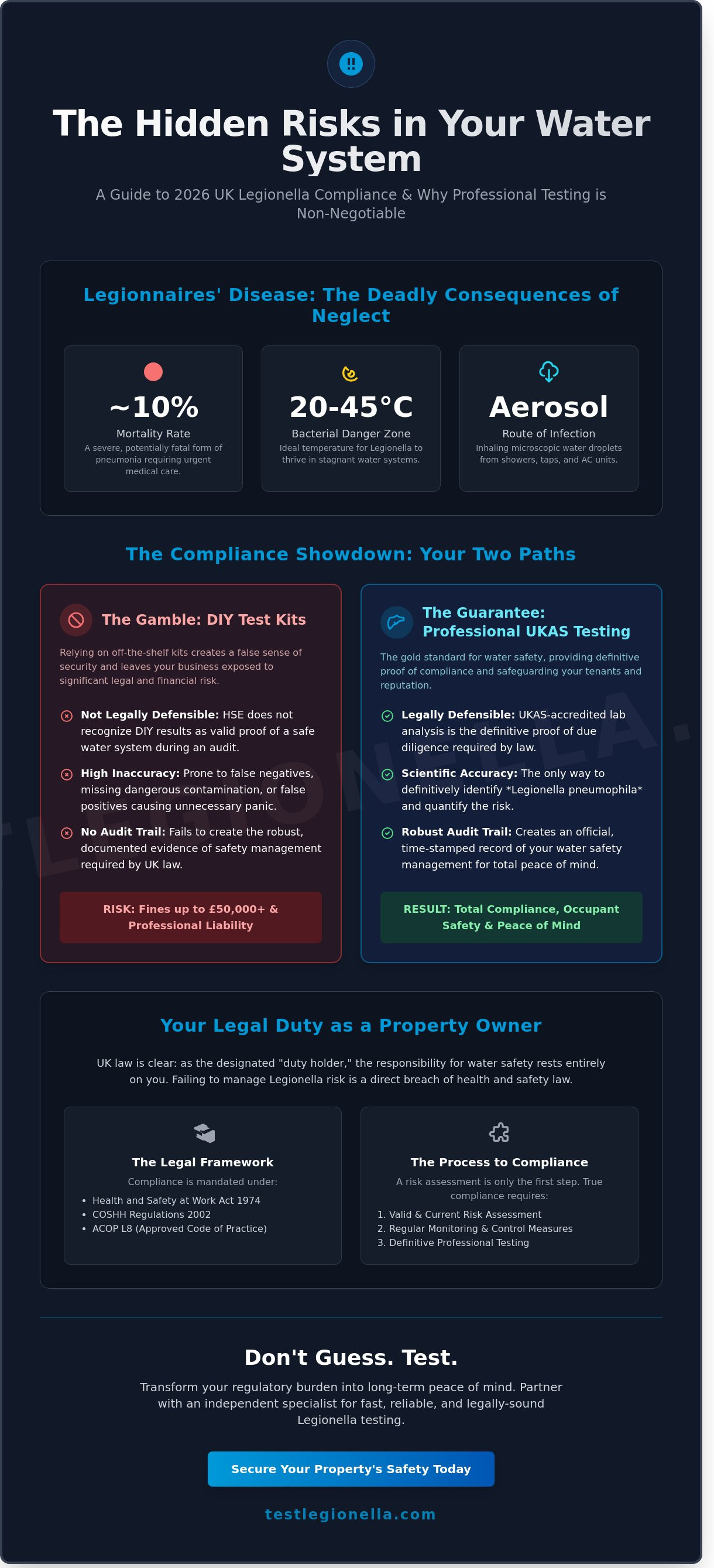
Legionnaires’ disease is a severe, potentially fatal form of pneumonia. According to data from UK health agencies, the mortality rate for those who contract the disease is approximately 10%. The bacteria thrive in stagnant water kept between 20°C and 45°C, making complex plumbing systems an ideal breeding ground. High-risk areas include cooling towers, commercial spa pools, and large-scale hot water networks found in hotels or care homes.
Infection doesn't happen through drinking contaminated water. Instead, the danger lies in aerosolisation. This occurs when tiny, invisible droplets of water are inhaled from everyday outlets like showers, spray taps, or air conditioning units. Professional legionella testing identifies these hidden threats in your pipework before they can be dispersed into the air. By the time symptoms appear in staff or tenants, the risk has already escalated. Proactive testing stops this cycle before it starts.
The Legal Burden of Proof for Property Owners
As a designated "duty holder" under the Health and Safety at Work etc. Act 1974 and the COSHH regulations, the legal responsibility for water safety rests entirely on your shoulders. You're required to manage risks through a valid risk assessment and regular monitoring. Professional testing creates a robust audit trail that is essential if you're ever visited by Health and Safety Executive (HSE) inspectors. It transforms your safety regime from a "best guess" into documented, scientific evidence of safety.
The regulatory environment in the UK is becoming more demanding. By 2026, the industry expects an even stronger shift from reactive fixes to proactive water management. Getting ahead of these changes now makes compliance easy and ensures your "Compliance Care" strategy is future-proof. We help you move from a state of uncertainty to total peace of mind by handling the logistics of sampling and reporting. This proactive stance isn't just about avoiding fines; it's about demonstrating a commitment to the safety of everyone who enters your property.
Legionella Testing Requirements: Navigating UK Law
The Health and Safety at Work etc Act 1974 creates a clear legal duty for employers and landlords to protect people from health risks. This includes managing biological hazards under the Control of Substances Hazardous to Health (COSHH) Regulations 2002. Legionella bacteria are classified as a biological agent; therefore, failing to control them is a direct breach of workplace safety laws. Compliance isn't optional. It's a fundamental requirement to ensure your water systems don't become a source of life-threatening disease. Failure to meet these standards can lead to unlimited fines, with recent HSE prosecutions resulting in penalties exceeding £50,000 for serious management failures.
ACOP L8 and HSG274: The Compliance Framework
The Approved Code of Practice (ACOP) L8 is your primary roadmap for safety. It holds a unique legal status. If you're prosecuted for a health and safety breach and haven't followed ACOP L8, you must prove in court that you met the law through other, equally effective means. This is an incredibly difficult task for any business owner. The 2013 update to this code reinforced that while risk assessments are mandatory for all premises, the depth of the plan must match the complexity of the system.
Technical guidance is found in HSG274, with Part 2 focusing specifically on hot and cold water systems. These documents dictate how often you should monitor temperatures and when legionella testing becomes a statutory necessity. Courts don't accept "I didn't know" as a valid defense. Following the UK Legionella Testing Requirements ensures your strategy is robust and your business is protected from litigation.
When is Testing Legally Required?
While a risk assessment is always the first step, physical water sampling is mandatory in specific scenarios. In high-vulnerability settings like care homes or healthcare facilities, the risk to residents is significantly higher, requiring more frequent and stringent checks. For most standard commercial buildings, legionella testing is triggered by specific events or system types:
- Open-circuit cooling towers and evaporative condensers require testing at least quarterly.
- Systems where temperature control is inconsistent or biocides are used as the primary control measure.
- Circumstances where a system has been out of use for a week or more.
- Immediate sampling is required if a system undergoes major structural changes or if monthly temperature checks fail (water below 50°C for hot or above 20°C for cold).
If you're unsure whether your current monitoring schedule meets these legal thresholds, you can get a professional compliance review to identify exactly where your property stands. This proactive approach transforms a complex legal burden into a manageable, stress-free routine.
Legionella Testing vs. Risk Assessment: Clearing the Confusion
The single biggest misconception we encounter among UK business owners is the belief that a risk assessment replaces the need for samples. It's a dangerous assumption that can lead to non-compliance. Think of your risk assessment as a map of your building's water system. It identifies where the hazards are, such as dead legs or tanks without lids. However, legionella testing is the physical proof that your controls are actually working. You wouldn't trust a map of a minefield without a metal detector; the same logic applies to water safety.
A risk assessment is your legal starting point under the HSE's ACoP L8 guidelines. It sets the stage by determining the level of threat. If your assessment identifies high-risk areas, you must validate your precautions. For example, while you might record a temperature of 51°C at a sentinel tap, testing confirms that no bacteria have survived in the stagnant pipework leading to that outlet. It turns "we think we're safe" into "we know we're safe."
The Limits of a Risk Assessment
A visual inspection has its boundaries. A qualified assessor can check for scale, debris, and temperature, but they can't see microscopic pathogens. Legionella bacteria often thrive within biofilms, which are slimy layers of microorganisms that cling to the inside of pipes. These biofilms protect bacteria from heat and chemicals. Even in systems that appear pristine on paper, bacteria can be present in concentrations exceeding 1,000 colony-forming units per litre (cfu/l). Relying solely on "paper compliance" without physical verification leaves you vulnerable to hidden colonization that a clipboard simply cannot detect.
Integrating Testing into Your Written Scheme
Once your risk assessment is complete, you must create a Written Scheme of Investigation. This is your proactive plan for managing water safety. Legionella testing should be a core component of this scheme, especially for cooling towers or complex hot and cold water systems in high-occupancy buildings. Using lab results to refine your strategy is common sense. If a test returns a positive result, you don't just treat the water; you update your risk assessment to find out why the failure happened.
Historical data is an incredibly powerful tool for property managers. By tracking sampling results over 12 to 24 months, you can identify seasonal risk patterns. You might notice that bacteria levels spike every July when building temperatures rise. This allows you to adjust your flushing regimes or biocontrols before a problem develops. This data-driven approach transforms compliance from a reactive chore into a streamlined, professional management system that ensures total peace of mind.
The Professional Testing Process: From Sample to Report
Professional legionella testing is a precise scientific operation; it's the method that transforms a complex legal requirement into a clear safety record. A specialist visit begins with identifying sentinel points, which are the outlets closest to and furthest from the water source. This ensures the samples represent the entire system's health rather than just a single tap. We use UKAS-accredited laboratories for analysis because their findings provide the only legally valid evidence of compliance. Since the 2013 update to the L8 Approved Code of Practice, UKAS accreditation has become the mandatory benchmark for proving your water management plan is effective. Results are delivered in Colony Forming Units per litre (CFU/L), giving you a mathematical breakdown of your water quality.
The Sampling Protocol (BS 7592)
Every sample we take follows the British Standard BS 7592 to ensure total accuracy. This protocol is vital because it prevents "false negatives" that could leave your tenants or staff at risk. We use pre-dosed bottles containing sodium thiosulfate to neutralise biocides like chlorine immediately. Without this step, chemicals in the water would continue to kill bacteria during transit, hiding the true scale of a potential outbreak. Our technicians maintain a strict chain of custody, ensuring samples are transported in temperature-controlled conditions and processed by the lab within 24 hours of collection.
What Happens if Legionella is Detected?
Finding a positive result is a signal to act, not a reason to panic. If levels exceed 1,000 CFU/L, the ACoP L8 guidelines require immediate intervention. We help you manage this through a structured response plan. This roadmap includes:
- Isolation: Shut down the affected outlets and install clear signage to prevent use.
- Remediation: We implement thermal disinfection by raising water temperatures to 60°C for one hour or perform a chemical shock treatment.
- Clearance Testing: After remedial works, a follow-up test is mandatory. You'll receive a clean report before the system is returned to service.
Don't leave your business safety to chance. Our Compliance Care approach makes regulatory adherence easy for business owners across the UK. You can secure your professional legionella testing today and get a clear, jargon-free report for your records.
Choosing a Legionella Testing Partner in 2026
Selecting the right partner for your legionella testing is a critical decision for any UK business owner or landlord. While it's tempting to look for the cheapest option, the legal stakes are too high for shortcuts. In 2024, the Health and Safety Executive (HSE) reinforced that the duty holder is responsible for the competence of those they appoint. This means that if your testing partner fails, the legal liability still rests on your shoulders.
DIY kits often fall short of full regulatory compliance for businesses. These kits typically only measure a single point in time and don't include the comprehensive site-wide risk assessment required by ACoP L8. They lack the professional "chain of custody" for samples, which is essential if you ever need to produce a defensible report in court. Without a specialist to identify structural risks like dead legs or thermostatic mixing valve (TMV) failures, a simple test strip provides a dangerous false sense of security.
General plumbers are excellent for fixing leaks, but they rarely possess the specific diagnostic tools or the deep regulatory knowledge required for water safety compliance. Independent specialists focus exclusively on microbiology and water systems. They provide a level of scrutiny that generalists simply can't match. Our automated Compliance Care systems prevent missed deadlines by tracking your testing schedule and sending proactive alerts. This ensures your property remains safe and your paperwork stays current without you having to lift a finger.
Evaluating Competence and Accreditation
Always verify that your partner holds UKAS accreditation and is a member of professional bodies like the Legionella Control Association. These credentials aren't just badges; they're your guarantee that the work meets the highest UK standards. Professional indemnity insurance is another non-negotiable factor. It protects your business from financial loss if a safety recommendation is missed. For UK landlords, you need a partner who understands the specific nuances of the Landlord and Tenant Act 1985 and the Housing Act 2004. We ensure your domestic or commercial properties meet every specific legal hurdle.
The Test Legionella Advantage
We're committed to fast, reliable, and authoritative compliance reporting. We don't believe in burying you under technical jargon. Instead, we transform complex legionella testing regulations into simple, actionable safety steps that protect your staff and tenants. Our reports are designed to be clear and easy to follow, giving you the confidence that your water systems are in expert hands. Don't leave your compliance to chance. Book your professional Legionella test today and let us handle the hard work for you.
Future-Proof Your Water Safety Strategy for 2026
Navigating the complexities of UK water safety doesn't have to be a burden. By 2026, the Health and Safety Executive expects all duty holders to demonstrate rigorous adherence to ACOP L8 requirements. You've learned that while a risk assessment identifies potential hazards, professional legionella testing provides the definitive data needed to protect your tenants and your reputation. Relying on UKAS-accredited laboratory analysis ensures every sample is processed with scientific precision, leaving no room for legal ambiguity.
Compliance is about more than avoiding fines; it's about creating a safe environment where you can focus on your business. Our team delivers comprehensive compliance reports that translate complex data into clear, actionable insights. We've simplified the process so you can secure your property without the stress of navigating technical jargon alone. Take the first step toward total peace of mind and ensure your water systems meet the highest safety standards.
Secure your property with professional Legionella testing today
Your safety is our priority, and we're ready to make your compliance journey smooth and stress-free.
Frequently Asked Questions
Is Legionella testing a legal requirement for UK landlords?
Yes, UK landlords have a legal duty to assess and manage the risk of exposure to Legionella under the Health and Safety at Work etc. Act 1974. You're responsible for the safety of your tenants and must ensure water systems are properly maintained. While the law doesn't mandate a specific certificate for every domestic home, it requires a formal risk assessment. Failing to comply can lead to prosecution by the HSE.
How often should Legionella water testing be carried out?
You should conduct legionella testing whenever your risk assessment identifies a potential hazard or if control measures aren't being met. For most UK business premises, we recommend reviewing your risk assessment every 2 years to stay compliant. You must test immediately if you change the water system, alter the building's use, or if water temperatures fluctuate between 20°C and 45°C. Regular checks provide total peace of mind.
Can I do my own Legionella testing with a DIY kit?
You can use DIY kits, but they often lack the UKAS accreditation required for a legally defensible audit trail. These kits don't provide the expert interpretation needed to manage a complex system safely. Professional testing ensures samples are handled correctly and analyzed in a controlled lab environment. This professional approach protects your business from liability and ensures your safety records meet the high standards expected by inspectors.
What is the difference between a Legionella test and a risk assessment?
A Legionella risk assessment is a physical survey of your water system to identify hazards, whereas a test involves taking water samples for lab analysis. The HSE ACoP L8 guidelines state that a risk assessment is a mandatory requirement for all UK businesses. Testing is the diagnostic tool used when the assessment suggests a high risk or when your temperature controls fail. Both are essential parts of your Compliance Care routine.
What happens if Legionella bacteria are found in my water system?
If samples return positive, you must take immediate action to protect occupants and staff. This usually involves chemical disinfection using chlorine or thermal disinfection at temperatures above 60°C. Once the system is cleaned, you'll need follow-up legionella testing to confirm the bacteria is gone. You should also update your risk assessment to identify the root cause of the outbreak. Our team guides you through this process to make it stress-free.
How long does it take to get Legionella test results back from the lab?
It typically takes 10 to 14 days to receive your final results from a UKAS-accredited laboratory. This timeframe is necessary because the lab must culture the bacteria to see if it grows, which is the most accurate method available. While some rapid tests offer results in 24 hours, they aren't always accepted for regulatory compliance. We deliver clear, digital reports as soon as the lab confirms your water's safety status.
Is a Legionella certificate the same as a test report?
There's no such thing as an official "Legionella Certificate" in UK law, so your test report serves as your proof of compliance. These documents provide a detailed breakdown of findings and any required actions for your water system. Our reports are designed for clarity, ensuring you have a solid paper trail for health and safety inspections. This documentation proves you've fulfilled your legal obligations under the Management of Health and Safety at Work Regulations 1999.
How much does professional Legionella testing cost in the UK?
Professional Legionella risk assessments for small UK properties typically range from £50 to £150. For larger commercial sites, costs vary based on the number of water outlets and system complexity. Laboratory testing for a single sample often costs between £30 and £60. Investing in professional services ensures you avoid the heavy fines associated with non-compliance, which can reach thousands of pounds for serious health and safety breaches. Get your quote today for an accurate price.