
Would you bet your business's future on a document you don't fully understand? With the UK Health Security Agency recording 488 cases of Legionnaires' disease in England and Wales in 2022, the stakes for property owners have never been higher. A professional legionella report is your primary shield against both health risks and legal liability, yet many landlords find these documents overwhelming and dense.
It's frustrating to face a pile of technical jargon when you just want to know if your building is safe. You likely feel the pressure of potential non-compliance fines and the weight of responsibility for your water systems. We promise to change that. You'll learn exactly how to interpret every section of your report, turning confusing data into a clear plan of action that ensures total property compliance.
This guide provides a transparent roadmap for 2026. We will examine specific report examples, explain which remedial actions require immediate attention, and show you how to manage water safety without the stress. It's about transforming a regulatory burden into genuine peace of mind and professional security.
Key Takeaways
- Understand the essential components of a professional legionella report and how it serves as a definitive roadmap for your property’s safety.
- Learn to accurately interpret risk categories by identifying the balance between hazard presence and the likelihood of exposure.
- Discover how to prioritize remedial recommendations to tackle high-risk areas first and maintain total regulatory compliance.
- See why standardized reporting is the most efficient way for landlords to manage safety across multiple property portfolios.
- Find out how our "Compliance Care" philosophy transforms complex legal jargon into clear, actionable steps for your peace of mind.
Understanding the Legionella Report: More Than Just a Compliance Document
A professional legionella report is far more than a simple administrative hurdle. It represents the formal output of a comprehensive risk assessment, acting as a strategic roadmap for your property's water safety. This document identifies exactly where the Legionella bacterium might find a foothold in your plumbing, cooling towers, or decorative fountains. By pinpointing these vulnerabilities, the report provides clear, actionable steps to eliminate hazards before they become a public health crisis.
You must treat this report as a live document. It's a common mistake to file it away once the assessment is complete. In reality, the law requires you to review and update your findings regularly. If you modify your water system, change the building's use, or if a site has been vacant for over 30 days, your risk profile shifts. A static report cannot protect you if the environment it describes has changed. Most industry standards recommend a full review every 24 months to maintain a high level of safety and operational excellence.
The Legal Framework: ACOP L8 and Your Responsibilities
Compliance isn't optional. Under the Health and Safety at Work etc Act 1974 (HSWA), employers and landlords have a statutory duty to protect employees and tenants from risks. The Health and Safety Executive (HSE) provides the technical roadmap through the Approved Code of Practice L8. For a deeper dive into these requirements, see our ACOP L8 explained guide which details the 2026 standards.
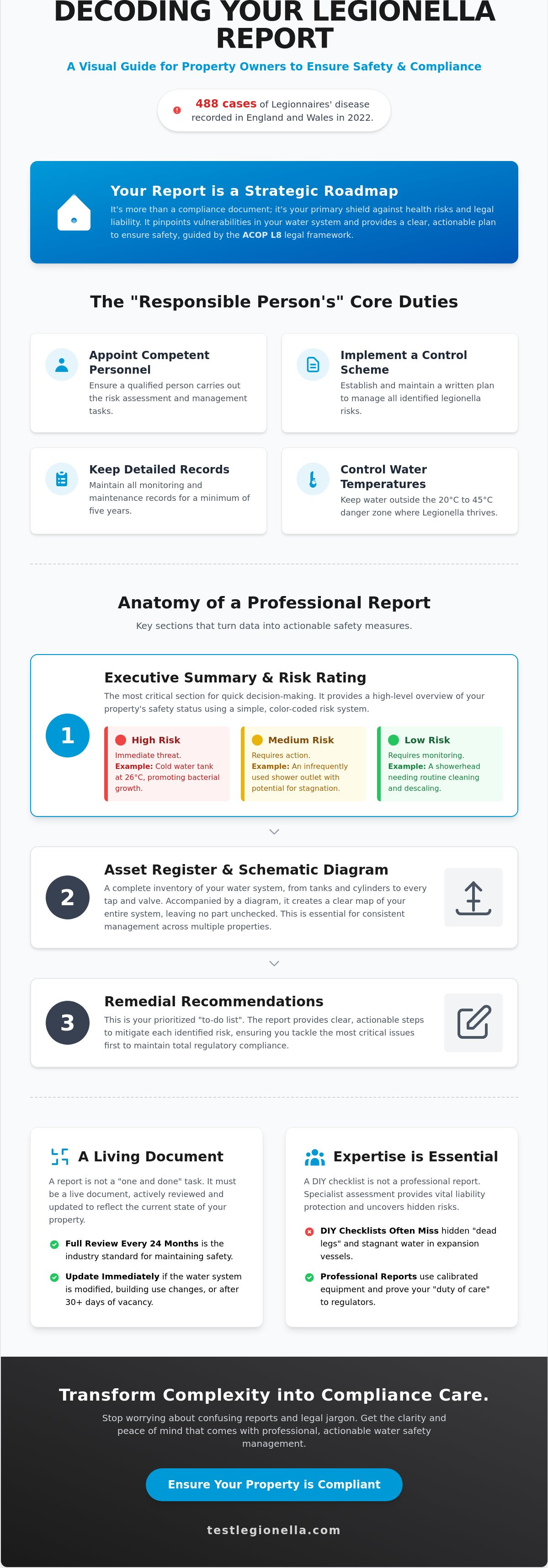
The law specifically identifies the "Responsible Person" as the individual tasked with managing water safety. Their duties include:
- Appointing a competent person to carry out the risk assessment.
- Implementing a written scheme of control to manage identified risks.
- Ensuring all monitoring and maintenance tasks are recorded and kept for at least five years.
- Maintaining water temperatures outside the 20°C to 45°C danger zone.
Why a DIY Checklist Is Not a Professional Report
While small, simple domestic properties might manage with basic checks, complex or high-occupancy systems require specialist expertise. A DIY checklist often misses hidden risks like "dead legs" (redundant pipework) or stagnant water in expansion vessels. If an inspector from the HSE or a local authority visits, they'll judge your compliance based on whether your legionella report is "suitable and sufficient."
A professional third-party report offers vital liability protection. It demonstrates that you've sought expert guidance to meet your legal obligations. Our specialists use calibrated equipment and industry-specific software to ensure every tap, tank, and valve is accounted for. This professional approach transforms a complex regulatory burden into Compliance Care, giving you total peace of mind that your property is safe and your legal standing is secure.
Anatomy of a Professional Legionella Report: Key Sections and Examples
A professional legionella report follows a rigorous, standardized structure to ensure every potential hazard is documented. For landlords managing a portfolio of 15 or more properties, these standardized documents are essential for maintaining oversight and consistency across different sites. Beyond simple organization, the report serves as your primary evidence of "duty of care" in any legal proceeding or regulatory audit. The Executive Summary is the most critical section for quick decision-making, offering a high-level overview of your site's safety status at a glance.
The Executive Summary and Risk Rating
Most specialists use a traffic light system to score risk levels. A "High Risk" finding might involve a cold water storage tank recorded at 26°C, a temperature that actively promotes bacterial growth. Conversely, a "Low Risk" observation might simply note a slightly dusty showerhead that requires a routine descale. While different regions have specific requirements, including U.S. regulations and guidelines for water safety, the core objective is to highlight immediate threats like stagnant water or failing temperatures before they cause harm.
Asset Register and Schematic Diagrams
Your legionella report must include an asset register. This is a detailed inventory of every tank, tap, and showerhead within the property. This list ensures that no part of the system is overlooked during monthly maintenance. To complement this, a schematic diagram provides a visual map of the water flow, helping engineers identify "dead legs" or redundant pipework where water can stagnate. Every professional report we produce includes timestamped photos of key assets, providing visual verification that the inspection was thorough and accurate.
Temperature Logs and Microbiological Analysis
Temperature control is the most effective way to manage risk. Inspectors record flow and return temperatures at sentinel points, which are the outlets closest and furthest from the water heater. A log entry showing a hot water return temperature of 47°C indicates a potential issue, as it must remain above 50°C to be effective. When temperatures fail or systems are complex, the report will include microbiological analysis from lab-tested water samples. This data confirms whether bacteria are physically present and at what concentration. You can simplify your oversight today with our Compliance Care services to ensure your records are always up to date.
Deciphering the Findings: How to Interpret Your Report’s Risk Categories
Your legionella report isn't a binary pass or fail grade. It's a calculated assessment of risk designed to keep your occupants safe. In professional water safety, risk is the combination of a hazard's presence and the likelihood of human exposure. For instance, a stagnant pipe in a locked basement carries a lower risk rating than a contaminated showerhead in a busy hotel. The report quantifies these variables so you can prioritize your maintenance budget where it matters most.
Findings differ significantly between property types. Residential reports for landlords often focus on simple issues like scaled-up showerheads or guest bathrooms that aren't flushed weekly. Commercial reports for offices or factories tend to highlight complex cooling towers and intricate HVAC systems. Don't worry if your report contains several "high-risk" flags. A report with findings doesn't mean you've failed your legal duties; it means you're now equipped with a roadmap for remediation. Think of the document as a tool for continuous improvement rather than a one-time test score.
Common Physical Risks: Dead Legs and Blind Ends
Dead legs and blind ends are two of the most frequent physical risks identified in modern water systems. A dead leg is a length of pipe leading to a tap or appliance that's rarely used, while a blind end is a redundant pipe that's been capped off but remains connected to the live system. Both are dangerous because they allow water to stagnate. Stagnant water loses its protective chlorine and reaches ambient temperatures, creating a perfect nursery for bacteria. A professional legionella report will document these with specific locations, such as "450mm redundant pipework behind the second-floor staff canteen sink," allowing your plumber to remove them efficiently.
Temperature-Related Risks: The "Danger Zone"
Temperature control is your primary defense against bacterial growth. Legionella bacteria thrive in the "Danger Zone" between 20°C and 45°C. As we explain in our What is Legionella guide, keeping cold water below 20°C and hot water above 50°C (or 55°C in healthcare) is vital. Reports frequently flag "lukewarm" water as a major compliance failure, which is often caused by faulty Thermostatic Mixing Valves (TMVs).
TMVs are designed to blend hot and cold water to prevent scalding, but they can become a liability if they aren't serviced. When a TMV fails or isn't adjusted correctly, it creates pockets of tepid water where bacteria can multiply rapidly. Your report will highlight any TMVs that aren't hitting the required temperatures, giving you a clear action plan to restore safety and peace of mind.
From Report to Action: Implementing Remedial Recommendations
Receiving your legionella report is a significant milestone, but the document's true value lies in the execution of its findings. It's a live roadmap designed to protect your tenants and your business. You shouldn't let it sit in an inbox; instead, use it as a checklist to transform potential risks into a secure environment. We recommend a structured five-step workflow to move from findings to full compliance care.
- Review the Remedial Actions: Head straight to the summary table. This section lists exactly what's wrong and the specific steps required to fix it.
- Prioritize by Risk Score: Your assessor ranks issues from low to high. Address 'High' or 'Critical' risks within 24 to 48 hours.
- Assign Competent Persons: Don't DIY complex plumbing changes. Hire specialists who understand ACoP L8 requirements to ensure the work meets legal standards.
- Document Everything: Record the date, the action taken, and the name of the person who completed the task. This builds your safety evidence.
- Schedule the Next Review: Compliance isn't a one-time event. Set your 2027 or 2028 review date now to avoid missing the deadline.
Prioritizing Urgent vs. Advisory Actions
Not every finding requires an emergency response. Findings labeled 'Immediate Action' usually involve water temperatures falling outside the safe 50°C to 60°C range or positive lab results. If your legionella report shows bacteria levels above 1,000 cfu/l, you must disinfect the system immediately. You'll then need to re-test the water within 7 to 10 days to confirm the treatment worked. Advisory actions, like descaling showerheads, are routine tasks you can schedule during monthly maintenance to keep the system clean.
The Importance of the Compliance Audit Trail
The law requires you to keep legionella records for at least five years. This includes the original risk assessment and proof of all remedial work. If an inspector visits or a health issue arises, this audit trail is your primary legal defense. Digital reporting makes this easy. It acts as a live logbook where you can track tasks across a large property portfolio. In 2026, paper files are a liability; digital compliance ensures you never lose a certificate or miss a critical safety window.
Ensure your property meets every safety standard with our expert guidance. Get your professional compliance score today.
Compliance Care: How Test Legionella Simplifies Your Reporting Process
Managing property safety shouldn't feel like a full-time job. At Test Legionella, we've refined our approach to ensure your legionella report is clear, actionable, and delivered without the technical headache. We operate under our "Compliance Care" philosophy. This means we don't just point out risks; we provide the roadmap to fix them. Our digital reporting platform gives you instant access to your safety data, allowing you to manage multiple properties from one secure dashboard.
Property owners often struggle with the complexity of water safety regulations. We strip away the jargon to provide a service that's fast and reliable. By using our streamlined process, you move from a state of potential risk to total peace of mind in a matter of days. Our goal is to make compliance a stress-free part of your maintenance schedule. We focus on being a trusted specialist that understands both the law and the logistics of property maintenance.
Fast Turnaround and Authoritative Results
Time is a critical factor in property management. We commit to delivering your comprehensive legionella report shortly after our site visit. You won't be left waiting for weeks to understand your risk level. Every assessor on our team is trained to the highest UK standards, ensuring your documentation stands up to legal scrutiny. Whether you own a single flat in the Midlands or a portfolio of commercial buildings across the UK, our national coverage ensures consistent, professional service everywhere you operate.
- Reports delivered via our digital portal for 24/7 access.
- Assessors fully qualified to ACOP L8 and HSG274 standards.
- Clear executive summaries that highlight urgent actions first.
Ongoing Support and Compliance Reminders
Compliance isn't a one-off event; it's a continuous cycle of safety. As we move through 2026, regulatory bodies are placing higher emphasis on the frequency and accuracy of risk assessments. To help you stay ahead, we provide an automated reminder service. We'll alert you when your annual or biennial review is approaching, so you never miss a deadline. This proactive system ensures you're always protected against changing legislation and potential fines.
Our team remains available to answer your questions long after the initial assessment is complete. We act as your efficient partner, guiding you through the maze of health and safety requirements with ease. Don't leave your property's safety to chance. Take the first step toward a simpler management process right now. Get your professional Legionella report today and secure the protection your property deserves.
Take Control of Your Building’s Safety Today
Managing water safety shouldn't feel like a complex regulatory burden. Your legionella report serves as the definitive roadmap for maintaining ACOP L8 compliance and protecting every occupant in your building. By understanding how to interpret risk categories and implementing remedial actions immediately, you transform a technical document into a shield against public health risks. Our specialist team provides UK-wide professional coverage to ensure your site meets the precise safety standards required by health and safety law. We deliver detailed reports that simplify the most technical findings into clear, actionable steps. With our automated compliance tracking and regular reminders, you'll never miss a critical inspection date again. We call this Compliance Care because it's designed to make your property management effortless. Don't leave your legal obligations to chance when expert support is a click away. Secure your professional Legionella report and peace of mind today. It's the most efficient way to stay protected and keep your focus on running your business safely.
Frequently Asked Questions
Is a Legionella report a legal requirement for UK landlords?
Yes, providing a Legionella report is a legal obligation for all UK landlords under the Health and Safety at Work Act 1974. The law requires you to identify and assess risks within your water systems to protect tenants from exposure. While you don't need a specific certificate, you must have a record of a risk assessment to prove compliance. This documentation ensures you meet your duty of care and avoid potential prosecution.
How long does a Legionella report stay valid?
Most industry experts recommend that a report stays valid for 24 months before a new assessment is required. Although the Health and Safety Executive (HSE) doesn't specify a fixed expiration date, they mandate that you review the assessment periodically. You must update your records if the water system changes or if the building's use evolves. Keeping your assessment current every two years provides continuous peace of mind and legal protection.
What happens if my Legionella report identifies high levels of bacteria?
You must take immediate remedial action if your report identifies high bacteria levels to ensure occupant safety. This process usually involves a full system disinfection, often called a chlorination, and adjusting temperatures so hot water reaches at least 60°C. You should also remove dead legs or redundant pipework where water stagnates. Once these fixes are complete, a follow-up test confirms the system is safe and your compliance is restored.
Can I produce my own Legionella report using a template?
You can technically produce your own report using a template if you're competent, but most landlords hire specialists to ensure no risks are missed. Professional assessors identify hidden dangers like internal scale or faulty thermostatic valves that a DIY check might overlook. Choosing an expert service makes compliance easy and provides a robust paper trail for local authorities. It's the most reliable way to manage your property's safety professionally.
What is the average cost of a professional Legionella report in 2026?
In 2026, the average cost for a professional domestic legionella report typically ranges from £50 to £150 according to industry market data. Prices for commercial properties or large houses in multiple occupation (HMOs) are often higher because their water systems are more complex. These rates cover the site visit and the detailed digital documentation you need for your records. Investing in a professional assessment delivers total Compliance Care for a predictable, flat fee.
Does a Legionella report cover both hot and cold water systems?
A comprehensive legionella report covers both hot and cold water systems to ensure every part of the property is safe. The assessor checks that cold water stays below 20°C and hot water reaches at least 50°C at the taps within 60 seconds of running. They also inspect storage tanks for debris and check calorifiers for signs of corrosion. This thorough approach ensures that bacteria cannot thrive in any section of your internal plumbing.
What is the difference between a water test and a Legionella report?
A water test is a laboratory analysis of a physical sample, while a report is a full audit of your entire water system's infrastructure. The report identifies structural risks like stagnant pipes or incorrect temperature settings before bacteria can grow. While a test shows what's in the water at one specific moment, the report provides a long term safety strategy. It's a proactive management tool rather than a reactive snapshot of water quality.
Do I need a new report if I change the boiler or water tank?
You need a new assessment immediately if you replace a boiler or water tank because these are significant system modifications. The HSE's ACoP L8 guidelines state that any change to the water system's architecture makes the previous risk assessment invalid. New equipment can alter flow rates and temperature profiles, creating different risk factors that must be documented. Updating your report straight away keeps your safety records accurate and ensures your new installation is fully compliant.