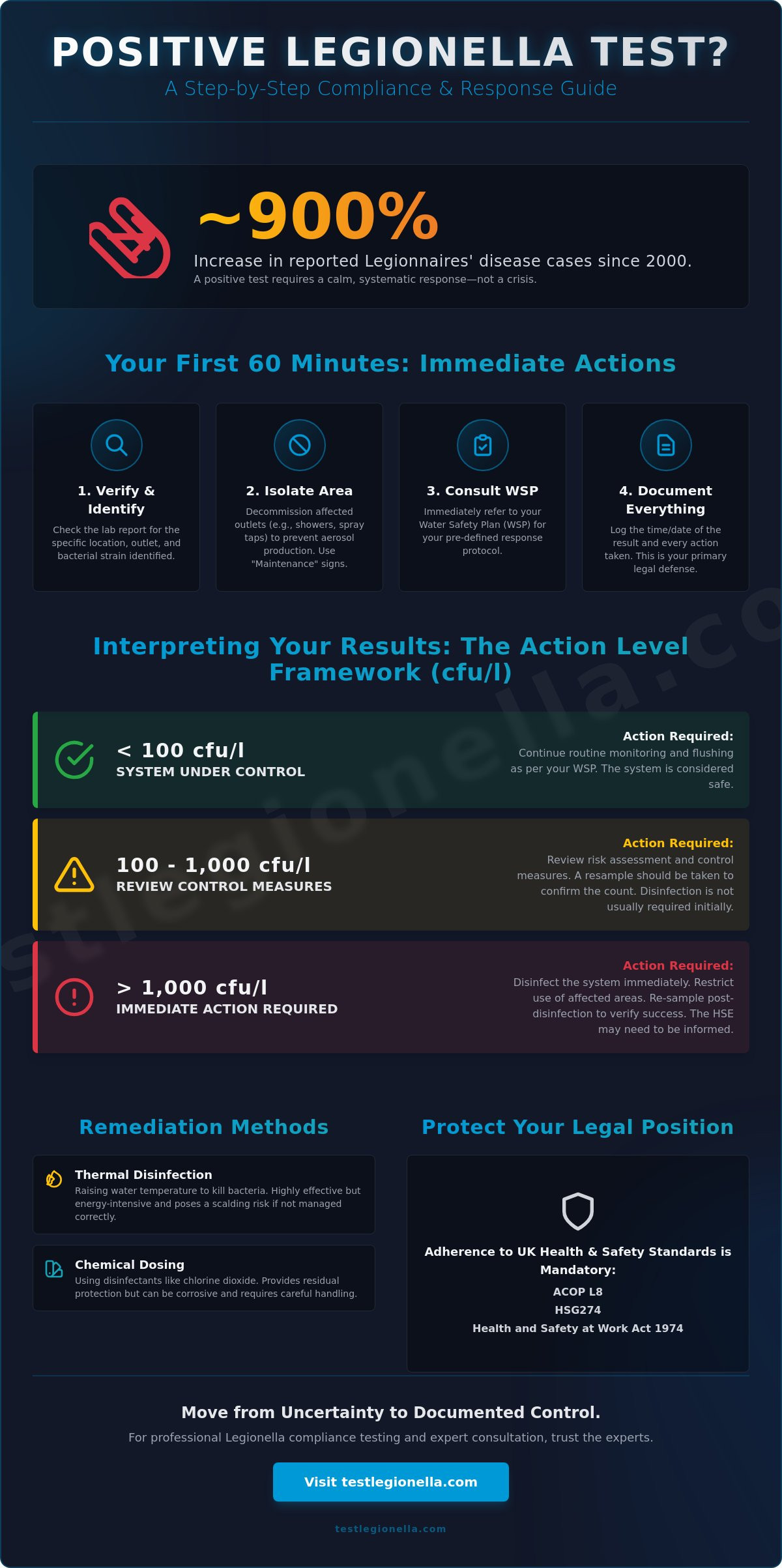
Reported cases of Legionnaires' disease have increased by nearly 900 percent since 2000; yet, receiving a notification of a positive sample still feels like an immediate crisis. If you've just opened a lab report showing elevated cfu/l levels, your first instinct might be anxiety. However, knowing exactly what to do after a positive legionella test result transforms a high-stakes safety risk into a manageable maintenance event. With UK health and safety standards requiring strict adherence to ACOP L8 and HSG274, reacting with speed and precision is the only way to protect your occupants and your professional standing.
It's natural to feel pressured when faced with technical lab jargon and the threat of legal prosecution. You need to ensure total safety without getting lost in a maze of regulatory red tape. This guide provides a clear, professional roadmap to navigate these requirements with confidence. We'll break down the essential physical response, explain the latest action thresholds, and show you how to document every step to ensure your facility remains fully compliant. You'll move from uncertainty to a state of calm, documented control that protects both your people and your reputation.
Key Takeaways
- Identify and isolate risk areas immediately by pinpointing the specific location and bacteria strain highlighted in your technical report.
- Decipher complex cfu/l data to determine exactly what to do after a positive legionella test result based on current HSE action levels.
- Navigate legal obligations under ACOP L8 and the Health and Safety at Work Act 1974 to secure your documented compliance.
- Compare remediation methods like thermal disinfection and chemical dosing to select the most efficient path for your specific water system.
- Confirm the success of your corrective actions through professional re-sampling and learn why timing is critical to avoid inaccurate results.
Immediate Actions: Your First Steps After a Positive Result
Receiving a positive lab report is a critical moment that requires a composed, systematic response. Your first move is to verify the data within the report itself. Look at the specific outlet identified; is it a shower in a guest suite or a rarely used sink in a staff room? Knowing the specific strain is equally vital for your risk assessment. While all Legionella bacteria require attention, certain serogroups are more frequently associated with outbreaks of Legionnaires' disease. Once you've confirmed the location and the strain, notify your designated Responsible Person immediately. This is the core of what to do after a positive legionella test result: move from raw data to controlled action without triggering unnecessary alarm among staff or residents.
Consult your Water Safety Plan (WSP) right away. This document should already contain a pre-planned response for positive samples. Following your established protocol ensures that your reaction is consistent with your legal duties under the Health and Safety at Work Act. By acting according to a pre-approved plan, you demonstrate professional competence and maintain a clear path toward resolution. Speed is essential, but accuracy in these first sixty minutes will define the success of your entire compliance roadmap.
Securing the Affected Area
Isolation is your most effective tool for immediate risk reduction. If the positive result came from a shower, spray tap, or any outlet that creates a fine mist, you must stop aerosol production. Physically decommission the outlet by removing showerheads or using "Do Not Use" covers. Communication here is a delicate balance. Use professional, neutral signage that indicates "Maintenance in Progress" rather than alarmist warnings. Identify any high-risk individuals on-site, such as those with weakened immune systems or the elderly, and ensure they are steered away from the affected zone until remediation is complete.
Initial Documentation and Records
Your legal defense begins the moment you receive the lab notification. Log the exact time and date the result arrived in your inbox. This creates a verifiable timeline for the Health and Safety Executive (HSE) should they ever audit your records. Document every action you take, from the minute you restricted access to the specific stakeholders you notified. A robust paper trail proves you acted with due diligence and followed your professional obligations. This documentation isn't just administrative work; it's your primary shield against claims of negligence and a vital part of what to do after a positive legionella test result.
Interpreting the Data: What Your cfu/l Count Actually Means
Your lab report arrives with a number followed by the unit cfu/l. This stands for Colony Forming Units per litre. It represents the number of individual bacteria in a water sample that were able to multiply and form visible colonies during the laboratory incubation period. Think of this as a snapshot of your water system's microbial health at the exact moment the sample was taken. While reported cases of Legionnaires' disease have increased by nearly 900 percent since 2000, a single positive result is rarely a reason for a total building shutdown. Instead, it's a signal to investigate. Knowing how to read these numbers is a vital part of what to do after a positive legionella test result.
Differentiating between a localized issue and a systemic problem is key to a cost-effective response. A positive result from a single distal outlet, like a specific staff sink, often indicates a local colonization rather than a contaminated water tank. You don't need to panic or close your doors; you need to follow the established action levels to restore safety. Most situations are resolved through targeted maintenance rather than expensive, building-wide interventions. If you need help analyzing your specific data, professional Legionella compliance testing experts can help you determine the most efficient path forward.
The Action Level Framework
The HSE HSG274 guidelines provide a clear hierarchy for response based on your cfu/l count. If your results are under 100 cfu/l, the system is generally considered under control. You should continue your routine monitoring and perhaps increase flushing in that specific area. For results between 100 and 1,000 cfu/l, you must review your control measures. This involves checking your water temperatures at the heater and points of use to ensure they meet ASHRAE or local standards. If the count exceeds 1,000 cfu/l, the bacteria have established a significant presence. This level requires immediate remedial action, a review of your risk assessment, and follow-up sampling to confirm the success of your intervention.
Identifying the Strain: Why Legionella Pneumophila Matters
The urgency of your response often depends on the specific strain identified in your report. Legionella pneumophila Serogroup 1 is the primary cause of Legionnaires' disease and is responsible for the majority of severe clinical outbreaks. If your report identifies this specific strain, you must prioritize your remediation efforts immediately. Other serogroups or non-pneumophila species still require attention to prevent future growth, but they typically present a lower immediate risk. Understanding this distinction helps you prioritize your resources and provides peace of mind that you're addressing the most critical threats first. This technical clarity is the foundation of what to do after a positive legionella test result while maintaining operational efficiency.
Remediation Strategies: Cleaning and Disinfecting Your Water System
Action follows interpretation. Once you've identified the severity of the contamination, your focus must shift to physical intervention. This is the most labor-intensive part of what to do after a positive legionella test result, but it's essential for long-term safety. You cannot simply rely on chemicals to penetrate thick biofilm; you must physically remove the habitat where bacteria thrive. Start by dismantling showerheads and hoses. These components often harbor scale and organic matter that protect Legionella from heat and chlorine. Descale them thoroughly or replace them entirely if they show signs of significant degradation.
Address stagnant water next. Legionella flourishes in "dead legs", which are sections of pipework where water no longer flows. If your site audit identifies these redundant pipes, remove them back to the main spur. For areas with low usage, implement a rigorous flushing regime. Moving water prevents the stagnation and temperature gain that allow microbial colonies to expand. Physical cleaning also extends to your cold water storage tanks. If sediment or debris has accumulated at the base, it provides a nutrient source for bacteria. Drain and scrub these vessels to ensure the water entering your system starts at the highest possible quality.
Thermal vs. Chemical Disinfection
Choosing between thermal and chemical methods depends on your system's design. Thermal disinfection, or "heat and flush," involves raising water temperatures to at least 60°C (140°F) at the heater and flushing every outlet for at least five minutes at 50°C or higher. While effective and chemical-free, it can stress older pipework and carries a scalding risk. Chemical shock dosing, often using chlorine or silver hydrogen peroxide, is highly effective for systemic contamination in cold water lines. It penetrates biofilms efficiently but requires careful monitoring of concentration levels to avoid pipe corrosion. Use a hybrid approach if necessary to ensure every part of the infrastructure is reached.
Targeting the Root Cause
Disinfection is a temporary fix if you don't address the underlying failure. Investigate why your temperature controls lapsed. ASHRAE Standard 188 recommends maintaining hot water above 140°F at the heater and above 122°F at points of use, while keeping cold water below 68°F. If your system falls into the danger zone of 20°C to 45°C, bacteria will return. Check for cross-contamination where uninsulated hot and cold pipes run too close together, causing "heat gain" in the cold supply. Resolving these structural issues is a critical step in what to do after a positive legionella test result to prevent a recurring compliance failure.
Legal Obligations and Compliance: Protecting Your Position
Protecting your business from legal scrutiny requires more than just fixing a plumbing issue. Under the Health and Safety at Work Act 1974, you have a non-delegable duty to ensure the safety of your water systems for employees, tenants, and visitors. A positive result is a formal notification that your current control measures have failed. Knowing exactly what to do after a positive legionella test result is central to demonstrating that you've fulfilled your statutory duties. Your primary legal defense rests on your ability to prove that you acted reasonably, promptly, and in full accordance with established codes of practice.
Aligning your response with ACOP L8 provides the technical framework necessary to secure your professional standing. This Approved Code of Practice has a special legal status; if you are prosecuted for a breach of health and safety law and it is proved that you did not follow the relevant provisions of ACOP L8, you will need to show that you complied with the law in some other way. The "Responsible Person" must take immediate ownership of the event, coordinating the isolation and remediation steps discussed in previous sections. To ensure your records meet these high standards, you should rely on professional Legionella compliance testing to provide the verifiable data required for your logbook.
Updating Your Risk Assessment
A positive lab report constitutes a "significant change" in your building's risk profile. Updating your risk assessment is a legal requirement following any significant change to your water system or the discovery of new risks. You must review your existing document to identify why the bacteria proliferated. Was it a temperature failure, a hidden dead leg, or a lack of consistent flushing? Integrate your remedial actions and follow-up test results directly into your long-term water safety logbook. This creates a continuous audit trail that transforms a potential liability into evidence of a proactive safety culture.
Reporting to Authorities
There is often confusion regarding when to notify external bodies. A positive Legionella result is not typically reportable under RIDDOR unless a doctor formally diagnoses a case of Legionnaires' disease in an employee who has worked on the premises. However, if your facility is under the jurisdiction of a local Environmental Health Officer (EHO), they may require notification depending on the cfu/l count and the nature of the building, such as a healthcare setting. Managing your reputation during this process involves transparent communication with stakeholders. By showing that you have a clear action plan and are following the 2026 compliance roadmap, you maintain trust and demonstrate that the risk is under expert management. This structured approach is the most effective way to handle what to do after a positive legionella test result without damaging your brand's integrity.
Verification and Prevention: Closing the Loop with Test Legionella
Remediation is only half the battle. Without verification, your efforts remain unproven in the eyes of the law. This final phase is arguably the most critical part of what to do after a positive legionella test result because it provides the objective data needed to close the incident in your logbook. Re-sampling isn't just a recommendation; it's a requirement to confirm that your thermal or chemical interventions reached every corner of the system and successfully eradicated the colonization. Only a clear lab report can restore the peace of mind that your occupants are safe and your legal position is secure.
Moving from a reactive crisis to a proactive state of control requires a long-term strategy. Implementing a robust Legionella monitoring schedule ensures that you catch minor fluctuations before they escalate into systemic failures. This consistent oversight transforms water safety from a stressful regulatory burden into a routine, manageable part of your facility operations. It's about maintaining a steady state of safety where the risk is known, measured, and consistently managed.
The 48-Hour to 2-Week Re-Testing Window
Timing is everything when it comes to follow-up sampling. While you might be eager to prove the system is clear, testing too soon after disinfection often leads to false negatives. Industry standards recommend waiting at least 48 hours, and ideally up to two weeks, before taking verification samples. This delay allows any residual disinfectant to dissipate and gives any surviving bacteria enough time to recover and show up in a culture test. A "clear" result obtained too early is legally fragile and technically unreliable. By waiting for the appropriate window, you ensure your data is accurate and your building is truly safe.
Professional Compliance Support
Achieving a state of calm competence requires an expert partner. Test Legionella provides the independent, accredited verification you need to satisfy both internal stakeholders and external regulators. Our process is designed for busy professionals who value speed and technical accuracy over complex jargon. We provide the documentation that serves as your primary shield against liability, ensuring your compliance roadmap is complete and verifiable. Don't leave your property's safety to chance after an incident. Take the final step to secure your property and book a professional re-test today. This proactive approach is the definitive answer to what to do after a positive legionella test result while protecting your long-term interests.
Securing Your Facility’s Future
Managing water safety is a continuous commitment to professional excellence. By isolating affected outlets immediately and interpreting your cfu/l counts with technical precision, you've already mitigated the primary risk. Following this with targeted remediation and updated risk assessments ensures you remain on the right side of ACOP L8 and the Health and Safety at Work Act. Now that you understand what to do after a positive legionella test result, the final step is to validate your success with objective, scientific data. Verification is the only way to transform a period of uncertainty back into a state of total operational confidence.
Restoring safety doesn't have to be a complex regulatory burden. Our specialists provide UKAS-accredited laboratory analysis and expert compliance reporting tailored specifically for landlords and businesses. We offer a fast, nationwide service to ensure your rapid response is backed by the highest standards of evidence. Get a professional Legionella compliance re-test today to close the loop on your remediation and protect your occupants. You've taken the right steps to manage the challenge; now, let us help you prove it. Your path back to tranquility and stress-free management starts with a single, verified clear result.
Frequently Asked Questions
Do I have to evacuate my building after a positive Legionella test?
Evacuation is rarely necessary following a positive result. Your primary goal is to prevent the inhalation of contaminated water droplets; therefore, you should focus on isolating specific outlets like showers or spray taps. A full building shutdown is typically reserved for high-risk healthcare environments or severe, widespread outbreaks where control measures have failed. Most commercial and residential buildings can remain operational while targeted remediation and follow-up testing are carried out.
How much does it cost to fix a positive Legionella result?
Remediation costs are highly variable because they depend on the size of your water system and the extent of the contamination. Minor issues might only require increased flushing or the replacement of showerheads, which involves minimal expense. More significant colonizations may require professional chemical disinfection or thermal flushing. While the cost of remediation isn't standardized, investing in a targeted response is always more cost-effective than facing legal penalties or the expenses associated with a full system failure.
Can I just use bleach to clear Legionella from my pipes?
Standard household bleach is insufficient for professional water system disinfection. Legionella bacteria often hide within thick layers of biofilm that household chemicals cannot penetrate. To ensure safety, you must use stabilized chemicals like silver hydrogen peroxide or high-concentration chlorine shock dosing. These professional-grade solutions are designed to strip away biofilm and eradicate bacteria throughout the entire infrastructure, providing the level of protection required for legal compliance.
How long do I have to wait to re-test after chemical disinfection?
Wait at least 48 hours to 14 days before taking follow-up samples. Testing too soon after a disinfection event often leads to false negatives because residual chemicals in the pipes can kill the bacteria in the sample bottle. This waiting period is a critical part of what to do after a positive legionella test result to ensure your data is accurate. A clear result after this window provides the objective proof needed to confirm your system is safe for use.
Will a positive test result lead to a fine from the HSE?
A positive test result itself does not automatically lead to a fine; however, failing to act on that result certainly can. The Health and Safety Executive (HSE) focuses on whether you followed ACOP L8 and your own risk assessment. If you can demonstrate a prompt, documented response that includes isolation and remediation, you are fulfilling your legal duties. Fines and prosecutions are generally reserved for cases of negligence where known risks were ignored.
Do I need to tell my tenants about a positive Legionella result?
Yes, you have a professional duty of care to inform anyone who might be at risk. Transparent communication is essential for maintaining trust and ensuring tenant safety. Provide clear instructions on which outlets to avoid and explain the specific steps you're taking to resolve the issue. Using a problem-solution framework in your communications helps keep residents calm while demonstrating that you're an organized and proactive landlord or building manager.
Is it safe to drink the water if Legionella is present in the system?
Ingesting water containing Legionella is generally not considered a risk for healthy individuals because the bacteria must be inhaled in mist form to cause infection. However, the presence of the bacteria indicates a wider systemic failure that must be addressed. While drinking the water may be technically safe, most managers provide alternative water sources during remediation to maintain a high standard of care and provide total peace of mind for occupants.
What is the most common cause of a positive Legionella test result?
Stagnation and poor temperature control are the most frequent drivers of bacterial growth. When water sits in "dead legs" or unused pipes, it often enters the danger zone of 20°C to 45°C, where Legionella multiplies rapidly. This is why understanding what to do after a positive legionella test result always involves a thorough review of your heating systems and flushing regimes. Maintaining consistent temperatures and high turnover is your best defense against a recurring positive result.