
Did you know that as of May 2026, failing to meet the new monthly cooling tower testing requirements in New York City carries a minimum civil penalty of $10,000 per violation? It's a staggering figure that transforms water safety from a hidden cost into a critical financial priority. You likely understand the gravity of these risks, yet you're still facing 2026 budget constraints and stakeholders who view compliance as a burden rather than an asset. It's difficult to quantify the ROI of prevention when the goal is simply for nothing bad to happen.
We're here to help you bridge that gap. This guide provides a step-by-step framework on how to build a business case for legionella testing budget by framing water safety as a strategic financial shield. You'll learn how to present a professional, data-backed proposal that secures executive approval and delivers total peace of mind regarding legal liability. We will analyze the latest 2026 regulatory shifts, quantify the cost of inaction, and show you how our Compliance Care approach makes long-term safety easy to manage and even easier to justify to your board.
Key Takeaways
- Reframe water safety as a proactive financial asset rather than a reactive repair cost to align with 2026 corporate goals.
- Learn how to build a business case for legionella testing budget using a five-step framework that leads with executive peace of mind and data-backed risk assessments.
- Evaluate the true ROI of prevention by comparing modest testing fees against the heavy costs of HSE Improvement Notices and the Fee for Intervention (FFI) scheme.
- Neutralize common C-suite budget objections by demonstrating that professional testing is the only reliable way to detect silent system vulnerabilities.
- Simplify your long-term safety obligations by partnering with a specialist who provides automated compliance tracking and expert analysis.
Defining the Value: Why Legionella Compliance is a Strategic Financial Priority
In 2026, viewing water safety as a simple line-item expense is a high-risk gamble that most businesses can't afford. Smart property managers and landlords now recognize that a robust testing program isn't just about ticking boxes; it's a proactive risk management strategy that protects the bottom line. When you understand how to build a business case for legionella testing budget, you're creating a powerful tool for strategic liability transfer. In this context, a business case is a formal proposal that justifies investment by proving how professional oversight shifts risk away from your balance sheet. This is the core of our Compliance Care standard, which transforms a complex regulatory burden into a streamlined path to operational security.
The Legal Framework: ACOP L8 and HSG274
The 2026 UK regulatory environment demands total transparency from those in charge of building safety. Under the guidelines of ACOP L8, the designated Responsible Person carries the legal weight of ensuring water systems remain safe. Ignorance of system colonization is never a valid defense in court. If a system becomes a source of infection, the law assumes you failed in your duty to monitor and manage. Understanding what Legionella is and how it thrives in stagnant or poorly maintained pipes is essential for any decision-maker. Because Legionnaires' disease can have a case fatality rate as high as 30%, the Health and Safety Executive (HSE) treats even minor gaps in testing with extreme gravity. Professional testing provides the objective, documented evidence you need to prove your system is under control at all times.
From Cost Center to Risk Mitigation
Shifting your mindset from crisis management to preventative maintenance is the most effective way to protect your 2026 budget. Reactive repairs are notoriously expensive, often involving emergency plumbing fees, intensive chemical flushes, and unplanned system shutdowns that halt business operations. Professional testing identifies bacterial growth before it requires these massive remedial works. Beyond immediate safety, a clear and consistent audit trail offers several financial advantages:
- Lower Insurance Premiums: Demonstrating rigorous compliance can reduce the perceived risk for insurers.
- Increased Property Value: Verified safety records are a high-value asset during building surveys or sales.
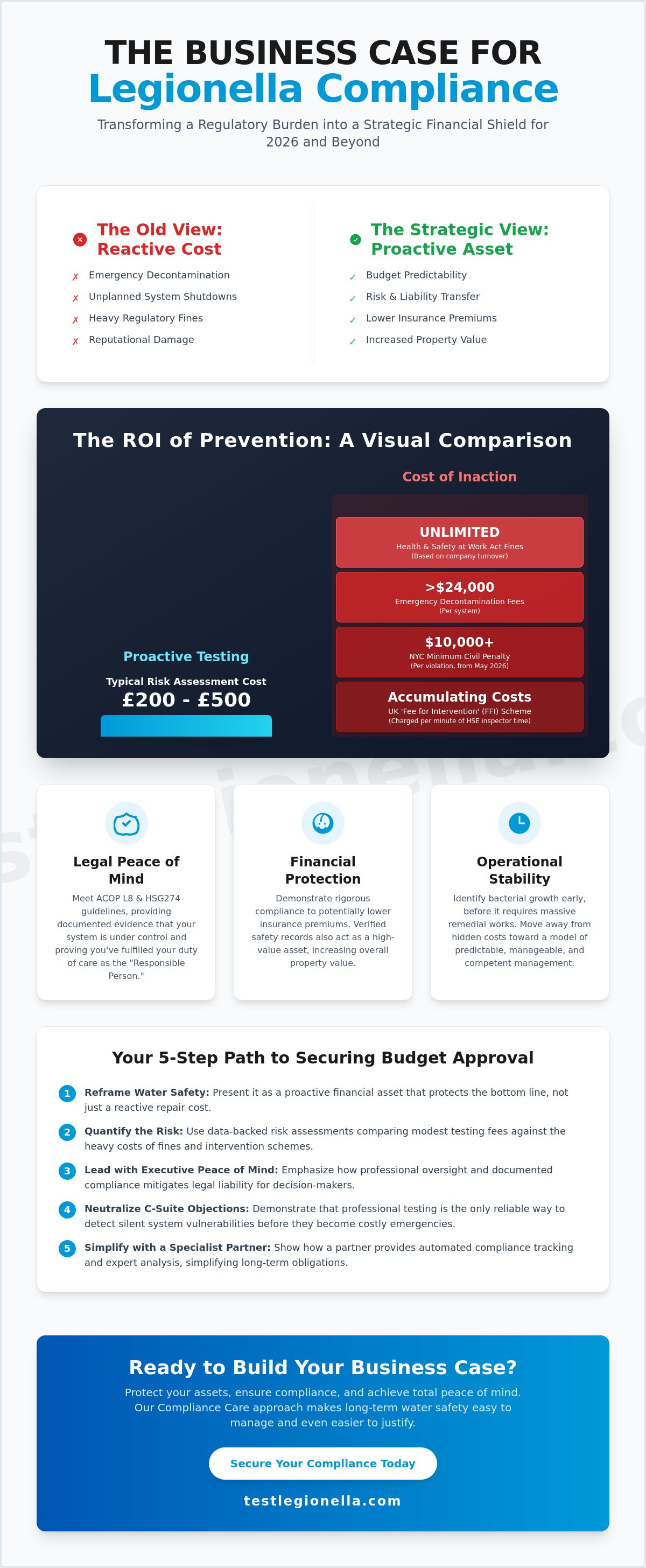
- Budget Predictability: Recurring testing costs are easy to manage, whereas emergency decontamination fees can exceed $24,000 for a single system.
By securing a dedicated budget now, you move away from the stress of "hidden" costs and toward a model of calm, competent management. This proactive stance ensures your facility remains open and your reputation stays intact throughout the year.
The Cost of Inaction: Evaluating the True ROI of Preventative Testing
The Health and Safety Executive (HSE) doesn't just issue warnings; they issue invoices. Under the 'Fee for Intervention' (FFI) scheme, if an inspector identifies a material breach in your water safety protocols, your business is charged for every minute of their time spent on the investigation. This includes site visits, writing reports, and legal consultations. These costs accumulate rapidly, often draining maintenance budgets before any actual repairs begin. Understanding these financial stakes is essential when you're learning how to build a business case for legionella testing budget. Beyond the FFI, the Health and Safety at Work Act allows for unlimited fines. Courts now base these penalties on company turnover, meaning a single lapse in compliance could lead to a six or seven-figure penalty that no insurance policy will cover.
Calculating Potential Liabilities
To see the true ROI, compare the relatively low cost of a risk assessment, which typically ranges from £200 to £500 for smaller commercial buildings, against the devastating price of a legal defense. Direct costs are easy to track: fines, solicitor fees, and emergency remedial plumbing. However, the indirect costs are often what sink a business. A publicized outbreak leads to immediate closure, catastrophic loss of tenant trust, and a permanent stain on your brand reputation. In 2026, news of a health violation spreads through social media in minutes. Recovering from that level of PR damage costs far more than a year of scheduled testing. You can request a compliance review to see where your current vulnerabilities lie before the HSE does.
The 'Peace of Mind' Dividend
Investing in a managed testing schedule delivers a return that doesn't always show up on a spreadsheet: the reduction of the mental load on your management team. When you have a specialist handling your water safety, you aren't constantly wondering if you've missed a deadline. Our Compliance Care approach ensures you have "ready-to-go" reports for any surprise health inspection. This transforms property management from a high-stress gamble into a streamlined, predictable process. Regular testing acts as a stress-free shield for your portfolio, ensuring that your buildings remain safe, compliant, and profitable without the constant threat of regulatory intervention.
5 Steps to Creating a Compelling Legionella Testing Budget Proposal
Securing a dedicated budget requires you to move beyond technical jargon and speak the language of the boardroom. Your stakeholders need to see that this investment is a strategic shield for the entire organization rather than just a maintenance chore. Follow this structured five-step framework to master how to build a business case for legionella testing budget that wins approval from even the most cautious decision-makers.
- Step 1: Executive Summary. Lead with the "Peace of Mind" benefit and total risk coverage. Frame the budget as a high-yield insurance policy that protects the company's reputation.
- Step 2: Risk Assessment Findings. Use hard data to show current system vulnerabilities. Highlight specific issues like dead legs or temperature fluctuations that were identified in your most recent survey.
- Step 3: Proposed Testing Schedule. Detail the frequency of sampling. Whether your system requires monthly or quarterly checks, show how this schedule aligns with your specific property types and usage patterns.
- Step 4: Financial Comparison. Contrast the predictable cost of testing against the catastrophic expenses of an outbreak. Mention the multi-faceted nature of these costs, including remediation fees and legal representation.
- Step 5: Implementation Timeline. Define how quickly the building can reach 100% compliance. This provides a sense of momentum and shows that you have a clear, actionable plan for 2026.
Structuring the Executive Summary
Your opening paragraph must grab a Director's attention immediately. Focus on "Compliance Made Easy" as the primary project goal to reassure them that this won't be an administrative burden. We recommend including a "Compliance Score" at the very top of the document. This simple metric gamifies the need for improvement and makes the current risk level impossible to ignore, moving the conversation from "if" we should fund it to "when" we can start.
Using Data to Support Your Claims
Objective data is your most persuasive tool in any budget negotiation. Present previous water temperature logs as concrete evidence of risk rather than just offering a subjective opinion. Visualizing this data is key for busy stakeholders. We suggest using a "Red, Amber, Green" status for every water outlet in the facility to show exactly where the system is failing. Professional, tailored reports are significantly more persuasive than generic templates because they prove you understand the specific logistics of your property maintenance and the unique needs of your tenants.
Addressing Common C-Suite Objections to Water Safety Spending
The most challenging part of how to build a business case for legionella testing budget often happens during the final review. Even with a solid proposal, you'll likely face pushback from stakeholders focused on immediate overheads. You must be prepared to counter these objections with logic and data. When a Director claims testing is "too expensive," remind them that the cost of a single HSE fine or a civil lawsuit far outweighs the price of prevention. In some jurisdictions, like New York City, failing to meet new 2026 testing frequencies now results in automatic $10,000 penalties. In the UK, the "Fee for Intervention" ensures that even the time an inspector spends pointing out your mistakes is billed to your company. Professional testing isn't an optional luxury; it's the only way to avoid these uncapped financial leaks.
Another common hurdle is the "we've never had a problem" argument. This is a dangerous fallacy because Legionella is a silent colonizer. It thrives in stagnant pipework and dead legs without changing the water's taste, smell, or appearance. You won't know there's a problem until an outbreak occurs, at which point the damage to your reputation is already done. Compliance is a 24/7 legal duty that doesn't follow a seasonal schedule. Waiting until next year to fund your safety program leaves a 365-day gap in your legal protection that a prosecutor will exploit if an infection is traced back to your site.
The Fallacy of 'In-House' Testing
Some managers suggest saving money by tasking internal maintenance staff with water sampling. This approach creates a significant liability gap. In-house staff often lack the specialized equipment and UKAS-accredited laboratory partnerships required for legally defensible results. There's also the risk of internal bias, where staff might overlook issues to avoid extra work. A third-party "Certificate of Compliance" provides an independent, expert stamp of approval that holds up in court. It proves you've taken every reasonable step to ensure safety, effectively transferring the technical risk to a specialist partner.
Winning Over the Finance Director
To get the Finance Director on your side, focus on budget certainty. Our "Fixed-Fee" approach means there are no surprise costs or hidden extras throughout the year. Explain how our Compliance Care model reduces the need for expensive emergency call-outs by catching system imbalances early. By providing fast, reliable reporting, we ensure your team spends less time on paperwork and more time on high-value tasks. You can Get My Quote today to provide your finance team with the exact figures they need for the 2026 budget cycle.
Securing Your Budget with a Professional Compliance Partner
You've identified the legal risks, quantified the potential for massive fines, and prepared your counters for C-suite objections. Now, you need the final piece of the puzzle: a partner who turns those theoretical plans into a tangible, fixed-cost reality. Choosing the right specialist is the most critical part of how to build a business case for legionella testing budget. You need a partner who understands that you aren't just buying water samples; you're buying a shield against legal liability and operational downtime. We provide the professional weight you need to move your proposal from a "maybe" to a definitive "yes."
The Test Legionella Advantage
Test Legionella offers a no-nonsense approach to complex health and safety regulations. We specialize in transforming the heavy burden of ACOP L8 into a streamlined, automated process we call Compliance Care. This isn't a one-off transaction. We provide automated reminders and deep expert analysis that keeps your property portfolio safe year-round. Our specialists, particularly across the Midlands and beyond, act as an extension of your team. Use our "Free Compliance Score" as your starting point; it's a powerful tool to show your board exactly where you stand today and why the 2026 budget is non-negotiable. We make the technical feel accessible and the legal requirements feel manageable.
Finalising the Proposal
A compelling business case needs hard numbers and clear timelines. Our tailored reports provide exactly that. When you're finalizing the "Financial Comparison" and "Implementation Timeline" steps of your proposal, our quotes give you a ready-to-present figure that eliminates guesswork. We understand that budget cycles are time-sensitive, so we prioritize rapid turnaround times for all inquiries. This ensures you can move from a state of risk to a state of total security without delay. By choosing a partner with national coverage and specialist expertise, you prove to your stakeholders that you've selected the most reliable path to safety.
Don't let another month pass with a "hidden" risk in your water system. By partnering with a specialist, you ensure that every pound spent is a pound invested in the longevity of your business and the safety of your tenants. Take the final step in how to build a business case for legionella testing budget by securing a professional quote that satisfies both your safety requirements and your finance director's need for certainty. Get My Quote Today and secure the peace of mind your business deserves for 2026.
Secure Your Facility's Future and Financial Standing
Water safety is more than a regulatory box to tick; it's a shield for your organization's most valuable assets. With 80% of all Legionellosis cases traced back to potable water systems, the risk of inaction is simply too high for any property manager to ignore. By mastering how to build a business case for legionella testing budget, you transition from reactive crisis management to proactive, stress-free compliance. Remember that the cost of a single violation can reach $10,000 or more in jurisdictions like New York, while a professional testing schedule provides the documented evidence needed to protect your reputation and your balance sheet.
Our team of ACOP L8 and HSG274 experts is ready to provide the UK-wide specialist testing and professional compliance reports your board requires. We offer the technical expertise and rapid turnaround needed to move your proposal forward with total confidence. Let us handle the logistics so you can focus on running your property with peace of mind. Secure your 2026 budget with a professional Legionella testing quote from Test Legionella. Start 2026 with the certainty that your building is safe and your legal duties are fully met.
Frequently Asked Questions
Is a Legionella risk assessment a legal requirement for UK businesses in 2026?
Yes, conducting a Legionella risk assessment is a mandatory legal duty for all UK employers and those in control of premises. Under the Health and Safety at Work Act 1974 and the ACOP L8 guidelines, you must identify and assess sources of risk in your water systems. Failing to have a valid assessment in place leaves your business open to unlimited fines and prosecution if an outbreak occurs.
How often should I budget for Legionella water testing?
Your budget should reflect the specific requirements of your water system, but most commercial buildings require at least quarterly sampling to remain compliant. For high-risk systems like cooling towers, monthly testing is the expected standard in 2026 to ensure early detection of bacterial growth. Understanding these frequencies is a vital part of how to build a business case for legionella testing budget that satisfies both safety and finance teams.
What happens if our business is found non-compliant during a HSE visit?
If an inspector finds a material breach, they'll likely issue a Fee for Intervention (FFI), meaning you'll be charged for every minute they spend investigating the fault. You may also receive an Improvement Notice, which legally compels you to fix the issue within a set timeframe. In 2026, courts frequently impose fines based on a percentage of company turnover, which can lead to six-figure penalties for even mid-sized firms.
Can a landlord be sent to prison for Legionella negligence?
Yes, the legal system can impose custodial sentences for serious breaches of health and safety law. While large fines are more common, a landlord or "Responsible Person" can face imprisonment if their gross negligence leads to a fatality. With a case fatality rate as high as 30% for Legionellosis, the HSE and the courts treat water safety failures with the same gravity as any other life-threatening workplace hazard.
How much does a professional Legionella compliance report cost?
For a standard commercial building, a professional Legionella risk assessment and compliance report typically costs between £200 and £500 as of 2026. This figure provides the baseline for your safety strategy and serves as the primary evidence that you're meeting your legal duties. Investing in these reports is the most cost-effective way to avoid the catastrophic expenses associated with emergency remediation or legal defense fees.
Does every commercial building need a water safety business case?
Any building manager dealing with 2026 budget constraints needs a formal case to justify their spending. It's the most effective tool for explaining how to build a business case for legionella testing budget to stakeholders who only see the surface-level costs. A well-structured case proves that testing isn't just a maintenance task; it's a strategic investment that protects the organization's reputation and legal standing.
What is the difference between a risk assessment and water sampling?
A risk assessment is a physical survey used to identify potential hazards like stagnant water or incorrect temperatures within your pipework. Water sampling is the actual process of collecting water to be analyzed in a lab for the presence of bacteria. While the assessment identifies where a problem might start, sampling provides the objective, scientific proof that your control measures are working effectively to prevent colonization.
How do I justify the cost of UKAS-accredited lab testing?
UKAS-accredited testing is the only way to ensure your results are legally defensible if they're ever challenged in court. Independent lab results remove the risk of "internal bias" that often occurs with in-house testing and provide a higher level of accuracy. This accreditation proves that you've used the most reliable methods available, offering total peace of mind that your compliance data is professional and beyond reproach.