
Receiving a stack of technical data after water testing often feels more like a riddle than a safety check. You're likely staring at terms like CFU/L and various species names, wondering if your property is actually safe or if you're facing a regulatory headache. It's completely normal to feel a sense of anxiety when technical jargon stands between you and your legal peace of mind. Learning how to read a legionella lab report shouldn't require a degree in microbiology, yet the stakes for your compliance are incredibly high.
We understand that managing these risks is a heavy responsibility, but it doesn't have to be overwhelming. This guide will show you exactly how to transform those confusing metrics into a clear, actionable strategy. You'll learn how to decipher technical lab metrics and understand exactly what your results mean for your legal standing. We will walk through the specific UK action levels defined in the 2024 HSG274 Part 2 guidance, helping you distinguish between minor detections and critical failures. By the end, you'll have a concrete plan for any necessary remedial works, moving you from uncertainty to total operational control.
Key Takeaways
- Master how to read a legionella lab report by identifying the critical components of a UKAS-accredited Certificate of Analysis.
- Understand technical metrics like CFU/L and detection limits to accurately assess the bacterial concentration within your water system.
- Align your findings with the latest HSG274 Part 2 (2024) action levels to determine if your property requires immediate remedial intervention.
- Interpret positive results as diagnostic snapshots that highlight specific environmental risks like temperature fluctuations or stagnation.
- Secure your legal standing by integrating lab results into a long-term compliance strategy, including the mandatory five-year record-keeping rule.
Understanding the Anatomy of a Legionella Lab Report
A Legionella lab report is more than just a summary of findings; it's a formal Certificate of Analysis. When you're learning how to read a legionella lab report, you must view it as a legal document that validates your commitment to water safety. This certificate acts as definitive proof of your "due diligence," providing a clear audit trail for health and safety inspectors or insurers. It specifically identifies the presence, concentration, and various species of the Legionella bacterium within your water system. Without this structured data, you cannot prove your site is compliant with UK safety standards. It's the primary evidence that you are proactively managing high-stakes risks.
The Header: UKAS Accreditation and Lab Credentials
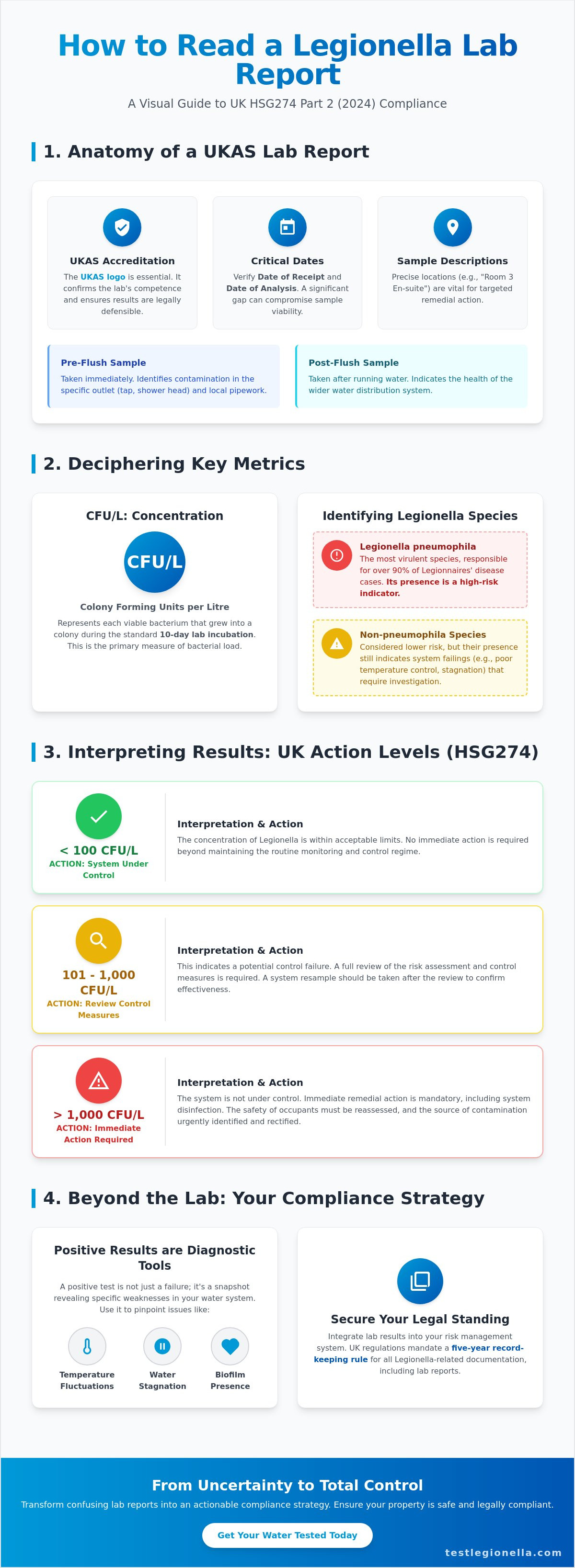
The top of your report contains the most critical administrative data. Look for the UKAS (United Kingdom Accreditation Service) logo immediately. This accreditation confirms the laboratory meets international standards for technical competence. If the logo is missing, the results might not hold up in a legal challenge. You should also verify the "Date of Receipt" and "Date of Analysis." A significant gap here can compromise sample viability, as bacteria levels can change if the water isn't tested promptly. Your laboratory reference number is your primary tool for tracking and auditing; keep this handy for any future queries or follow-up testing.
Sample Descriptions and Locations
Effective risk management depends on knowing exactly where a problem exists. Your report will link results to specific locations, such as "Room 3 En-suite" or "Cold Water Storage Tank." Pay close attention to whether the sample was "Pre-flush" or "Post-flush." A pre-flush sample, taken immediately upon opening the tap, identifies issues within the specific outlet or local pipework. A post-flush sample, taken after the water has run for several minutes, tells you about the health of the wider distribution system. Understanding these distinctions is a vital part of how to read a legionella lab report because it dictates whether you need to replace a single tap or disinfect your entire building.
To ensure your records are robust and ready for inspection, check that these administrative details are accurate:
- Site Address: This must match the specific property being tested to remain valid for compliance.
- Sample Point: Descriptions must be precise to avoid confusion if you need to carry out remedial works.
- Analysis Completion Date: This confirms the report is current and reflects the recent state of your water system.
By treating the report as a diagnostic management tool rather than a simple pass or fail grade, you can move from a state of uncertainty toward a clear, structured solution. This professional approach transforms complex regulatory burdens into a sense of security for you and your tenants.
Key Metrics: Deciphering CFU/L, Species, and Detection Limits
When you receive your results, the technical shorthand can feel like a barrier to understanding your property's safety. However, once you grasp the core metrics, you can transform that data into a clear risk management plan. The primary figure you'll see is the bacterial concentration, which labs determine using the "agar plate" method. This process involves culturing your water samples over a 10-day period to see if any bacteria grow into visible colonies. Because Legionella is a slow-growing organism, this 10-day window is a standard requirement for accuracy. Understanding how to read a legionella lab report starts with these specific measurements of growth.
Understanding CFU/L: The Concentration Metric
CFU/L stands for Colony Forming Units per Litre. Each "unit" represents a single bacterium that was present in the original sample and successfully grew into a colony during the lab's incubation period. In the UK, we use Litres (L) as our standard denominator to align with the UK Action Levels (HSG274 Part 2). This differs from US reports that often use millilitres (mL), so always verify the units to ensure you aren't misinterpreting the scale of the results. Simply put, CFU/L is the primary indicator of the total bacterial load currently present in your water system.
Identifying Species: Pneumophila vs. Non-Pneumophila
Not all Legionella bacteria carry the same level of risk, and your report will categorise them accordingly. You should look specifically for Legionella pneumophila Serogroup 1, as this is the strain most commonly associated with outbreaks of Legionnaires’ disease. Serogroups 2-14 are still significant health concerns but often indicate different environmental conditions within your pipework. If your report lists "Legionella species (spp)," it means the lab found bacteria from the Legionella genus that are not the pneumophila strain. While these are typically considered lower risk, their presence still signals that your system's control measures, such as temperature or biocides, may be failing. If you're unsure about a specific species listed on your certificate, professional Legionella Compliance Testing can provide the clarity you need to move forward confidently.
Another common source of confusion is the "Detection Limit." Most UK laboratories have a lower detection limit of 100 CFU/L. If your report shows "<100 CFU/L" or "Not Detected," it means the concentration of bacteria is below the level the lab can reliably count. This is generally the desired outcome for most property owners, as it suggests your current maintenance regime is effective. However, "Not Detected" does not mean the system is sterile; it simply means the bacterial load is currently within a manageable, compliant range. Use these metrics as a diagnostic baseline to ensure your property remains a safe environment for all occupants.
Interpreting Your Results: The UK Action Levels (HSG274 Part 2)
The Health and Safety Executive (HSE) provides a clear roadmap for property managers through the HSG274 Part 2 guidance. This document acts as the definitive authority for interpreting your results. It transforms raw laboratory data into a structured set of regulatory instructions. For most domestic and commercial systems, the primary action level is triggered at 100 CFU/L. However, if you manage a healthcare environment such as a hospital or care home, you must adhere to stricter alert levels that often start as low as 10 CFU/L. Mastering how to read a legionella lab report means knowing which specific threshold applies to your unique property type.
Results are categorised into three main tiers: Not Detected, Low Level, and High Level. This tiered system ensures that your response is proportionate to the risk. It prevents unnecessary panic while ensuring that genuine threats are met with immediate, professional intervention. By following this framework, you move from a state of uncertainty to a position of informed control. You aren't just looking at numbers; you're following a legally recognised safety protocol.
The Three-Tier Action Framework
The HSE thresholds provide a logical progression for your compliance strategy. Use these tiers to determine your next steps:
- Tier 1 (<100 CFU/L): The system is considered under control. You should maintain your current legionella precautions and continue regular monitoring. No immediate changes to your maintenance regime are required.
- Tier 2 (100 - 1,000 CFU/L): This indicates minor colonisation. You must review your acop l8 risk assessment to identify why the bacteria are proliferating. Disinfection should be considered if the majority of samples return positive results.
- Tier 3 (>1,000 CFU/L): Significant colonisation is present. The system is not under control. You must carry out an immediate review of control measures, perform system disinfection, and conduct re-sampling to verify that the remedial works were successful.
Special Considerations for Cooling Towers
Evaporative cooling systems have a much lower tolerance for bacteria because they create fine aerosols that can be inhaled over a wide area. Consequently, the action levels for cooling towers are more aggressive. A result of 1,000 CFU/L triggers an immediate review of the water treatment programme. If levels reach 10,000 CFU/L, the risk is considered critical, often requiring a system shut down and intensive chlorination. Rapid notification is essential for cooling tower positives. Because the stakes are higher, your laboratory will often flag these results to you within hours of the initial count. Understanding how to read a legionella lab report for these complex systems is vital for protecting both your staff and the surrounding community.
What a 'Positive' Result Actually Means for Your Property
Seeing a "positive" result on your water analysis can feel like a major setback, but it's vital to treat it as a diagnostic tool rather than a disaster. A positive finding is essentially a snapshot in time. It reveals that the current environment within your pipework, likely due to temperature drops, scale build-up, or water stagnation, has become hospitable to bacterial growth. Often, these issues are isolated to a single "dead leg" or an infrequently used outlet. By learning how to read a legionella lab report with a focus on specific sample locations, you can often resolve the issue with targeted maintenance rather than a full system overhaul.
Legal responsibility becomes the priority when concentrations rise. If any result exceeds 1,000 CFU/L, the designated "Duty Holder" for the property must be informed immediately. This is a critical step in your compliance chain. It ensures that the person responsible for safety can authorize the necessary resources to fix the problem. You aren't just managing a biological risk; you're managing your legal liability and ensuring the safety of everyone on-site.
Immediate Actions Following a High Result
When a report indicates a high-level failure, you must move quickly to break the chain of potential infection. Start by isolating the affected outlet to prevent any aerosol generation. Once the area is safe, conduct a "for cause" review of your legionella risk assessment to determine why your existing controls failed. This review should lead directly to a thermal or chemical disinfection of the contaminated area as recommended by your specialist.
The Role of Re-sampling
Verification is the final pillar of a successful response. You must wait at least 48 hours after any disinfection process before taking a "clearance" sample. If you sample too early, residual chemicals in the water may produce a "false negative," giving you a dangerous sense of security while the underlying biofilm remains active. Most compliance experts recommend achieving two consecutive "Not Detected" results to prove the system is back under control. If you've encountered a positive result and need to verify your system's safety, you should arrange your Legionella Compliance Testing today to secure your property's legal standing.
Beyond the Lab: Turning Your Report into a Compliance Strategy
A single lab report provides a vital snapshot, but it is only one component of a robust Legionella control programme. To achieve true water safety, you must view these results as part of a continuous cycle of monitoring and adjustment. Understanding how to read a legionella lab report allows you to identify dangerous trends before they escalate into a health crisis. For instance, if you notice bacterial concentrations steadily increasing over several months, your current control measures are likely losing their effectiveness. Catching these patterns early transforms a reactive burden into a proactive, stress-free management strategy.
Professional Legionella Compliance Testing services simplify this "read and react" process by providing the technical expertise needed to interpret complex data. Instead of guessing whether a result requires action, you receive clear guidance based on current UK regulations. This professional oversight ensures that you aren't just collecting certificates, but actively reducing the risk profile of your property. It moves your operations from a state of uncertainty toward a position of calm, specialist-backed competence.
Record Keeping and the Log Book
Your legal safety depends heavily on your ability to produce an audit trail during an inspection. You must keep records of all lab results for at least five years to remain compliant with UK health and safety law. Integrate every lab certificate into your physical or digital compliance log book as soon as it arrives. If a report indicates a positive result, you must document the specific remedial actions you took in response. Inspectors look for this direct link between a test result and a corrective action. Signing off on these tasks proves you've met your legal obligations as a Duty Holder and provides the emotional security of knowing your records are robust.
Choosing a Professional Testing Partner
The quality of your compliance strategy is only as good as the data you receive. Always ensure your testing provider utilizes UKAS-accredited laboratories for all analysis. This accreditation is your guarantee that the results are technically sound and legally defensible. A high-quality partner will often provide an "Executive Summary" alongside the raw data. This summary distils the technical jargon into actionable insights, highlighting exactly which outlets require attention and which are under control. This structured approach ensures that even the most complex technical requirements feel manageable for busy professionals. Need help interpreting your results? Contact Test Legionella for professional compliance support to ensure your property remains safe and your legal liability is fully managed.
Secure Your Compliance and Peace of Mind
Mastering how to read a legionella lab report transforms a complex regulatory burden into a manageable safety routine. You now know that identifying specific species and understanding the 2024 HSG274 action levels are the keys to protecting your tenants and your legal standing. Remember that a positive result isn't a disaster; it's a prompt for targeted maintenance that keeps your system healthy. By maintaining a five-year audit trail and reacting quickly to high bacterial loads, you ensure your property remains fully compliant with ACOP L8 standards.
Don't let technical jargon stand in the way of your safety obligations. Our specialists provide the clarity you need to manage your water systems with total confidence. Book Professional Legionella Testing and Get Clear, Compliant Reports Today. Our service includes UKAS Accredited Laboratory Analysis and expert interpretation to ensure you are fully ACOP L8 and HSG274 compliant. You've got the knowledge to manage your risks; now take the final step toward a stress-free compliance strategy.
Frequently Asked Questions
What is a "pass" on a Legionella test report?
A result below 100 CFU/L is generally considered a "pass" for standard domestic and commercial water systems. This level indicates that your system is currently under control according to the HSG274 Part 2 guidance. However, a "pass" is context-dependent; healthcare settings have much stricter requirements where even low-level detections trigger an immediate investigation of control measures.
How long does it take to get Legionella lab results back?
Standard culture testing typically takes 10 to 12 days to complete from the date the lab receives the sample. This timeframe is a biological requirement because Legionella is a slow-growing bacterium that must be incubated to produce visible colonies. While some labs offer rapid results via PCR testing, the 10-day culture method remains the gold standard for demonstrating UK regulatory compliance.
What does "CFU/L" mean in simple terms?
CFU/L stands for Colony Forming Units per Litre, which is a measure of the concentration of live bacteria in your water. Think of it as a headcount of the bacteria that were active enough to grow during the laboratory's incubation period. Higher numbers indicate a significant "bacterial load," suggesting that your current control measures, such as temperature or biocides, are not working effectively.
Is Legionella pneumophila more dangerous than other species?
Yes, Legionella pneumophila, specifically Serogroup 1, is the strain responsible for the vast majority of Legionnaires' disease outbreaks. While other Legionella species (spp) can still cause illness, they are generally considered less virulent than the pneumophila strain. Your lab report will categorize these findings so you can prioritize remedial actions based on the specific health risk identified.
What should I do if my Legionella report shows a high count?
You must immediately isolate the affected outlets to prevent aerosol generation if counts exceed 1,000 CFU/L. Following this, conduct a "for cause" review of your risk assessment and implement thermal or chemical disinfection as recommended. Professional Legionella Compliance Testing must be repeated after 48 hours to verify the system is safe before you allow it back into normal service.
Does a "Not Detected" result mean my water is 100% safe?
No, a "Not Detected" result simply means any bacteria present are below the laboratory's detection limit, which is typically 100 CFU/L. It is a snapshot showing that your system is currently under control, but it does not guarantee permanent sterility. You must continue with your regular maintenance regime, including temperature monitoring and flushing, to ensure the system remains safe between tests.
How often should I be receiving these lab reports for my property?
The frequency of testing is determined by your specific risk assessment, though many commercial property owners conduct sampling on a quarterly or annual basis. High-risk systems, such as cooling towers or healthcare facilities, require much more frequent analysis to remain compliant. Regularly reviewing how to read a legionella lab report ensures you can identify emerging trends in water quality before they become a liability.
Can I read a Legionella report myself, or do I need a specialist?
You can learn the fundamentals of how to read a legionella lab report to understand your immediate compliance status. However, a specialist is often required to translate those numbers into a long-term safety strategy. Professionals provide the necessary expertise to help you navigate complex remedial works and ensure your documentation meets the rigorous audit standards required by ACOP L8.