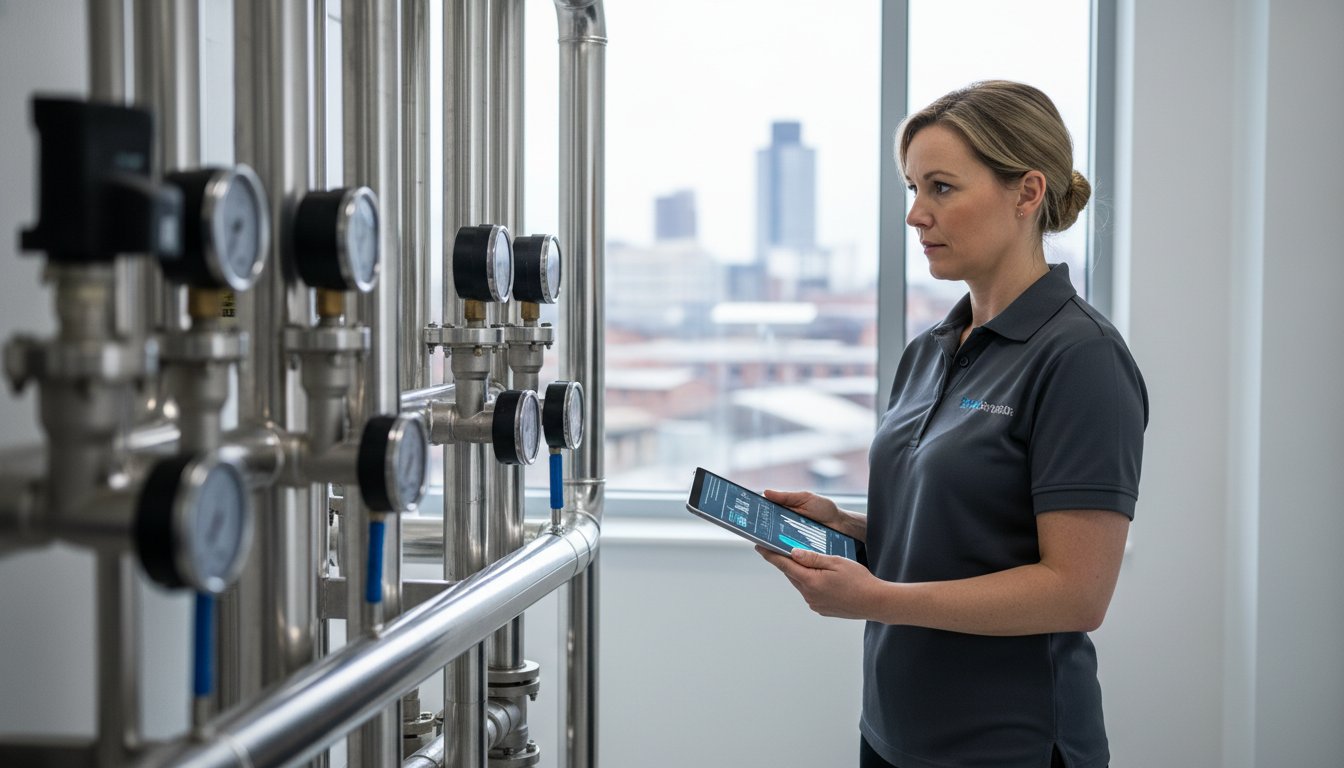

Could your trusted local plumber be the hidden link that leaves you vulnerable to an HSE prosecution? It's a common trap for business owners trying to balance tight maintenance budgets with strict safety laws. You likely assume that because someone understands your building's pipework, they're the natural choice for testing. But when it comes to identifying who is qualified to take legionella water samples uk, the answer depends on specific biological expertise rather than general mechanical skill. Using the wrong person doesn't just result in poor data; it can invalidate your entire compliance strategy and leave you legally liable.
We understand the pressure to simplify your regulatory burdens while keeping your site safe. This article explains the strict legal definition of a competent person under the current ACOP L8 and why a standard plumbing qualification often falls short of these requirements. You'll learn how to verify credentials, the role of UKAS accredited laboratories, and how to ensure your sampling process provides total legal protection. We provide a clear roadmap to move you from uncertainty toward a state of calm, professional compliance that protects both your people and your reputation.
Key Takeaways
- Understand why general plumbing experience fails to meet the HSE's strict "competent person" criteria under ACOP L8 guidelines.
- Identify exactly who is qualified to take legionella water samples uk by verifying specific certifications from bodies like City & Guilds or BOHS.
- Avoid the "insurance black hole" where standard public liability policies may not cover biological risks or invalid sampling reports.
- Learn how to use a simple two-step verification process to check your assessor’s technical training and industry professional memberships.
- Secure a legally robust compliance report that transforms complex regulatory burdens into a sense of operational security and safety.
The Legal Definition of a "Competent Person" Under ACOP L8
The Health and Safety Executive (HSE) sets a high bar for water safety. Under the acop l8 guidelines, a "competent person" must possess the specific skills, knowledge, and experience to carry out the task effectively. This definition moves beyond general trade skills. Determining who is qualified to take legionella water samples uk requires an assessment of their technical training rather than just their years in a mechanical trade. By 2026, the requirements for documented evidence of competence have become even more stringent. You can't rely on verbal assurances; you need a paper trail that proves your sampler understands the biological risks inherent in your water system.
The law requires a "Duty Holder" to appoint someone with specific water safety knowledge because the risks are invisible and potentially fatal. A general "handyman" check might confirm that water is running, but a formal risk-based sample identifies if that water is safe to breathe. This distinction is vital for your legal protection. Without a documented competent person, your compliance report carries no weight in a court of law.
The Legal Framework: HSWA and COSHH 2026
The Health and Safety at Work etc. Act 1974 remains the bedrock of UK safety law, but its application to water hygiene is increasingly scrutinized. Under the COSHH regulations, Legionnaires' disease is treated as a biological hazard that requires proactive management. You can't delegate the legal liability; as the Duty Holder, you're responsible for ensuring your contractor has the right expertise. If a contractor fails to follow the correct protocol, the legal fallout lands on your desk. This shift in liability means that hiring an unqualified person isn't just a technical error; it's a significant legal risk that could lead to heavy fines or HSE prosecution in 2026.
What "Proven Ability" Looks Like in Water Safety
True competence requires an understanding of how bacteria thrive in stagnant or warm water. While a plumber focuses on pressure and flow, a qualified sampler identifies hidden risks like "dead legs" or "blind ends" where water doesn't circulate. These areas are breeding grounds for bacteria that a general trade professional would likely overlook. Consider the following markers of proven ability:
- Theoretical Knowledge: Understanding the Legionella lifecycle and the conditions that encourage growth.
- Practical Identification: The ability to spot system flaws that lead to stagnation.
- Independence: The sampler should ideally be independent of the person fixing the pipes to ensure an unbiased report.
Documented certificates from bodies like City & Guilds or the BOHS are the gold standard for proving this level of ability. These credentials transform a simple water check into a legally robust compliance document that protects your business and your residents.
Plumbing vs. Legionella Sampling: Why the Difference Matters
Hiring a local plumber to handle your water safety might seem like a logical, cost-saving move. However, plumbing is fundamentally a mechanical trade. It focuses on the physical integrity of pipes, water pressure, and flow. Legionella sampling is a scientific discipline rooted in microbiology and the complex legionella lifecycle. While an NVQ Level 3 Plumbing qualification or a Gas Safe registration proves mechanical competence, these certifications don't cover biological risk management. Understanding who is qualified to take legionella water samples uk requires looking beyond the toolbox and into the lab-grade protocols required by law.
The risk of cross-contamination is high when samples are taken by non-specialists. A plumber's daily work involves handling grease, jointing compounds, and various metal residues. If these substances enter a sample bottle, they can interfere with laboratory results. This leads to "false negatives" that leave your building at risk, or "false positives" that trigger expensive, unnecessary disinfections. Specialist samplers operate under strict hygienic conditions to ensure the water profile remains untainted from the tap to the lab.
The Protocol Gap: Following BS7592
Legionella sampling isn't just about filling a bottle. It must follow the BS7592 code of practice, which dictates precise "pre-flush" and "post-flush" timings. These steps help determine if a bacterial problem exists at the specific outlet or deep within the system's pipework. Professional samplers use sterile containers pre-filled with sodium thiosulphate to neutralise biocides like chlorine immediately. Without this chemical neutralisation, any bacteria in the bottle could be killed during transit to the lab, providing an inaccurate "clear" result. You can review the official government guidance to see the level of technical detail required for a valid sample.
When a Plumber is the Right Choice
This doesn't mean plumbers have no role in your water safety strategy. They're essential for executing "remedial works" identified in your risk assessment. You should use a qualified plumber for tasks such as cleaning and descaling cold water storage tanks, removing dead legs, or installing thermostatic mixing valves. They're the "hands" that repair the system, while the sampler acts as the "eyes" that monitor its health. To maintain total transparency and protect your legal position, keep the "Assessor" and the "Repairer" as separate entities. This ensures your compliance data remains unbiased and robust. If you're unsure about your current system's health, it's safer to arrange a professional Legionella compliance test to establish a clear baseline.
Insurance and Liability: The Risks of Unqualified Sampling
The "Insurance Black Hole" is a reality many business owners face only after a crisis occurs. Most standard plumbing contracts include Public Liability insurance, which covers physical accidents like a burst pipe or a flooded floor. However, these policies almost universally exclude biological hazards and pathogenic risks. If an outbreak occurs and your sampler lacked the specific coverage for microbiological work, you are effectively uninsured for any resulting claims. Determining who is qualified to take legionella water samples uk isn't just about technical skill; it's about ensuring your contractor has the right insurance profile to protect your assets.
An invalid sample report is legally equivalent to having no report at all. If the person taking the samples cannot prove their competence, the HSE will likely disregard the data during an investigation. This leaves you wide open to negligence charges. While the legionella risk assessment cost represents a manageable operational expense, a negligence fine can easily exceed £20,000. For larger organisations, these penalties often reach six or seven figures, far outweighing the perceived savings of using an unqualified contractor.
Professional Indemnity vs. Public Liability
Professional Indemnity (PI) insurance is the critical differentiator. This coverage protects against errors in professional advice or testing. A specialist water hygiene consultant carries PI specifically for water safety, meaning their insurance covers the accuracy of their sampling and the advice they provide. When reviewing a contractor's credentials, ask to see their insurance schedule. Look specifically for "pollution and contamination" clauses. If their policy doesn't explicitly mention biological agents or waterborne pathogens, your business is carrying the full weight of the risk.
The Consequences of a "Shallow" Assessment
A "shallow" assessment happens when a non-specialist misses high-risk areas. For example, a standard plumber might overlook a stagnant Thermostatic Mixing Valve (TMV) hidden behind a panel. If that valve becomes a breeding ground for bacteria, your compliance certificate will be rejected by health inspectors. We've seen cases where landlords were fined heavily despite presenting a "plumber’s note" as proof of maintenance. The UK legal system operates on the principle of "strict liability" in health and safety. Claiming "I thought they were qualified" is never a valid defence; the burden of proof remains on you to verify their credentials before they set foot on your site.
The HSE also evaluates the "chain of custody" for every water sample. This involves documenting exactly who took the sample, how it was stored, and how it reached the UKAS laboratory. A specialist ensures this chain is unbroken and legally defensible. This level of detail transforms a simple test into a shield of security for your business.
How to Verify if Your Assessor is Actually Qualified
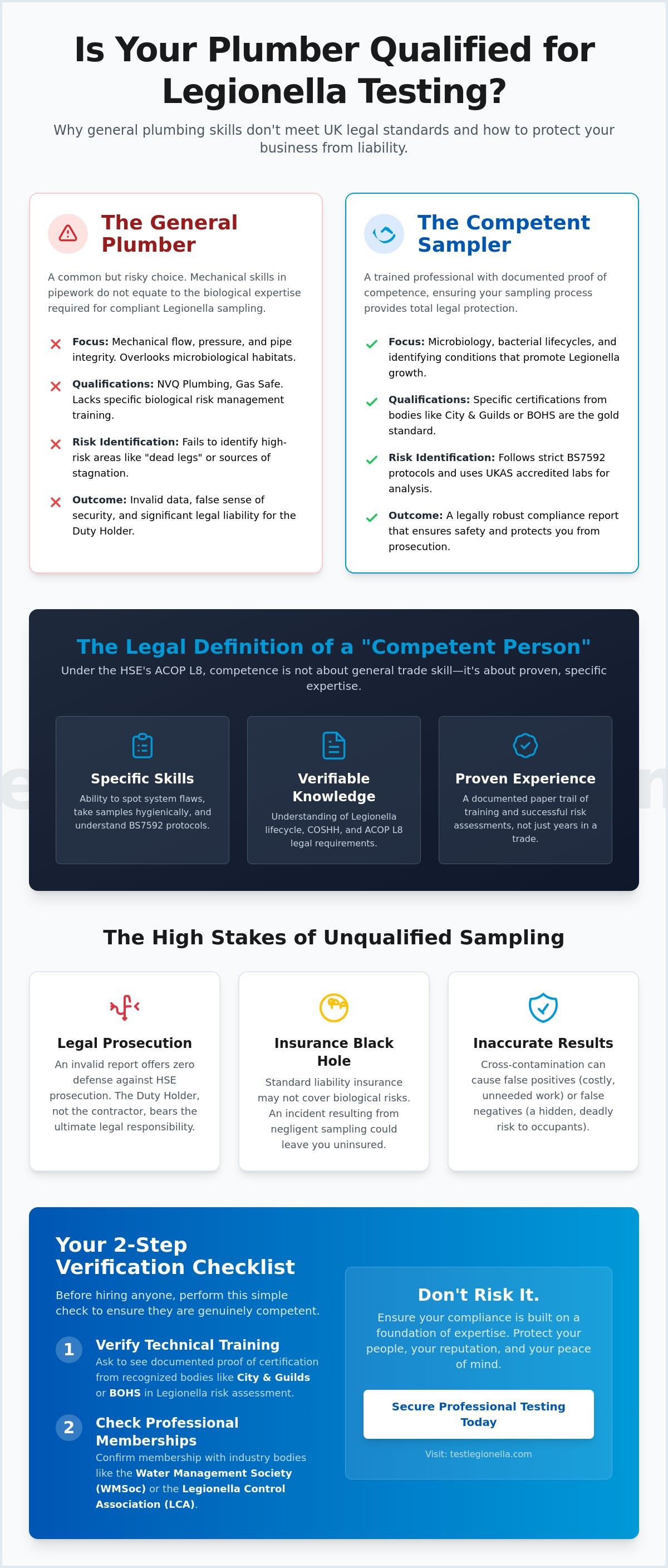
Determining who is qualified to take legionella water samples uk isn't about taking a contractor's word for it. It's about following a rigorous verification process that protects your business from legal fallout. You need to move beyond general trade reputations and focus on specific, documented evidence of competence. Don't settle for a badge on a van; ask for the paperwork that proves they understand the microbiology of your water system. Use this five-step checklist to ensure your assessor meets the required standards for 2026.
- Step 1: Request specific Legionella training certificates. Look for recognized providers like City & Guilds or the British Occupational Hygiene Society (BOHS).
- Step 2: Verify membership in the Water Management Society (WMSoc). This indicates a commitment to staying updated on evolving safety standards.
- Step 3: Ensure they use a UKAS-accredited laboratory for analysis. While the sampler needs competence, the lab must have the official accreditation to process the results.
- Step 4: Check for Legionella Control Association (LCA) registration. This voluntary code of conduct is a strong indicator of a professional service provider.
- Step 5: Confirm they hold Professional Indemnity insurance specifically for water safety. As discussed previously, standard public liability is insufficient for biological risks.
Key Accreditations to Look For
The gold standard for hot and cold water system management is the BOHS P901 certificate. This qualification proves the assessor can manage the risks effectively and understands the technical nuances of complex pipework. Another vital credential is the City & Guilds WH004, which focuses specifically on Legionella Risk Assessment. Remember that while a laboratory might have UKAS accreditation, this only covers the testing of the water once it arrives. It doesn't guarantee that the person who took the sample followed the correct sterile protocols. You need to verify the competency of both the sampler and the lab to ensure a legally robust result.
Three Questions to Ask Your Contractor
Before signing a contract, put your assessor to the test. Their answers will quickly reveal if they are a generalist or a true water safety specialist. Ask these three direct questions:
- "Do you have Professional Indemnity insurance that explicitly covers biological agents and waterborne pathogens?"
- "Which UKAS-accredited lab do you use for your analysis, and can I see a sample of a previous compliance report?"
- "Can you explain the specific temperature regime requirements for our type of system as outlined in HSG274 Part 2?"
A qualified professional will answer these questions with confidence and provide the necessary documentation immediately. If a contractor hesitates or provides vague answers, they likely lack the specialized training required for full compliance. To eliminate the guesswork and secure your site, you can book a certified Legionella compliance test today with a specialist who meets every one of these criteria.
Why Professional Compliance Testing is the Safest Path
Choosing a dedicated specialist transforms your water safety from a recurring worry into a managed, professional process. While a general contractor might offer a lower initial price, they cannot provide the comprehensive legal shield that comes with a specialist compliance report. When evaluating who is qualified to take legionella water samples uk, the decision often comes down to the level of security you require for your business or property. Professional testing ensures that every step, from the initial site visit to the final laboratory analysis, meets the high standards expected by the HSE.
Our specialists use advanced reporting tools that cross-reference your site data against the latest HSG274 technical guidance. This structured approach ensures that no risk factor, regardless of how small, is overlooked. By using a specialist, you gain more than just a data point; you receive a roadmap for long-term safety. This transition from reactive maintenance to proactive management is what separates compliant businesses from those at risk of prosecution.
The Specialist Advantage
Working with a dedicated water hygiene firm provides access to precise UKAS-accredited lab data for every sample taken. This level of detail is essential if you ever need to defend your actions during a health and safety audit. Beyond the immediate results, professional services offer automated reminders for re-assessments. This ensures perpetual compliance without you having to track dates manually. Our comprehensive reports prioritize remedial actions based on actual risk levels, allowing you to allocate your maintenance budget where it matters most. It's an efficient, logical way to handle a complex regulatory requirement.
Next Steps for Property Owners
Transitioning from a "handyman" approach to a professional compliance strategy is the most effective way to protect your reputation. A specialist assessment covers all legal bases, providing you with the peace of mind that your tenants are safe and your legal obligations are met. We offer nationwide assessments that simplify the entire process, bringing specialist expertise directly to your site regardless of location. This authoritative approach removes the stress of regulatory adherence and replaces it with a sense of calm competence.
Don't leave your legal standing to chance by using unqualified contractors. Secure your property and ensure your records are beyond reproach. Secure your property today with a professional Legionella assessment from the specialists at Test Legionella.
Secure Your Site With Certified Water Safety Expertise
Protecting your property requires a clear distinction between mechanical repairs and biological safety. While plumbers are vital for system maintenance, they lack the specific microbiological training and professional indemnity insurance required for legal sampling. Understanding who is qualified to take legionella water samples uk is the first step in shielding your business from the severe financial and legal consequences of non-compliance. By choosing a specialist, you ensure that every report is robust, accurate, and fully aligned with current HSE standards.
Test Legionella offers a streamlined, authoritative solution for landlords and commercial property managers across the United Kingdom. Our specialists provide nationwide coverage and deliver ACOP L8 and HSG274 compliant reporting that transforms complex regulatory burdens into long-term security. Don't leave your legal protection to chance or invalid documentation. We handle the technical details so you can focus on your core operations with absolute confidence.
Get a Professional Legionella Compliance Quote Now
Take control of your water hygiene today and enjoy the peace of mind that comes with expert-led management.
Frequently Asked Questions
Is it a legal requirement for a plumber to have a Legionella certificate?
No legal requirement exists for a plumber to hold a Legionella certificate for standard pipework repairs or installations. However, if they are appointed as the competent person to manage water safety or take samples, they must demonstrate specific training. A general plumbing NVQ focuses on mechanics rather than microbiology. Without a specific Legionella qualification, their sampling results may not hold up under HSE scrutiny.
Can a landlord take their own Legionella water samples in 2026?
Landlords can technically take their own samples if they are demonstrably competent, but this is a high-risk strategy for 2026. Competence requires sufficient knowledge and training to follow BS7592 sterile protocols accurately. Most landlords lack the specialized equipment and theoretical understanding to provide a legally defensible report. Hiring a specialist is the most reliable way to ensure your samples are valid and your liability is protected.
What is the difference between a water safety check and a Legionella risk assessment?
A water safety check usually focuses on mechanical integrity, such as checking for leaks or ensuring taps function correctly. A Legionella risk assessment is a statutory requirement under ACOP L8 that evaluates the entire system for bacterial growth potential. It identifies dead legs, calculates aerosol risks, and reviews temperature regimes. A risk assessment provides a formal written scheme of control that a simple safety check lacks.
Does a plumber need professional indemnity insurance for Legionella work?
Yes, any individual providing water safety advice or sampling must carry Professional Indemnity insurance. Standard public liability only covers physical damage like a burst pipe or a leak. Professional Indemnity protects against errors in professional judgment or testing accuracy. Most general plumbers don't have the specific pollution and contamination clauses required to cover biological hazards like Legionella bacteria.
What happens if a tenant contracts Legionnaires’ disease and my assessment was done by a plumber?
You may face immediate prosecution for failing to appoint a competent person as defined by the HSE. If the plumber lacks specific Legionella training, your risk assessment will likely be deemed invalid by investigators. This leaves you with no legal defense against negligence claims. Determining who is qualified to take legionella water samples uk is critical, as the ultimate liability for an outbreak rests with the duty holder.
How much does a professional Legionella assessment cost compared to a plumber?
Professional assessments carry a higher upfront cost than a plumber's call-out fee because they include UKAS-accredited laboratory analysis and technical reporting. A plumber might offer a cheaper check, but it rarely includes the legal documentation required for full compliance. Investing in a professional assessment prevents the far higher costs of HSE fines, which frequently reach five or six figures for serious safety breaches.
What specific qualifications should I ask a water sampler for?
Always ask for BOHS P901 or City & Guilds WH004 certifications before allowing someone to sample your water. These are the industry-recognized qualifications that prove a sampler understands the technical requirements of HSG274. You should also check if their company is a member of the Legionella Control Association. These credentials ensure the person taking your samples has the specialized knowledge that a general plumber typically lacks.
How often should professional Legionella water sampling be carried out?
Sampling frequency is determined by your specific risk assessment rather than a fixed calendar date. While some systems require monthly testing, others may only need sampling if control measures, such as temperature monitoring, fail to stay within range. High-risk environments or systems with complex pipework often require more frequent testing. A professional assessor will define the exact sampling schedule within your written scheme of control to maintain safety.