
Could a simple oversight in your water system lead to a criminal record? With the Renters' Rights Act 2026 now in full effect, the risk of landlord prosecution legionella uk has moved from a theoretical concern to a concrete legal reality. You likely feel the pressure of these heightened enforcement standards and the confusion surrounding the lack of a formal "compliance certificate" in UK law. It's natural to feel anxious when the penalty for a safety breach is an unlimited fine or even imprisonment.
We understand that you want to protect your tenants and your reputation without getting lost in a maze of technical jargon. This article provides the clarity you need to move from uncertainty to total security. You'll learn exactly which laws the authorities use for prosecution and how to establish a robust legal defence through professional testing. We'll outline the practical steps to satisfy "competent person" requirements and show you how to transform complex safety obligations into a streamlined, stress-free management process.
Key Takeaways
- Understand your statutory duty of care under the Health and Safety at Work etc. Act 1974 and why the law treats landlords as self-employed entities.
- Identify the specific "competence" requirements for risk assessments to avoid the common legal pitfalls that lead to landlord prosecution legionella uk.
- Learn why health and safety breaches are prosecuted in criminal courts and how modern sentencing guidelines link financial penalties to your total turnover.
- Discover how to build a contemporaneous, prosecution-proof audit trail that serves as your primary legal defence during an inspection.
- See how professional Legionella Compliance Testing provides the objective, expert validation needed to secure your property and your reputation.
The Legal Framework: Why Landlords Face Prosecution for Legionella
Understanding the gravity of your responsibilities starts with a clear picture of the biological threat. What is Legionnaires' disease? It's a lethal form of pneumonia caused by inhaling tiny, contaminated water droplets. Because this bacteria thrives in domestic plumbing, the law doesn't view water safety as an optional extra. Under UK legislation, landlords are treated as self-employed individuals with a statutory duty of care. This means you're legally responsible for the health and safety of your tenants from the moment they sign a tenancy agreement.
Many property owners mistakenly believe that an investigation only occurs after someone falls ill. This is a dangerous assumption. In reality, landlord prosecution legionella uk is often triggered by a simple failure to manage risk. The Health and Safety Executive (HSE) enforces these regulations with significant powers. Inspectors can enter your premises, examine your records, and take water samples without a warrant if they suspect a safety breach. If your risk management is found wanting, you've already committed a criminal offence, regardless of whether an outbreak has occurred.
The Health and Safety at Work Act 1974 (HSWA)
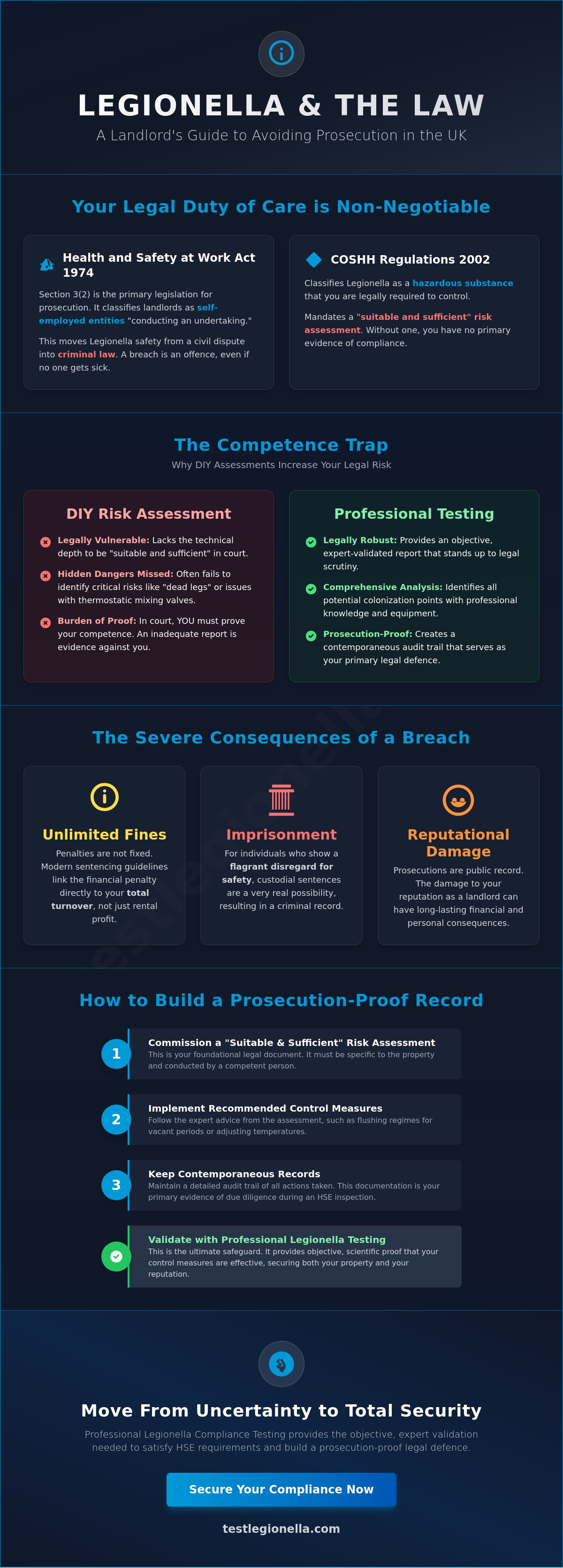
Section 3(2) of the HSWA is the primary legislation used in court. It dictates that self-employed persons must conduct their "undertaking" in a way that ensures, as far as reasonably practicable, that others aren't exposed to health risks. The courts have consistently ruled that letting a property, even if it's just one flat, constitutes "conducting an undertaking." This legal classification moves your responsibilities from civil disputes into the realm of criminal law. Breaching the HSWA carries severe consequences, including unlimited fines and potential imprisonment for those who show a flagrant disregard for safety.
The COSHH Regulations 2002
The Control of Substances Hazardous to Health (COSHH) provides the specific technical framework for biological hazards. Within this legislation, Legionella is classified as a "hazardous substance" that you must control. To meet your legal baseline, you're required to carry out a "suitable and sufficient" risk assessment. This isn't a mere suggestion; it's a mandatory requirement to identify potential colonization points in your water system. Without this documented assessment, you lack the primary evidence needed to prove you've fulfilled your duty of care, leaving you vulnerable to immediate enforcement action during an HSE inspection.
The Competence Trap: Why DIY Assessments Increase Legal Risk
The law provides a deceptive amount of flexibility regarding who can conduct a water safety evaluation. While current Health and Safety Executive (HSE) guidance states that landlords can carry out their own assessments, this permission comes with a significant caveat. You must be truly "competent" to do so. In a legal context, competence isn't a self-certified status. It's a specific combination of knowledge, skills, and experience that allows you to identify every potential risk within a unique water system. If you lack the technical background to spot a failing system, your DIY effort is a legal liability rather than a shield.
If you face a landlord prosecution legionella uk, the court will scrutinise your technical understanding of the property's plumbing. They'll ask if you recognized "dead legs" where water stagnates or if you understood how a faulty thermostatic mixing valve could encourage bacterial growth. A DIY approach often fails because it lacks the depth required to spot these subtle hazards. Mistakes in temperature monitoring or failing to identify stagnant areas don't just lead to bad data. They can invalidate your entire compliance strategy and prove you failed your statutory duty.
Defining "Suitable and Sufficient" in Court
A judge won't accept a generic, five-minute checklist downloaded from a free website. To be legally valid, an assessment must be "suitable and sufficient" for the specific property in question. This means accounting for periods when the property might sit vacant between tenancies. Stagnant water in an empty flat is a high-risk scenario. If your DIY assessment didn't include a specific flushing regime for these gaps, it's unlikely to stand up under cross-examination in a criminal court.
The Burden of Proof on the Landlord
In most criminal cases, you're innocent until proven guilty. However, health and safety law often places the burden of proof on the defendant to show they did everything "reasonably practicable" to prevent harm. This is a high bar to clear. When you consider that the legionella risk assessment cost is a minor operational expense, the decision to self-assess becomes a massive financial gamble. Ignorance of how your water system works is never a valid legal defence when facing a landlord prosecution legionella uk.
Protecting your reputation requires more than just a tick-box exercise. You need an audit trail that proves you prioritised tenant safety over cost-cutting. Using a professional service for your Legionella Compliance Testing ensures that your records are technically accurate, objective, and legally defensible. This proactive approach transforms a complex regulatory burden into a sense of total security for both you and your tenants.
Understanding the Consequences: Fines, Prison, and Reputation
The stakes of non-compliance extend far beyond a simple administrative penalty. When a landlord prosecution legionella uk reaches the court, it's heard in a criminal setting rather than a civil one. This distinction is vital; you aren't just arguing over damages, you're defending yourself against criminal charges brought by the state. Current sentencing guidelines have evolved so that fines for health and safety breaches are now directly linked to a landlord's turnover or total income. This ensures the penalty is proportionate to your financial means, making the cost of failure potentially devastating.
Financial penalties are only one part of the legal fallout. Under the "Fees for Intervention" (FFI) scheme, the HSE recovers the costs of their entire investigation from the landlord if a material breach of law is identified. This includes the time spent on inspections, writing reports, and legal preparation. For cases involving "reckless" or "highly culpable" behaviour, custodial sentences are a real and documented possibility. The legal system is designed to ensure that safety management is never viewed as a negotiable expense or a corner to be cut.
Criminal Records and Professional Standing
A conviction under the Health and Safety at Work Act (HSWA) results in a permanent criminal record. This has immediate and devastating effects on your "Fit and Proper Person" status, which is a mandatory requirement for HMO licensing and membership in professional landlord bodies. Losing this status can effectively end your ability to manage properties legally. Beyond the legalities, the long-term reputational damage within the local rental market is often irreparable. A public record of safety negligence makes it difficult to attract high-quality tenants or secure competitive insurance rates in the future.
Case Study Scenarios (Anonymised)
- The Vacancy Oversight: A landlord leaves a property empty for three months. They fail to implement a flushing regime before the new tenant moves in, leading to a serious illness. Because the landlord couldn't produce records of water turnover, the HSE viewed this as a high-culpability breach of the HSE guidance on Legionella for landlords.
- The Ignored Recommendation: A previous risk assessment flagged a "dead leg" in the plumbing. The landlord ignored the recommendation to remove it. During a routine inspection, the HSE identified the unaddressed risk. Even without a tenant falling ill, the landlord faced a landlord prosecution legionella uk for failing to manage a known hazard.
In both instances, strict adherence to acop l8 would have served as the primary shield. By following established safety codes, you create a documented history of proactive care. This evidence is your best defence, proving you took every reasonably practicable step to ensure tenant safety and maintain your professional standing.
The Audit Trail: How to Build a Prosecution-Proof Record
In the event of a landlord prosecution legionella uk, your compliance file is your strongest witness. It provides the objective evidence needed to prove you fulfilled your statutory duty of care. Without a structured audit trail, an inspector will likely assume that safety checks simply didn't happen. A prosecution-proof record must be contemporaneous. This means you record data as it occurs. You cannot "back-fill" logs or create assessments after an HSE visit. Such actions are easily detected and can lead to additional charges of obstructing an investigation.
Maintaining these records demonstrates a proactive safety culture. In court, showing a consistent history of monitoring significantly reduces your culpability. It's not just about the final report. It's about showing the journey: the assessment, the identified findings, and the specific remedial actions you took to resolve them. Even recording that a system was checked and found safe, known as negative reporting, carries immense weight. It proves you were watching when nothing was wrong, which makes your data more credible when a risk is actually identified.
Essential Documents for Your Compliance File
To build a robust file, you need specific technical anchors. These documents should be organised and easily accessible during an unannounced inspection. A well-maintained file turns a high-stakes audit into a routine verification of your professional standards.
- The current Risk Assessment report, ideally conducted by an objective third party to ensure impartiality.
- Temperature logs for hot and cold water outlets, specifically at sentinel points like the nearest and furthest taps from the boiler.
- Detailed records of showerhead descaling and cleaning, which must be performed at least quarterly to prevent aerosol contamination.
Communicating with Tenants
Tenant cooperation is a vital component of risk management. You must provide evidence that you've informed tenants of their responsibilities, such as flushing taps after a holiday or reporting leaks immediately. Include specific water safety clauses in your tenancy agreements to formalise these expectations. If a tenant refuses access for an inspection, document this refusal immediately via email or letter. A record of attempted access is often just as important as the inspection itself in proving you did everything reasonably practicable to maintain safety.
Don't leave your legal defence to chance. Secure your property by booking Legionella Compliance Testing today to ensure your audit trail is technically sound and legally robust.
Professional Testing: The Ultimate Safeguard for Landlords
Professional testing provides the objective, expert validation required to withstand the highest levels of legal scrutiny. While previous sections explored the "competence trap," hiring a specialist effectively transfers the technical liability of identifying risks to a qualified expert. In the event of an investigation, a third-party report carries significantly more weight in a criminal court than a self-assessment. It demonstrates that you didn't just try to be safe; you sought out the highest standard of verification available. This proactive choice is often the deciding factor in avoiding a landlord prosecution legionella uk.
Specialists utilize calibrated equipment to detect hazards that remain invisible to the untrained eye. Digital thermometers with high-precision probes and ultrasonic flow meters identify systemic failures that a standard household thermometer might miss. By integrating professional landlord prosecution legionella uk protection into your management strategy, you ensure that every compliance deadline is met with technical accuracy. Ongoing monitoring from a dedicated partner means you're never caught off guard by regulatory changes or gradual system degradation.
Why Water Sampling Matters
Physical sampling is the only definitive method to confirm the presence or absence of legionella bacteria. While not always a mandatory requirement for simple domestic systems, it becomes a legal necessity when specific high-risk factors are present. For instance, verified data from 2024 shows that 63.9% of legionellosis cases in England and Wales occurred in individuals aged 60 and over. If your tenants fall into this demographic, a UKAS-accredited laboratory report provides the ultimate peace of mind. It serves as an irrefutable piece of evidence that your water system is biologically safe and your management is beyond reproach.
Achieving Total Compliance with Test Legionella
Our nationwide service is designed to simplify the complexities of UK water safety laws for busy professionals. We take a reassurance-first approach, providing clear reporting and practical remedial advice that moves you quickly from uncertainty to total security. We understand local contexts and the logistical challenges of property maintenance. Our goal is to transform your regulatory burden into a streamlined, stress-free process. Don't leave your reputation to chance. Ensure your property is fully compliant and book your professional assessment today.
Securing Your Reputation through Verified Compliance
The implementation of the Renters' Rights Act 2026 has fundamentally shifted the landscape of property management. You now recognize that water safety isn't just a maintenance task; it's the foundation of your legal defence. We've explored how the "competence trap" and poor record-keeping can lead directly to a landlord prosecution legionella uk. By moving away from DIY risks and embracing professional standards, you transform a high-stakes regulatory burden into a sense of total security. This proactive approach ensures you're always prepared for an HSE inspection.
As specialists in landlord duties and ACOP L8 requirements, we provide expert compliance reporting with full nationwide UK coverage. We handle the technical complexities of system evaluations so you can focus on your portfolio with confidence. Our process is designed for busy professionals who value efficiency and operational excellence. Don't leave your professional standing to chance. Protect your property and tenants with a professional Legionella assessment today. Taking this step guarantees a safer environment for your tenants and a more resilient, stress-free future for your business.
Frequently Asked Questions
Can a landlord really go to prison for a Legionella outbreak?
Yes, custodial sentences are a real legal possibility for landlords who show a flagrant disregard for safety. If an outbreak occurs and you're found to be "highly culpable" or "reckless" in your risk management, the courts can impose prison time. This is why professional validation is so critical; it proves you took every reasonably practicable step to protect your tenants from harm.
Is a Legionella risk assessment a legal requirement for every UK rental property?
Yes, conducting a risk assessment is a mandatory legal requirement for every residential rental property in the UK. This duty is established under the Health and Safety at Work Act 1974 and the COSHH Regulations 2002. While the depth of the assessment should be proportionate to the complexity of the water system, you cannot legally opt-out of this evaluation.
Does the HSE proactively inspect domestic rental properties for Legionella?
The Health and Safety Executive (HSE) typically conducts reactive investigations rather than random proactive sweeps of single domestic properties. However, an investigation can be triggered by a tenant complaint or a reported case of illness. Once an inspector is involved, they have significant powers to examine your records and water systems to ensure compliance with safety standards.
What is the maximum fine a landlord can face for a Legionella breach?
There is no upper limit on the financial penalty for a health and safety breach. Since sentencing guidelines were updated, fines for landlord prosecution legionella uk are linked to the defendant's total turnover or income. This means a serious breach could result in an unlimited fine that's designed to be a genuine financial deterrent based on your specific means.
Do I need a new Legionella risk assessment for every new tenant?
You don't necessarily need a brand-new assessment for every tenancy change, but you must review your existing one. If a property has been vacant for several weeks between tenants, the risk profile changes due to stagnant water. Reviewing the assessment and recording a fresh flushing regime ensures your compliance remains current and technically accurate for the new occupant.
Who is legally responsible for Legionella in a block of flats?
Responsibility is usually split between the individual landlord and the building's freeholder or management company. As a landlord, you're responsible for the water system within the flat's boundaries. The freeholder is responsible for communal tanks and shared distribution pipework. It's vital to confirm that the management company is conducting their own professional testing on these shared assets.
What should I do if a tenant refuses access for a water safety check?
You should immediately document the date, time, and method of your communication if a tenant denies entry. A record of your attempt to fulfill your duty of care is a critical component of your legal defence. You should explain the safety benefits to the tenant in writing and keep a copy of this correspondence in your compliance file to show you acted reasonably.
Is a Legionella certificate the same as a gas safety certificate?
No, a Legionella report is fundamentally different from a gas safety certificate. While gas safety requires a specific annual certificate, Legionella compliance is based on a "suitable and sufficient" risk assessment. There is no legal requirement for a standardized "certificate," but the documented assessment and audit trail are what an inspector will demand during a landlord prosecution legionella uk.