
Your legionella logbook isn't just a collection of dates and temperatures; it's the only legal shield standing between your business and a heavy HSE fine. Many duty holders find the specific legionella testing record keeping requirements uk confusing, especially when balancing ACOP L8 guidance with the latest HSG274 updates. It's natural to feel overwhelmed by the volume of monitoring data, but mastering these documents is the only way to transform a regulatory burden into genuine property safety and peace of mind.
We know you want to pass every audit with total confidence while keeping your management processes lean. This guide provides the definitive 2026 checklist for UK compliance, ensuring you know exactly which documents to store and how long to keep them. You'll learn how to organize your records efficiently, move toward digital certainty, and maintain a robust audit trail that satisfies even the most rigorous inspections.
Key Takeaways
- Align your documentation with ACOP L8 and the Health and Safety at Work Act to meet all legionella testing record keeping requirements uk and secure your legal defense.
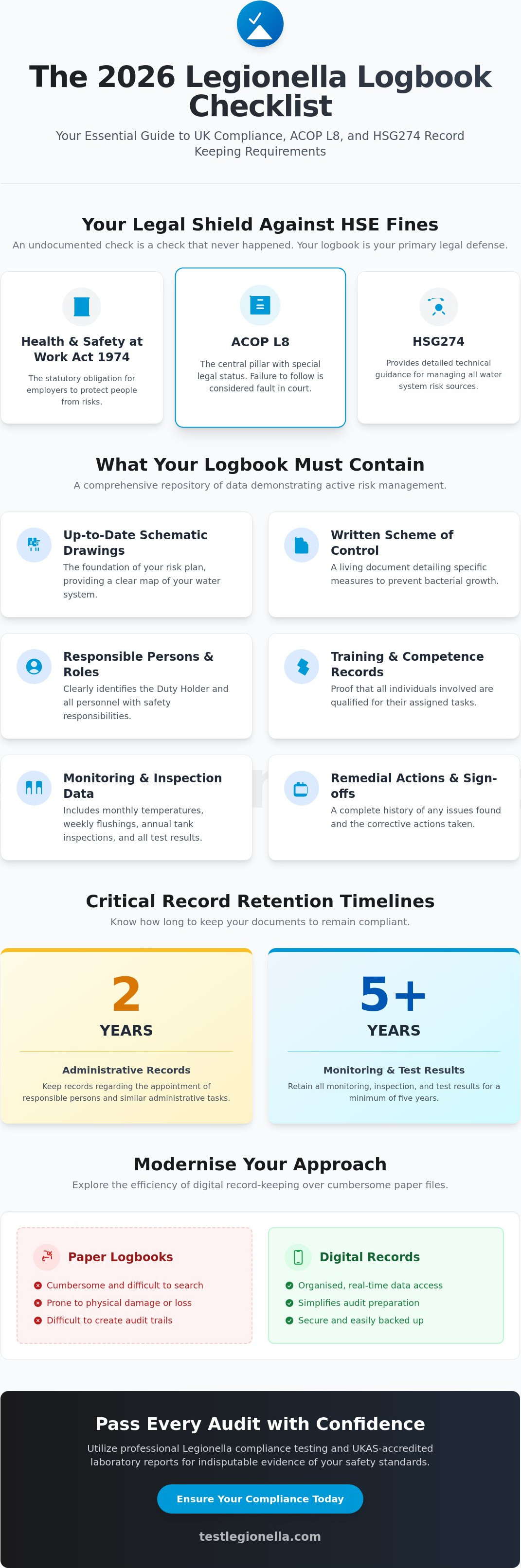
- Master the critical retention timelines by keeping administrative records for two years and all monitoring or test results for at least five years.
- Ensure your logbook includes up-to-date schematic drawings to provide a clear, compliant foundation for your entire water control scheme.
- Explore the efficiency of digital record-keeping to replace cumbersome paper files with organized, real-time data that simplifies audit preparation.
- Utilize professional Legionella Compliance Testing and UKAS-accredited laboratory reports to provide indisputable evidence of your safety standards.
Understanding UK Legionella Record Keeping Requirements in 2026
Meeting the legal standards for water safety in 2026 requires more than just good intentions. It's about a rigorous, documented approach to risk management. The Health and Safety at Work etc. Act 1974 places a clear duty on employers and those in control of premises to protect people from risks. This isn't a suggestion; it's a statutory obligation. When the Health and Safety Executive (HSE) visits your site, they won't just look at your pipework. They'll look at your logbook. Mastering the legionella testing record keeping requirements uk is your most effective way to demonstrate that you're fulfilling your legal role and protecting your community.
The Legal Framework: ACOP L8 and HSG274
The Approved Code of Practice L8 (ACOP L8) is the central pillar of water safety law. While it isn't a law itself, it has a unique legal status. If you're prosecuted for a breach of health and safety law and it's proved you didn't follow the ACOP, the court will find you at fault unless you can prove you complied in another way. Understanding Legionella Bacteria and its growth patterns is the first step in creating the "written scheme" required by this code. Supporting this is HSG274, which provides the technical guidance for cooling towers, hot and cold water systems, and other risk sources. Together, these documents turn "best practice" into a mandatory framework for every UK property manager. This structure ensures that technical requirements feel accessible and manageable for busy professionals.
Why Documenting Compliance is Non-Negotiable
In the eyes of a safety inspector, an undocumented check is a check that never happened. Your records serve as a continuous narrative of safety, proving that you've identified risks and taken proactive steps to mitigate them. This documentation isn't just a filing exercise; it's your primary defense. Beyond the legalities, there's a profound sense of emotional security that comes with organized data. You don't have to worry about "what-if" scenarios when you have a clear, chronological history of your control measures. Professional Legionella Compliance Testing provides the hard data that anchors this narrative, transforming complex regulatory burdens into a manageable, stress-free routine. By maintaining precise records, you move from a state of uncertainty to one of calm, professional competence where your liability is clearly managed through evidence.
Essential Data: What Must Your Legionella Log Book Contain?
A log book isn't just a binder sitting on a dusty shelf; it's the pulse of your water safety strategy. To meet the legionella testing record keeping requirements uk, you need a structured repository for data that demonstrates active management. Whether you choose a traditional physical folder or a modern digital system, clarity is your best friend. Every compliant log book begins with an accurate schematic drawing. This diagram isn't just a map of pipes. It's the foundation for your entire risk management plan, providing the context needed for every temperature check and inspection you perform.
Your written scheme of control serves as the central living document in this collection. It must evolve alongside your property, detailing the specific measures you take to prevent bacterial growth. Following Legionella Risk Assessment Best Practices ensures that your scheme remains robust and defensible. Don't forget to document the training and competence of everyone involved. If an auditor asks why a specific person is performing a task, your records should clearly display their qualifications and training history. This level of detail transforms a simple filing exercise into a narrative of professional competence.
Identifying Responsible Persons and Roles
Ambiguity is a major risk in safety management. Your log book must clearly state who is in charge by recording the names and contact details of the Duty Holder and the Responsible Person. Map out the lines of authority for deputies and external specialist contractors. This clarity ensures that when a problem arises, everyone knows their specific role and who to contact. It eliminates confusion and ensures that your internal communication is as reliable as your water system.
Technical Data: Temperatures, Flushings, and Samples
Precision is everything when recording technical data. You must log monthly temperatures at sentinel points and perform annual tank inspections to ensure the system remains within safe parameters. If you have infrequently used outlets, record your weekly flushing routines to prevent water stagnation. These logs prove you're maintaining the thermal "kill zone" required to keep systems safe. Integrating professional Legionella testing results and UKAS-accredited laboratory reports into your log completes the story. These documents provide the objective proof that your control measures are actually working, giving you the reassurance that your property is protected. Maintaining this data doesn't have to be a burden when you have a clear, action-oriented system in place.
Retention Periods and the Five Employee Rule
Keeping track of dates is just as vital as keeping track of temperatures. To maintain compliance with legionella testing record keeping requirements uk, you must understand that different documents have different lifespans. Storing records isn't just about satisfying a checklist; it's about building a historical shield that proves your long-term commitment to safety. If an inspector requests data from three years ago, "we used to do that" won't suffice. You need the physical or digital proof to back up your claims and ensure your business remains protected from legal scrutiny.
How Long Must You Keep Legionella Records?
The UK legal framework creates two distinct timelines for record retention. First, you must keep your risk assessments and written schemes of control for the entire period they're active, plus an additional two years after they've been superseded. This ensures a clear handover between old and new safety strategies. Second, any records concerning monitoring, inspections, or test results must be retained for at least five years. This five-year window allows authorities to trace the health of a water system over a significant period, identifying trends or recurring issues that might otherwise go unnoticed. If you sell your property or change ownership, these records should be handed over to the new duty holder to ensure a continuous chain of safety data.
Small Business and Landlord Exemptions vs. Reality
There's a common misconception that small businesses are exempt from water safety duties. While the Health and Safety Executive (HSE) states that businesses with fewer than five employees aren't legally required to keep written records of their risk assessments, the duty of care remains identical. You're still responsible for the safety of your tenants or staff. In a court of law, a lack of written evidence makes defending a negligence claim nearly impossible. Without a logbook, you have no way to prove that you've been proactive. We recommend that every landlord and small business owner maintains a simple, punchy recording method. Even a basic digital log of monthly temperature checks provides the emotional security of knowing you can prove your compliance if challenged.
- 2-Year Retention: Risk assessments, written schemes, and administrative records (post-validity).
- 5-Year Retention: Monitoring data, temperature logs, flushing records, and laboratory test results.
- The 5-Employee Threshold: Written records are mandatory for 5+ employees but recommended for everyone to manage liability.
Professional Legionella Compliance Testing helps bridge this gap for small operations. By receiving formal reports from a specialist, you gain a ready-made audit trail that satisfies the legionella testing record keeping requirements uk without the stress of managing complex data yourself. This proactive approach transforms a potential legal headache into a streamlined, professional process that values your time and protects your reputation.
Modernising Your Approach: Digital vs. Paper Records
Choosing between a traditional paper logbook and a modern digital system is a decision that impacts your daily efficiency and your legal safety. While paper records have been the industry standard for decades, they carry inherent risks like physical damage, loss, or illegible handwriting. In 2026, the trend has shifted decisively toward digital logbooks. These systems offer a level of data integrity that paper simply can't match. Electronic logs with tamper-proof timestamps ensure that your entries are seen as credible and accurate during an inspection. Staying ahead of legionella testing record keeping requirements uk often means embracing these technological shifts to reduce the administrative load while increasing your level of protection.
Moving to cloud-based compliance software allows for real-time reporting and instant access to historical data. This is particularly useful for managing the five-year retention period for monitoring results discussed earlier. Instead of digging through boxes of old files, you can retrieve any specific test result with a few clicks. This modern approach transforms record-keeping from a reactive chore into a proactive management tool. It creates an atmosphere of calm competence where you know exactly where your data is at all times. Secure your site today by scheduling your professional Legionella Compliance Testing to ensure your digital records are backed by expert analysis.
Remote Monitoring and Automated Data Entry
The rise of remote temperature monitoring has revolutionized how we meet safety standards. IoT sensors can now automatically log temperatures every hour, providing a far more comprehensive data set than monthly manual checks. These systems send automated alerts the moment a reading falls outside of compliant parameters, allowing you to take immediate action before a risk develops. By automating data entry, you significantly reduce the potential for human error and ensure that your logs are always up to date without constant manual intervention.
Preparing for a Health and Safety Executive (HSE) Audit
An HSE audit can be a high-stakes event, but preparation turns it into a simple demonstration of your expertise. We recommend creating a dedicated "Compliance Folder"—either physical or digital—that contains all required documents for immediate inspection. The ability to produce records quickly is a key indicator to an auditor that the system is under control. Conduct regular internal audits of your logbook to ensure there are no gaps in your data. This proactive habit ensures your legionella testing record keeping requirements uk are always met, giving you total confidence that you'll pass any official inspection with ease.
Streamlining Compliance with Professional Testing Services
Professional water sampling provides the objective evidence needed to validate every temperature check and flushing routine you've recorded. It's the final piece of the puzzle. Without UKAS-accredited laboratory reports, your logbook is merely a list of internal observations. By integrating professional results, you transform your documentation into a legally defensible narrative. Understanding the Legionella risk assessment cost is an investment in this legal security. It ensures that your 2026 compliance strategy is backed by scientific data rather than guesswork. This proactive approach turns a complex regulatory burden into a sense of genuine security for you and your stakeholders.
The Role of Professional Lab Analysis in Record Keeping
DIY testing kits might seem convenient, but they often fail to meet the rigorous documentation standards of ACOP L8. A professional lab report provides specific Colony Forming Unit (CFU) counts. This precision allows you to distinguish between "Not Detected" results and low-level colonization that requires immediate action. You must store these laboratory certificates as high-priority evidence in your compliance folder. They prove that your control measures are effective in real-world conditions. These reports are the gold standard for satisfying legionella testing record keeping requirements uk during an audit. They provide a level of detail that manual temperature logs simply cannot provide on their own.
How Test Legionella Simplifies Your Documentation
Managing water safety data shouldn't be a full-time job. Test Legionella provides structured, audit-ready reports that plug directly into your logbook. We take the technical complexity of Legionella monitoring and turn it into actionable management insights. Our reports are designed for busy professionals who need clear, concise data to prove compliance and protect their property. We act as your efficient partner, ensuring your records are organized, proactive, and helpful. This creates an atmosphere of calm competence where you feel protected by specialists who understand the legal framework.
Stop worrying about conflicting advice or missing data. Our professional testing services ensure your records are accurate, up-to-date, and fully compliant with all UK regulations. We help you move from uncertainty to a state of total property safety. By providing clear descriptions of your system's health, we make the technical requirements feel manageable. Book your Legionella Compliance Testing today to secure your audit trail and gain the peace of mind that comes with expert support. It's the most efficient way to maintain a long-term commitment to safety while focusing on your core operations.
Take Control of Your Water Safety Documentation
Mastering the legionella testing record keeping requirements uk transforms a complex regulatory burden into a clear, manageable path for property safety. By maintaining accurate schematics, adhering to strict five-year retention periods for monitoring results, and embracing digital data integrity, you build a robust legal defense. These records aren't just administrative paperwork; they're the living evidence of your professional competence and your commitment to public health. Staying organized ensures that technical requirements feel accessible rather than overwhelming.
Don't let documentation gaps or conflicting advice leave your business vulnerable to HSE scrutiny. Secure your compliance with professional Legionella testing today and benefit from our UKAS-accredited laboratory analysis. We offer national coverage for UK landlords and businesses, providing comprehensive, audit-ready reports that integrate seamlessly into your safety narrative. Our structured approach ensures that your technical data is accurate and your liability remains fully managed through expert evidence.
Transitioning to a proactive monitoring system ensures you're always prepared for an inspection. You deserve the emotional security and tranquility that comes with specialist support and organized safety data. Take the first step toward a more efficient, protected future today and move forward with total confidence.
Frequently Asked Questions
Is it a legal requirement to keep a Legionella log book in the UK?
Yes, keeping a log book is a legal requirement for any business with five or more employees under ACOP L8. While smaller businesses aren't strictly mandated to keep written risk assessments, they still hold a legal duty of care. Maintaining a log book is the most reliable way to prove you've identified and managed risks, protecting you from potential prosecution and providing essential peace of mind.
How long do I need to keep Legionella temperature records?
You must keep temperature monitoring records for at least five years to comply with legionella testing record keeping requirements uk. This timeframe allows you to track long-term trends and demonstrate a consistent history of control to any inspector. Administrative records, such as the risk assessment itself, should be kept for at least two years after they've been superseded by a newer version.
What records do landlords need to keep for residential properties?
Landlords should keep copies of the current risk assessment, the written scheme of control, and logs of all maintenance or monitoring tasks performed. Even in simple residential settings, having a record of annual inspections and tenant advice letters provides a vital audit trail. These documents act as your primary defense if a tenant raises a health concern, transforming a complex duty into a manageable process.
Can I keep Legionella records electronically instead of on paper?
Yes, digital records are fully accepted and often preferred by inspectors for their clarity and data integrity. Electronic systems with tamper-proof timestamps ensure that your entries are seen as reliable, professional evidence. Moving to a digital format simplifies the management of the five-year retention period and makes retrieving specific data during an audit much faster and more efficient.
Do I need to record every single time I flush a tap?
You only need to record the flushing of outlets that are identified as "infrequently used" within your risk assessment. Typically, these outlets should be flushed weekly for several minutes to prevent water stagnation and bacterial growth. Keeping a simple log of these sessions proves you're actively managing dead legs and low-flow areas, ensuring your water system remains safe and compliant.
What happens if I cannot produce Legionella records during an HSE inspection?
Failing to produce records can lead to Improvement Notices, Prohibition Notices, or significant fines from the HSE. Without a log book, you have no evidence to prove that you've been fulfilling your legal duties. This lack of proof makes it nearly impossible to defend against negligence claims if an incident occurs, leaving your business exposed to high-stakes risks.
Who is responsible for keeping the Legionella records in a rented property?
The Duty Holder, usually the landlord or building owner, is ultimately responsible for ensuring records are kept and maintained. They can appoint a "Responsible Person" to manage the daily logistics of record keeping, but the legal liability remains with the Duty Holder. In commercial leases, the responsibility often depends on the specific maintenance terms agreed upon between the landlord and the tenant.
Do I need a new record every time I have a Legionella risk assessment?
Yes, every new risk assessment is a distinct legal document that must be added to your compliance folder. You need to retain the previous assessment for at least two years after it's replaced to provide a continuous history of your safety strategy. This ensures that you can always demonstrate how your control measures have evolved to meet the specific needs of your property.